Most digital investments underperform not because the technology is wrong, but because no one audited whether the strategy, processes, and governance were ready to support it. For enterprise leaders managing complex IT portfolios, a structured digital transformation audit is the mechanism that separates purposeful progress from expensive trial and error. This guide covers what a digital transformation audit entails, why it matters at the executive level, the five key points every audit must address, and a step by step process your team can execute or commission with confidence.
What is a Digital Transformation Audit?
A digital transformation audit is a structured, comprehensive evaluation of an organization’s digital strategy, technology stack, operational processes, data governance, and security posture. It is not a routine IT health check. It is a strategic instrument that tells senior leadership whether digital investments are generating the business outcomes they were designed to deliver.
The distinction matters. Many organizations invest heavily in digital tools and platforms, then measure success by deployment milestones rather than business impact. A digital transformation strategy must be treated as a living system, not a one time project. Audits are the mechanism that keeps that system honest.
Key dimensions a digital transformation audit covers:
- Strategy Alignment: Do digital initiatives map directly to business objectives and measurable KPIs?
- Technology Optimization: Does the current stack support operational needs efficiently and at scale?
- Process Efficiency: Where do workflows break down, and where can automation reduce friction?
- Data Quality and Governance: Is data accurate, accessible, and compliant with applicable regulations?
- Security and Compliance: Are cybersecurity controls and regulatory obligations being met?
Digital transformation is a continuous process. Companies across the US are increasing technology spend year over year, and according to Deloitte’s 2025 Tech Value Survey, the leading differentiator between organizations that capture value and those that do not is whether they measure outcomes against strategic intent. A regular audit creates that measurement discipline.
Digitally Transform Your Business
Why Digital Transformation Audits Matter for Enterprise Leaders?
Businesses often prioritize implementation speed over outcome measurement. A digital transformation audit closes that gap. For a CTO or CIO managing a multimillion dollar technology portfolio, the audit provides four concrete returns.
1) Maximized ROI
Audit findings surface underperforming investments before they compound. Resources can be reallocated toward initiatives that demonstrably drive value.
2) Risk Reduction
Undetected vulnerabilities in IT systems, data governance gaps, or compliance failures can generate regulatory fines, reputational damage, and operational disruption. An audit surfaces these before they escalate.
3) Operational Efficiency
Workflow bottlenecks, redundant platforms, and manual processes are common in organizations that have rapidly accumulated technology. Audits identify where automation and consolidation will generate the highest returns.
4) Competitive Positioning
Benchmarking your digital maturity against industry peers reveals where you are ahead and, more importantly, where you are falling behind. In sectors where digital experience is a differentiating factor, that intelligence is strategically critical.
For organizations exploring where digital transformation services fit into their broader roadmap, the audit is the logical starting point. It defines what needs to change before prescribing how to change it.
Useful link: How Leading Enterprises Use Applied Generative AI for Digital Transformation?
5 Key Points to Consider for a Digital Transformation Audit
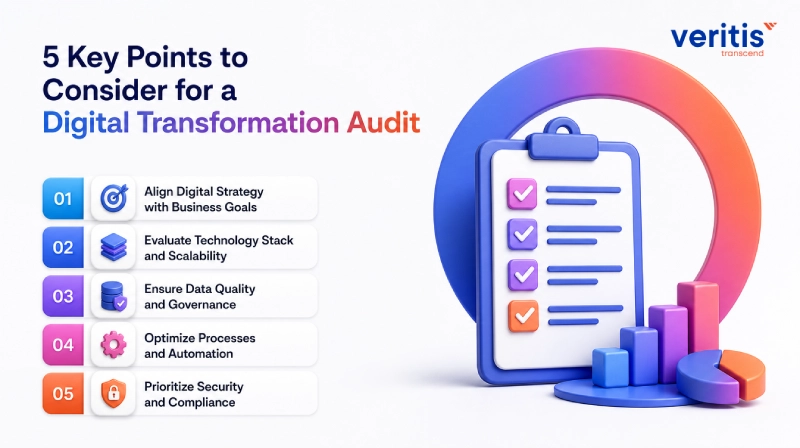
A thorough digital transformation audit evaluates five interdependent dimensions. Each informs the others. Weakness in one area will limit performance across all the rest.
1) Align Digital Strategy with Business Goals
Why it matters: The most common reason digital initiatives fail is misalignment between technology decisions and business objectives. Tools get deployed, budgets get spent, and adoption remains low because the initiative was never anchored to a specific, measurable business outcome.
An audit that starts with strategy alignment ensures every project, platform, and process is traceable to a KPI the business actually cares about.
Key actions:
- Map each active digital initiative to specific business KPIs, revenue growth, cost reduction, customer satisfaction, and cycle time improvement.
- Validate the current digital roadmap against organizational goals by engaging both IT leadership and business unit owners.
- Review adoption and performance metrics regularly, not just at project close.
- Retire or reprioritize initiatives that cannot demonstrate a clear connection to strategic outcomes.
Organizations that have not defined their digital transformation strategy at the enterprise level often discover during an audit that individual business units are running parallel, uncoordinated initiatives. Consolidating those efforts under a unified strategy is frequently the single highest value finding an audit produces.
2) Evaluate Technology Stack and Scalability
Why it matters: Technology is the operational backbone of digital transformation. Outdated systems, poor integration, and platform redundancy create hidden costs that accumulate silently. Organizations often carry legacy infrastructure that limits their ability to adopt modern capabilities, not because leadership has decided to keep it, but because no structured evaluation has forced the question.
Key actions:
- Complete a full inventory of all software, platforms, cloud services, and tools currently in use across the organization.
- Assess integration between systems and document data flows. Identify where manual handoffs compensate for missing integrations.
- Evaluate scalability: can the current stack support projected growth in users, transactions, and data volume over the next three to five years?
- Identify legacy systems that represent technical debt and model the cost of maintaining them versus modernizing.
A scalable, well integrated technology stack is also a prerequisite for the process automation and data governance improvements that the audit will surface in later stages. Investing in automation on top of fragmented infrastructure produces fragile, limited results.
3) Ensure Data Quality and Governance
Why it matters: Strategic decisions made on inaccurate, inconsistent, or ungoverned data produce poor outcomes regardless of how sophisticated the analytics platform is. Data quality problems are pervasive in organizations that have scaled quickly or operated in silos. Regulatory obligations, including GDPR, CCPA, and HIPAA, impose additional requirements, making governance a compliance necessity rather than a best practice.
A data strategy checklist for digital transformation should be a core input to this audit dimension.
Key actions:
- Audit data for accuracy, consistency, completeness, and accessibility across all key systems.
- Review data governance policies, including ownership, access controls, retention schedules, and lineage documentation.
- Verify compliance with applicable regulations and confirm that data handling practices are documented and enforced, not just assumed.
- Establish or reinforce processes for continuous data validation so governance does not degrade between audits.
Organizations that invest in data and analytics as part of their transformation strategy gain the most when data governance is treated as foundational infrastructure rather than an afterthought. Audit findings in this area frequently unlock efficiency gains that would otherwise require additional technology investment.
4) Optimize Processes and Automation
Why it matters: Digital tools do not automatically produce efficient operations. New platforms layered on top of broken workflows often automate the inefficiency rather than eliminating it. A digital transformation audit must examine the processes that technology is intended to support, not just the technology itself.
Key actions:
- Map key workflows end to end to identify bottlenecks, redundant steps, and manual handoffs that could be automated or eliminated.
- Evaluate the current use of automation tools including robotic process automation platforms, workflow engines, and integration middleware.
- Identify processes where automation has not yet been applied and prioritize by effort and impact.
- Measure process performance against baseline metrics and set targets for cycle time, error rate, and cost per transaction.
Process optimization findings are among the fastest returning audit outcomes. Organizations regularly discover manual processes that can be automated in weeks, delivering measurable productivity gains before the broader transformation roadmap is even approved.
5) Prioritize Security and Compliance
Why it matters: The attack surface expands with every digital initiative. More cloud services, more integrations, more data flows, and more endpoints mean more potential failure points. Regulatory requirements in sectors including financial services, healthcare, and retail impose specific obligations that cannot be managed informally at enterprise scale.
For enterprises in regulated industries, security and compliance are not audit items to address last. They are constraints that shape the entire transformation strategy.
Key actions:
- Conduct vulnerability assessments and penetration tests across all digital infrastructure.
- Review identity and access management protocols, including role based access controls, privileged access management, and multi factor authentication enforcement. A formal IAM audit is a valuable complement to the broader digital transformation audit.
- Audit compliance with industry specific regulations and document the evidence trail required for regulatory review.
- Assess data encryption standards, incident response procedures, and third party vendor security practices.
Security findings should inform technology stack decisions, process design, and data governance policies. Treating security as a standalone workstream creates gaps. A mature audit integrates it across all five dimensions.
Accelerate Your Digital Transformation
Digital Transformation Audit Checklist
Use this checklist to ensure no critical dimension is overlooked. Each item maps to one of the five key audit areas.
1) Strategy Alignment
- Digital initiatives mapped to specific business KPIs
- Digital roadmap reviewed against current organizational priorities
- Adoption and performance metrics defined and tracked
- Underperforming initiatives flagged for reprioritization or retirement
2) Technology Stack and Scalability
- Full platform and tool inventory completed
- Integration gaps and manual handoffs documented
- Scalability assessed against three year growth projections
- Legacy system costs modeled versus modernization options
3) Data Quality and Governance
- Data accuracy, consistency, and completeness audited
- Governance policies, access controls, and retention schedules reviewed
- Regulatory compliance verified (GDPR, CCPA, HIPAA as applicable)
- Continuous data validation processes established
4) Process Optimization and Automation
- Key workflows mapped end to end
- Automation gaps identified and prioritized
- Process performance baselines established
- Automation platform effectiveness evaluated
5) Security and Compliance
- Vulnerability assessments and penetration tests completed
- Identity and access management controls reviewed
- Regulatory compliance documented with evidence
- Vendor and third party security practices assessed
Common Challenges in Digital Transformation Audits
Even well resourced organizations encounter predictable obstacles during digital transformation audits. Recognizing these challenges in advance allows leadership teams to plan mitigation strategies before the audit begins.
1) Resistance to Change
Employees and middle managers may resist the scrutiny an audit brings, particularly when findings are likely to challenge existing workflows or reporting structures. Securing executive sponsorship before the audit begins is essential. Leadership visibility signals that the process has organizational commitment, not just IT buy in. Workshops and clear communication about the audit’s purpose and benefits reduce friction within the team.
2) Poor Data Quality
Data inaccuracies, silos, and inconsistent reporting across business units can compromise audit findings before analysis even begins. Implementing a data validation step before formal analysis, and using analytics platforms to surface inconsistencies, protect the integrity of audit conclusions.
3) Tool Overload
Organizations that have grown through acquisition or rapid technology adoption often carry dozens of overlapping platforms. Consolidating redundant tools, ensuring integration across retained systems, and monitoring adoption rates post consolidation are all outcomes that a mature audit process drives toward.
4) Lack of Skilled Resources
A comprehensive digital transformation audit requires cross functional expertise spanning technology architecture, data governance, process design, and cybersecurity. Few organizations maintain all those capabilities internally at the depth required by the audit. Engaging an experienced external partner fills that gap without requiring permanent headcount additions.
5) Infrequent or One Time Audits
Treating the audit as a one time event rather than a recurring discipline is the most common structural mistake. Scheduling quarterly or semiannual reviews, integrating audit cycles into planning and budgeting calendars, and using KPI dashboards for continuous monitoring convert a point in time assessment into a continuous improvement capability.
Useful link: How Digital Transformation in Finance and Accounting is Reshaping Business Operations?
Step by Step Digital Transformation Audit Process
A structured process ensures the audit produces actionable findings rather than a lengthy report that sits unread. The following ten steps can be applied by internal teams or executed in partnership with an experienced digital transformation advisory firm.
1) Define Scope and Objectives
Identify which departments, systems, and processes are in scope. Define specific audit objectives, whether that is ROI assessment, process efficiency review, risk mitigation, or all three. Establish the KPIs that will measure audit success. Tools: strategy documents, KPI dashboards, project management platforms such as Jira or Trello.
2) Collect Data
Gather system logs, usage reports, workflow metrics, and stakeholder input through interviews and surveys. Review past project outcomes and existing KPI tracking. Tools: analytics platforms such as Tableau or Power BI, collaboration tools, and process documentation repositories.
3) Benchmark Against Peers
Research industry standards and competitor positioning in digital strategy, technology adoption, and automation maturity. Compare performance metrics against benchmark data from sources including Gartner, Forrester, and IDC. This step surfaces both the gaps and the opportunities revealed by competitive intelligence.
4) Evaluate Strategy Execution
Map current initiatives against strategic objectives. Measure adoption and effectiveness using the KPIs defined in Step 1. Identify underperforming or misaligned projects and document why they have drifted from original intent.
5) Assess Technology Stack
Evaluate software for scalability, integration completeness, and user adoption. Identify legacy systems and redundant platforms. Recommend upgrades or consolidation where the evidence supports it. Tools: cloud monitoring platforms such as AWS CloudWatch and Azure Monitor, IT inventory tools such as ServiceNow and SolarWinds.
6) Analyze Processes and Automation
Map workflows to detect bottlenecks and redundancies. Evaluate current automation coverage and identify gaps. Recommend process improvements and automation priorities ranked by impact and implementation effort. Tools: process mapping software such as Lucidchart or Visio, automation platforms such as UiPath or Automation Anywhere.
7) Review Data and Governance
Assess data quality, consistency, and completeness. Review access controls and governance policies. Verify compliance with GDPR, CCPA, HIPAA, and any sector specific regulations. Tools: data governance platforms such as Collibra or Informatica.
8) Security and Compliance Assessment
Conduct vulnerability assessments and penetration tests. Review identity and access management protocols. Audit compliance with industry specific regulations and document the evidence trail. Tools: security monitoring platforms such as Splunk, Qualys, and Tenable; compliance management tools such as MetricStream and RSA Archer.
9) Identify Gaps and Prioritize Actions
Categorize findings into high, medium, and low priority based on business impact and implementation feasibility. Develop an actionable roadmap that sequences improvements across strategy, technology, processes, data, and security.
10) Implement Changes and Monitor Progress
Execute high priority recommendations first. Assign ownership and accountability at the team level. Track KPI improvements over defined intervals. Build the continuous monitoring loop that prevents the organization from returning to an unaudited state. Tools: project management platforms like Asana or Jira, analytics dashboards for ongoing performance tracking.
Case Study: Digital Transformation Audit in Manufacturing
A mid sized US manufacturer was experiencing operational inefficiencies, poor data visibility across production lines, and difficulty scaling to meet market demand. The organization had invested in multiple digital tools over a 3 year period but had not conducted a formal audit to assess whether those investments were delivering the expected outcomes.
Veritis conducted a structured digital transformation audit covering all five key dimensions. The engagement identified redundant platforms consuming budget without delivering measurable value, data governance gaps that produced unreliable production metrics, and manual workflows that could be automated with already licensed tooling.
Following the audit, Veritis deployed automation, IoT enabled monitoring, and a consolidated data analytics layer across key production processes.
Outcomes achieved:
- Measurable increase in operational efficiency through targeted automation of manual workflows
- Improved decision making accuracy with real time production data replacing manual reporting
- Scalable infrastructure designed to support a 40% increase in production volume without proportional headcount growth
The client moved from reactive technology management to a proactive, audited improvement cycle, establishing a competitive advantage in a margin sensitive sector.
Read the Complete Case Study: Leveraging Digital Technologies for Manufacturing Success
How Does Veritis Support Digital Transformation Audits?
Veritis brings a structured, end to end audit methodology that covers all five key dimensions. The engagement model is built around measurable business outcomes, not deliverable documents.
- Strategy Alignment: Map digital initiatives directly to business KPIs. Identify and retire low value projects. Prioritize the initiatives most likely to deliver measurable impact.
- Technology Assessment: Evaluate existing tools, identify integration gaps, and recommend scalable solutions including cloud adoption, automation platforms, and legacy system rationalization.
- Data Governance and Compliance: Assess data quality, accessibility, and regulatory compliance to ensure accurate reporting and defensible data management practices.
- Process and Automation Optimization: Map workflows, identify bottlenecks, and implement automation where it delivers measurable productivity and cost benefits.
- Security and Risk Management: Conduct cybersecurity assessments, identity and access audits, and compliance reviews to protect organizational assets and minimize regulatory exposure.
- Continuous Monitoring and Reporting: Provide KPI dashboards, progress tracking, and ongoing recommendations that ensure audit findings drive sustained improvement rather than one time fixes.
Organizations evaluating digital transformation implementation factors alongside their audit process will find that the audit findings directly inform which implementation priorities deserve the most immediate investment.
Strategic Takeaway
A digital transformation audit is not a compliance exercise. It is the mechanism through which enterprise leaders convert technology investment into documented, measurable business value. Organizations that audit regularly gain three compounding advantages: they identify and correct underperformance before it compounds, they build the institutional discipline to evaluate technology strategically rather than reactively, and they create the evidence base that justifies future investment to boards and investors.
The five key points covered in this guide, strategy alignment, technology stack evaluation, data governance, process optimization, and security and compliance, are interdependent. Addressing them in isolation produces partial results. Addressing them together through a structured, repeatable audit process is how leading enterprises maintain their competitive position as the pace of digital change continues to accelerate.
Veritis brings cross functional expertise, a structured methodology, and a delivery track record to execute this process at enterprise scale. If your organization is ready to convert audit findings into measurable outcomes, the conversation starts with a clear scope and a committed executive sponsor.
Schedule a call with Veritis to begin your digital transformation audit.