Enterprises are operating in markets where speed, accuracy, and adaptability determine who leads and who follows. Digital transformation has become the core lever executives rely on to modernize operations, strengthen decision making, and create long term competitiveness. When done right, the benefits of digital transformation reach every corner of the business, from financial performance to customer experience.
Leaders across industries are seeing the impact firsthand. Organizations in finance, healthcare, manufacturing, government, retail, energy, and banking are using digital capabilities to reduce operational friction, maximize real time insights, and build more resilient operating models. These outcomes represent the actual business benefits of digital transformation: measurable, enterprise wide, and strategically significant.
To achieve this at scale, companies are turning to specialized partners for digital transformation consulting services. The goal is direct: simplify complexity, accelerate change, and ensure transformation delivers material value. For modern enterprises, digital transformation is not an initiative; it is a necessity. It is the foundation of future performance.
Veritis Insight: With 21+ years delivering Digital Transformation Services, we’ve seen one truth: C-suite leaders who treat transformation as strategic repositioning, not IT modernization, capture measurable shareholder value. The difference is execution speed and ROI discipline.
Start Your Digital Innovation Journey
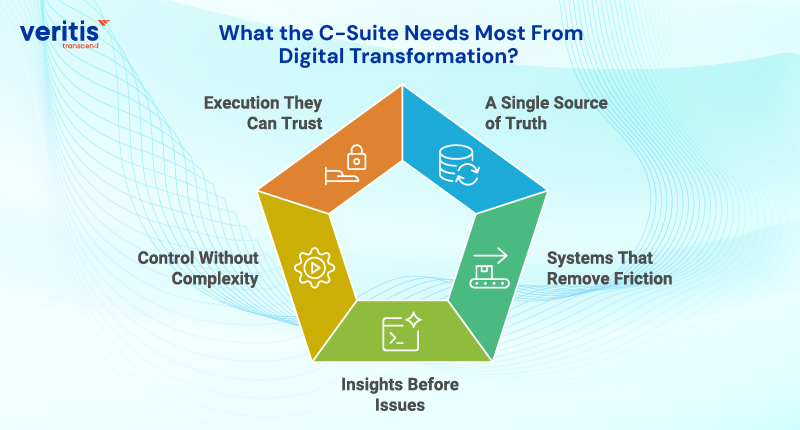
What the C-Suite Needs Most From Digital Transformation?
1) A Single Source of Truth
For most organizations, the challenge is not a lack of data; it’s a lack of alignment. The C-suite needs a transformation approach that eliminates competing performance metrics, consolidates insights into a single authoritative view, and anchors decisions in facts rather than assumptions. When the business runs on unified intelligence, leadership gains speed and certainty.
2) Systems That Remove Friction
Enterprises don’t fall behind because of strategy gaps; they fall behind because day to day operations slow them down. Leaders expect digital transformation to streamline how work moves across functions, reduce handoffs, and create a rhythm in which processes reinforce one another rather than interrupt each other. A friction free environment becomes a measurable advantage.
3) Insights Before Issues
Modern leadership cannot rely on backward looking reporting. The expectation is simple: transformation must elevate the organization’s ability to see around corners. Executives want early signals on risk, performance drift, customer behavior, and operational stress, insights that prompt action before impact, not explanations after the fact.
4) Control Without Complexity
Governance should never feel like an extra layer. The C-suite needs a transformation that embeds control into the way the business runs, in a transparent, automated, and unobtrusive way. When compliance, security, and auditability are built into the system itself, leaders operate with confidence and teams stay focused on outcomes rather than administration.
5) Execution They Can Trust
Digital transformation fails when execution is inconsistent. Leaders want transformation that lands cleanly, scales responsibly, and stays stable under pressure. This is why many rely on experienced partners offering Digital Transformation Services and consulting to ensure the roadmap is practical, disciplined, and delivered without disrupting core operations.
Useful link: How Digital Transformation Maturity Models Help Organizations Scale Their Digital Efforts
Why Has Digital Transformation Become a Boardroom Priority?
1) Operational Efficiency
Boards see digital transformation as a direct path to reducing structural inefficiencies. Automation, integration, and real time systems consistently improve cycle times and lower operating costs, which strengthen the core digital transformation benefits leaders expect from modern enterprises.
2) Competitive Challenge
Digital first competitors set faster delivery standards. Boards prioritize modernization to avoid performance gaps and capture the business benefits of digital transformation, especially in industries that are moving quickly, such as digital transformation in finance and accounting and digital transformation in healthcare.
3) Risk Reduction
Legacy systems amplify compliance and cybersecurity exposure. Modern platforms improve control, auditability, and resilience, which is why sectors such as the banking industry and government see digital transformation as a risk management requirement, not an IT upgrade.
4) Decision Speed
Boards expect leadership to act on real time data, not retrospective reports. Digital ecosystems provide unified insight, enabling faster, more accurate decisions, one of the most consistent benefits of digital strategy for enterprise scale organizations.
5) Enterprise Value
Digital maturity now influences investor perception, scalability, and long term valuation. Industries undergoing large scale modernization, from benefits of digital transformation in insurance to digital transformation in energy industry, show stronger, more predictable performance when supported by Digital Transformation Services.
8 Strategic Benefits of Digital Transformation
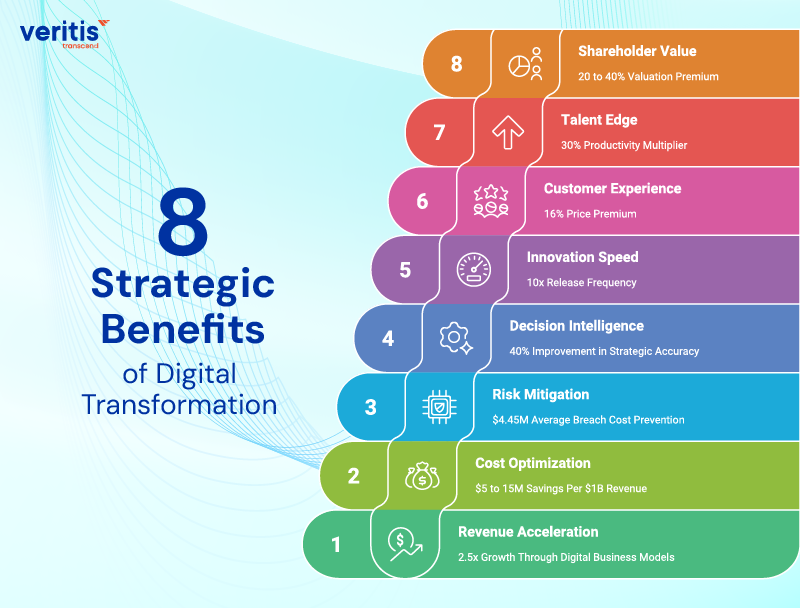
What are the benefits of digital transformation? It’s a business imperative that separates market leaders from those disrupted. 89% of companies have already embraced digital transformation, and those that execute it strategically see a 23% revenue acceleration and a 40% productivity gain within three years.
1) Revenue Acceleration: 2.5x Growth Through Digital Business Models
The Strategic Play
Digital first organizations grow revenue 2.5x faster than competitors. Why? They create recurring revenue streams that legacy models can’t match.
Financial Impact
- New revenue channels: Subscription, platform, and data driven offerings maximize $200B+ markets
- Customer acquisition cost: 50 to 70% reduction through digital channels
- Pricing power: 5 to 8% premium through AI driven personalization
- Time to revenue: Marcus by Goldman Sachs captured $50B deposits in 3 years, a trajectory requiring decades via branches
Industry ROI Snapshots
- Insurance: Usage based policies drive 30 to 40% annual growth (Progressive, Root Insurance), key benefits of digital transformation in insurance.
- Manufacturing: Connected equipment generates 15 to 20% recurring revenue on hardware sales (GE Digital Predix), demonstrating the benefits of digital transformation in manufacturing.
- Automotive: Aftermarket digital services create 30 to 40% margin expansion, showcasing the benefits of digital transformation in automotive industry.
Veritis Approach: We architect cloud native, API first platforms that enable rapid business model iteration, launching new revenue streams in weeks, not quarters.
2) Cost Optimization: $5 to 15M Savings Per $1B Revenue
The CFO Mandate
Intelligent automation eliminates 60 to 80% of manual processing. That’s not efficiency, it’s structural cost transformation.
Quantified Savings
- Finance and accounting: $5 to 15M annual savings per $1B revenue through AP/AR automation, the prime benefits of digital transformation in finance and accounting
- Healthcare administration: $30 to 50 per patient encounter × 1M patients = $50 to 80M savings
- Supply chain: 20 to 30% working capital reduction = $50 to 150M inventory optimization
- Real estate: 30 to 40% footprint reduction = $50 to 200M for Fortune 500 firms
Operational Leverage
- Predictive maintenance: 15 to 25% reduction in unplanned downtime = $100 to 200M for major utilities
- Deployment frequency: 200x deployment improvement through continuous delivery
- Infrastructure capital: 30 to 50% reduction via cloud migration (CapEx to OpEx shift)
Veritis Case Study: We helped a financial services client eliminate legacy infrastructure costs while improving operational agility and modernizing systems to enable faster innovation at a lower total cost.
3) Risk Mitigation: $4.45M Average Breach Cost Prevention
The Board Level Concern
Cyber risk is enterprise risk. Digital transformation strengthens your operating model.
Risk Reduction Metrics
- Breach prevention: 60 to 70% lower probability through zero trust architecture
- Compliance cost: 40 to 50% reduction via automated monitoring
- Incident response: 80% faster containment with AI driven threat detection
- Business continuity: 95%+ operational capacity maintained within 48 hours during disruptions
COVID19 Reality Check
- Digital leaders: 95% capacity within 2 days
- Digital laggards: 40 to 60% capacity loss for weeks
- Retail divergence: Digital retailers grew; traditional retailers lost 20 to 40% revenue, highlighting the benefits of digital transformation in retail
Regulatory Agility
- Time to compliance: 60 to 80% faster for new regulations
- Product launch speed: Weeks vs. months for insurance policy administration
- Audit efficiency: Automated compliance trails reduce regulatory risk exposure
Veritis Expertise: Our cloud and security implementations create resilient architectures that turn disruption from an existential threat to a competitive advantage.
4) Decision Intelligence: 40% Improvement in Strategic Accuracy
The Competitive Edge
Most executives make decisions based on 30 to 90 day old data. Real time intelligence changes the game.
Data Driven Results
- Forecasting accuracy: 30 to 50% improvement in demand prediction
- Inventory optimization: 5 to 8% revenue uplift from availability + 20 to 30% carrying cost reduction
- Credit risk modeling: 40% accuracy improvement = 15 to 25 basis point reduction in loan losses = $200 to 500M for major banks
- Marketing ROI: 200 to 300% improvement through micro segmentation
- Customer lifetime value: 25 to 35% increase via personalized experiences
Operational Visibility
- Manufacturing OEE: 15 to 25% improvement = $30 to 80M additional capacity
- Real time KPIs: Executive dashboards eliminate decision lag
- Scenario modeling: Quantitative risk assessment for strategic choices
Veritis AI Analytics: We implement data platforms that convert data into competitive intelligence, enabling faster, smarter decisions.
Talk to a Digital Strategy Expert
5) Innovation Speed: 10x Release Frequency
The Market Timing Advantage
Speed kills, competitively. Organizations deploying daily vs. quarterly compound small advantages into market leadership.
Speed Metrics
- Release cycles: Quarters to weeks = 10x deployment frequency
- Deployment failures: 80% reduction through automated testing
- Partnership integration: 6 to 12 months to 4 to 8 weeks via API first architecture
- Product development: 30 to 50% faster time to market with digital twins
Innovation Economics
- GE turbines: 5 years to 18 months development time
- Boeing 787: 40% fewer design errors through digital pre assembly
- Banking APIs: Dozens of integrated services vs. a handful in legacy systems
Ecosystem Strategy
Digital platforms enable third party innovation, distributing development costs while accelerating capability expansion.
Veritis DevOps Excellence: We build CI/CD pipelines that enable continuous innovation, converting ideas into production features in days.
6) Customer Experience: 16% Price Premium
The Loyalty Multiplier
A superior digital experience is not about satisfaction; it’s about pricing power and market share.
Experience Economics
- Price premium: 16% for superior CX + 20% higher satisfaction scores
- Omnichannel conversion: 30 to 50% improvement vs. channel siloed competitors
- Self service adoption: 40 to 60% support cost reduction with 24/7 availability
- Proactive retention: 15 to 25% improvement = $250M preserved revenue for major insurer
Channel Migration Value
- Banking transactions: 40 to 60% reduction in branch volume
- Call center deflection: 30 to 40% decrease through digital self service
- Cost per interaction: $100 to 300M annual savings for major banks
Healthcare Patient Experience: Veritis helped a leading healthcare organization modernize its digital ecosystem by unifying legacy systems through cloud integration and managed services, enabling seamless patient experiences and improving operational efficiency. This exemplifies the benefits of digital transformation in healthcare.
7) Talent Edge: 30% Productivity Multiplier
The Human Capital ROI
The digital workplace is not about remote work; it’s workforce multiplication.
Productivity Gains
- Employee effectiveness: 20 to 30% higher productivity
- Collaboration efficiency: 25 to 35% improvement
- Administrative time: 40 to 50% reduction
- Effective capacity: $200M for a 10,000 person organization at $100K average compensation
Talent Marketplace
- Candidate attraction: 30 to 40% more qualified applicants
- Technology retention: 25% lower turnover
- Geographic flexibility: Global talent pools vs. office commute zones
- Skills development: 30 to 40% faster new technology adoption
Workforce Evolution
Manufacturing workers retrained as equipment technicians generate 3 to 5 times more value by managing autonomous systems than in traditional roles.
Veritis Digital Workplace: We enable distributed, productive teams through modern collaboration platforms and cloud infrastructure.
8) Shareholder Value: 20 to 40% Valuation Premium
The Market Capitalization Impact
Public markets reward digital maturity with hundreds of billions in enterprise value.
Valuation Metrics
- Premium multiple: 20 to 40% for digital transformation leaders
- Banking example: Traditional banks at 0.8 to 1.2x book; digital leaders at 2 to 5x
- ROIC improvement: 3 to 5 percentage points through capital efficiency
- Customer acquisition: 70 to 80% lower cost for digital first organizations
Capital Efficiency
- Infrastructure CapEx: 30 to 50% reduction via cloud
- Inventory efficiency: 2 to 3x higher revenue per square foot for digital retailers
- Working capital: 40 to 60% better inventory turnover
M&A Value Creation
- Integration speed: 6 to 12 months vs. 2 to 3 years for system consolidation
- Cost synergies: 15 to 25% within the first year
- Deal Speed: Digital platforms enable rapid acquisition integration
Veritis Track Record: With over 21 years of experience, Veritis delivers digital transformations with AWS, Azure, and GCP certified consultants, achieving 100% client satisfaction.
Useful link: How Digital Transformation in Finance and Accounting is Reshaping Business Operations?
The Veritis Advantage: Strategy to Execution
Why C-Suite Leaders Choose Veritis
- Proven ROI: We align business strategy, technology, and teams through digital transformation consulting services, driving scalable innovation, growth, and efficiency
- Industry Recognition: Stevie Award and Globee Business Award winner
- Certified Expertise: AWS, Azure, and GCP certified cloud consultants
- Client Satisfaction: 100% quality commitment, 100% client satisfaction record
- 21+ Year Track Record: Successfully transforming enterprises across Healthcare, Financial Services, Manufacturing, Automotive, Energy, and Government
Our Methodology
- Strategic Assessment: Quantify current state and transformation opportunity
- Value Driven Roadmap: Prioritize initiatives by ROI and strategic impact
- Agile Execution: Deliver measurable results in 90 day sprints
- Continuous Optimization: Monitor metrics and optimize for sustained value
Engagement Models
- Digital Transformation Consulting
- Cloud Migration and Modernization (AWS, Azure, GCP)
- Application Modernization
- Data and AI Strategy
- Managed Digital Services
Executive Action Plan: The 90 Day CEO Agenda
Month 1: Quantify the Opportunity
- Calculate revenue at risk from digital disruption
- Measure operational cost improvement potential
- Assess competitive positioning gap
- Identify quick success opportunities
Month 2: Build the Business Case
- Define transformation objectives tied to strategic goals
- Quantify expected ROI across 8 benefit dimensions
- Secure C-suite and board alignment
- Select transformation partner (evaluation criteria: expertise, track record, ROI accountability)
Month 3: Launch First Wave
- Initiate 2 to 3 high impact pilot initiatives
- Establish success metrics and governance
- Build internal capability and change management
- Plan scaling strategy based on pilot results
Critical Success Factors
- CEO sponsorship: Transformation is a business strategy, not an IT project
- Cross functional alignment: Eliminate silos that block change
- Sustained investment: 5 to 10% of revenue for 3 to 5 years
- Metrics discipline: Measure ROI, payback, strategic option value
- Partner expertise: External consulting accelerates time to value by 50 to 70%
Useful link: Successful Digital Transformation: CEO’s Path to Digital Transformation Success
The Binary Choice
Understanding what are the benefits of digital transformation reveals measurable, compounding returns:
- Revenue: 2.5x growth acceleration
- Costs: $5 to 15M savings per $1B revenue
- Valuation: 20 to 40% market premium
- Risk: $4.45M average breach prevention
The window is closing. Industry leaders have established positions that will be difficult to overcome. Organizations in planning phases face mounting urgency. For shareholders, customers, and employees, the stakes couldn’t be higher.
Conclusion
The benefits of digital transformation are now part of how modern enterprises run, not a side project. Organizations implementing a successful Digital Transformation strategy through proven Digital Transformation Technologies end up faster, clearer, and better prepared for whatever comes next.
Whether you’re exploring the benefits of digital transformation in manufacturing, seeking the benefits of digital transformation in retail, or modernizing operations in banking, energy, or government, the time to act is now. A well executed digital transformation strategy delivers concrete ROI through revenue growth, cost reduction, risk mitigation, and competitive positioning.