Applied generative AI can support digital transformation by helping teams create content, retrieve enterprise knowledge, and assist with decisions. Gartner’s September 2026 forecast puts worldwide AI spending at $2.7 trillion for the year, up 49.5% from 2025. This is a forecast for AI spending overall, not a measure of generative AI spending or the return any single enterprise should expect.
Gartner previously forecast that more than 80% of enterprises would have used generative AI APIs or deployed GenAI applications by 2026. Because this was a forecast, it should not be presented as a confirmed adoption result.
AI investment does not guarantee business value. Organizations need to select workflows with measurable problems, establish data and governance controls, and compare results with a defined baseline. Veritis supports this work through its digital transformation services, aligning AI initiatives with enterprise architecture, security, and business objectives.
Start Your Digital Innovation Journey
Where Generative AI Fits in Digital Transformation
Generative AI is one component of digital transformation, alongside predictive analytics, automation, cloud, and data modernization. It can draft or summarize information, help employees find relevant knowledge, and support analysis. Predictive systems estimate likely outcomes, while rules based automation follows predefined steps. Enterprises may combine these capabilities, but should measure each one’s contribution separately.
Aligning Applied Gen AI for Digital Transformation with Business Outcomes
Successful deployment of applied gen AI for digital transformation requires more than technical expertise. It demands a comprehensive reimagining of organizational architecture, decision rights, and value measurement systems.
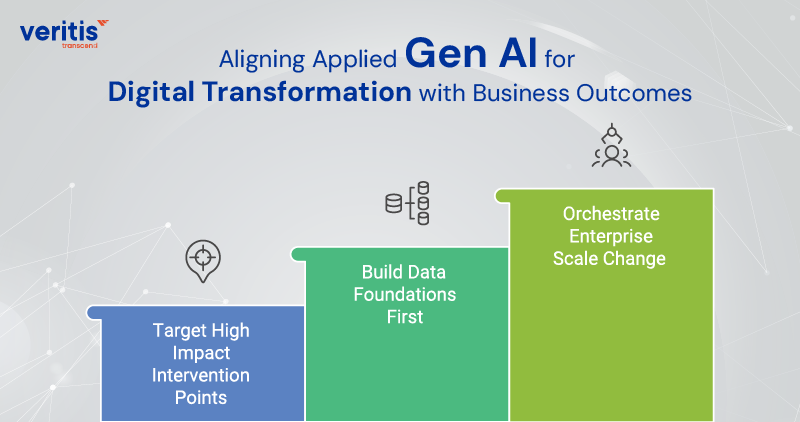
1) Target High Impact Intervention Points
Start with a specific workflow bottleneck, such as slow document review or repeated searches across internal knowledge bases. Define the current cost, cycle time, quality level, and human review effort before testing an AI enabled process.
2) Build Data Foundations First
AI results depend on the quality, permissions, and currency of the information used. Before connecting enterprise data to a model, establish ownership, access controls, data lineage, and quality requirements. Data and analytics in digital transformation offers related guidance.
3) Orchestrate Enterprise Scale Change
Prepare employees for changed workflows with role specific training, clear review responsibilities, and a process for reporting errors. Align business, technology, security, and operations teams before expanding beyond a pilot.
Useful link: How to Develop a Digital Business Strategy for Enterprise Scale Transformation?
Benefits of Using Generative AI in Digital Transformation Solutions
1) Revenue Acceleration
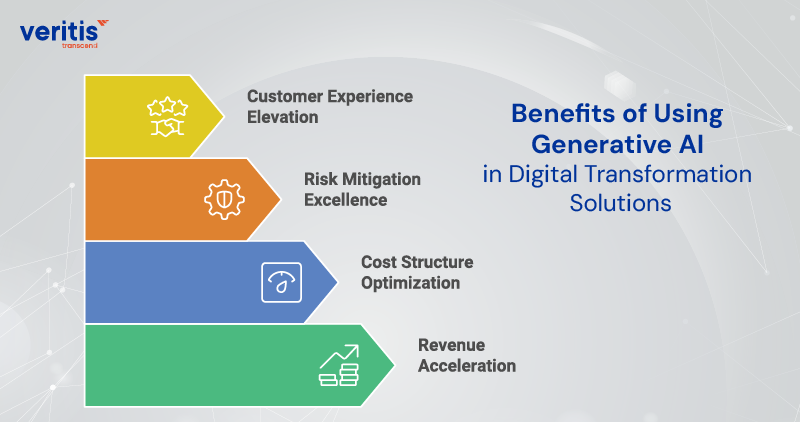
Generative AI may help teams prepare proposals, product content, or customer communications more quickly. Measure the result through approved output, conversion, adoption, or time to launch. Do not attribute revenue gains to AI without evidence connecting the intervention to the outcome.
2) Cost Structure Optimization
Automation can reduce repetitive work, but total cost should include model usage, integration, security, monitoring, employee training, and human review.
3) Risk Mitigation Excellence
AI can assist with policy search, document review, and anomaly triage. Human owners should remain accountable for regulated decisions, exceptions, and actions with material business impact.
4) Customer Experience Elevation
For customer facing workflows, assess response accuracy, resolution quality, escalation rates, customer satisfaction, and handling time together. Faster responses alone do not establish a better customer experience.
Business Goals and Performance Measures
| Business goal | Primary measure | Quality safeguard |
| Reduce service costs | Cost per resolved request | Resolution quality and escalation rate |
| Accelerate document processing | Time per completed document | Accuracy and correction effort |
| Improve software delivery | Time to an accepted change | Defects, security findings, and review effort |
| Improve knowledge access | Time to a verified answer | Source accuracy and permission compliance |
| Support commercial execution | Time to an approved proposal | Factual accuracy and approval status |
Generative AI Use Cases in Digital Transformation Solutions
1) Intelligent Document Processing
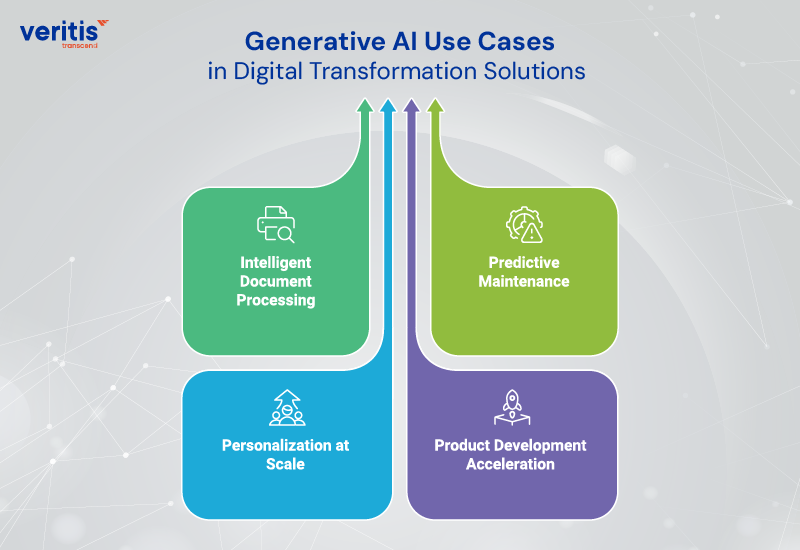
AI can extract fields, summarize documents, and route exceptions for review. Test it against representative documents and measure accuracy, processing time, and staff correction effort before production use.
2) Predictive Maintenance
Predictive models can estimate equipment failure risk. Generative AI may help summarize alerts, retrieve maintenance procedures, or draft work orders. Validate the prediction model and the generated guidance separately.
3) Personalization at Scale
Generative AI can help create or adapt customer content. Use customer data only under approved privacy and consent rules, and assess personalization through relevance, customer response, and complaint rates.
4) Product Development Acceleration
In product development, AI can assist with research synthesis, design exploration, code generation, and testing. Teams should validate outputs against technical, safety, security, and regulatory requirements.
Useful link: 8 Factors That Drive Digital Transformation in Banking Industry
The Future of Digital Transformation by Generative AI for Business Leaders
1) Autonomous Operations
Some AI enabled workflows may progress from recommendations to limited automated actions. Expand autonomy only when permissions, testing, monitoring, and rollback procedures are in place.
2) Hyper Personalization
Personalized services require appropriate consent, data protection, and human oversight. In healthcare and other regulated settings, generated content should not be treated as validated professional advice.
3) Decision Intelligence
Generative AI can make information easier to search and summarize, but decision makers remain responsible for checking evidence, context, and uncertainty.
Challenges and Solutions for Applied Gen AI for Digital Transformation
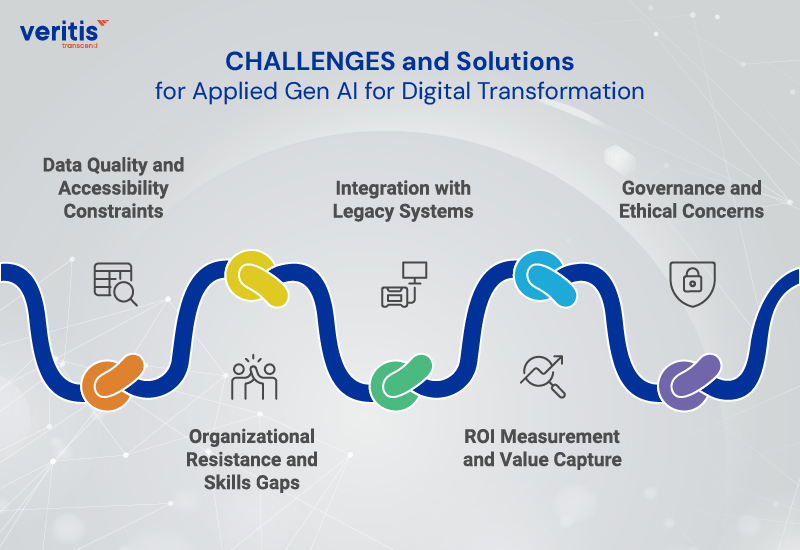
1) Data Quality and Accessibility Constraints
Most enterprises store data across siloed systems with inconsistent formats, incomplete records, and dubious accuracy.
Veritis can help organizations assess data readiness, improve data quality, and plan the architecture needed for AI enabled workflows. Data controls reduce risk, but outputs still need evaluation, source verification, and escalation paths.
2) Organizational Resistance and Skills Gaps
Clear policies, role based training, and employee feedback help teams understand when to use AI, how to review outputs, and when to escalate concerns.
3) Integration with Legacy Systems
Enterprises operate complex technology ecosystems accumulated over decades. Integrating applied generative AI for digital transformation with mainframe systems, proprietary databases, and custom applications presents substantial technical challenges.
Integration planning should include APIs, identity controls, testing, and operational support. Veritis’ digital application services can support organizations modernizing applications and connecting AI capabilities with existing systems.
4) ROI Measurement and Value Capture
Many enterprises struggle to measure the business impact of AI for digital transformation, making ongoing investment justification difficult.
Set a baseline and success criteria before launch. Review realized savings, released capacity, quality, adoption, and operating costs separately so the business case reflects measured results.
5) Governance and Ethical Concerns
Regulatory uncertainty, bias in AI outputs, data privacy requirements, and accountability questions create implementation risks. Executives worry about reputational risks and regulatory penalties from poorly governed applied gen AI for digital transformation.
Governance should define approved data and use cases, access permissions, human review, monitoring, incident response, and accountability. See Top 10 Digital Transformation Trends for 2026 for related enterprise trends.
Useful link: Top 10 Digital Transformation Trends for 2026 and Further
Building a Roadmap for Generative AI in Digital Transformation
1) Phase 1: Foundation and Quick Successes
Select a bounded use case with a clear business owner, baseline, approved data, evaluation criteria, and defined stop conditions. A successful demonstration alone is not enough to justify expansion.
2) Phase 2: Scaling Core Operations
Expand only when the pilot demonstrates acceptable quality, security, cost, and adoption. Reuse approved patterns while adapting controls to each workflow.
3) Phase 3: Strategic Differentiation
Assess whether differentiation depends on proprietary data, workflow design, integration, or a model choice. Training a custom model is not necessary for every business use case.
4) Phase 4: Continuous Evolution
Monitor performance as models, prompts, data, and policies change. Reassess whether each use case remains useful, secure, and cost effective.
Conclusion
Applied generative AI can support digital transformation when it addresses a defined business need and operates with reliable data, clear governance, and measurable outcomes. Start with a focused workflow, evaluate its performance against a baseline, and scale only when the evidence supports it.
Veritis helps organizations plan and implement digital transformation initiatives with attention to business objectives, architecture, security, and operational readiness. Talk to Veritis about digital transformation services.