Machine learning in automotive industry is now embedded in the day to day operations of major automotive players. It shows up in engineering decisions, plant performance, warranty models, and the way companies understand driver behaviour. This is not a futuristic conversation inside executive rooms. It is an operational one tied directly to cost, safety, and growth.
Leadership teams are evaluating machine learning the same way they evaluate capital investments or platform shifts. They want proof of efficiency gains, risk reduction, and revenue impact. The companies getting value are embedding data systems into the mechanics of how vehicles are built and supported. That discipline is starting to separate high performers from the rest of the market.
This is the environment where experienced transformation partners such as Veritis deliver machine learning services that help enterprises convert machine learning initiatives into scalable operating models, driving measurable business outcomes.
Connect with Our Machine Learning Expert
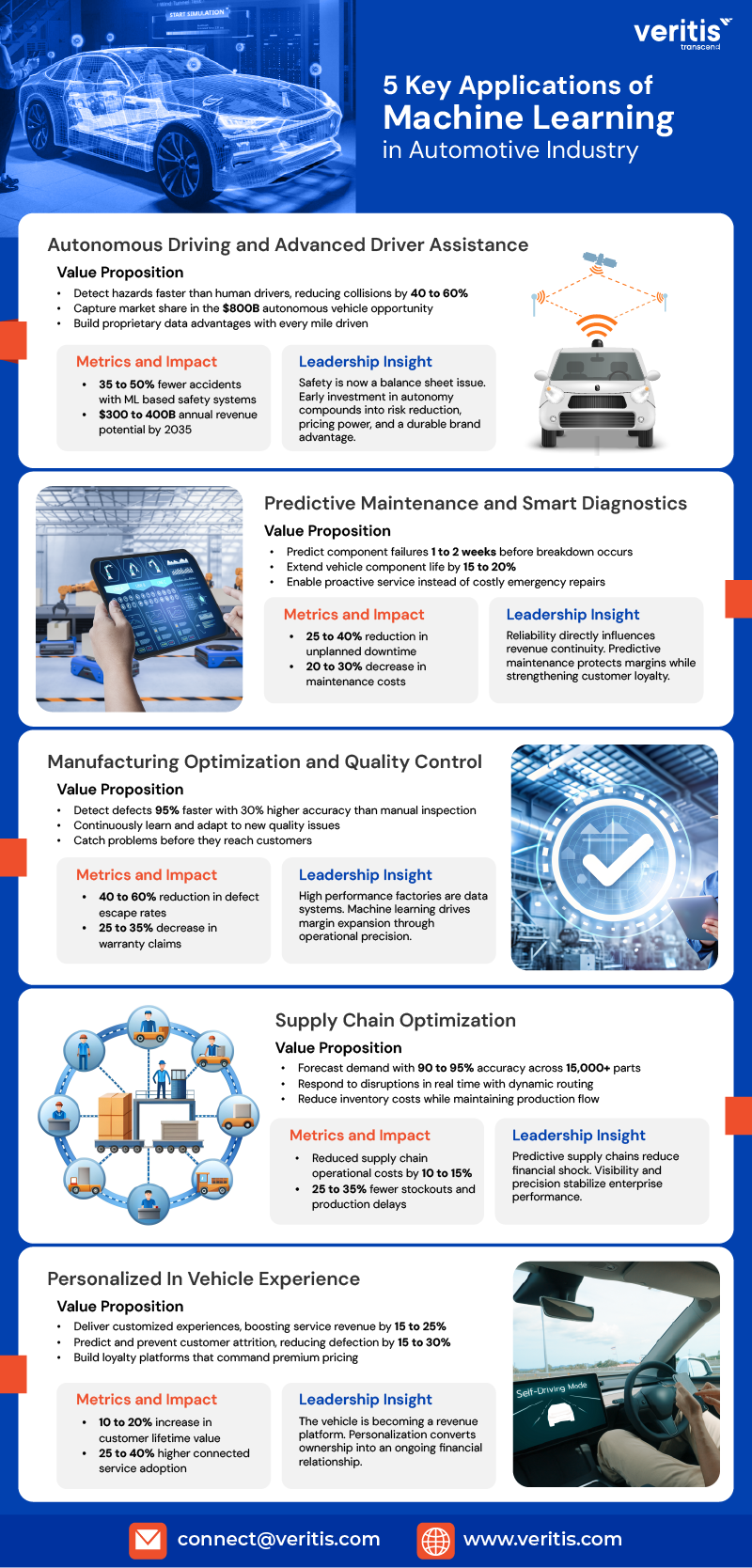
5 Key Applications of Machine Learning in Automotive Industry


Email-us: connect@veritis.com; Call: 972-753-0022
5 Strategic Applications of Machine Learning in Automotive Industry
1) Autonomous Driving and Advanced Driver Assistance
Value Proposition
- Detect hazards faster than human drivers, reducing collisions by 40 to 60%
- Capture market share in the $800B autonomous vehicle opportunity
- Build proprietary data advantages with every mile driven
Metrics and Impact
- 35 to 50% fewer accidents with ML based safety systems
- $300 to 400B annual revenue potential by 2035
Leadership Insight
Safety is now a balance sheet issue. Early investment in autonomy compounds into risk reduction, pricing power, and a durable brand advantage.
2) Predictive Maintenance and Smart Diagnostics
Value Proposition
- Predict component failures 1 to 2 weeks before breakdown occurs
- Extend vehicle component life by 15 to 20%
- Enable proactive service instead of costly emergency repairs
Metrics and Impact
- 25 to 40% reduction in unplanned downtime
- 20 to 30% decrease in maintenance costs
Leadership Insight
Reliability directly influences revenue continuity. Predictive maintenance protects margins while strengthening customer loyalty.
3) Manufacturing Optimization and Quality Control
Value Proposition
- Detect defects 95% faster with 30% higher accuracy than manual inspection
- Continuously learn and adapt to new quality issues
- Catch problems before they reach customers
Metrics and Impact
- 40 to 60% reduction in defect escape rates
- 25 to 35% decrease in warranty claims
Leadership Insight
High performance factories are data systems. Machine learning drives margin expansion through operational precision.
4) Supply Chain Optimization
Value Proposition
- Forecast demand with 90 to 95% accuracy across 15,000+ parts
- Respond to disruptions in real time with dynamic routing
- Reduce inventory costs while maintaining production flow
Metrics and Impact
- Reduced supply chain operational costs by 10 to 15%
- 25 to 35% fewer stockouts and production delays
Leadership Insight
Predictive supply chains reduce financial shock. Visibility and precision stabilize enterprise performance.
5) Personalized In Vehicle Experience
Value Proposition
- Deliver customized experiences, boosting service revenue by 15 to 25%
- Predict and prevent customer attrition, reducing defection by 15 to 30%
- Build loyalty platforms that command premium pricing
Metrics and Impact
- 10 to 20% increase in customer lifetime value
- 25 to 40% higher connected service adoption
Leadership Insight
The vehicle is becoming a revenue platform. Personalization converts ownership into an ongoing financial relationship.
Strategic Implications for Automotive Leadership
Machine learning is an enterprise capability that touches product design, operations, and customer strategy. Automotive leaders should approach it with board level alignment and disciplined execution.
Actionable Recommendations
- Treat machine learning as core infrastructure, not a side project
- Build cross functional AI governance that includes engineering and business leaders
- Prioritize data quality and integration across vehicle, factory, and supply chain systems
- Invest in scalable cloud and edge platforms that support real time learning
- Align AI investments with measurable safety, cost, and revenue targets
- Partner with experienced technology integrators capable of enterprise scale execution
Organizations that adopt Veritis enabled AI strategies are demonstrating how disciplined implementation converts machine learning into operational advantage. The opportunity is measurable, immediate, and widening the gap between leaders and laggards.
For automotive executives, machine learning is now part of the industry’s competitive foundation. The question is not about whether to invest, but how fast leadership can operationalize it across the enterprise.
Conclusion
Machine learning is quickly becoming a key factor in how modern automotive companies remain competitive. It is influencing safety outcomes, production economics, and the generation of new revenue from connected vehicles. The manufacturers moving ahead are treating it as a business capability. With industry leaders such as Veritis helping scale these systems responsibly, machine learning is turning into a practical advantage that shows up in real operating results. Get in touch with us to schedule a consultation and explore how this can translate into measurable value for your organization.
Talk to a Managed Services Specialist
Additional Resources:
- 5 Enterprise Benefits and ROI of the Managed Services Model
- 7 AIOps Strategies to Turn IT Operations into Profit Drivers
- The Impact of Managed Services in the Automotive Industry
- Which Cloud Migration Tools Deliver the Best ROI for Enterprises?
- Why Every Enterprise Needs Identity and Access Management Risk Assessment?