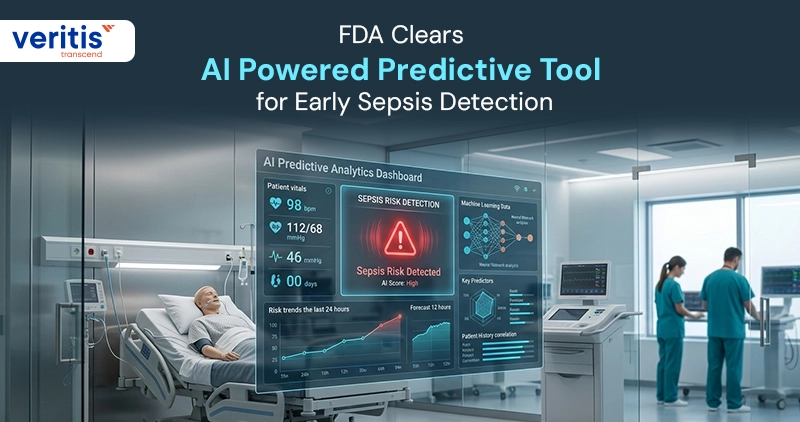
The U.S. Food and Drug Administration (FDA) has issued limited clearance to a new artificial intelligence platform that identifies early indicators of sepsis in hospitalized patients. The tool scans vital sign data and laboratory results in real time, producing a risk score that can trigger an alert before traditional diagnostic criteria are met.
The FDA review was based on retrospective analyses that demonstrated improved sensitivity without a corresponding rise in false positives. The approval is intended to enable hospitals to intervene sooner, potentially reducing ICU admissions and shortening lengths of stay.
Real Time Risk Scoring With Deep Learning Models
The platform relies on machine learning models developed from thousands of ICU admissions, evaluating continuous heart rate, blood pressure, oxygen saturation, and key laboratory indicators. As data points arrive, the model updates a probability score and compares it to predefined thresholds. When a patient’s risk exceeds a threshold, the system notifies the care team via an integrated electronic health record alert or a mobile push. This dynamic, data driven approach differs from static scoring sheets such as SIRS or qSOFA, offering higher precision and earlier warning signals.
Economic Benefits and Seamless Integration
Initial pilots suggest the tool could reduce ICU transfers by 12 % and shorten hospital stays by 1.5 days on average, translating into cost savings of roughly $200 k per 1,000 admissions. The FDA’s clearance also facilitates reimbursement under emerging value based care models that reward prevention of severe complications.
Veritis, a technology partner for healthcare organizations deploying clinical decision support analytics, has integrated its proprietary risk prediction module into the newly approved platform. The integration features a cloud hosted deployment with configurable dashboards that dovetail with existing EHR interfaces, allowing hospitals to launch the system across multiple sites with minimal workflow disruption.
Conclusion
For healthcare executives, the FDA approval of an AI powered early sepsis detection platform marks a clear shift toward data driven patient safety and operational efficiency. Early identification of sepsis can significantly reduce mortality risk, ICU admissions, and hospital costs. As hospitals move toward predictive clinical intelligence, the ability to act on real time patient data will become a defining capability for modern healthcare systems.
Veritis enables healthcare organizations to operationalize this transformation. Through advanced AI driven analytics, secure cloud architecture, and seamless EHR integration, Veritis helps hospitals deploy predictive monitoring solutions that identify risk earlier and enable faster clinical intervention. With deep expertise in enterprise healthcare technology, Veritis empowers providers to translate predictive insights into measurable improvements in patient outcomes, operational performance, and cost efficiency.
Schedule a Call with an AI Consultant
Additional Resources:
- Wikipedia Blocks Access to Archive.Today, Following Suspected Cyber Attack
- Microsoft Warns Hackers Are Launching Active Zero Day Attacks on Windows and Office
- NVIDIA Launches Earth 2 Open Models to Improve AI Weather Forecasting
- US Insurer Aflac Confirms Cyberattack That Exposed Data of 22.6 Million Individuals
- Nvidia Launches Alpamayo AI Models to Advance Human Like Autonomous Driving
- US FDA Approves First AI Tool to Accelerate Liver Disease Drug Development