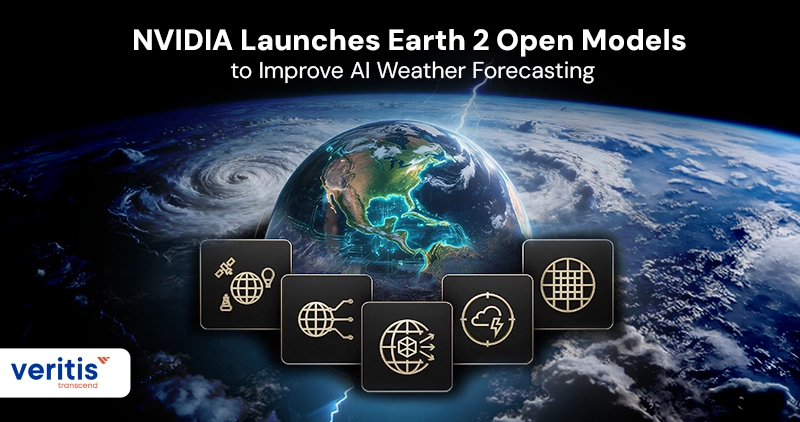
NVIDIA has announced the launch of Earth 2, a new family of fully open, accelerated AI models and tools designed to advance weather forecasting and climate intelligence. The release marks a significant step in applying high performance computing and artificial intelligence to one of the world’s most data intensive scientific challenges.
Earth 2 is positioned as the first fully open and accelerated AI weather modeling stack, enabling researchers, enterprises, and public sector organizations to build, customize, and scale AI driven weather and climate solutions. By making these models openly available, NVIDIA aims to broaden access to advanced forecasting capabilities while accelerating innovation across industries that depend on accurate environmental insights.
Open Models Built for Scale and Scientific Rigor
At the core of Earth 2 is a set of open foundation models designed to simulate and predict complex atmospheric behavior at high resolution. Traditional numerical weather prediction methods are computationally expensive and time consuming. Earth 2 uses AI to complement these methods, delivering faster insights while maintaining scientific fidelity.
The open nature of the models allows developers and researchers to inspect, adapt, and extend them for specific use cases. This approach supports transparency, collaboration, and reproducibility, which are critical in climate and weather research. It also enables organizations to integrate Earth 2 models into existing forecasting pipelines without vendor lock in.
By combining open model access with accelerated computing, Earth 2 lowers the barrier to entry for advanced AI weather forecasting and supports experimentation at regional, national, and global scales.
Accelerated AI for Faster and More Accurate Forecasts
Earth 2 is optimized to run on NVIDIA’s accelerated computing platforms, enabling high throughput and energy efficient processing of massive climate datasets. This acceleration allows models to generate forecasts faster than traditional methods, supporting near real time decision making.
Faster forecasting has practical implications across multiple sectors. Energy providers can improve demand planning, agriculture organizations can respond more effectively to changing conditions, insurers can better assess risk, and governments can strengthen disaster preparedness and response.
The combination of AI and acceleration also enables ensemble forecasting and scenario analysis at scale, helping organizations evaluate uncertainty and make more informed decisions based on probabilistic outcomes rather than static predictions.
By releasing Earth 2 as an open platform, NVIDIA is encouraging a broader ecosystem of innovation around AI driven weather and climate solutions. Researchers can build on shared models, enterprises can tailor solutions to operational needs, and startups can develop new tools without having to start from scratch.
This ecosystem approach aligns with the growing demand for collaborative, interoperable AI systems that address global challenges. Open access supports faster validation, cross domain collaboration, and continuous improvement in forecasting accuracy and reliability.
Conclusion
The launch of Earth 2 represents an important milestone in the evolution of AI powered weather forecasting. By combining open models, accelerated computing, and a platform focused on scalability and collaboration, NVIDIA is helping move weather and climate intelligence from research environments into practical, real world applications.
For enterprises, the value lies not in access to advanced models but in the ability to operationalize them responsibly, securely, and at scale. Veritis helps organizations apply AI, high performance computing, and data platforms to deliver a measurable business advantage, enabling weather and climate intelligence to support risk management, operational resilience, and strategic planning at scale.
Schedule a Call with an AI Consultant
Additional Resources:
- Nvidia Launches Alpamayo AI Models to Advance Human Like Autonomous Driving
- US Insurer Aflac Confirms Cyberattack That Exposed Data of 22.6 Million Individuals
- US FDA Approves First AI Tool to Accelerate Liver Disease Drug Development
- OpenAI Eyes Consumer Health Tools as the Next Big Leap in AI Evolution
- Foxconn and OpenAI Announce Collaboration to Advance the US AI Manufacturing
- OpenAI Introduces ChatGPT Atlas, an AI Browser Shaping the Future of Digital Interaction