
When someone uses the term DevOps, they typically mention the automation of the Infrastructure as code (IaC), build, and deployment process. However, DevOps has gained immense popularity due to the prevalence of organizational structures with distinct departments that oversee various tasks, which necessitate separate teams, individuals, and processes.
This causes inefficiencies in the development process, which DevOps aims to eliminate by automating processes and giving dev teams greater control. However, similar bottlenecks exist with testing.
In many organizations, the testing team depends on other teams to set up the testing environment or provide test results. Moreover, many of these businesses have separate security, performance, and automated testing divisions.
Most companies’ testing teams depend on other teams to establish the testing culture or present test results. In addition, most organizations have distinct security, performance, and automated testing divisions.
It is imperative to prioritize testing and make necessary operational adjustments to promote a DevOps adoption strategy across your organization. This is the only other way to increase your team’s productivity. A DevOps services company can help seamlessly integrate testing into your DevOps pipeline, improving efficiency and reducing bottlenecks.
Testing is integral to software development and should be implemented throughout the development lifecycle to ensure high quality output. However, most companies practice testing as an individual process dependent on other teams for test data and environment setup. This creates many hurdles in the testing process, resulting in DevOps culture bottlenecks.
So, suppose you are experiencing delays or challenges in the software development lifecycle. In that case, it’s time to reconsider your company’s testing methodologies and adopt integrated testing alongside development and operations activities, with guidance from a DevOps services company.
This revision introduces the role of DevOps services and solutions in helping businesses streamline testing and eliminate bottlenecks in the DevOps process.
Connect With DevOps Strategist
The Most Important DevOps Testing Strategy Elements

Every DevOps project aims to streamline as many manual processes as possible, increase attention to people and interactions, and encourage regular communication to enable rapid response to change. However, a DevOps pipeline has several barriers that impede deployment, particularly regarding timely team handoffs. Furthermore, the absence of collective responsibility for the project’s achievements or the result’s excellence stems from a lack of shared ownership.
The team, including developers, testers, and operations personnel, must test as early and frequently as possible in every DevOps project to overcome these obstacles. The top 3 components of a practical DevOps automated testing approach are as follows:
1) Testing Driven Development
Building a successful DevOps pipeline involves writing unit tests for each line of code, even before it is written. Test driven development, a crucial component of DevOps testing, enables programmers to consider the desired behavior of each software unit they’re building, including inputs, outputs, and error conditions, from the beginning. In addition, such a method enables the creation of test cases first, allowing code to be developed to pass the test, making the underlying code error free, and preventing code duplication.
2) Continuous Testing
Continuous testing in DevOps must be essential to any DevOps testing strategy if you want to execute a DevOps automated testing pipeline successfully. The shift left testing strategy ensures that development teams find and fix errors and issues early in the development lifecycle before they escalate into more severe and expensive problems. This quick, frequent testing shortens lengthy testing cycles and improves the overall quality of the product being developed, but it also reduces the likelihood that flaws will enter production.
3) Automated Testing
Test automation is a crucial component of a successful DevOps testing approach. Your code is continuously merged into a shared repository as part of the Continuous Integration used to update the applications in your DevOps test automation pipeline. While providing teams with immediate feedback on the functionality and quality of applications, test automation reduces the risk associated with continuous integration. In addition, test automation reduces the likelihood of errors in the finished product by automating testing for every new code iteration.
Useful link: Derive ‘ROI’ from ‘DevOps’: An Overview of Performance and Metrics
3 Ways to Build an Effective DevOps Testing Culture:
Creating an influential DevOps automated testing culture is essential for organizations aiming to enhance software quality, accelerate development cycles, and improve collaboration between development and operations teams. Here are three strategies to cultivate such a culture:
1) Laying the Right Foundation
The initial challenge is finding the basis for changing this unfriendly DevOps testing culture. To do this, you will first need to enhance your quality assurance (QA) team’s skill set. The QA testing team should perform automated testing and understand how the application is built and how the testing process can enhance its functionality.
Moreover, testers need to know about and understand processes such as continuous integration and Infrastructure as Code (IAC).
To enhance your workforce’s skill set, you can train your testers or have vendors replace manual testers with engineers. While it is still manageable with manual testers on board, hiring testers with the relevant skills is advisable.
2) Redefine the Way Your Team Works
DevOps methodology is a process focused on minimizing inconsistencies caused by dependencies, repetition, and delays through a culture of self sufficiency.
Test automation in DevOps enables timely feedback and boosts process efficiency, underscoring its significance within the DevOps culture. Testers should be responsible for creating and maintaining automation from the beginning and, ideally, strive to be self reliant to achieve the desired DevOps test automation benefits.
3) Contribute to Innovation Through Empowerment
Giving your team the leverage to learn and experiment within their work hours helps them identify better work DevOps practices and enhance their technical skills. In that case, you, as a leader, must also take the initiative to help people innovate.
Create time during regular work hours for employees to invest in themselves and improve their work. Also, instead of rewarding only one person per project, motivate employees who learn new skills and leverage them to improve process efficiency.
Useful link: How to Implement Artificial Intelligence in DevOps Transformation?
Best Practices for a Successful DevOps Testing Strategy
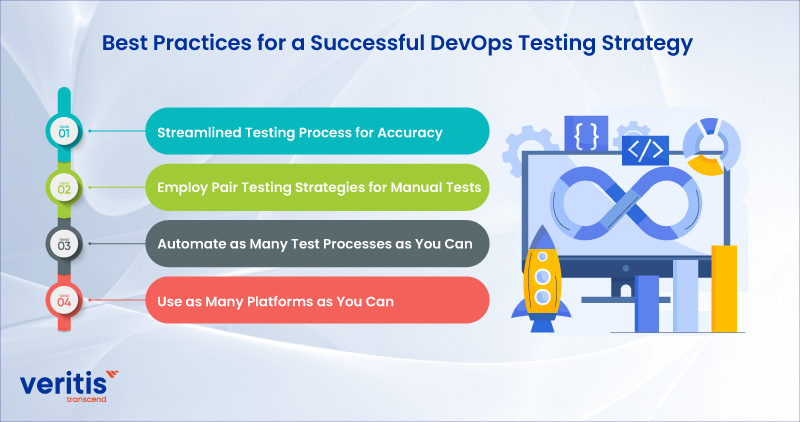
The strategy for planning successful DevOps testing tools needs to be revised. A poor understanding of recommended practices for its implementation can severely hamper its effectiveness.
1) Streamlined Testing Process for Accuracy
Typically, a combination of scripting and programming languages is used for testing. Non technical stakeholders may only sometimes be able to comprehend this. All stakeholders can become more aligned using a framework like Gherkin, which QA teams can use to explain testing to non technical audiences.
2) Employ Pair Testing Strategies for Manual Tests
A certain number of manual tests must always be run, even though the best DevOps testing tools strategy fully uses automated testing’s power. Two testers work side by side, running the test while the other checks the outcomes. Any two DevOps team members can form a pair, particularly when developers are analyzing tests run to address code errors more effectively.
3) Automate as Many Test Processes as You Can
Resolving problems is essential for the effective functioning of DevOps principles during development. For instance, developers can improve efficiency, save resources, and expedite regression testing by automating visual tests and implementing parallel testing. This also enables them to fix any bugs before they impact the application.
4) Use as Many Platforms as You Can
Today, many devices are used to deploy mobile and web apps. Therefore, regularly testing the application on all anticipated devices is crucial to achieving optimum performance. Unfortunately, simulators and emulators fall short in accurately simulating real world program performance. Therefore, accurate device testing is essential to ensuring that the DevOps testing tools strategy is deployed and operates as intended.
Case Study Spotlight: DevOps Solutions for the Data Analytics Industry
Building a strong DevOps testing culture is essential for continuous improvement and rapid delivery. In our engagement with a leading data analytics firm, we implemented DevOps solutions that fostered automated testing, streamlined workflows, and improved deployment quality—paving the way for a robust DevOps culture.
Read the complete case study: DevOps Solutions for Data Analytics Industry
Conclusion
Embracing collaboration, automation, and a continuous testing culture in DevOps improvement lays the foundation for a thriving DevOps testing culture. This multifaceted approach enables faster, more reliable software releases while fostering shared responsibility for quality across teams. Ultimately, it improves customer satisfaction and contributes to overall business success.
A successful DevOps culture implementation goes beyond automating the SDLC and demands changes in the overall organizational structure, operating teams, and work culture. It means having sufficient resources for each process and reducing reliance on enterprise IT teams for operations and security testing. Testing teams impact the way features are deployed to production. Ensure they are included in this cultural DevOps transformation.
Veritis, the Stevie Award winner, delivers comprehensive DevOps consulting services for DevOps testing, emphasizing collaboration, automation, and a culture of continuous improvement. We understand the importance of organizational change, sufficient resources, and reducing dependency on enterprise IT teams. By involving testing teams and fostering shared responsibility for quality, Veritis enables faster, more reliable software releases, thereby improving customer satisfaction and overall business success.
Got Questions? Schedule A Call
Also Read:
- DevOps outsourcing: Things to Know About Before Getting Started
- DevOps Implementation: 4 Steps to Success
- Future of DevOps: Top DevOps Trends in 2025 and Beyond
- Building a High Performing DevOps Culture: Strategies and Best Practices for CEOs and CTOs
- Explained: Pros and Cons of DevOps Methodology and its Principles
- Why Should You Adopt DevOps and What are the Benefits it Offers?