Automotive digital transformation connects software, data, and business processes across vehicle engineering, manufacturing, supply chains, sales, and service. It can improve uptime, quality, customer experience, and digital revenue, but success depends on managing integration, cybersecurity, data, skills, and long term costs.
The goal is not to adopt more technology. It is to improve business outcomes while protecting production continuity, vehicle safety, and customer trust.
Get Started with Digital Transformation
What Does Automotive Digital Transformation Change?
Transformation redesigns processes around connected data and software. Converting a paper inspection form to a tablet is digitization. Connecting inspection results to supplier batches, production settings, and warranty claims can change how quality issues are detected and resolved.
1) Engineering and Vehicle Design
Simulation, digital twins, and automated testing help teams evaluate designs earlier and coordinate hardware and software development.
2) Manufacturing
Connected sensors, machine vision, robotics, and analytics give teams better visibility into equipment, materials, and product quality.
3) Supply Chains
Shared data and consistent identifiers help manufacturers and suppliers track demand, capacity, component history, and quality issues.
4) Sales, Service, and Fleets
Connected customer and dealer systems can link online research, ordering, delivery, diagnostics, maintenance, and fleet operations.
5) Electric Vehicles and Sustainability
Battery and charging data support vehicle readiness and energy planning. Material traceability can also inform sourcing, reuse, and recycling decisions.
A digital thread connects information as a product moves from design to production and operation. Without it, teams may have dashboards but still reconcile data across disconnected systems.
Which Technologies Support Transformation?
Technology choices should follow the business need. Cloud, AI, connected equipment, and vehicle software create value when they support a specific decision or workflow.
1) Connected Equipment, Edge, and Cloud
Sensors collect data from equipment and process it. Edge systems process selected data near machines or vehicles, while cloud platforms can combine information across plants and business units. Local processing may be essential when latency or network interruptions matter.
2) Analytics, AI, and Digital Twins
Analytics reveals patterns, AI can support tasks such as visual inspection or maintenance prioritization, and digital twins help evaluate assets or processes. Choose the method that fits the decision and available data; not every reporting problem requires machine learning.
3) Software Defined Vehicles and Remote Updates
Software defined vehicles use software to deliver and evolve functionality within hardware limits. Over the air updates require more than remote delivery: manufacturers need compatibility checks, release approval, secure distribution, installation verification, and recovery procedures.
4) Battery and Charging Data
Electric vehicle programs need reliable data across vehicles, chargers, and energy systems. Fleet operators should consider vehicle readiness, charging availability, and energy costs together.
5) Data Standards and Interoperability
Shared identifiers and definitions help systems, suppliers, and plants exchange useful information. A digital platform cannot improve coordination if participants interpret the data differently.
Where Do the Benefits Become Measurable?
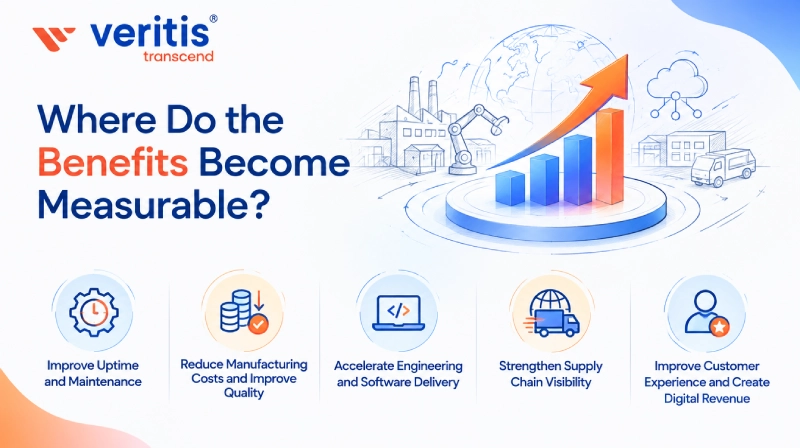
Automotive transformation can improve existing operations and support new services. Measure each initiative against a business outcome rather than counting connected assets, models, or software releases.
1) Improve Uptime and Maintenance
Predictive maintenance can help teams identify failure patterns and intervene before production stops. BMW reported in 2023 that predictive maintenance at its Regensburg plant helped avoid about 500 minutes of assembly disruption annually. This is a plant specific result, not an industry benchmark.
Track downtime, response time, alert accuracy, and production recovered. An alert has value only when it leads to an effective maintenance action.
2) Reduce Manufacturing Costs and Improve Quality
Connected production and machine vision can help identify process variation earlier. The World Economic Forum’s manufacturing report reported results at Bosch’s Suzhou plant, including 15% lower manufacturing costs, a 10% improvement in quality, 35% lower production stock, and 8% higher direct productivity. The report does not precisely define the quality measure, so it should not be described as a 10% reduction in defects.
3) Accelerate Engineering and Software Delivery
Simulation and automated testing can help teams find issues earlier and make releases more predictable. Measure engineering change lead time, escaped defects, test coverage, and release reliability. Faster releases that increase field failures are not an improvement.
4) Strengthen Supply Chain Visibility
Shared supplier data can help identify shortages, trace components, and coordinate responses. Visibility must connect to decision authority, inventory, production priorities, and approved alternatives to improve resilience.
5) Improve Customer Experience and Create Digital Revenue
Connected service and customer systems can reduce repeated requests and help service teams prepare for repairs. Digital services can also create recurring revenue, but adoption and support costs matter.
According to Ford’s fourth quarter 2024 investor presentation, Ford ended 2024 with about 865,000 paid software subscriptions, up nearly 40%, with gross margins above 50%. Ford Pro accounted for nearly 650,000 of those subscriptions. Ford also reported nearly 29 million software updates across more than 4 million vehicles in 2024; this demonstrates delivery scale, not necessarily avoided dealership visits.
| Business area | Useful measures |
| Operations | Downtime, first pass yield, scrap, rework, maintenance response |
| Engineering | Change lead time, escaped defects, release reliability |
| Supply chain | Inventory accuracy, traceability, disruption related production loss |
| Customer service | Completed bookings, repair turnaround, retention |
| Digital services | Paid adoption, renewal, cancellation, support cost |
| Technology and risk | Availability, recovery performance, vulnerability remediation, operating cost |
What Challenges Should Leaders Address?
The main risks often arise where systems, teams, or organizations meet: legacy and new platforms, IT and factory networks, or software delivery and vehicle safety.
1) Legacy Integration and Production Continuity
Older equipment and applications may lack consistent identifiers, interfaces, or documentation. Map dependencies before connecting or replacing them. Test changes in representative conditions and define rollback procedures and maintenance windows.
2) Cybersecurity Across Vehicles, Factories, And Suppliers
Connected equipment, vehicles, customer platforms, and remote updates expand the attack surface. The National Highway Traffic Safety Administration’s vehicle cybersecurity guidance recommends layered protection throughout the vehicle lifecycle.
Practical controls include network segmentation, appropriate identity controls, secure software build and update processes, supplier access management, monitoring, and rehearsed recovery. Cybersecurity and functional safety are related, but they address different risks.
3) Safety, Regulation, And Privacy
Assess applicable laws, standards, customer requirements, and guidance separately. ISO 26262 addresses functional safety for road vehicle electrical and electronic systems; ISO/SAE 21434 addresses automotive cybersecurity engineering. Their relevance depends on the product, market, and engineering scope.
Maintain traceable requirements, test evidence, change approvals, and supplier responsibilities. For vehicle and customer data, define what is collected, why it is needed, who can access it, and how long it is retained.
4) Data Quality and Skills
Inconsistent part, supplier, vehicle, or asset identifiers can produce conflicting analytics. Assign owners for key data, quality rules, access, and sharing. Pair digital specialists with employees who understand production and service operations, and include knowledge transfer in delivery plans.
5) Lifecycle Cost and Organizational Adoption
Pilots may omit integration, cloud consumption, security operations, support, training, and retirement costs. Build these into the business case. Assign a business owner for the outcome and involve the employees, suppliers, dealers, or service teams whose workflows will change.
What Does a Practical Transformation Roadmap Look Like?
Use staged delivery and evidence based decisions. The following roadmap from assessment to scale provides a practical sequence.
1) Select an Outcome and Establish a Baseline
Choose a measurable problem, such as unplanned downtime or slow quality investigations. Name the business owner and record current performance.
2) Assess Systems, Data, and Readiness
Map applications, equipment, suppliers, data flows, security dependencies, and skills gaps. Identify prerequisites such as better asset data or instrumentation.
3) Prioritize Initiatives
Compare opportunities by business impact, feasibility, safety exposure, adoption effort, and reuse potential. There is no universally correct first project.
4) Define Architecture and Controls
Set workload placement, integration patterns, access controls, recovery requirements, support ownership, and full lifecycle costs. Veritis cloud consulting services can support architecture and operating model decisions.
5) Pilot, Validate, and Scale
Test the complete workflow with representative users and conditions. Scale only when results are repeatable, security and safety needs are met, users can operate the process, and ongoing costs are understood. DevOps services can support consistent software delivery and infrastructure automation. Managed IT services can support ongoing operations where internal capacity is limited.
How Should You Measure Return on Investment?
Evaluate validated savings, incremental revenue, and documented avoided costs against implementation and ongoing expenses.
Net value = validated operating savings + incremental revenue contribution + documented avoided costs − implementation and ongoing costs.
Keep realized savings separate from estimates. For example, recovered production capacity is not revenue unless demand and fulfillment make that conversion possible.
Conclusion: Build a Transformation the Business Can Sustain
Successful automotive digital transformation improves decisions and workflows while protecting safety, production continuity, and financial discipline. Start with a measurable business constraint, build the required data and security foundations, and expand only when the operating model works.
Contact Veritis to assess your environment, prioritize modernization opportunities, and define a practical path forward.