For CIOs and CFOs, cloud spending has moved from an IT line item to a board level accountability. What began as an agility play has become a margin conversation. Enterprises now face a clear mandate. Deliver innovation at speed while enforcing financial discipline through proven cloud cost optimization strategies that protect growth and shareholder value.
Leading organizations are not reacting to cloud bills after the fact. They are institutionalizing cloud cost optimization best practices to align engineering decisions with financial outcomes. This shift requires more than periodic reviews. It demands a structured cloud cost optimization framework that connects architecture, governance, and forecasting to deliver cloud ROI and sustainable cloud cost reduction.
The difference between cloud success and cloud sprawl is execution. CIOs and CFOs who adopt disciplined cloud cost optimization techniques, supported by the best cloud cost optimization tools and enterprise grade cloud cost optimization solutions, gain visibility, control, and confidence. When paired with the right cloud consulting services and scalable enterprise cloud services, cloud economics become a competitive advantage rather than a financial risk.
Schedule a Cloud Cost Optimization Consultation
Why Cloud Cost Optimization Strategies Are a Shared Priority for CIOs and CFOs?
Cloud spending now shapes margins, risk, and growth. That makes cloud cost optimization strategies a leadership responsibility, not an IT or finance exercise. When managed in isolation, cloud costs escalate. When managed jointly, they deliver predictable cloud ROI and sustained cloud cost reduction.
CIOs influence architecture, scalability, and performance. CFOs control budgets, forecasting, and financial discipline. Without alignment, even strong platforms lead to inefficiency. With alignment, cloud cost optimization strategies connect technical decisions to financial outcomes through consistent cloud cost optimization best practices.
Enterprises that treat cloud cost optimization strategies as a shared CIO and CFO priority gain transparency, control, and execution speed. Optimization becomes continuous, measurable, and embedded in how the business operates, ensuring cloud investments support growth rather than erode it.
Establish FinOps as the Foundation for Cloud Cost Optimization Strategy
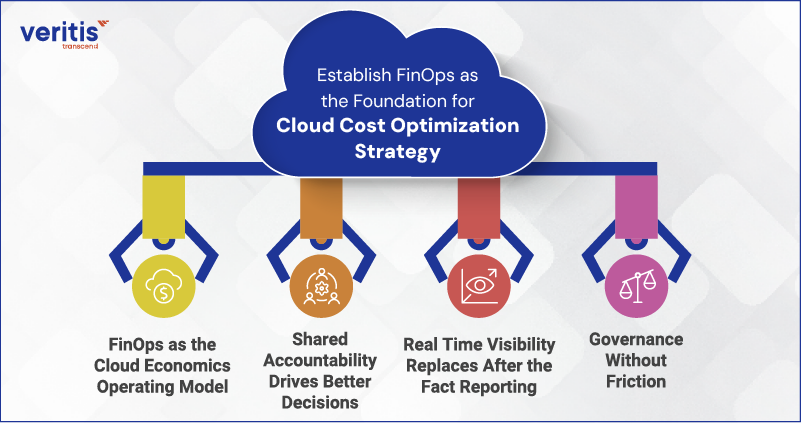
1) FinOps as the Cloud Economics Operating Model
FinOps establishes the leadership model required for effective cloud cost optimization strategies. It aligns engineering speed with financial accountability, ensuring decisions are made with cost, performance, and value in view. For executives, FinOps turns cloud spend from a variable expense into a managed business lever that improves cloud ROI.
2) Shared Accountability Drives Better Decisions
At its core, FinOps connects CIO and CFO priorities. Technology teams retain speed and flexibility. Finance teams gain transparency and predictability. This shared model enables consistent cloud cost optimization best practices and supports disciplined cloud cost reduction without slowing innovation.
3) Real Time Visibility Replaces After the Fact Reporting
FinOps shifts organizations from monthly invoice reviews to continuous insight. Costs are mapped to applications, products, and owners, enabling faster intervention and smarter trade offs. This visibility is essential to any scalable cloud cost optimization framework.
4) Governance Without Friction
Effective FinOps embeds guardrails, not gates. Automated policies, standardized cloud cost optimization techniques, and clear decision rights allow teams to optimize as they build. This approach sustains efficiency while preserving delivery speed.
Optimize Cloud Pricing Models: Reserved Instances, Savings Plans, and Commitments
1) Start With Workload Certainty
Pricing optimization begins with understanding which workloads are stable, scalable, and core to the business. Reserved instances and savings plans create value only when commitments are aligned to predictable demand. When applied correctly, they become a powerful lever in broader cloud cost optimization strategies.
This clarity is established through:
- Identification of long running, steady state workloads
- Separation of elastic and experimental usage from core capacity
- Alignment of commitments to application criticality and growth plans
This approach ensures that pricing decisions support sustained cloud cost reduction, not short term savings.
2) Treat Commitments as Assets
High maturity organizations treat pricing commitments as financial assets. CIOs provide workload intelligence and architectural insight. CFOs define risk tolerance, coverage ratios, and financial exposure. Together, they embed pricing decisions into the cloud cost optimization framework.
Effective commitment management includes:
- Defined coverage targets based on utilization confidence
- Time bound commitments aligned to business planning cycles
- Governance checkpoints tied to cloud ROI
This discipline transforms commitments from discounts into strategic controls.
3) Optimize After Purchase
The real value of pricing models is realized after commitments are made. Without continuous oversight, underutilization erodes savings. Leading enterprises apply cloud cost optimization techniques that track utilization, detect drift, and adjust coverage proactively.
Core execution practices include:
- Ongoing utilization analysis and trend monitoring
- Demand based rebalancing of commitments
- Continuous visibility powered by the best cloud cost optimization tools
This ensures pricing models deliver consistent cloud cost reduction without limiting flexibility.
4) Govern by Process
Pricing optimization must operate as part of daily cloud governance. Mature organizations institutionalize cloud cost optimization best practices by embedding commitment reviews into monthly financial and operational cadences.
Key governance elements include:
- Regular commitment performance reviews
- Automated alerts for underutilization and risk exposure
- Executive dashboards linked to cloud ROI
This keeps pricing aligned with real world consumption and business change.
5) Scale With Confidence
As environments grow, pricing optimization requires scale. CIOs and CFOs rely on cloud cost optimization solutions, supported by specialized cloud consulting services, to manage complexity across providers and workloads.
When delivered through proven enterprise cloud services, pricing optimization becomes repeatable, defensible, and enterprise ready.
Also Read: Cloud Computing Market Share Analysis: Strategic Takeaways for Business Leaders
Why is It Difficult to Control Cloud Costs?
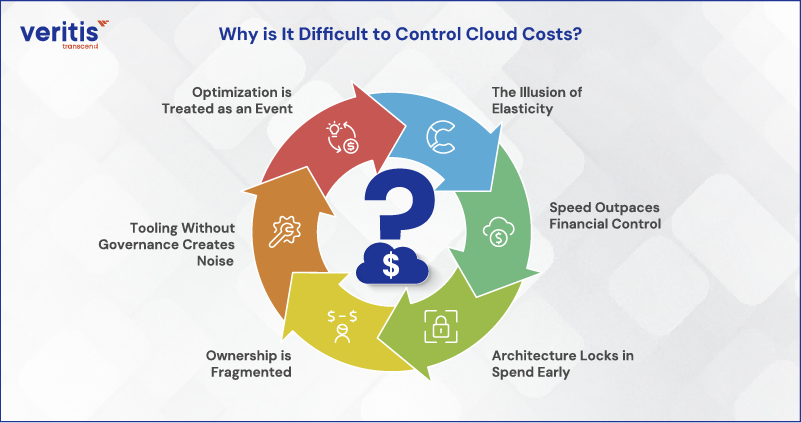
1) The Illusion of Elasticity
Cloud promises flexibility, but elasticity without discipline creates volatility. Costs expand silently as environments scale faster than governance. What looks efficient at launch becomes structurally expensive without deliberate cloud cost optimization strategies.
2) Speed Outpaces Financial Control
Cloud decisions are made in minutes, while financial controls still operate in weeks. This timing gap is where overruns emerge. As enterprises prepare for the future of quantum computing, where compute intensity and cost will continue to accelerate, cloud cost optimization best practices must be enforced during design and deployment, not after spend has already occurred.
3) Architecture Locks in Spend Early
Most cloud costs are determined by architecture, not usage. Over engineered designs, unmanaged data growth, and always on services create fixed cost pressure. Without a governing cloud cost optimization framework, these decisions compound and limit effective cloud cost reduction.
4) Ownership is Fragmented
Cloud environments span teams, tools, and providers. When accountability is unclear, no one owns outcomes. CIOs see performance. CFOs see invoices. Without alignment, cloud cost optimization techniques fail to translate into measurable cloud ROI.
5) Tooling Without Governance Creates Noise
Enterprises often deploy multiple platforms without standardization. Dashboards multiply, insight diminishes. Without the best cloud cost optimization tools operating under a single model, visibility does not equal control.
6) Optimization is Treated as an Event
Many organizations optimize once, then move on. Cloud costs, however, are dynamic. Without continuous cloud cost optimization solutions embedded in operations, savings erode as quickly as they appear.
Also Read: Driving Resilient, Cost Effective Transformation for an Automotive Leader
Cloud Cost Optimization Tools
1) Native Hyperscaler Controls
These tools provide baseline visibility and governance directly from the cloud computing market share provider. AWS cost management capabilities, alongside native Azure controls, give CIOs and CFOs essential insight into consumption, budgeting, and optimization signals.
- AWS Cost Explorer
- AWS Budgets
- AWS Trusted Advisor
- Azure Cost Management + Billing
- Azure Advisor
Used correctly, these form the foundation for AWS cost optimization and Azure cost management, but they require operational discipline to deliver sustained value.
2) Commitment and Pricing Optimization Tools
Focused on reserved instances, savings plans, and long term commitment decisions.
- AWS Savings Plans Recommendations
- AWS Reserved Instance Utilization Reports
- Azure Reservations
- Azure Reserved Instance Recommendations
These tools support pricing strategy decisions that directly influence cloud cost reduction and long term cloud ROI.
3) Enterprise FinOps and Cost Intelligence Platforms
Designed for multi account, multi cloud, and executive reporting at scale.
- Apptio Cloudability
- VMware Aria Cost (CloudHealth)
- Flexera One
- Spot by NetApp
- Harness Cloud Cost Management
These platforms enable advanced cloud cost optimization techniques, cross team accountability, and executive level governance.
4) Automation and Optimization Engines
Focused on continuous optimization, not reporting.
- Spot Ocean / Eco
- CAST AI
- Kubecost
- StormForge
These tools drive real time efficiency and are critical for modern, dynamic environments running containers and Kubernetes.
No single tool delivers optimization on its own. High performing enterprises standardize a focused toolset, align it with a cloud cost optimization framework, and reinforce it with governance, accountability, and experienced cloud consulting services delivered through robust enterprise cloud services.
Best Practices for Cloud Cost Optimization
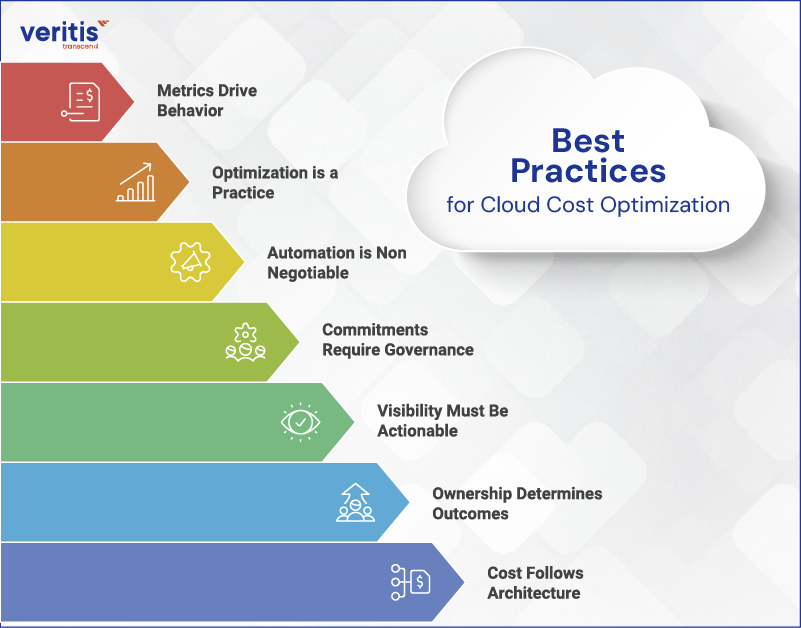
1) Cost Follows Architecture
Fact: 65 to 70% of cloud cost is locked in by architectural decisions.
Executive practice: Enforce cost impact as a mandatory input in architecture and design approvals.
Outcome: 20 to 30% lower baseline spend before optimization even begins.
2) Ownership Determines Outcomes
Fact: Unallocated cloud spend above 10% correlates with uncontrolled growth.
Executive practice: Assign financial ownership at the application and product level.
Outcome: Faster intervention cycles and sustained cloud cost reduction.
3) Visibility Must Be Actionable
Fact: Dashboards without ownership reduce spend by less than 5%.
Executive practice: Tie visibility to accountability, thresholds, and decision rights.
Outcome: Spend variance reduced to under 10% against forecast.
4) Commitments Require Governance
Fact: Enterprises that fail to govern commitments lose 15 to 25% of expected savings.
Executive practice: Set utilization targets above 90% and review monthly.
Outcome: Predictable cloud ROI and defensible financial planning.
5) Automation is Non Negotiable
Fact: Manual optimization plateaus within 90 days at scale.
Executive practice: Automate rightsizing, scheduling, and lifecycle controls.
Outcome: 25 to 40% efficiency gains sustained year over year.
6) Optimization is a Practice
Fact: Quarterly reviews miss cost drift by weeks.
Executive practice: Monthly cloud economics reviews aligned to financial cadence.
Outcome: Continuous optimization instead of periodic correction.
7) Metrics Drive Behavior
Fact: Organizations that track fewer than five core metrics outperform their peers.
Executive practice: Standardize on:
- Cost per application or product unit
- Commitment utilization rate
- Unallocated spend percentage
- Forecast vs actual variance
- Cloud ROI by business outcome
Outcome: Cost control becomes operational rather than reactive.
Talk to a Cloud Cost Optimization Expert
A Step by Step Cloud Cost Optimization Strategies Roadmap for CIOs and CFOs
CIO and CFO Execution Timeline
Phase 1: Align the Mandate
Objective: One shared definition of success.
What CIO + CFO decide: Target savings range, risk tolerance, and required cloud ROI outcomes.
Deliverables:
- Cloud economics charter (who owns what)
- Baseline spend and variance summary
- Top 10 cost drivers by application and environment
Phase 2: Establish Cost Visibility and Ownership
Objective: Make every dollar traceable.
What changes: Costs are mapped to products, applications, teams, and business units.
Deliverables:
- Allocation model (tagging plus account structure)
- Executive dashboard with spend by owner
- Unallocated spend target set below 5%
Phase 3: Set Guardrails and Governance
Objective: Prevent waste before it happens.
What changes: Policies move from guidance to enforcement.
Deliverables:
- Budget thresholds and alerts
- Standardized architecture guardrails
- Monthly CIO and CFO cloud economics review cadence
Phase 4: Execute the High Impact Efficiency Moves
Objective: Reduce structural spend fast without risking performance.
What changes: Optimization prioritizes compute, storage, and idle resources.
Deliverables:
- Rightsizing actions by workload tier
- Scheduling for non production environments
- Storage lifecycle and retention policies
- Decommission plan for unused resources
Phase 5: Optimize Pricing and Commitments
Objective: Turn predictable demand into predictable savings.
What changes: Commitments are managed like assets, not discounts.
Deliverables:
- Commitment coverage targets
- Utilization thresholds above 90%
- Monthly commitment performance review
Phase 6: Institutionalize FinOps and Automation
Objective: Make optimization continuous.
What changes: Governance and automation scale across teams and clouds.
Deliverables:
- FinOps operating model and roles
- Automated enforcement workflows
- Standard toolset defined across environments
Phase 7: Prove Cloud ROI and Sustain the Gains
Objective: Tie cloud spend to measurable business outcomes.
What changes: Optimization becomes value management.
Deliverables:
- Cloud ROI scorecard by business service
- Forecast accuracy improved toward ±10%
- Quarterly board level cloud economics summary
This roadmap works because it follows an executive truth: control comes from ownership, guardrails, and cadence. When the CIO and CFO operate as a single system, cloud cost optimization strategies become repeatable, defensible, and scalable.
Also Read: CXO Roadmap to Overcoming Cloud Migration Challenges
Common Cloud Cost Optimization Challenges and How to Overcome Them
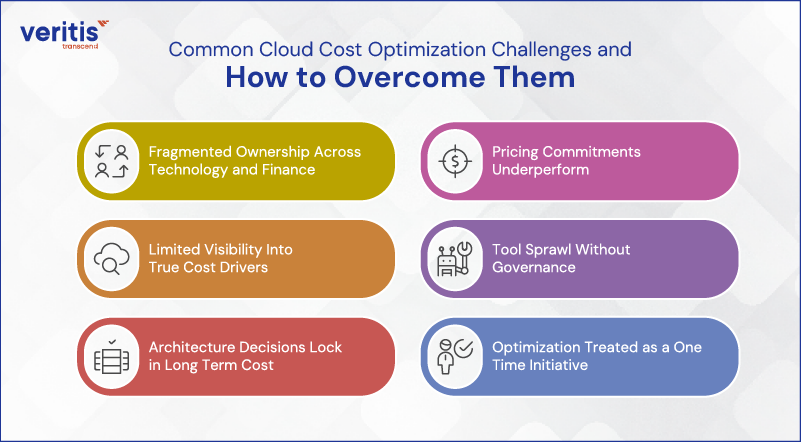
1) Fragmented Ownership Across Technology and Finance
The Challenge:
Cloud spend grows without a clear owner. CIOs see performance and scalability. CFOs see invoices and variance. This disconnect delays decisions and weakens cloud cost optimization strategies.
How Does Veritis Address It?
Veritis establishes a shared CIO to CFO operating model with defined ownership at the application, product, and business unit level, supported by governance cadence and decision rights.
Measurable Outcome:
- Unallocated spend reduced to below 5%
- Faster cost intervention cycles
- Sustainable cloud cost reduction without delivery impact
2) Limited Visibility Into True Cost Drivers
The Challenge:
Most organizations know total cloud spend but not what drives it. Costs are reviewed after invoices arrive, weakening cloud ROI and forecast accuracy.
How Does Veritis Address It?
Veritis implements unified cost visibility across environments, mapping spend to workloads, teams, and outcomes using executive dashboards and allocation models.
Measurable Outcome:
- Clear identification of top cost drivers
- 20 to 30% faster cost correction
- Improved forecast accuracy tied to business outcomes
3) Architecture Decisions Lock in Long Term Cost
The Challenge:
Over engineered architectures and unmanaged data growth create permanent cost pressures that optimization cannot fully reverse.
How Does Veritis Address It?
Veritis embeds cost aware architecture governance into delivery pipelines, aligning design standards with a disciplined IT cost optimization framework.
Measurable Outcome:
- 20 to 30% lower baseline cloud spend
- Reduced need for reactive optimization
- Long term cost control without sacrificing performance
4) Pricing Commitments Underperform
The Challenge:
Reserved Instances and Savings Plans are often purchased without workload certainty, leading to underutilization and financial risk.
How Does Veritis Address It?
Veritis manages commitments as financial assets, aligns pricing strategies with workload behavior, and enforces utilization thresholds through continuous review.
Measurable outcome:
- Commitment utilization above 90%
- Predictable spend and more substantial cloud ROI
- Reduced exposure to overcommitment risk
5) Tool Sprawl Without Governance
The Challenge:
Multiple tools produce dashboards, but not decisions. Visibility increases while control remains limited.
How Does Veritis Address It?
Veritis rationalizes AWS cost optimization tools and integrates them into a single governance model focused on action, automation, and enforcement.
Measurable Outcome:
- Reduced reporting noise
- Clear executive decision signals
- Optimization driven by insight, not data overload
6) Optimization Treated as a One Time Initiative
The Challenge:
Initial savings fade as environments scale and usage patterns change.
How Does Veritis Address It?
Veritis operationalizes FinOps as a continuous discipline, embedding automation, policy enforcement, and recurring executive reviews into day to day operations.
Measurable Outcome:
- Sustained efficiency gains of 25 to 40%
- Continuous cloud cost optimization at scale
- Audit ready governance and reporting
Cloud cost optimization challenges persist because they are operational and organizational, not technical. Veritis helps CIOs and CFOs overcome these challenges by aligning ownership, enforcing discipline, and embedding optimization into how the enterprise runs the cloud, converting cloud spend into a controlled, predictable, and scalable business advantage.
Also Read: Cloud Cost Optimization and Management (Infographic)
Conclusion
Cloud cost optimization is not about reducing invoices. It is about governing a core business capability. As cloud environments scale, the organizations that succeed are those in which CIOs and CFOs operate as a single system, aligning architecture, finance, and governance to deliver predictable cloud ROI, sustained cloud cost reduction, and resilient growth.
This is where Veritis differentiates. Veritis helps enterprises move beyond fragmented initiatives and one time savings by institutionalizing cloud cost optimization strategies as an operating discipline. Through FinOps led governance, cost aware architecture, disciplined pricing optimization, and continuous execution, we enable CIOs and CFOs to regain control without sacrificing agility or innovation.
With over two decades of enterprise delivery experience, Veritis partners with leadership teams to transform cloud economics into a measurable business advantage. The result is not lower costs, but stronger financial predictability, faster decision making, and cloud investments that consistently support growth, resilience, and long term shareholder value.