Legacy applications that once powered growth are now throttling execution, limiting integration, and inflating maintenance budgets. That tension is what drives application modernization to the top of every CIO and CTO agenda. For enterprise leaders across automotive, healthcare, banking, manufacturing, energy, government, and telecom, the question is no longer whether to modernize but how to do it without disrupting operations or overextending the budget.
This guide covers what application modernization is, why it matters, the patterns and strategies executives use to execute it, and the emerging role of APIs in unlocking enterprise value from modernized systems.
Accelerate Your Application Modernization
What is Application Modernization?
Application modernization is the process of evolving existing enterprise applications to meet current business, technology, and operational demands. At the executive level, it is less about rewriting software and more about improving how applications support speed, resilience, security, and scale.
In practice, application modernization involves updating architectures, platforms, and operating models to align with modern environments. This may include adopting cloud platforms, improving integration, strengthening security, and enabling faster change cycles. The objective is to reduce dependency on rigid legacy systems while improving performance, reliability, and cost efficiency.
For leadership teams, modernization is a strategic lever. Understanding the importance and benefits of application modernization helps executives address persistent challenges including high maintenance costs, limited agility, and growing operational risk.
Why Modernize Legacy Applications?
Legacy systems slow execution, restrict integration, and increase maintenance effort, making it harder to respond to business and market changes. Enterprise leaders modernize applications to:
- Reduce infrastructure and maintenance costs
- Strengthen security and compliance posture
- Improve scalability without adding operational complexity
- Shorten release cycles and accelerate time to market
- Enable integration with modern data, AI, and cloud services
Organizations that treat modernization as a structured business initiative, rather than a technology refresh, consistently realize faster returns and fewer disruptions.
Application Modernization Patterns
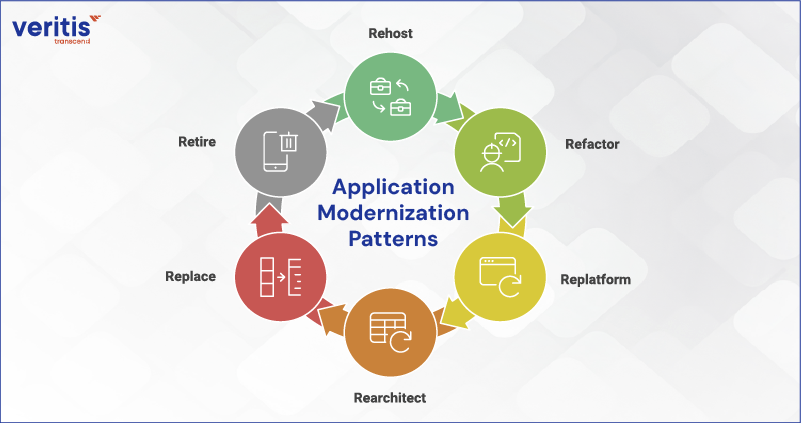
Enterprise leaders select modernization patterns based on risk tolerance, business urgency, and long term goals. The following six patterns are the most widely applied.
1) Rehost
Moves applications to modern infrastructure with minimal change. Reduces infrastructure costs and improves stability while the organization prepares for deeper modernization.
2) Refactor
Improves application structure and performance without altering core functionality. This approach addresses scalability and reliability issues using current technology without a full rebuild.
3) Replatform
Introduces selective improvements such as managed databases or cloud native services. It balances speed and value, delivering early benefits without major disruption.
4) Rearchitect
Redesigns applications to support modern architectures, including the shift from monolith to microservices. Used when the business requires agility, independent deployability, and faster innovation cycles. Cloud native applications built on microservices also unlock the ability to deploy containers technology for faster, more consistent delivery.
5) Replace
Swaps legacy systems for modern platforms or packaged solutions when existing applications no longer meet business or compliance requirements. Simplifies operations and reduces long term maintenance effort.
6) Retire
Eliminates unused or redundant applications to reduce cost and complexity. A critical step in controlling application sprawl and freeing budget for higher value modernization work.
Useful link: 8 SaaS Security Best Practices to Secure Applications
Exposing Functionality via APIs
One of the highest value outcomes of application modernization is making existing business logic accessible through APIs. Rather than replacing a legacy system outright, organizations can expose its core functionality as a service, allowing modern applications, partners, and data pipelines to consume it without touching the underlying code.
This approach delivers several strategic benefits for enterprise leaders:
- Faster integration. APIs create a clean interface between legacy and modern systems, eliminating brittle point to point connections.
- Incremental modernization. Teams can modernize the interface layer first and tackle the core system in later phases, reducing risk.
- Partner and ecosystem enablement. APIs allow external partners, vendors, and platforms to integrate with enterprise systems in a controlled, governed way.
- Foundation for AI and analytics. Modern AI and decision making tools require structured, accessible data. APIs create that pathway from legacy systems to AI driven decision making without a full data migration.
For regulated industries, API led connectivity also improves auditability. Every call is logged, every integration is governed, and access is controlled centrally rather than scattered across custom scripts and middleware.
Enterprises executing modernization programs should treat API exposure as a parallel workstream, not an afterthought. It accelerates the value of every other pattern applied to the portfolio.
Transform Your Enterprise Applications
Application Modernization Assessments
Before committing resources, enterprise leaders conduct a structured assessment of the application portfolio. A modernization assessment answers four questions:
1) Which applications are business critical? Systems that directly affect revenue, compliance, or customer experience take priority.
2) What is the current cost and risk profile? High maintenance cost and security exposure signal urgent modernization candidates.
3) What modernization pattern fits each application? Not every system needs a full rearchitect. Matching the pattern to the situation controls cost and risk.
4) What is the sequencing logic? Dependencies between systems determine which applications can be modernized independently and which require coordinated effort.
A disciplined assessment prevents overinvestment in low value systems and ensures modernization capital flows to applications with the highest business impact.
Application Modernization Benefits
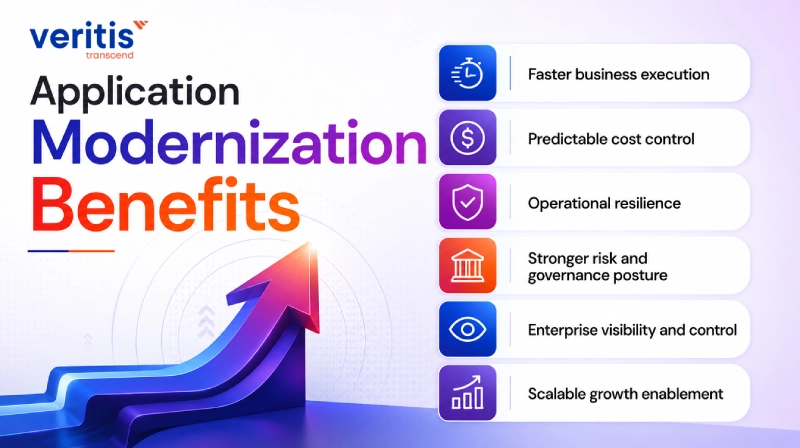
For enterprise leadership, modernization benefits are measured by their impact on performance, risk, and long term enterprise value.
- Faster business execution. Shortened release cycles and reduced system dependencies allow the organization to respond faster to customers, markets, and regulations.
- Predictable cost control. Replacing maintenance heavy legacy environments stabilizes technology spend and redirects budgets toward growth.
- Operational resilience. Improved application reliability and availability reduce business disruption across finance, healthcare, manufacturing, and government.
- Stronger risk and governance posture. Embedded security, access control, and audit readiness reduce regulatory and cyber risk exposure.
- Enterprise visibility and control. Cleaner integration and consistent data flow improve reporting accuracy and executive decision making.
- Scalable growth enablement. Modernized applications support expansion across users, regions, and workloads without adding operational complexity.
Application managed services can complement a modernization program by ensuring newly modernized systems are monitored, maintained, and supported at the level the business requires.
Useful link: Top 10 Applications of Quantum Computing
Application Modernization Strategies
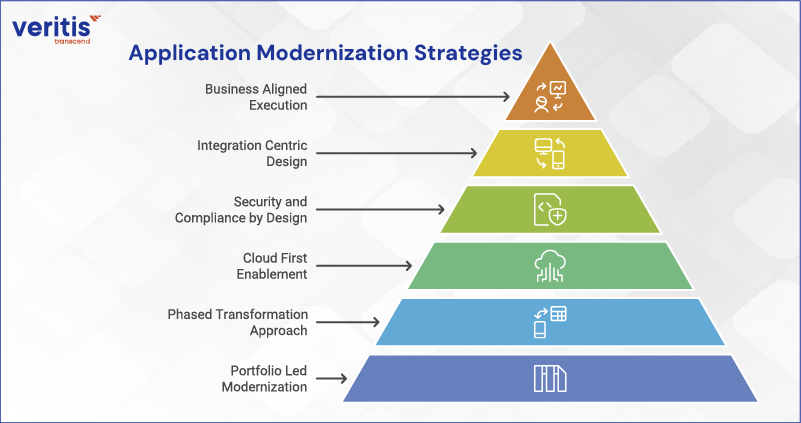
Enterprise leaders apply deliberate strategies that balance speed, risk, and long term value.
1) Portfolio Led Modernization
starts with an assessment of the full application estate. Applications are prioritized based on business criticality, risk exposure, and return on modernization investment, ensuring capital is focused where it matters most.
2) Phased Transformation
modernizes applications in stages across architecture, integration, and performance layers. Milestones, success metrics, and rollback plans are defined upfront to maintain control.
3) Cloud First Enablement
prepares applications for scalable, resilient environments aligned with cost models, compliance requirements, and operational readiness.
4) Security and Compliance by Design
embeds governance, identity, and audit requirements directly into application design rather than applying them after the fact.
5) Integration Centric Design
ensures modernized applications connect seamlessly across enterprise systems, eliminating data silos and improving executive visibility.
6) Business Aligned Execution
anchors every modernization decision to measurable outcomes such as cost reduction, improved uptime, and speed to market. KPIs are reviewed regularly at the leadership level.
Application Modernization Trends
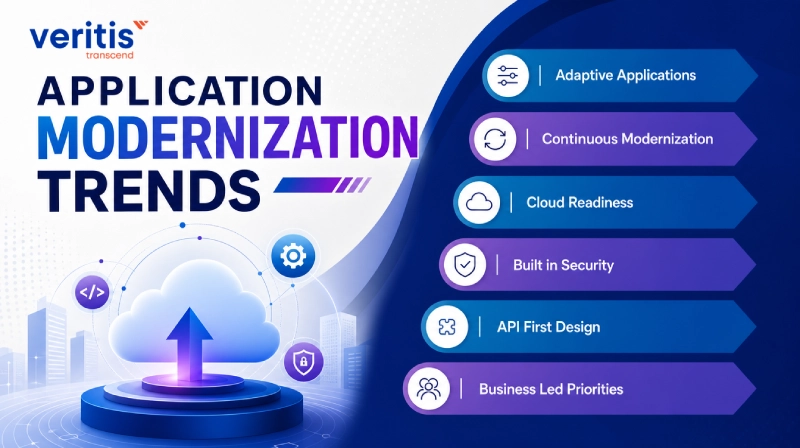
Application modernization trends signal where enterprise investment delivers the strongest returns.
- Adaptive Applications: Systems designed to evolve continuously reduce disruption and improve responsiveness.
- Continuous Modernization: Organizations treat modernization as an ongoing discipline rather than a one time project, limiting accumulated risk and cost.
- Cloud Readiness: Applications are modernized to be cloud ready without forcing an immediate migration, improving flexibility and cost control.
- Built in Security: Security, identity, and compliance are embedded directly into applications rather than bolted on afterward.
- API First Design: New and modernized applications are built to expose and consume functionality via APIs from the outset, accelerating integration and ecosystem growth.
- Business Led Priorities: Applications are modernized based on business impact, not system age, ensuring investment delivers measurable enterprise value.
Conclusion
Application modernization has become a leadership decision because it directly influences performance, risk, and long term growth. Enterprises that modernize with clear strategies, a structured framework, and disciplined execution turn their applications into platforms that support speed, resilience, and scale. Veritis partners with enterprise leaders to modernize applications in a controlled, outcome driven way, ensuring technology strengthens the business rather than holding it back.