The ultimate goal of DevOps is to promote strong collaboration between lines of business, development, operations, and IT frameworks. Though the DevOps movement has gained a massive footprint across IT organizations, significant changes continue to set afoot in the field, making it hard to stay abreast of the trend.
There is a constant influx of new ideas for improving software delivery, making it faster, efficient, and quality focused.
New disciplines, such as software delivery management, tools, and protocols, are introduced periodically, challenging organizations to adopt enterprise level DevOps successfully. As tactics and challenges change at every stage of the DevOps journey, even the most promising efforts ultimately fail to complete full DevOps adoption.
To achieve business value through DevOps, many organizations have turned to containers to simplify their build/test/deploy pipelines.
Containerization for DevOps
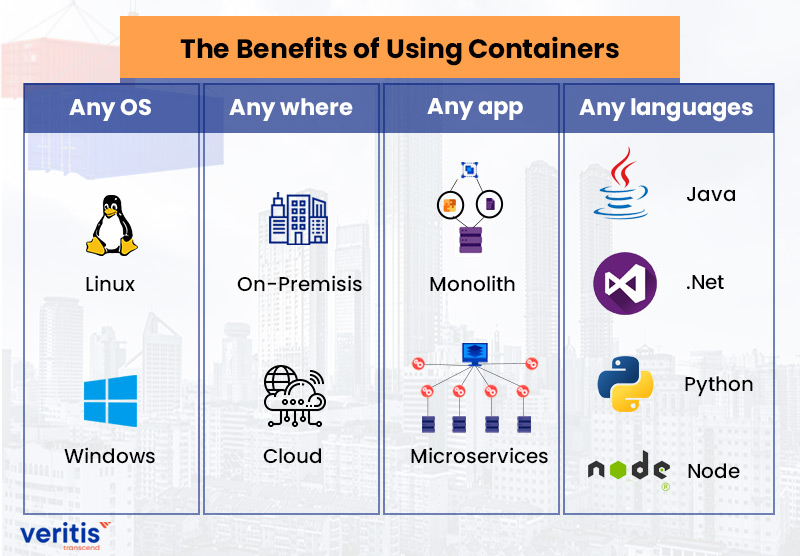
Containers are lightweight, portable software units that package application code, its OS, libraries, and dependencies. Thus, the software can run anywhere, without re configuration, whether on the desktop, laptop, traditional IT, or the cloud.
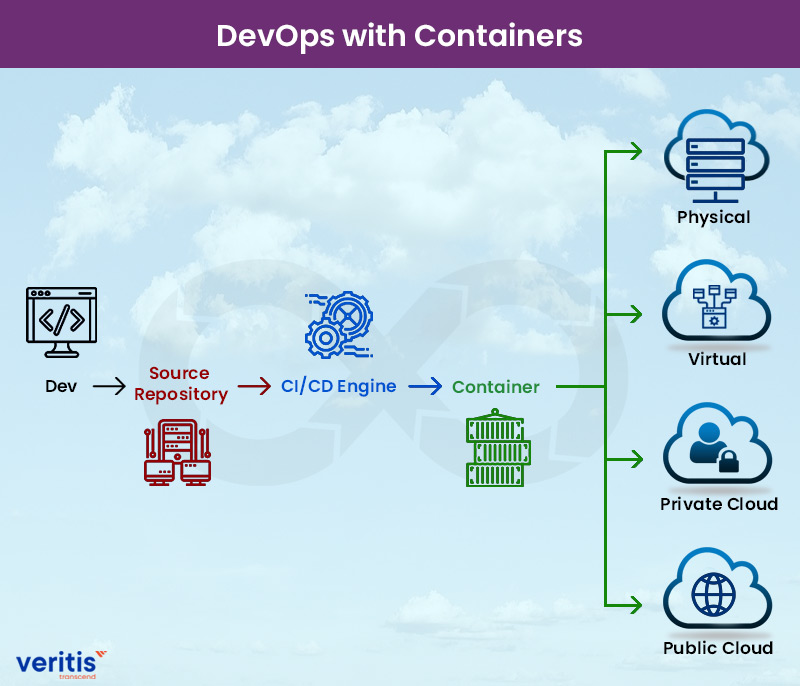
With containers, developers can easily share their software and dependencies with IT operations while eliminating the typical application conflicts between production environments. The developers own the container’s content, application, interdependencies, and components, while the operations team manages production environments and infrastructure to ensure that deployed applications are delivered appropriately. Thus, containers indirectly bring developers and IT operations closer, promoting effective collaboration.
How Can Containers Accelerate Your DevOps Journey?
By simplifying the process of designing, testing, and deploying software from a developer’s computer to various production environments, containers in DevOps benefits in the following ways:
- Improved flexibility
- Improved operation consistency
- High production deployment
- Enhanced development pipeline
- Optimal resource utilization
- High platform independence
- Greater scalability
- High modularity and security
When containers are fused with DevOps practices, they help organizations drive their DevOps journey in the following ways:
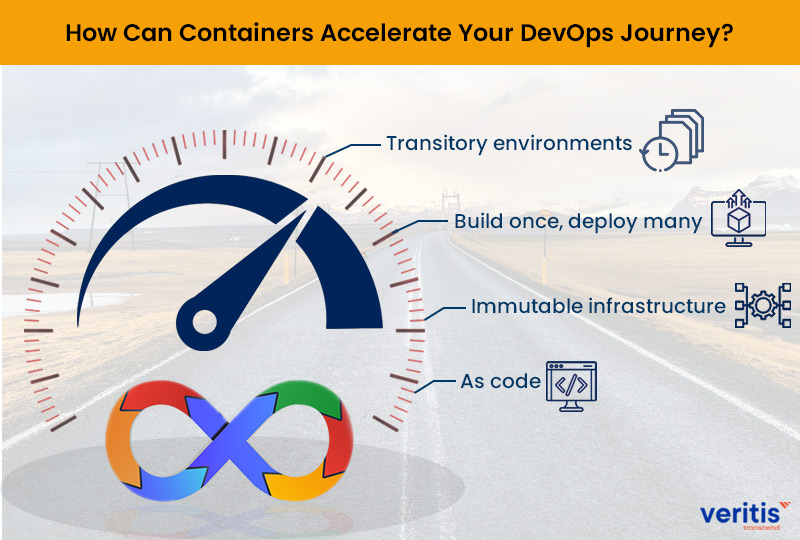
1) Transitory environments
Containers are suitable for ephemeral or transitory environments as they are lightweight, portable, quickly deployable, and require fewer resources. Containers can be spun up, leveraged to execute specific activities such as continuous testing, and recycled once the activity is over. This process can be repeated each time a new environment is needed.
2) Build once, deploy many
Rather than compiling and rebuilding your application for every environment you plan to deploy to, DevOps enables organizations to build the application binary once and deploy it from Integration to Test and then to Production. This reduces the deployment time variables that could lead to errors.
Containers enable the “build once, deploy many” process through images, immutable artifacts container engines use to build new containers.
3) Immutable infrastructure
The concept of Immutable infrastructure is relatively new in the DevOps ecosystem. Instead of updating the infrastructure, a new infrastructure set is built for every deployment based on the update requirements. And the previous infrastructure becomes obsolete.
This approach to DevOps benefits in the following ways:
- Reduced downtime
- Thorough testing
- Automated failure recovery
- Quick deployments and easier rollback
Containerization in DevOps naturally supports the concept of immutable infrastructure. Container images are immutable artifacts, allowing containers to be deployed consistently across environments, Dev, Test, or Prod.
4) As code
The ‘As Code’ concept applied to infrastructure is one of the critical DevOps methodology principles. It is the practice of describing and managing infrastructure, including networks, virtual machines, load balancers, and connection topology, using a descriptive model similar to the one the DevOps team uses for source code.
Containers also support and leverage the ‘as code’ concept. At a container level, a Dockerfile defines the container in code. It contains command line calls that can automatically create a Docker image, which can then be used to create container instances.
Kubernetes is another area where the container supports the ‘as code’ concept. The Kubernetes configuration is defined using YAML, a human readable data serialization language.
Thus, containers support a key DevOps concept that enables greater automation, version control, repeatable outcomes, and faster pipelines.
Useful link: What is DevOps Services?
In Conclusion
Containers can significantly drive DevOps maturity, but properly configuring, managing, and deploying them securely can be challenging.
With the right tools and technology, a well designed container strategy can deliver speed, agility, efficiency, and reduced resource consumption.
Looking for a Containerization services Partner? Veritis can help through our unmatched IT expertise, experienced guidance, and best practices. We also offer comprehensive DevOps consulting services to ensure seamless integration and continuous improvement.
We offer a lifecycle of Container Services using a host of containerization tools, including Docker, HELM, Kubernetes, Amazon ECS, Amazon EKS, Amazon Fargate, and Docker Compose.

More Articles:
- DevOps Configuration Management: A Guide to the Top Tools in the Field
- DevOps Transformation: Approach, Best Practices and Business Benefits
- Cloud Implementation Services: Strategy, Solutions and Benefits
- Building a High Performing DevOps Culture: Strategies and Best Practices for CEOs and CTOs
- Cloud Governance Services: Best Practices and Benefits