According to Gartner, worldwide public cloud end user spending is expected to reach approximately USD 845 billion in 2026, following USD 723.4 billion in 2025. Behind that number lies a straightforward reality for enterprise leaders: organizations that execute cloud implementations with discipline are pulling ahead, while those that treat migration as the finish line are losing ground.
This will define everything a senior technology or business leader needs to ensure that cloud implementation delivers measurable returns: the strategy, the architectural decisions, the governance models, the quantified benefits, and the mitigation playbook for the challenges that derail even well funded programs.
At Veritis, we have spent more than two decades helping global enterprises design and execute complex cloud implementations across AWS, Azure, and Google Cloud. The insights here reflect that delivery experience, not a vendor pitch.
What is Cloud Implementation?
Cloud implementation is the structured, end to end process of adopting, integrating, and optimizing cloud technologies within an enterprise ecosystem. It spans infrastructure as a service (IaaS), platform as a service (PaaS), and software as a service (SaaS) models. It covers every phase from initial readiness assessment through architecture design, migration, security integration, and continuous optimization.
Cloud implementation is distinct from simple migration. Migration moves workloads. Implementation transforms the operating model. A mature cloud computing implementation plan addresses governance, automation, compliance, and financial management from day one, not as afterthoughts once systems are running in the cloud.
To explore the essential concepts behind this discipline, see our article on what is cloud computing and the service models it encompasses.
Talk to a Cloud Implementation Expert
Why Cloud Implementation is a Boardroom Priority in 2026?
Three macro trends are accelerating enterprise investment in cloud implementation services.
1) Multicloud is the Default Architecture
Hybrid and multicloud environments dominate enterprise IT. According to the 2026 Flexera State of the Cloud Report, 73% of organizations operate hybrid cloud environments, while multicloud adoption continues to grow as enterprises balance performance, resilience, and governance across multiple providers. That complexity demands implementation rigor that ad hoc migration projects cannot provide.
2) Spending Thresholds are Rising Sharply
Cloud investment continues to accelerate. 76% of large enterprises now spend more than USD 5 million per month on public cloud services, underscoring the growing scale of cloud investments. At this level of spending, governance, architecture, and cost optimization become strategic business priorities rather than operational considerations.
3) Automation is the New Baseline
Infrastructure as Code (IaC) has been adopted by 89% of organizations. The differentiation now lies in maturity of usage, not adoption itself.
Organizations leading in growth do not treat cloud implementation as a one time project. They treat it as a continuous strategic capability that integrates governance, automation, compliance, and innovation at scale.
Useful link: A Practical Guide to DevOps Implementation on Google Cloud
Elements of a Successful Cloud Implementation Strategy
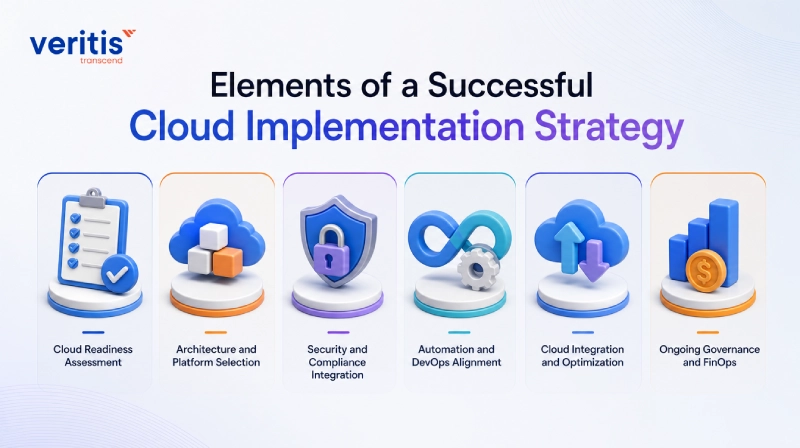
Every successful transformation begins with a well defined cloud implementation strategy that unites business priorities, compliance mandates, and technology investments.
1) Cloud Readiness Assessment
A readiness assessment evaluates infrastructure, applications, and security posture across the enterprise. It determines which workloads can migrate immediately, which require refactoring, and which demand hybrid models. Skipping this step is the single most common cause of cost overruns and delayed timelines.
2) Architecture and Platform Selection
The architecture decision underpins every downstream outcome. Enterprises must choose between public, private, and hybrid configurations while ensuring interoperability across systems and existing technology investments. The platform choice, whether AWS, Azure, or Google Cloud, should follow the workload profile and compliance requirements, not market preference.
3) Security and Compliance Integration
Modern cloud implementation services embed compliance from the start, not after the fact. Security controls aligned with ISO 27017, HIPAA, GDPR, and SOC 2 must be part of the architecture from the earliest implementation phase. For a detailed approach, our cloud security automation best practices guide outlines how automated policy enforcement replaces manual oversight at scale.
4) Automation and DevOps Alignment
Automation defines implementation efficiency. Integrating DevOps practices and IaC into CI/CD pipelines accelerates delivery, ensures consistency, and establishes repeatable, auditable deployment models. This is where implementation strategy translates directly into release velocity.
5) Cloud Integration and Optimization
Once workloads are live, the real work begins. Effective cloud integration and optimization ensure that disparate systems communicate reliably, costs are continuously governed, and performance improvements compound over time through FinOps disciplines.
6) Ongoing Governance and FinOps
Post migration optimization separates tactical cloud moves from strategic cloud implementation. FinOps practices provide cost transparency, allocate spending to business units, and create accountability frameworks that sustain value beyond initial deployment.
Cloud Implementation Steps: A Practical Roadmap
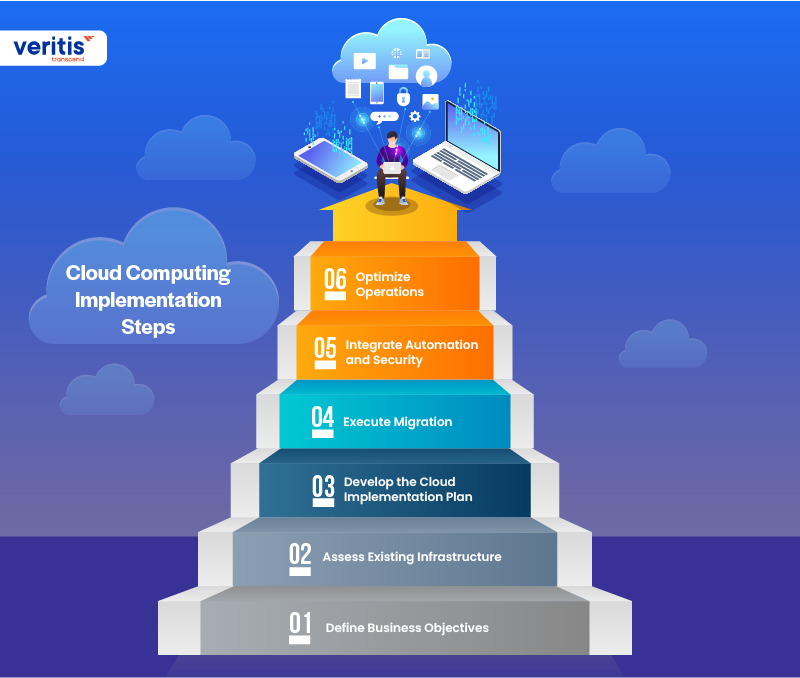
While approaches differ across industries and organizational maturity levels, most enterprise implementations follow these core cloud computing implementation steps.
1) Define Business Objectives
Align the cloud strategy with specific, measurable business goals. Cost reduction targets, time to market requirements, and compliance mandates all belong here before any architecture work begins.
2) Assess Existing Infrastructure
Evaluate readiness across workloads, data environments, and networks. Identify dependencies that will complicate migration sequencing.
3) Develop the Cloud Implementation Plan
Build a phased roadmap covering design, migration waves, and optimization milestones. The plan should include rollback scenarios and success criteria for each phase.
4) Execute Migration
Apply the most appropriate migration pattern for each workload: rehost for speed, refactor for performance, or replatform for long term scalability. See our Azure cloud migration strategy for a structured, four step approach to migrating Microsoft environments.
5) Integrate Automation and Security
Embed continuous monitoring, IaC templates, and automated compliance checks from the first deployment. Security posture should be measurable and reportable from go live.
6) Optimize Operations Continuously
Use cloud implementation services to fine tune performance, manage costs through FinOps, and maintain governance as the environment scales.
When executed with discipline, these steps shorten transformation timelines, enhance scalability, and strengthen operational resilience.
Benefits of Cloud Implementation Services
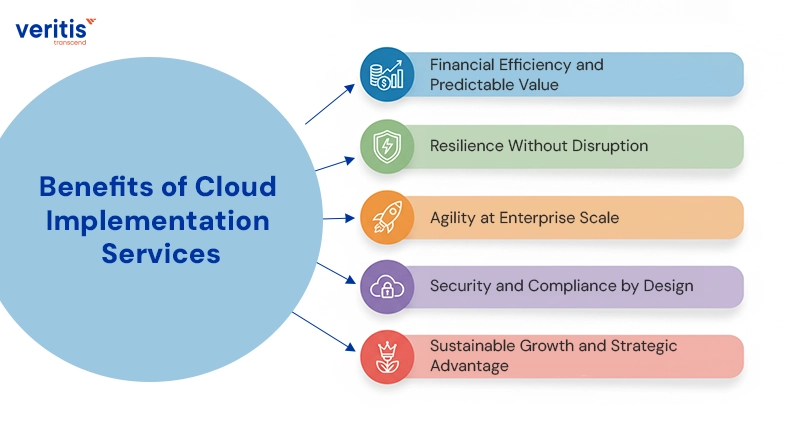
The benefits of cloud implementation services extend well beyond infrastructure modernization. For enterprise leaders, the real case is financial, operational, and strategic, and each dimension is quantifiable.
1) Financial Efficiency and Predictable Value
Cloud transformation shifts enterprises from fixed capital models to flexible, consumption based architectures that scale with business demand. With FinOps led governance embedded in every cloud implementation plan, Veritis clients report up to a 45 percent reduction in infrastructure spending, alongside enhanced visibility that ties every cloud dollar directly to business KPIs.
For context on the financial opportunity across different organization types, our overview of cloud financial services benefits covers the specific levers available to regulated industries.
2) Resilience Without Disruption
Multiregion failover, real time monitoring, and automated disaster recovery are no longer premium features. They are baseline requirements for enterprise cloud architectures. Veritis designed implementations deliver 99.99 percent availability and near zero data loss across global workloads. For enterprises operating in volatile markets, that resilience is brand protection and regulatory assurance built into the architecture from day one.
3) Agility at Enterprise Scale
With DevOps automation and cloud computing implementation steps embedded into CI/CD pipelines, Veritis enables rapid provisioning, testing, and deployment. Clients consistently achieve 60 percent faster go to market timelines and a 2x increase in deployment frequency. IT transforms from a support function into a growth engine.
4) Security and Compliance by Design
Security must be intrinsic, not reactive. Veritis integrates zero trust architectures and automated compliance checks aligned with ISO 27001, HIPAA, GDPR, and SOC 2, starting from the initial configuration. Every workload is audit ready. Every policy is enforced automatically. Continuous compliance replaces periodic manual review.
5) Sustainable Growth and Strategic Advantage
The compounding effect of automation, FinOps, and continuous optimization creates durable competitive advantages: faster decision cycles, greater market responsiveness, and improved environmental efficiency. Veritis clients report up to 40 percent reduction in infrastructure costs, 60 percent faster delivery cycles, and consistent 99.99 percent uptime across global operations.
The 10 benefits of cloud computing services infographic provides a concise visual summary of the broader value case for executive stakeholders.
Connect with Our Cloud Specialists
Cloud Implementation Framework and Maturity Model
A cloud computing implementation plan evolves through maturity stages. Understanding where an organization sits on that maturity curve shapes the right investment priorities and sequencing decisions.
| Maturity Stage | Characteristics | Primary Focus |
| Foundational | Ad hoc migration, limited governance | Stabilization, basic security |
| Managed | Standardized processes, centralized visibility | Cost control, compliance baseline |
| Optimized | Automation first, FinOps embedded | Performance tuning, FinOps maturity |
| Innovative | AI/ML integration, continuous improvement culture | Business model transformation |
A disciplined cloud implementation plan guides progression across these levels, ensuring every step aligns with measurable business value rather than technology novelty.
Industry Use Cases and Quantifiable Outcomes
Cloud implementation services deliver differentiated impact based on the specific demands and regulatory context of each industry. Below are outcome driven examples from Veritis engagements.
1) Healthcare
Healthcare enterprises are moving beyond EHR modernization toward data driven precision medicine. Veritis designed a HIPAA compliant cloud computing implementation framework that unified patient data, imaging, and analytics into a single secure cloud platform.
Impact:
- 35 percent reduction in infrastructure cost
- 2x faster insights from diagnostic data
- Enhanced compliance across multisite operations
2) Financial Services
Innovation in financial services must coexist with strict regulation. Veritis engineered a cloud computing implementation strategy for a global bank, modernizing core platforms using microservices, zero trust architecture, and policy driven compliance.
Impact:
- 3x faster time to market for digital products
- Automated alignment with FINRA, PCI DSS, and SOC 2 controls
- 99.9 percent operational availability
3) Retail
Every second of downtime translates directly to revenue loss. Veritis implemented a cloud implementation plan leveraging autoscaling, predictive analytics, and continuous delivery pipelines.
Impact:
- 99.99 percent uptime across omnichannel storefronts
- 40 percent faster inventory synchronization
- 25 percent increase in customer engagement metrics
4) Manufacturing
Modern manufacturing requires intelligent, connected operations. Veritis implemented a hybrid cloud strategy that integrated IoT telemetry, AI driven analytics, and automation across production lines.
Impact:
- 40 percent reduction in unplanned downtime
- 15 percent increase in equipment utilization
- Unified visibility from shop floor to supply chain
5) Energy
The energy sector demands precision, resilience, and accountability. Veritis implemented an edge to cloud architecture that unified real time monitoring across assets and geographies.
Impact:
- 35 percent efficiency gain in power transmission
- Improved ESG reporting accuracy
- Proactive detection of system anomalies
6) Government
Public agencies are under pressure to deliver citizen services at private sector speed. Veritis modernized a state government’s IT infrastructure through a secure cloud computing implementation plan that integrated interagency data and automated key workflows.
Impact:
- 50 percent faster service delivery
- Enhanced cybersecurity posture
- Improved citizen satisfaction and accessibility
Challenges and Mitigation Strategies in Cloud Implementation
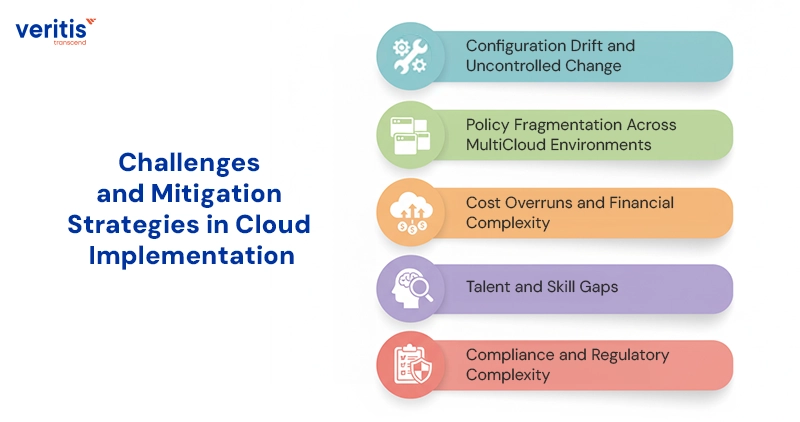
Even the most mature enterprises encounter roadblocks during cloud computing implementation. The difference between friction and failure lies in how effectively those challenges are anticipated, governed, and mitigated.
1) Configuration Drift and Uncontrolled Change
The Challenge: As cloud environments scale, configuration drift becomes inevitable. Inconsistent settings across environments create security gaps, failed deployments, and compliance violations.
Veritis Mitigation: Continuous configuration monitoring and automated governance controls are embedded across all infrastructure layers. Policy as code and drift detection tools identify and correct deviations in real time.
Outcome: 90% reduction in post deployment misconfigurations and complete audit traceability.
2) Policy Fragmentation Across Multicloud Environments
The Challenge: Enterprises operating across AWS, Azure, and Google Cloud face distinct policy frameworks per provider. Without centralized control, governance becomes inconsistent and regulatory exposure rises.
Veritis Mitigation: A centralized policy orchestration layer unifies security and compliance policies, enabling consistent enforcement, visibility, and reporting across all cloud providers.
Outcome: Streamlined governance with uniform compliance across environments and faster audit readiness cycles.
3) Cost Overruns and Financial Complexity
The Challenge: Without clear visibility, cloud consumption quickly exceeds forecasts. Hidden costs from unused resources and poor provisioning create financial inefficiency that compounds over time.
Veritis Mitigation: FinOps driven governance embeds cost analytics and budget controls directly into the cloud computing implementation plan. Automated guardrails, usage dashboards, and real time alerts track spend against business outcomes.
Outcome: 35 to 45% reduction in cloud waste and sustainable cost to value alignment.
4) Talent and Skill Gaps
The Challenge: Cloud adoption strategy consistently outpaces internal capability. Many enterprises struggle to recruit or retain skilled architects, DevOps engineers, and compliance specialists needed for end to end cloud computing implementations.
Veritis Mitigation: Veritis closes that gap through co creation and managed expertise. Multicertified teams bring cross industry experience with AWS, Azure, and GCP, backed by DevOps automation, data engineering, and security specialists.
Outcome: Accelerated project delivery, reduced dependency on niche hires, and up to 50% faster time to value realization.
5) Compliance and Regulatory Complexity
The Challenge: Evolving data residency laws and sector specific standards including HIPAA, PCI DSS, and GDPR create a shifting compliance landscape that manual adherence models cannot manage at scale.
Veritis Mitigation: Compliance is embedded by design. Automated policy mapping, encryption enforcement, and evidence logging are integrated from day one of the cloud computing implementation strategy.
Outcome: Continuous compliance with zero manual intervention and complete audit readiness at any point in time.
Useful link: 10 Key Security Considerations During Cloud Selection and Implementation
Case Study: Data Center Migration and IT Infrastructure Modernization for Banking
A leading banking institution collaborated with Veritis to modernize its IT landscape through a large scale data center migration and cloud implementation initiative. The client required new server builds, cloud ready infrastructure, and end to end IT support to ensure business continuity and regulatory compliance.
Veritis delivered a phased cloud migration strategy, optimized infrastructure performance, and enabled seamless deployment of critical banking applications.
Results:
- Reduced operational complexity across the data center estate
- Enhanced scalability to support digital product growth
- Reinforced data security aligned with banking regulatory requirements
This engagement demonstrates the tangible financial and operational benefits of strategic cloud implementation services in a highly regulated industry.
Cloud Implementation Services with Veritis
For over two decades, Veritis has guided global enterprises through successful cloud computing implementation journeys. Our approach integrates strategic consulting, architectural design, security governance, and post migration optimization into a single, cohesive cloud implementation strategy.
Veritis Cloud Capabilities Include:
- Cloud readiness and migration assessments
- Secure multicloud architecture and governance frameworks
- Automated IaC deployment pipelines
- Continuous monitoring and FinOps optimization
- Cloud managed services with SLA driven performance
- Cloud automation services and tools for consistent, repeatable delivery
We partner with AWS, Azure, and Google Cloud to deliver cloud computing implementation steps customized to each client’s industry, compliance requirements, and business objectives.
Clients achieve faster innovation cycles, reduced operational costs, and enhanced compliance visibility. That is why global enterprises trust Veritis as a cloud implementation services partner for large scale transformation.
Strategic Insight: Implementation Quality Determines Cloud ROI
Cloud adoption has evolved from an IT choice to a boardroom priority. Success in 2025 does not hinge on which platform an enterprise chooses. It hinges on how well the cloud implementation plan integrates automation, security, governance, and continuous improvement from the outset.
Enterprises that treat cloud implementation services as a technology project will achieve technology outcomes. Those that treat it as a business model transformation will achieve compounding business advantages: faster decision cycles, greater market responsiveness, lower operating costs, and the organizational agility to capture opportunities as they emerge.
The principles of successful implementation remain constant regardless of industry or scale: strategy, precision, and disciplined execution. Every architecture Veritis builds, every migration we execute, and every governance model we define connects directly to measurable business objectives, operational resilience, and documented ROI.
With the right cloud implementation partner, cloud is not about reaching the cloud. It is about getting more from it, securely, efficiently, and strategically.
Looking for Cloud Support? Schedule a Call with Our Cloud Specialist
For a broader view of where cloud technology is heading and how to stay ahead of the curve, our cloud computing trends and benefits guide provides the strategic context enterprise leaders need to plan with confidence.