Cybersecurity has become a defining variable in enterprise risk, valuation, and operational continuity. For boards and senior executives, discussing cybersecurity trends is not a matter of technical oversight. It is a leadership discipline tied directly to resilience and financial exposure. The latest trends in cybersecurity indicate a shift; security posture now influences investor confidence, regulatory standing, and the ability to scale safely. In practical terms, understanding trends in cybersecurity has become as critical as understanding market or credit risk.
- 94% of leaders say AI will be the most significant driver of change in cybersecurity over the next year.
- 64% of organizations now assess the security of AI tools before deployment, up from 37% in 2026.
- 87% of respondents say AI related vulnerabilities are increasing, pushing AI risk into board level oversight.
- Ransomware remains a material macro risk: one widely cited industry forecast estimates global ransomware damage at $74B in 2026 (forecast, not audited financial reporting).
- Recent threat reporting shows ransomware victim disclosures are still rising: one 2026 ransomware threat report recorded 7,515 public victim posts in 2025 and a 46% YoY increase in distinct named ransomware groups
What makes 2026 different is the speed at which the threat environment is evolving. Emerging cybersecurity technologies are accelerating both defence and attack capabilities, forcing enterprises to rethink governance and response models. The emerging trends in cybersecurity point to automated threat ecosystems and heightened executive accountability. Leaders who track the top cybersecurity trends early can align investment and policy before disruption occurs. Those who do not are left reacting under pressure, where the cost of delay is measured in lost trust and operational shock.
Talk to Our Cybersecurity Service Expert
What Are Cyber Security Trends?
Cybersecurity trends are recurring patterns that show how threats, attacker methods, and defensive practices evolve over time. They include shifts in which industries are being targeted, which attack types are increasing, how quickly incidents spread, and where security failures occur most often across people, processes, and technology.
For executives, cybersecurity trends are best viewed as early warning signals. They help leadership identify which risks are becoming more costly, which controls are becoming outdated, and where the organization needs to invest in modern cybersecurity consulting services to reduce financial exposure and operational disruption before an incident occurs, enabling proactive rather than reactive decisions.
Useful link: Top 20 Use Cases for Blockchain in Cybersecurity
Why They Matter to Executives?
1) Business And Financial Impact
Tracking cybersecurity trends improves decision making by linking security to business outcomes, including downtime risk, regulatory penalties, customer trust, and revenue protection. It also supports smarter investment choices by separating urgent risk from background noise.
2) Governance And Accountability
Cybersecurity trends also shape board oversight. They guide the questions executives should ask about resilience, third party exposure, incident readiness, and whether security operating models are keeping pace with business growth and the threat environment.
Useful link: AI in Cybersecurity: Defending Against Evolving Threats
Top Cybersecurity Trends in 2026
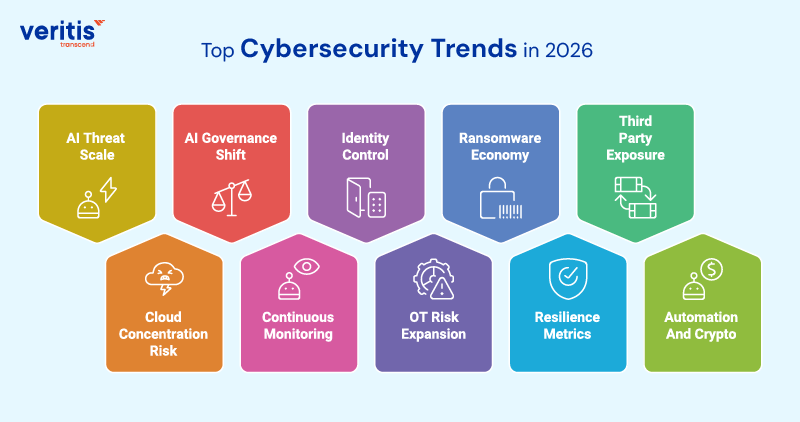
These are cybersecurity trends that matter at the executive and board level in 2026. These are enterprise risk patterns that change how you govern resilience, allocate capital, and protect earnings. The latest trends in cybersecurity show a widening gap between organizations that can absorb shocks and those that cannot. Understanding trends in cybersecurity at this level is now part of executive responsibility, not technical curiosity. These top cybersecurity trends define how enterprises survive disruption.
1) AI Threat Scale
Attackers are using AI to increase speed, realism, and volume, especially in social engineering and reconnaissance. This is one of the fastest moving emerging trends in cybersecurity because AI lowers the barrier to high impact attacks. Defenders are also using AI, but without governance, AI becomes a new source of exposure within the broader cybersecurity trends landscape.
Leadership Action
Treat AI as a regulated business system: approved use cases, controls for sensitive data, and clear accountability. Among the latest trends in cybersecurity, organizations that formalize AI governance are already reducing untracked risk. Leaders who understand these top cybersecurity trends treat AI oversight as financial risk control.
2) AI Governance Shift
This remains one of the defining trends in cybersecurity in 2026: boards are being pulled into AI risk because it affects privacy, IP, regulatory exposure, and incident response decisions. The speed of AI adoption is forcing governance changes that mirror other major cybersecurity trends tied to enterprise accountability.
Leadership Action
Adopt AI risk policies that connect to security, legal, and audit. These governance models reflect how emerging cybersecurity technologies are now shaping executive oversight. Organizations aligning policy with the latest trends in cybersecurity are moving from reaction to prevention.
3) Identity Control
Credential theft remains a consistent path to compromise. Identity is now the most common starting point for many breach patterns, reinforcing long standing cybersecurity trends around access abuse. As attackers scale automation, identity becomes central to the discussion of the top cybersecurity trends.
Leadership Action
Prioritize identity hardening: phishing resistant MFA, privileged access controls, and continuous access evaluation. Enterprises that align identity strategy with emerging trends in cybersecurity consistently reduce incident probability and recovery costs.
4) Ransomware Economy
Ransomware is not a single event. It is an ecosystem with affiliates, brokers, data extortion, and repeatable playbooks. This remains one of the top cybersecurity trends because it directly impacts revenue, operations, and legal exposure. It is also one of the most persistent latest trends in cybersecurity affecting board level decisions.
Leadership Action
Build an executive grade ransomware posture: recovery time objectives that match business reality, immutable backups, and tested crisis decisioning. Leaders who track ransomware alongside broader trends in cybersecurity reduce downtime impact.
5) Third Party Exposure
Complex vendor ecosystems create shared failure modes. The latest trends in cybersecurity show that third party exposure can turn a supplier incident into multi enterprise disruption. This is an accelerating example of emerging trends in cybersecurity tied to ecosystem risk.
Leadership Action
Move from vendor paperwork to measurable controls: continuous monitoring, contractual security requirements tied to evidence, and exit plans for critical providers. Mature organizations now treat third party governance as a pillar of modern cybersecurity trends strategy.
6) Cloud Concentration Risk
Enterprise dependency on a small number of platforms is becoming systemic risk. This is a clear emerging trend in cybersecurity because concentration amplifies failure impact. It is increasingly visible across trends in cybersecurity tied to resilience planning.
Leadership Action
Decide where concentration is acceptable and where diversification is mandatory. Executives aligning architecture with the latest trends in cybersecurity are treating platform dependency as financial exposure.
7) Continuous Monitoring
Static controls cannot keep pace with attack speed. A growing share of cybersecurity trends in 2026 point toward always on monitoring across cloud, identity, endpoints, and data movement. This is one of the most operationally visible top cybersecurity trends.
Leadership Action
Shift budgets from periodic audits to continuous validation and real time telemetry. Enterprises that align operations with the emerging cybersecurity technologies behind monitoring gain earlier incident visibility.
8) OT Risk Expansion
Operational technology environments are increasingly targeted. This is one of the top cybersecurity trends boards feel immediately through operations. Physical downtime transforms cyber incidents into production risk, a major shift in trends in cybersecurity.
Leadership Action
Unify IT and OT ownership and fund segmentation where downtime cost is highest. Organizations responding to these emerging trends in cybersecurity treat OT security as operational insurance.
9) Resilience Metrics
Boards are shifting from prevention claims to evidence of recovery. This reflects the broader latest trends in cybersecurity, where resilience metrics replace tool inventories. It is one of the most important cultural cybersecurity trends in executive governance.
Leadership Action
Adopt KPIs focused on containment speed and restoration time. Enterprises measuring resilience in line with trends in cybersecurity outperform those measuring coverage alone.
10) Automation And Crypto
The most valuable emerging cybersecurity technologies reduce human bottlenecks: AI assisted detection, automated response, and control validation. Post quantum planning is also moving into procurement discussions, an example of long horizon emerging trends in cybersecurity.
Leadership Action
Invest in automation where it reduces incident cost and requires crypto agility roadmaps. Leaders who align with the top cybersecurity trends treat automation as a means of reducing risk, not as a convenience.
Useful link: Cybersecurity Best Practices: Protecting Your Business From Data Breaches in 2026
Case Study: Modernizing Cybersecurity for a Global Financial Enterprise
Veritis collaborated with a global financial services provider to revamp its cybersecurity strategy in response to evolving digital threats and compliance pressures. The client needed to stay ahead of emerging risks, including sophisticated cyberattacks and regulatory changes. Veritis delivered a tailored security framework grounded in Cybersecurity Best Practices, incorporating threat intelligence integration, real time monitoring, and incident response automation, while aligning with the latest cybersecurity trends. This project underscores the importance of continuous security evolution in maintaining resilience in a dynamic threat landscape.
Read the Complete case study: Modernizing Cybersecurity for a Global Financial Enterprise.
Final Thoughts
Cybersecurity in 2026 is ultimately about judgment. The companies that navigate this environment well are not chasing headlines or tools. They are paying attention to cybersecurity trends because those patterns reveal where real business risk is forming. Emerging cybersecurity technologies will continue to reshape the ecosystem, but leadership discipline determines whether the organization absorbs shocks or amplifies them.
Veritis helps enterprises turn the latest trends in cybersecurity solutions into practical safeguards, so resilience becomes part of how the business operates every day, not something tested only during a crisis.
Consult for Cybersecurity Services
Additional Resources:
- Cybersecurity Best Practices: Protecting Your Business From Data Breaches in 2026
- What is SOAR in Cybersecurity and How Do Fortune 500 Leaders Gain an Advantage?
- Which Cloud Migration Tools Deliver the Best ROI for Enterprises?
- Why Every Enterprise Needs Identity and Access Management Risk Assessment?
- How Leading Enterprises Use Applied Generative AI for Digital Transformation?