Table of contents
Digital transformation has changed the face of every industry. Companies embracing these digital transformation trends must strive for the ultimate digital experience and meet the ever evolving demands of consumers. These digitalization trends are reshaping how companies operate, emphasizing innovation and agility.
Companies (irrespective of size) underwent strategic shifts in this transformation process. Some have skyrocketed with digital trends, some have entered into technology mergers and acquisitions, and some have ended up in shackles. Leading in future trends in digital transformation has become vital for companies seeking a competitive edge.
Your organization has likely invested millions in digital initiatives. Yet a recent digital transformation survey reveals a troubling reality: while 97% of global enterprises run mission critical operations on digital platforms, fewer than 30% of transformation programs deliver their projected business value.
For CEOs, CTOs, CFOs, and CIOs, this represents more than an IT problem; it’s a threat to competitive positioning, operational efficiency, and shareholder value.
The Business Impact: $10 Trillion at Stake
Digital transformation trends in 2026 directly influence 80%+ of enterprise revenue across every sector. Organizations implementing digital transformation best practices consistently outperform competitors in:
- Cost efficiency: 25 to 40% reduction in operational expenses
- Speed to market: 50% faster product launches
- Customer acquisition: 35% improvement in conversion rates
- Talent productivity: 30% gains in workforce output
Global spending on digital transformation initiatives is projected to reach USD 10+ trillion by 2026, with the digital transformation market projected at USD 3.7 trillion (CAGR 22%). The question is not all about whether to invest; it’s whether your investment delivers measurable returns.
Talk to a Digital Transformation Specialist
Industry Specific Imperatives
Digital transformation use cases vary by sector, but the urgency is universal:
- Digital trends in oil and gas industry: Real time IoT monitoring reduces downtime by 45%
- Digital trends in insurance industry: AI driven underwriting cutting claims processing time by 60%
- Digital trends in retail banking and the future of digital transformation in banking: Hyper personalized experiences driving 40% deposit growth
- Best digital solutions for manufacturing: Predictive maintenance saving $12M+ annually per facility
- Digital services in automotive: Connected vehicle platforms creating new revenue streams worth $280B globally
Why 68% of Digital Programs Fail and How to Be in the 32% That Succeed
Digital innovation insights from hundreds of enterprise transformations reveal common failure points:
- Lack of executive alignment on business outcomes
- Technology first approaches are disconnected from strategy
- Underestimated change management complexity
- Insufficient measurement of business impact
Organizations leveraging digital transformation with AI, cloud modernization, and digital transformation best practices with disciplined execution achieve 3-5x higher success rates.
What This Guide Delivers?
This article provides C-suite executives with:
1) Proven frameworks from real world digital transformation use cases
2) Industry specific strategies covering digital transformation news and emerging trends
3) Financial models for cost benefit analysis and investment prioritization
4) Partner selection criteria to accelerate implementation while reducing risk
Whether you’re addressing digital trends in your industry or planning enterprise wide transformation, this guide translates digital innovation insights into actionable business strategy.
The State of Digital Transformation in 2026
Digital transformation in 2026 is defined by scale, accountability, and outcomes. Enterprises are not measuring progress by adoption milestones. They are measuring performance impact.
1) 2026 Market Snapshot
- 97% of global enterprises are running at least one mission critical workload on cloud or digital platforms
- Over 80% of enterprise revenue is now digitally influenced, either through digital products, platforms, or customer journeys
- USD 10 to 11 trillion in cumulative global digital transformation investment by 2026
- 65%+ of enterprise workflows now include some level of automation or AI augmentation
- AI enabled decision systems are actively used in finance, supply chain, cybersecurity, and customer operations across most large organizations
These figures confirm that digital transformation trends have moved from transformation to normalization.
2) Where Enterprises Are Actually Investing?
The distribution of spend reveals how trends in digital transformation have matured:
| Investment Area | Share of 2026 Spend |
| Cloud optimization and modernization | High |
| AI and advanced analytics | Very high |
| Cybersecurity and zero trust | High |
| Automation and hyper automation | High |
| Data platforms and governance | High |
| Legacy system modernization | Moderate but sustained |
This reflects a shift from “build fast” to “operate well,” a defining enterprise trend in 2026.
3) The AI Effect on Digital Transformation
In 2026, AI is not a standalone initiative. It is embedded across the digital value chain.
Enterprises are using AI to:
- Predict operational and financial risk
- Optimize infrastructure and cloud spend
- Automate complex decision workflows
- Personalize customer engagement in real time
- Strengthen cybersecurity detection and response
This integration marks a critical inflection point in the future of digital transformation, where AI moves from enablement to orchestration.
4) Global Digital Transformation by Region
Global digital transformation is progressing unevenly but decisively:
- North America leads in AI adoption, cybersecurity maturity, and cloud optimization
- Europe emphasizes regulation driven digitalization trends, data governance, and sustainability
- Asia Pacific accelerates platform scale, automation, and mobile first digital ecosystems
- The Middle East invests heavily in national digital infrastructure, and AI led public services
These regional dynamics influence how digital technology trends are prioritized and executed across multinational enterprises.
Useful link: 8 Strategic Benefits of Digital Transformation for Enterprise Leaders
Digital investments not delivering returns yet?
We help Fortune 500 leaders align strategy, AI, cloud, and data into one execution framework, delivering measurable ROI in 90 days, not years.
Digital Transformation Best Practices
CFOs report that 64% of digital investments lack clear success metrics. According to digital transformation survey data, organizations fail not from poor technology choices but from three critical gaps: misaligned metrics, data fragmentation, and blind spots on ROI.
Organizations without structured digital transformation best practices experience:
- 40 to 60% project budget overruns
- 12 to 18 months delays in value realization
- 70% lower adoption rates among frontline employees
- 3 to 5x higher total cost of ownership over 5 years
Conversely, companies implementing proven frameworks achieve digital transformation use cases that deliver 250 to 400% ROI within 24 months.
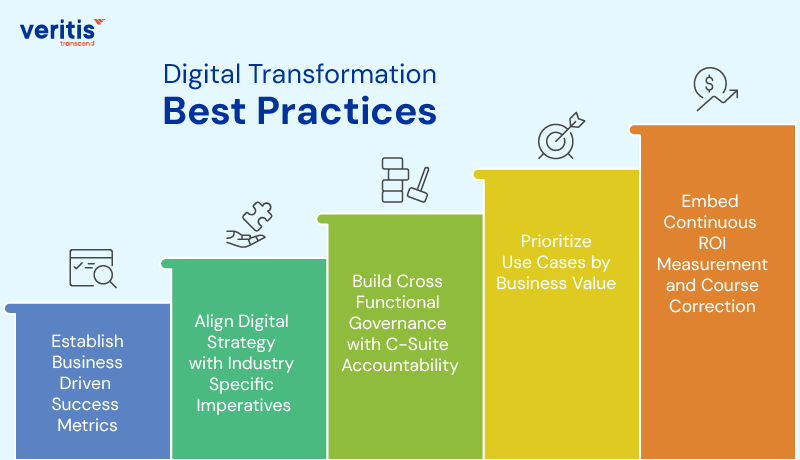
1) Establish Business Driven Success Metrics
Before initiating any digital transformation with AI or cloud modernization, CFOs and CIOs must establish baseline measurements across:
| Metric Category | Example KPIs | Measurement Frequency |
| Revenue Impact | Customer lifetime value, conversion rates, and average transaction value | Monthly |
| Operational Efficiency | Process cycle time, error rates, and manual touchpoints | Weekly |
| Cost Structure | Labor costs per transaction, infrastructure spend, and maintenance burden | Monthly |
| Customer Experience | NPS, resolution time, digital adoption rate | Real time |
Implementation Steps:
1) Month 1: Audit existing data infrastructure and identify measurement gaps
2) Month 2: Deploy analytics platforms with executive dashboards (budget: $150K to $500K)
3) Month 3: Establish automated reporting tied to business outcomes, not IT metrics
Cost Considerations:
- Data platform investment: $200K to $2M, depending on enterprise scale
- Analytics talent: $180K to $350K annually for dedicated data scientists
- ROI timeline: Positive returns typically emerge in quarters 3 to 4
2) Align Digital Strategy with Industry Specific Imperatives
A) Digital Trends in Oil and Gas Industry
- Problem: Unplanned downtime costing $500K to $2M per incident
- Solution: IoT sensor networks with predictive maintenance AI
- ROI: 35 to 45% reduction in equipment failures, 8 to 12 month payback
- Implementation: 6 to 9 month deployment with specialized consulting partners
B) Digital Trends in Insurance Industry
- Problem: Claims processing is taking 45 to 90 days, driving customer churn
- Solution: AI powered document processing and fraud detection
- ROI: 60% faster claims resolution, 25% reduction in fraudulent payouts
- Cost: $500K to $3M initial investment, $1.2M to $1.8M annual operational savings
C) Digital Trends in Retail Banking and Future of Digital Transformation in Banking
- Problem: 68% of customers start account opening online but abandon before completion
- Solution: Hyper personalized digital onboarding with real time decisioning
- Business Impact: 40% completion rate improvement, 22% deposit account growth
- Implementation: 4 to 6 months rollout, requires core banking integration
D) Best Digital Solutions for Manufacturing
- Problem: 30 to 40% of production capacity lost to unscheduled maintenance
- Solution: Digital twin technology with machine learning optimization
- Metrics: 28% OEE improvement, $8 to $15M annual savings per facility
- Investment: $1.5M to $5M per production line
E) Digital Services in Automotive
- Problem: Declining aftersales revenue as vehicle reliability improves
- Solution: Connected vehicle platforms enabling predictive service and subscription models
- New Revenue: $850 to $1,200 per vehicle annually through digital services
- Deployment: 18 to 24 month timeline with OEM system integration
3) Build Cross Functional Governance with C-Suite Accountability
A) Problem: Siloed Ownership Kills Transformation
Digital innovation insights from failed programs reveal that 78% lacked a single executive owner with budget authority and P&L accountability.
B) Solution Approach
Establish a Digital Transformation Steering Committee with:
- CEO: Ultimate accountability for business outcome delivery
- CFO: ROI tracking, budget allocation, financial modelling
- CTO: Technology architecture, vendor management, cybersecurity
- CIO: Data governance, system integration, change management
- Business Unit Leaders: Use case prioritization, adoption metrics
C) Implementation Framework
| Phase | Duration | Activities | Investment |
| Assessment | 6 to 8 weeks | Capability maturity mapping, ROI modelling | $75K to $200K |
| Roadmap Design | 4 to 6 weeks | Use case prioritization, vendor selection | $50K to $150K |
| Pilot Execution | 3 to 6 months | Proof of concept in 1 to 2 business units | $300K to $1.5M |
| Enterprise Rollout | 12 to 24 months | Phased deployment with change management | $2M to $15M+ |
4) Prioritize Use Cases by Business Value
A) Data Driven Prioritization Matrix
CTOs often face pressure to adopt trending technologies (blockchain, metaverse, generative AI) without clear business justification. Apply this scoring framework:
B) Use Case Evaluation Criteria (Score 1-10 each)
- Revenue Impact: Direct contribution to top line growth
- Cost Reduction: Quantifiable operational savings
- Competitive Urgency: Risk of market share loss if delayed
- Implementation Feasibility: Technical complexity and resource availability
- Scalability: Ability to expand across business units
C) Example: Digital Transformation Use Cases Ranked by Total Score
- Customer data platform with AI personalization: 44/50 (High Priority)
- Blockchain for supply chain transparency: 28/50 (Low Priority)
- Robotic process automation for finance: 41/50 (High Priority)
- VR training simulations: 32/50 (Medium Priority)
D) Cost Considerations
High scoring use cases should receive 70% of transformation budget. Allocate 20% to medium priority innovation pilots and 10% to exploratory emerging tech.
5) Embed Continuous ROI Measurement and Course Correction
The Metrics That Matter to the Board Financial ROI Formula
Transformation ROI = (Cumulative Business Value – Total Investment Cost) / Total Investment Cost × 100
A) Business Value Components:
- Incremental revenue from new digital channels
- Cost savings from process automation
- Risk mitigation value (reduced fraud, compliance penalties)
- Customer lifetime value improvements
B) Implementation Steps
- Establish baseline metrics 90 days prelaunch
- Deploy real time dashboards tracking leading indicators (adoption, usage, engagement)
- Conduct quarterly business reviews with the CFO, presenting the financial impact
- Kill underperforming initiatives within 6 months if metrics don’t improve
C) Example: Digital Transformation with AI in Customer Service
| Metric | Baseline | 6 Month Result | 12 Month Target |
| First call resolution | 58% | 72% | 80% |
| Average handle time | 8.5 min | 5.2 min | 4.0 min |
| Cost per interaction | $12.50 | $7.80 | $6.00 |
| Customer satisfaction | 3.2/5 | 4.1/5 | 4.5/5 |
| Annual Cost Savings | — | $2.8M | $6.5M projected |
D) Cost Considerations
Budget Planning for CFOs
| Transformation Type | Year 1 Investment | 3 Year TCO | Expected ROI | Payback Period |
| Point Solution (single use case) | $200K to $800K | $500K to $2M | 150 to 300% | 12 to 18 months |
| Departmental | $1M to $5M | $3M to $12M | 200 to 400% | 18 to 24 months |
| Enterprise wide platform | $5M to $25M+ | $15M to $75M+ | 250 to 500% | 24 to 36 months |
Useful link: What is a Digital Transformation Strategy?
Top 10 Essential Digital Transformation Trends of 2026
As digital business trends continue to evolve, remaining at the forefront of the latest digital transformation trends is no longer optional; it’s essential. From cutting edge technologies to groundbreaking digital innovations, companies are riding the wave of digitalization trends to redefine success in a hyper connected world.
At Veritis, we ensure your organization is ready to embrace the digital transformation trends that will shape 2026. Let’s dive into the advancements in the top 2026 digital business trends, setting the pace for a smarter, more efficient future.

1) AIOps (AI/ML)
Artificial Intelligence (AI) and Machine Learning (ML) remain at the forefront of digital transformation trends. They automate complex workflows and drive more intelligent decision making. AIOps is revolutionizing IT operations, enabling organizations to analyze vast amounts of data in real time.
2) Generative AI
As one of the most exciting recent trends in technology, generative AI is reshaping content creation, customer interactions, and product design. This transformative technology ensures companies stay ahead in the digital transformation trends.
3) Quantum Computing
Quantum computing is no longer a futuristic concept; it’s happening now. This game changer in digitalization trends promises unparalleled computational power, transforming industries like finance, healthcare, and logistics.
4) Automation (RPA)
Robotic Process Automation (RPA) is at the forefront of the latest trends in digital transformation. It streamlines repetitive tasks and frees up human capital for digital transformation innovation. Due to its vast potential, automation continues to dominate digital transformation.
5) Edge Computing and IoT
Edge computing and IoT are revolutionizing connectivity by processing data closer to the source. This is one of the most impactful digital transformation trends, ensuring faster response times and greater business reliability.
6) Low Code/No Code Development
Empowering teams with no technical expertise, low code and no code platforms epitomize recent trends in technology, enabling rapid application development and supporting seamless digital transformation trends.
7) 5G and 6G Enhancement
With 5G now mainstream and 6G on the horizon, connectivity is reaching unprecedented levels. These advancements are among the most anticipated digitalization trends, revolutionizing communication and data transfer capabilities.
8) Cybersecurity
Cybersecurity is a top priority in the era of digital transformation. Protecting data and infrastructure from emerging threats remains crucial to the advancement of digital transformation and innovation.
9) Digital Twins
Digital twins, a significant part of the latest technology trends 2026, enable organizations to create virtual replicas of physical systems. This digital transformation innovation enhances efficiency, monitoring, and decision making across industries.
10) Big Data and Analytics
Leveraging the power of data, big data analytics remains a cornerstone of the latest trends in digital transformation. Businesses leverage insights to drive growth, optimize strategies, and enhance customer experiences.
Stay ahead with Veritis. At Veritis, we don’t track digital transformation trends; we make them work for you. From understanding digitalization trends to implementing the latest trends, we’re here to lead your business into an innovation driven future.
Useful link: How to Drive Digital Transformation in Mining and Metals Industry?
Advanced Digital Business Trends Powering the Next Wave of Digital Transformation
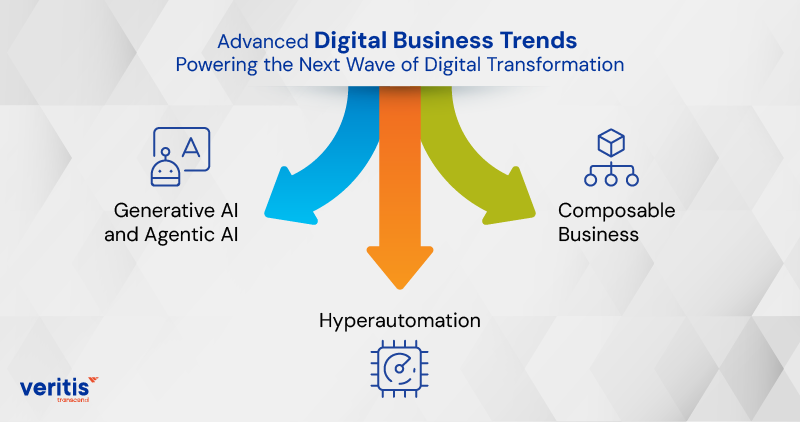
1) Generative AI and Agentic AI: Beyond Automation to Autonomous Strategy
Generative AI is no longer limited to content creation; it now powers decision making systems, automates strategic workflows, and delivers hyper personalized user experiences. Enterprises are embedding agentic AI in self learning tools, virtual agents, and autonomous business processes.
Where to Start:
- Pilot agentic AI in customer support, internal ops, or knowledge management
- Evaluate tools like OpenAI, Anthropic, and enterprise specific agents
- Identify high cost, repetitive workflows as automation candidates
2) Hyperautomation: Orchestrating AI, RPA, and ML at Scale
Hyperautomation unifies robotic process automation (RPA), artificial intelligence (AI), and machine learning (ML) to automate entire workflows, not just isolated tasks. In 2026, it will be a cornerstone of business scalability and cost optimization.
Where to Start:
- Map end to end processes for automation potential
- Use platforms like UiPath, Power Automate, or Appian
- Establish KPIs like process cycle time, bot ROI, and human in loop value
3) Composable Business: Modular Innovation for Enterprise Agility
Composable architecture enables enterprises to rapidly reconfigure their business capabilities using modular building blocks, thereby accelerating innovation and reducing legacy dependencies.
Where to Start:
- Adopt MACH principles (Microservices, API first, Cloud native, Headless)
- Leverage low code platforms for front end agility
- Form cross functional squads for business unit specific deployments
Digital Transformation Use Cases
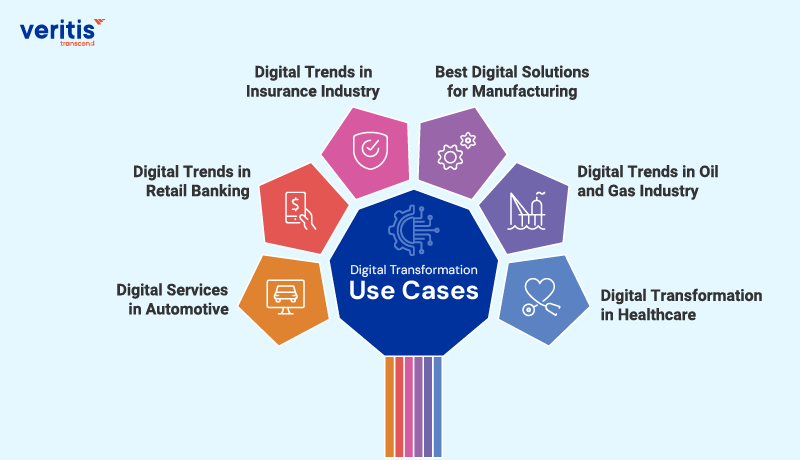
1) Digital Services in Automotive
Digital services in automotive are reshaping industry economics:
- Connected Vehicle Platforms: OEMs generate $850 to $1,200 per vehicle annually through predictive maintenance subscriptions and infotainment services.
- Digital Twin Simulations: BMW reduced product development cycles by 30% and recall costs by $180M using AI driven vehicle performance modelling.
- Business Impact: 22% improvement in customer retention, 15% reduction in warranty claims
ROI: $2.8M investment in connected platforms delivers $8.5M annual recurring revenue within 18 months.
2) Digital Trends in Retail Banking
Digital trends in retail banking centre on hyper personalized customer experiences:
- AI Powered Onboarding: 40% improvement in account opening completion rates
- Composable Banking Platforms: Launch new financial products 60% faster, accelerating time to market from 9 months to 3 months
- Intelligent Virtual Agents: Handle 75% of routine queries, reducing cost per interaction from $12 to $3.50
Metrics: Regional bank achieved 28% deposit growth and $6.2M annual savings through digital first strategy.
3) Digital Trends in Insurance Industry
Digital trends in insurance industry focus on operational efficiency:
- AI Powered Claims Processing: Reduced settlement time from 45 days to 18 days, improving customer satisfaction scores 35%
- Fraud Detection Models: Machine learning identifies fraudulent claims with 92% accuracy, saving $12M annually
- Edge Computing for Risk Assessment: Real time underwriting decisions reduce policy issuance time by 65%
ROI: $1.8M AI investment delivers $7.5M in annual savings and 20% customer retention improvement.
4) Best Digital Solutions for Manufacturing
Best digital solutions for manufacturing eliminate unplanned downtime:
- Hyper Automation + Digital Twins: 28% OEE (Overall Equipment Effectiveness) improvement across production lines
- AI Driven Quality Control: Defect detection accuracy increased from 85% to 98%, reducing waste by $4.2M annually
- AR Enabled Remote Repairs: 40% reduction in maintenance costs, 50% faster issue resolution
Business Impact: Global manufacturer achieved $15M annual savings per facility and 99.2% uptime.
5) Digital Trends in Oil and Gas Industry
Digital trends in oil and gas industry and the broader energy sector address operational reliability:
Oil and Gas Operations:
- IoT Sensor Networks + Predictive AI: Prevented 38 equipment failures, averaging $1.2M per incident
- Digital Twin of Refineries: Optimized asset performance, extending equipment lifespan 18%
- Edge Computing for Remote Sites: Real time anomaly detection reduced safety incidents by 52%
Utilities and Power Generation:
- Smart Grid AI: Predict failures 72 hours in advance, reducing outages from 8.2 hours to 2.1 hours annually per customer
- Demand Forecasting Models: AI optimization reduced energy waste by 12%, saving $22M in operational costs
- Digital Twin Power Plants: 15% improvement in asset utilization, deferring $85M in capital expenditures
Combined Metrics: Energy operators saved $48M+ annually while improving safety compliance 30% and grid reliability 35%.
ROI: Integrated energy company invested $9M in an IoT/AI platform, achieved $31M annual benefit within 24 months.
6) Digital Transformation in Healthcare
Digital transformation with AI in healthcare focuses on clinical outcomes:
- AI Powered Radiology: Reduced diagnosis time from 48 hours to 6 hours, increasing patient throughput 35%
- Edge Computing in ICUs: Real time monitoring with 99.8% uptime, reducing critical incident response time by 60%
- Predictive Analytics: Hospital readmission rates dropped 28%, saving $4.8M annually in penalties
Business Impact: The health system improved patient satisfaction scores 42% while reducing operational costs 18%.
Why Partner with Veritis for Digital Transformation Success?
1) Build vs. Partner: The Strategic Decision
When to Build In House:
- Transformation limited to 1-2 use cases with existing internal expertise
- 18+ month timeline acceptable with tolerance for trial and error
When to Partner with Veritis:
- Enterprise wide transformation across multiple business units
- Lack of in house expertise in AI, cloud, or data platforms
- Need to compress timelines from 24 months to 12 months
- Require proven digital transformation best practices and industry specific digital transformation use cases
2) How Veritis Accelerates Your Transformation ROI?
Veritis delivers measurable value through:
1) Accelerated Time to Value: Pre built frameworks and accelerators reduce deployment time by 40 to 60%.
2) Risk Mitigation: Proven methodologies with 80%+ success rates vs. 32% industry average.
3) Industry Expertise: Deep knowledge in the oil and gas industry, in the insurance industry, in retail banking, the best digital solutions for manufacturing, and digital services in automotive.
4) Technology Agnostic Guidance: Vendor neutral recommendations aligned to your business needs, not vendor quotas.
Capability Transfer: Upskill your internal teams while delivering immediate outcomes.
Case Study: Revolutionizing Financial Services Through Digital Transformation
- Objective:
Adopt cutting edge digital technologies to improve customer experiences, streamline operations, and enable real time data driven decision making in the financial services sector. - Challenge:
Outdated legacy systems and manual processes hindered agility, delayed service delivery, and limited the ability to offer personalized, real time financial services. - Solution:
Veritis introduced cloud solutions, AI analytics, and automation, modernizing infrastructure and enabling faster, more efficient decision making across the organization. - Outcome:
a) Enhanced customer engagement with seamless digital services
b) Improved operational efficiency through automation
c) Faster decision making with real time data insights
- Impact:
The client successfully leveraged digital transformation trends to boost agility, reduce operational costs, and enhance its competitive position in the financial industry.
Read the Full Case Study: Revolutionizing Financial Services Through Digital Transformation
Conclusion
Adopting digital technology trends by a company results in disruption and increased revenue, a process known as digital business transformation. New digitalization trends emerge each year with the potential to accelerate business growth. The benefits of successful digital transformation include enabling software monetization, driving data based insights, enhancing customer satisfaction, increasing agility, and more.
With 21+ years in digital transformation consulting services, Veritis has helped businesses navigate their digital transformation journeys. Our team of AWS Certified Cloud Consultants is committed to delivering 100% quality and driving 100% client satisfaction. We work with trusted industry leaders like Harshi Corp and AWS to provide cutting edge, scalable solutions tailored to your needs.
Whether you want to start your corporate digital transformation journey or need guidance, Veritis, winner of the Stevie Award and Globee Business Award, will support you by leading your business through implementing digital transformation.