Table of contents
Not long ago, IT primarily supported business operations. However, IT has become a core business function as digital services become the primary touchpoint between brands and customers. Rapid technological change demands that IT teams balance system performance with innovation.
Almost every business today relies on its digital services to operate effectively and generate innovative ideas. However, finding the right balance between making things work and developing new ideas is becoming more complex as technology changes.
However, these new ways of doing things can create a lot of data that IT teams need help understanding. This makes it challenging to identify and resolve problems quickly. It also means problems go unnoticed or take a long time to resolve, which can frustrate customers, cause delays, and prevent new ideas from emerging. Interestingly, the solutions to these problems are often hidden in the data. IT teams need help connecting the dots fast.
AI for IT Operations (AIOps) solves this problem. The AIOps platform uses intelligent computer programs and machine learning to process and interpret large volumes of data from a company’s IT systems. It makes things clearer by consolidating all the data and identifying the essential parts. It also looks for patterns and groups helpful information so IT teams can solve problems faster.
AIOps helps IT teams address issues before they escalate. It gives IT teams the tools to stop problems before they happen, which can save time and improve work. AIOps can also predict potential issues.
AIOps are becoming more popular because they can help companies operate more effectively. Even though they’re still new, they’re not just empty promises. Some of the first companies to use them are already seeing good results.
But what can AIOps do for big companies? How do they use it, and what could it do in the future? Let’s explore key ways AIOps can help.
How Does AIOps Work?
What is AIOps? AIOps (Artificial Intelligence for IT Operations) is an intelligent tool that helps companies manage their computer systems effectively during the digital transformation era. An AIOps platform employs intelligent computer programs and machine learning to continuously monitor these systems. It identifies issues by detecting deviations from the norm and can forecast potential problems, preventing significant disruptions.
Moreover, AIOps streamlines IT teams’ workload by categorizing similar alerts and messages to avoid overwhelm. It analyzes various events and deduces their significance, guiding IT teams on necessary actions.
AIOps operates through three main steps: Big Data, Machine Learning, and Intelligent Automation.
1) Big Data Collection
AIOps platforms aggregate data from diverse sources, including networks, applications, logs, and performance metrics. This comprehensive data collection allows IT teams to gain real time insights into system behavior and historical performance trends.
2) Machine Learning Analysis
Advanced machine learning algorithms process and analyze this data, identifying anomalies, patterns, and root causes of potential issues. By continuously learning from historical data, AIOps improves its ability to detect and predict problems before they impact operations.
3) Intelligent Automation
AIOps enables cloud automation by automating repetitive tasks such as alert management, incident resolution, and capacity optimization. By reducing manual intervention, IT teams can focus on strategic initiatives rather than firefighting issues.
Useful link: How AI Adoption Will Transform Your Business
What Are the Key AIOps Benefits for Enterprise IT Operations?
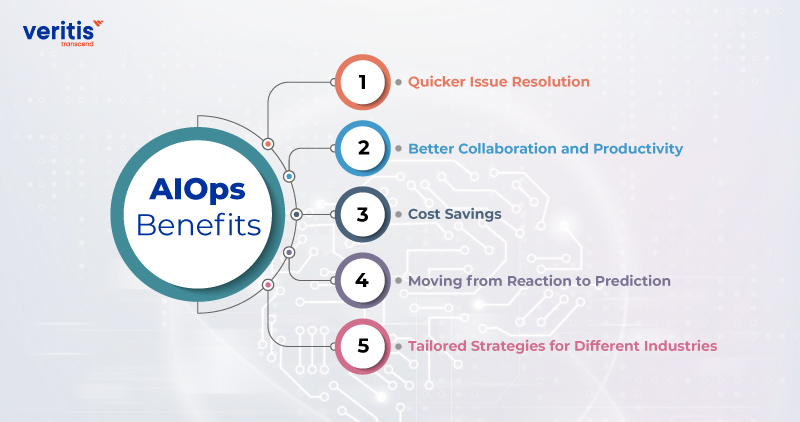
AIOps improves team efficiency by saving time otherwise spent sorting through system failure reports. This is particularly valuable as it can catch problems before they become significant issues that affect the business or users. Adopting AIOps services and a platform approach offers several key benefits:
1) Quicker Issue Resolution
AIOps accelerates troubleshooting by pinpointing the root cause of issues in real time. For example, during website downtime, AI driven insights help IT teams quickly diagnose and resolve issues, reducing Mean Time to Resolution (MTTR).
2) Better Collaboration and Productivity
AIOps enables IT teams to focus on critical issues by filtering out unnecessary alerts and categorizing incidents. Additionally, cross functional teams can collaborate more effectively by leveraging AI generated insights.
3) Cost Optimization
Costs are reduced in various ways. For example, the time between a problem occurring and a solution being implemented is shorter, reducing downtime costs. Also, less staff might be needed with an AIOps system in place. Moreover, there’s less risk of losing revenue due to insufficient user experiences with the system.
4) Predictive Analytics for Proactive IT Management
Rather than reacting to issues, AIOps enables predictive maintenance. By forecasting potential failures and performance bottlenecks, businesses can proactively address issues before they affect end users.
5) Industry Specific Customization
Different industries have unique IT requirements. AIOps solutions can be tailored for finance, e-commerce, and healthcare sectors, ensuring that AI models are optimized for industry specific challenges.
Useful link: 6 Ways AIOps Optimizes Cloud Security
How Can AIOps Use Cases Drive Cost Optimization and Business Continuity?
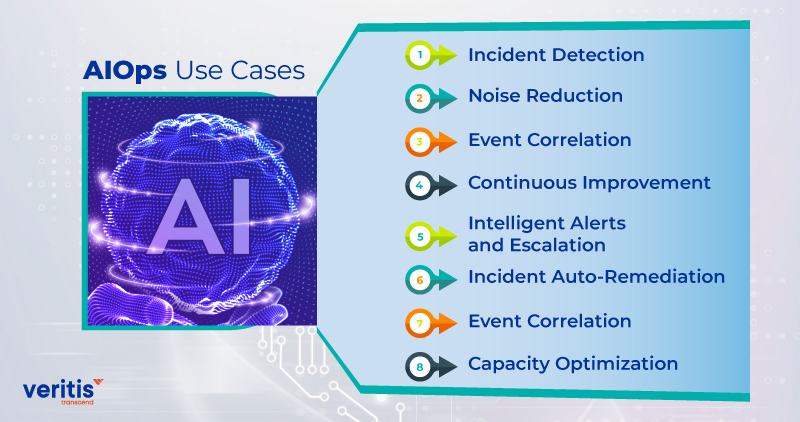
AI for IT operations, or Artificial Intelligence for IT Operations, finds valuable applications across a spectrum of IT related scenarios. It employs AI and machine learning to improve incident management, alert handling, capacity planning, security analysis, and other vital aspects of IT operations. AIOps is transforming AI use cases in IT operations, delivering tangible benefits across various domains:
1) Incident Detection
AIOps solutions are handy for spotting issues well in advance. For instance, they can identify unusual events in your systems before they become real problems. This proactive approach ensures you’re aware of potential issues long before they impact your customers, giving you more time to address them and maintain a smooth operation.
2) Noise Reduction
Alert fatigue is a significant issue when dealing with incidents. When you receive a flood of alerts, it’s easy to become overwhelmed and ignore them, even if some are important. The goal is to filter out less urgent alerts and group those connected. AIOps strategy can help by organizing, reducing, and ranking alerts. This way, your team can concentrate on the most crucial issues that affect reliability.
3) Event Correlation
AIOps become invaluable in event correlation as infrastructure teams frequently receive numerous alerts, of which only a few hold real significance. AIOps solutions take action to differentiate these critical alerts, utilizing inference models to group them and identify the primary reasons behind the issue. This leads to infrastructure teams no longer being overwhelmed with alert emails and instead receiving just one or two genuinely essential notifications.
4) Continuous Improvement
Learning from past incidents, current performance, and user feedback helps avoid problems that have occurred before. This is vital for making ongoing improvements. AI automation tools use this knowledge to keep learning and become more intelligent, offering personalized connections, insights, and advice.
Useful link: Demystifying MLOps vs DevOps: Understanding the Key Differences
5) Intelligent Alerts and Escalation
Once problems are pinpointed through root cause alerts, IT operations (ITOps) teams use artificial intelligence to promptly alert the right experts or response teams for a speedy resolution. AI can even begin fixing the issue before human intervention is required. In many cases, AIOps tools continuously watch over hardware using machine learning, foreseeing errors based on past and current data before they happen. They then automatically send a detailed ticket with instructions on addressing the problem, ensuring you’re informed and equipped to tackle the issue.
6) Data Integration
Data from various sources seamlessly connects with your existing incident management tools and processes. The more data you gather, the brighter your machine learning becomes, offering more customized and helpful outcomes. An AIOps solution takes in this data, adds important information, and then notifies the appropriate teams or responders through the incident management tools they’re already familiar with. This eliminates the need for teams to waste precious time switching between different tools.
7) Automated Incident Remediation
The seventh practical application of AIOps involves automated incident resolution. AIOps is a comprehensive link between IT services and operation management tools. Traditionally, IT service management teams have had to manually sort through infrastructure data to find and fix the main problems. AIOps simplifies this process by deducing the root causes from infrastructure alerts and sending them directly to the IT service management team or tool using integrated API pathways.
8) Capacity Optimization
The final AIOps application is all about making the most of your resources. This involves predicting future needs and using statistical analysis or AI powered tools to ensure your applications run smoothly on your infrastructure. AIOps monitors usage, bandwidth, CPU, and memory to ensure your applications run efficiently.
The AIOps strategy uses AI to help you manage your IT operations effectively while saving on your overall IT budget. It automates solutions in today’s intricate IT setups, making problem solving much smoother.
Implementing an Effective AIOps Strategy
To maximize the benefits of AIOps, businesses should adopt a structured approach:
- Define Key Objectives: Identify IT challenges AIOps will address, such as incident reduction, performance optimization, or predictive analytics.
- Integrate with Existing IT Ecosystem: Ensure seamless integration with IT service management (ITSM) tools, monitoring solutions, and cloud platforms.
- Leverage Machine Learning Models: Train AI models using historical IT data to improve anomaly detection and predictive capabilities.
- Automate Incident Response: Implement automated workflows to resolve common issues without manual intervention.
- Continuously Optimize AIOps Models: Regularly refine AI algorithms based on real time insights and evolving IT environments.
Case Study: Revolutionizing IT Management in E-commerce with AIOps
A fast growing e-commerce platform partnered with Veritis to modernize its IT operations by leveraging AIOps for more innovative incident management.
Challenge: The client experienced frequent service disruptions, delayed incident response, and increasing operational complexity, which affected both the user experience and business continuity.
Solution: Veritis implemented an AI driven AIOps solution that enabled real time monitoring, intelligent root cause analysis, and automated incident resolution, dramatically improving IT responsiveness.
Results:
- 70% reduction in incident resolution time
- Increased service uptime and reliability
- Minimized manual intervention through automation
This case illustrates how AIOps is reshaping IT management by delivering proactive, intelligent operations that empower businesses to maintain stability while scaling effectively.
Read the Full Case Study: Revolutionizing Incident Management With AIOps in E-commerce Platform
Conclusion
AIOps is revolutionizing IT operations management, providing businesses with AI driven automation, real time insights, and predictive analytics. By leveraging AIOps benefits, companies can enhance IT efficiency, minimize downtime, and drive digital transformation.
With over two decades of intense experience transforming IT technology environments, Veritis is an enviable leader in AIOps strategy. Our team, which includes AWS, Azure, and GCP certified cloud consultants, ensures Veritis has the expertise to deliver robust AIOps solutions that meet your requirements. With a proven 100% client satisfaction record, Veritis provides most Fortune 500 companies and new enterprises with optimized IT infrastructures for business success.
To take this a step further, authority in AIOps, demonstrated through an innovative approach, will help companies improve incident management efficiency, achieve substantial cost savings, and boost operational effectiveness. We are one of the leading cloud consulting firms, offering high quality solutions that enable companies to thrive as the world continues to go digital.
Be it an AIOps case investigation, the transformation of IT operations to artificial intelligence for IT operations, or something else, this will undoubtedly be the partner you need on your way to the next evolution of your IT operations.
Talk to our experts today and discover how AIOps can transform your IT operations!