For modern enterprises, the pace of digital innovation has never been faster. Customers expect immediate experiences. Teams must deploy updates continuously. Infrastructure must scale instantly without compromising reliability, cost, or security.
Cloud native applications have emerged as the most effective way to achieve this reality. They allow organizations to innovate quickly, scale without limits, and strengthen resilience while improving cost efficiency. With the rise of AI enabled automation, microservices, Kubernetes platforms, and hybrid cloud adoption, cloud native application services have transitioned from a technology choice to an enterprise mandate.
This guide provides executive decision makers with a detailed understanding of what are cloud native applications, why they matter, their architectural foundations, and how organizations can successfully adopt them to remain competitive in 2026 and beyond.
What Are Cloud Native Applications?
Cloud native applications are software systems intentionally built to leverage the full capabilities of the cloud. Unlike monolithic architectures that depend on tightly coupled components and traditional infrastructure, cloud native applications operate in distributed, flexible, and highly automated environments.
They allow enterprises to build cloud native applications that can evolve continuously, recover instantly, and scale dynamically across multiple cloud platforms.
1) Core Characteristics That Define Cloud Native Applications
A) Elastic and Auto Scaling
Cloud native workloads automatically scale based on user demand, workload spikes, or business cycles, without manual intervention.
B) Resilient by Architecture
Failures in a single microservice or node do not bring down the entire system. Applications self heal through redundancy and distributed design.
C) Portable Across Clouds
Cloud native applications run consistently across AWS, Azure, GCP, Kubernetes, and private cloud environments.
D) API Driven and Modular
Interfaces are standardized, enabling interoperability and faster integration with third party systems.
E) Observable and Measurable
Built in telemetry, monitoring, and distributed tracing create real time operational visibility.
2) Core Technologies Powering Cloud Native Applications
A) Microservices
Small, independently deployable components that allow teams to innovate and scale specific features without affecting the entire application.
B) Containers and Kubernetes
Containers package applications consistently, while Kubernetes orchestrates deployment, scaling, networking, and failover across the cluster.
C) Serverless Computing
Serverless platforms eliminate infrastructure management, allowing teams to focus entirely on application logic.
D) DevOps Automation and CI/CD
Automated pipelines reduce delivery cycles from months to minutes.
These foundations enable organizations to build cloud native applications that are agile, scalable, and business aligned.
Why Cloud Native Applications Are Critical for Enterprises in 2026?
Executives across industries are moving cloud native to the center of their application strategy, and for good reason.
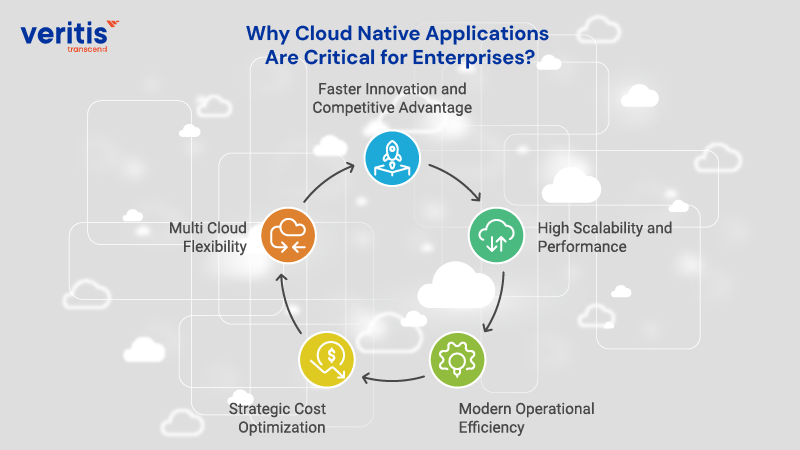
1) Faster Innovation and Competitive Advantage
Enterprises release new features more frequently, experiment faster, and respond to market changes instantly.
Executive Impact:
- Accelerated revenue growth through rapid product iteration
- Better customer experiences
- Shorter innovation cycles
2) High Scalability and Performance
Cloud native applications can support millions of users with minimal latency.
Executive Impact:
- Seamless peak season demand handling
- High performance even under global workloads
3) Modern Operational Efficiency
Automation reduces manual effort across provisioning, deployments, scaling, and monitoring.
Executive Impact:
- Leaner operations
- Reduced downtime
- Lower support burden
4) Strategic Cost Optimization
Cloud native models eliminate expensive over provisioning and pay only for what is needed.
Executive Impact:
- Lower infrastructure expenses
- Predictable OPEX based costing
- Better alignment with business forecasting
5) Multi Cloud Flexibility
Enterprises avoid vendor lock in and deploy across diverse platforms.
Executive Impact:
- Increased negotiating leverage
- Business continuity through diversified infrastructure
Useful link: Which AWS Cloud Management Tools Should You Use to Manage Your Business
Core Components of Cloud Native Architecture
1) Microservices Architecture
How Microservices Work?
Applications are redesigned as modular, independent services that connect through APIs.
Business Value:
- Independent scaling
- Faster development cycles
- Simplified maintenance
- Faster deployment of new features
2) Containers and Orchestration
Containers encapsulate application code and dependencies into isolated, portable units.
Why Containers Matter?
- Lightweight runtime environment
- Consistent behavior across development, testing, and production
- Lower resource consumption vs. VMs
Role of Kubernetes:
Kubernetes automates:
- Scaling
- Load balancing
- Self healing
- Traffic routing
- Zero downtime deployments
It is the backbone of modern cloud native application services.
3) Serverless Computing
Serverless platforms like AWS Lambda, Azure Functions, and Google Cloud Run accelerate innovation.
Executive Benefits:
- No server management
- Auto scaling with near zero overhead
- Massively reduced operational load
- Highly cost efficient for event driven use cases
Benefits of Cloud Native Applications
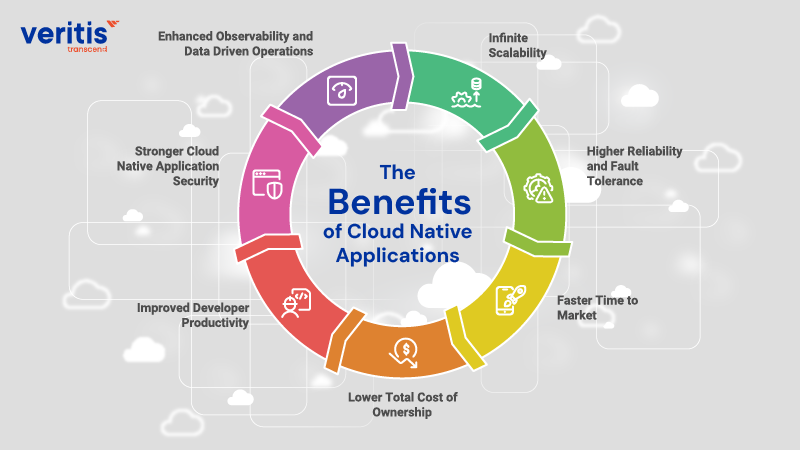
Modern enterprises choose cloud native applications because they deliver measurable business outcomes, not technical improvements. They accelerate innovation, reduce operational friction, and create a scalable foundation for future growth. Below is an expanded view of the benefits of cloud native applications that matter most to executive leaders, transformation officers, and technology strategists.
1) Infinite Scalability
Cloud native applications scale automatically based on real time demand. Whether an application experiences a seasonal spike, a viral surge, or normal growth, it can scale up or down instantly without manual intervention.
Executive Advantages:
- Eliminates the need for capacity planning
- Supports high growth digital products
- Ensures uninterrupted user experience under heavy load
- Aligns cloud consumption directly with business activity
The ability to scale dynamically is one of the most powerful strategic advantages for companies looking to grow without infrastructure constraints.
2) Higher Reliability and Fault Tolerance
Cloud native applications use a distributed architecture in which each service runs independently. If a single component fails, the application continues functioning, often without users noticing.
Executive Advantages:
- Increased uptime and operational continuity
- Reduced revenue impact from outages
- More resilient digital experiences
- Easy isolation and remediation of failing components
This built in reliability ensures business services remain available, even during system disruptions.
3) Faster Time to Market
By combining DevOps automation, microservices, containers, and CI/CD pipelines, cloud native teams deploy features rapidly and consistently.
Executive Advantages:
- Release cycles improve from quarterly to daily
- New products and features reach customers 5 to 10x faster
- Reduced dependency on centralized teams
- Immediate response to customer feedback or market shifts
This agility helps organizations outperform competitors and convert innovation into measurable business value.
4) Lower Total Cost of Ownership
Cloud native applications eliminate the need for over provisioned hardware and reduce infrastructure maintenance costs.
Executive Advantages:
- Pay only for actual usage (significant OPEX optimization)
- Reduced maintenance costs through automation
- No capital expense for data centers or idle servers
- Lower operational overhead versus monolithic systems
Over time, the shift to cloud native models results in predictable, cost efficient operations and stronger financial governance.
5) Improved Developer Productivity
Cloud native architectures empower teams to innovate without waiting for infrastructure provisioning, lengthy testing cycles, or centralized approvals.
Executive Advantages:
- Developers ship features independently
- Increased output due to automation (CI/CD, IaC, QA automation)
- Higher code quality and fewer production bugs
- Better collaboration across distributed teams
Organizations that build cloud native applications often see a measurable rise in engineering speed and team morale.
6) Stronger Cloud Native Application Security
Security is not an afterthought at the end of development; in cloud native environments, it is embedded at every stage of the software lifecycle.
Executive Advantages:
- Automated vulnerability scanning across code and containers
- Zero Trust principles protect every service interaction
- Runtime security detects anomalies instantly
- Identity based access controls minimize insider threats
- Compliance becomes easier through policy as code governance
With strong cloud native application security, enterprises protect sensitive data while accelerating delivery, a balance that traditional architectures rarely achieve.
Useful link: 6 Ways Why Cloud Based Solutions Benefit Small and Medium Sized Enterprises
Disadvantages of Cloud Native Applications
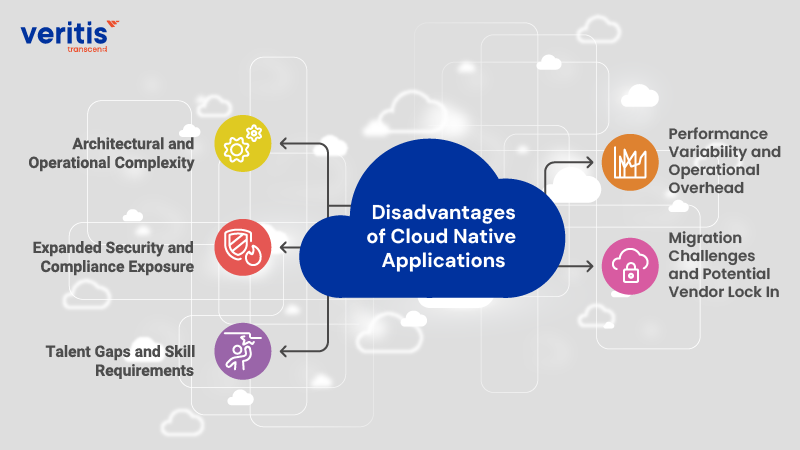
While cloud native applications deliver major strategic advantages, they also introduce new complexities that enterprises must plan for. Understanding these challenges helps leaders make informed decisions, allocate resources effectively, and design a long term cloud strategy that balances performance, cost, and security.
Below are the key disadvantages executives should consider.
1) Architectural and Operational Complexity
Cloud native architectures introduce many moving parts, microservices, containers, orchestration, service meshes, distributed APIs, and observability stacks. This complexity demands advanced engineering skills, robust automation, and strong governance.
Executive Implications:
- Requires a steep learning curve for development and operations teams
- Needs specialized talent such as DevOps engineers, platform engineers, SREs, and Kubernetes administrators
- Higher initial implementation effort compared to monolithic systems
- Increased complexity in managing distributed systems at scale
Without proper planning, this complexity can slow adoption and increase operational overhead.
2) Broader Attack Surface and Advanced Security Requirements
As organizations build cloud native applications, the number of components, APIs, containers, and service interactions increases, naturally expanding the attack surface. Security must evolve from perimeter defense to continuous, layered protection.
Executive Implications:
- Traditional security models are insufficient
- Requires strong cloud native application security practices
- Increased need for automated scanning, secrets management, and runtime protection
- Distributed environments demand Zero Trust policies
- Misconfigurations can lead to compliance violations
Security cannot be an afterthought. It must be integrated into every phase of the cloud native lifecycle.
3) Potential Vendor Lock In
Cloud native architectures rely on proprietary tools and managed services from public cloud providers. While these accelerate development, they may limit future portability.
Executive Implications:
- Switching between cloud providers can become expensive and complex
- Some managed services (databases, serverless platforms, AI services) are not easily portable
- Long term dependency reduces negotiation leverage
- Multi cloud strategies require additional architectural planning
Leaders must weigh speed and convenience against long term flexibility.
4) Higher Skill Requirements and Talent Gaps
Cloud native adoption requires teams proficient in modern engineering practices, including microservice design, distributed systems, DevOps automation, Kubernetes, IaC, and observability.
Executive Implications:
- Upskilling internal teams requires time and financial investment
- Recruiting specialized talent can be costly and competitive
- Organizations lacking cloud native maturity may experience slow transformation
- Productivity may temporarily dip during the transition
Enterprises must plan for a phased, well supported cloud adoption journey.
5) Performance Variability Across Shared Cloud Infrastructure
In cloud environments, performance depends on shared underlying resources. Even with autoscaling, workloads can face latency or inconsistent throughput under certain conditions.
Executive Implications:
- Latency sensitive applications require careful architecture design
- Cost performance trade offs must be considered
- Multi region deployments may be necessary for global performance consistency
- Requires investment in monitoring and performance tuning
This variability can affect customer experience if not properly managed.
6) Increased Observability and Monitoring Requirements
Traditional monitoring tools are not designed for microservices based, containerized, distributed systems.
Executive Implications:
- Requires advanced observability platforms for logs, metrics, and traces
- Root cause analysis becomes more complex
- More data points increase monitoring costs
- Failure patterns in distributed systems are harder to diagnose
Without modern observability, operational teams struggle to maintain reliability.
7) Complex Migration From Legacy Systems
Modernizing monolithic or legacy applications into cloud native architectures is not a lift and shift process.
Executive Implications:
- Re architecture requires time, budget, and phased execution
- Business critical systems cannot be disrupted during migration
- Hybrid operating models may be needed temporarily
- Strong governance is essential to avoid fragmented modernization
This transformation requires careful planning and expert guidance.
How to Build Cloud Native Applications the Right Way?
1) Modern Engineering Practices
A) DevOps and CI/CD
Continuous integration and deployment pipelines automate releases and testing.
B) GitOps Approaches
Declarative infrastructure managed via Git improves reliability and governance.
C) Infrastructure as Code
Terraform, Pulumi, and CloudFormation standardize deployment.
2) Platform Architecture
A) Kubernetes as the Foundation
Central orchestrator for cloud native workloads.
B) Service Mesh Implementation
- Tools like Istio and Linkerd manage:
- Service to service traffic
- Security
- Observability
C) API Gateways
They enforce authentication, rate limiting, and routing policies.
3) Cloud Native Application Security Framework
A) Shift Left Security
Security is integrated into the SDLC early.
B) Zero Trust Architecture
Every entity is authenticated and authorized; no inherent trust.
C) Runtime Threat Protection
Detects container, API, and service level anomalies.
D) Automated Compliance
Policy as code ensures regulatory alignment.
Cloud Native Trends Shaping 2026
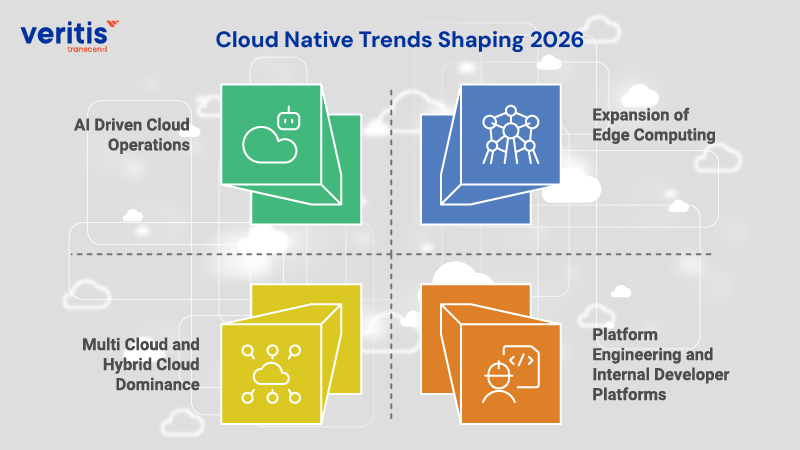
Cloud native adoption continues to accelerate, driven by innovation in automation, AI, distributed computing, and enterprise scale application management. These cloud computing trends are changing how organizations build cloud native applications, improve performance, and strengthen security while preparing for long term digital growth.
1) AI Driven Cloud Operations
AI has become a core enabler of modern cloud native environments. Intelligent automation now handles decisions that once required large operations teams.
What Does This Mean for Enterprises?
- AI predicts traffic surges and auto scales environments before demand hits.
- Machine learning models detect anomalies, misconfigurations, and performance degradation in real time.
- AI driven testing reduces release bottlenecks and increases deployment reliability.
- Automated remediation cuts downtime and operational risk.
As a result, organizations gain highly efficient, self adjusting platforms that optimize costs and reduce manual intervention, a major advantage when running large scale cloud native application services.
2) Expansion of Edge Computing
Enterprises are extending cloud native architectures to the edge to deliver faster, more localized experiences.
Why Does This Matter?
- Ultra low latency is now crucial for IoT, healthcare, retail, manufacturing, and autonomous operations.
- Edge deployments reduce bandwidth usage and improve responsiveness.
- Cloud native applications can now run seamlessly across centralized cloud and distributed edge locations.
This hybrid distribution of computing power enables businesses to explore new use cases while improving customer experience and service reliability.
3) Multi Cloud and Hybrid Cloud Dominance
Most enterprises do not need to choose a single cloud. They are designing architectures that run across multiple providers and local deployment environments.
Key drivers:
- Avoiding vendor lock in
- Enhancing resilience and disaster recovery
- Optimizing cost and performance per workload
- Meeting regulatory or data residency requirements
Cloud native applications are inherently portable, making them ideal for multicloud and hybrid strategies. Kubernetes, containers, and API based architectures ensure consistent deployment and governance across platforms.
4) Platform Engineering and Internal Developer Platforms
Platform engineering is becoming a strategic priority as enterprises look to simplify operations and accelerate innovation.
Impact on development:
- Internal Developer Platforms (IDPs) provide self service environments for deploying cloud native applications.
- Developers do not need to manage infrastructure; everything is abstracted into automated workflows.
- Teams ship features faster with fewer errors and greater consistency.
- Organizations enforce governance and cloud native application security centrally without slowing innovation.
This evolution improves productivity, reduces cognitive load on engineering teams, and ensures architectural standards across the enterprise.
Conclusion
Cloud native applications represent the future of enterprise software. They offer unmatched agility, resilience, scalability, and security, qualities required for sustained digital competitiveness and enabled through expert cloud consulting services.
By adopting cloud native application services, strengthening cloud native application security, and learning what are cloud native applications, leaders can guide their organizations toward building high performance systems that scale with business growth.
Enterprises that commit now will be positioned to build cloud native applications capable of delivering superior customer experiences, faster innovation cycles, and long term operational excellence.
Also Read:
- Cloud Adoption Strategy: Which Approach Would be Most Effective for Your Company?
- How Does Cloud Computing Help Fintech?
- What is Cloud Security Posture Management?
- What is Cloud Migration? Strategy, Process, and Tools
- What You Should Know About Containers Threats in Cloud Computing
- AWS Vs Azure Vs GCP – The Cloud Platform of Your Choice?