DevOps skills help security leaders turn policies into repeatable controls across software delivery and cloud infrastructure. They support better risk decisions, clearer ownership, and stronger security without adding unnecessary friction to delivery.
Security leaders do not need to become production engineers. They do need enough technical fluency to evaluate cloud architecture, delivery pipelines, infrastructure as code, automation, and recovery.
Why Are DevOps Skills Becoming Essential?
Cloud infrastructure and delivery processes are increasingly managed through software. This creates opportunities to apply security controls consistently, but it also means a compromised pipeline or unsafe configuration can affect many services.
DevOps knowledge helps security leaders:
- Identify where risks enter the delivery process.
- Understand who can change production and what checks apply.
- Weigh security actions against their operational impact.
- Confirm that fixes made in production are also applied to the source configuration.
Consult our Devops Consulting Expert
What is the Difference Between DevOps, DevSecOps, and Platform Security?
| Discipline | Primary focus | What security leaders need to understand |
| DevOps | Shared ownership, automation, and reliable software delivery | How changes move from development into operation |
| DevSecOps | Security integrated throughout delivery | Where controls run, who fixes findings, and how exceptions work |
| Platform engineering | Reusable delivery capabilities for application teams | How shared workflows embed security |
| Software supply chain security | Integrity and traceability from source through deployment | Whether dependencies, builds, and artifacts can be trusted |
DevSecOps supports security governance, but does not replace it. Risk acceptance, threat odelling, and architectural review still require human judgment.
Which DevOps Skills Should Security Leaders Prioritize?
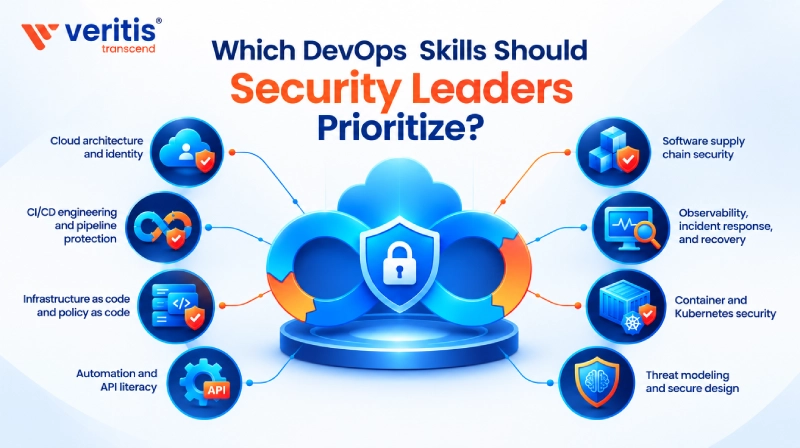
1) Cloud architecture and identity
Understand workload identities, permissions, network boundaries, encryption, secrets, and logging. Ask who can change production, whether access is limited to what is needed, and how sensitive changes are traced.
Veritis cloud consulting services can help organizations align infrastructure design, identity, and operational governance.
2) CI/CD engineering and pipeline protection
CI/CD defines how code is built, tested, packaged, and released. Security leaders should understand both:
a) Security within the pipeline: Code analysis, dependency checks, secrets detection, and configuration tests.
b) Security of the pipeline: Protection of repositories, build workers, credentials, artifact storage, and deployment permissions.
A pipeline that scans code but exposes production credentials to untrusted jobs remains at risk. NIST guidance on software supply chain security in DevSecOps pipelines treats source, dependencies, builds, artifacts, and deployment as connected parts of the delivery system. For Microsoft environments, see Azure DevOps services.
3) Infrastructure as code and policy as code
Infrastructure as code defines environments through version controlled configuration. Policy as code makes requirements enforceable through automated rules.
For example, a control against public access to sensitive storage can include a secure infrastructure template, a pre deployment check, monitoring for out of process changes, and an exception process with an accountable owner.
Automated checks handle defined conditions. They do not replace threat odelling or business context.
4) Automation and API literacy
Automation can enrich alerts with asset ownership, open remediation tickets, collect evidence, or connect an incident to a deployment. Before automating a response, confirm its trigger, permissions, failure handling, reversibility, and human approval requirements.
The leadership skill is knowing whether an automation has safe boundaries and an accountable owner.
5) Software supply chain security
These controls address different risks and should be evaluated together:
| Control | What it provides | What it does not prove |
| Software bill of materials (SBOM) | Inventory of software components | That every component is safe |
| Dependency scanning | Findings about known vulnerabilities | That the build process is uncompromised |
| Artifact signing | Link between an artifact and a signing identity | That the software has no vulnerabilities |
| Build provenance | Record of how an artifact was produced | That every input was trustworthy |
| Deployment verification | Enforcement of release requirements | That the rules cover every threat |
Review dependency sources, build isolation, artifact integrity, provenance, and deployment verification. NIST’s software supply chain guidance provides a framework for evaluating these controls.
6) Observability, incident response, and recovery
Connect production events to artifacts, configurations, identities, and deployment history. Recovery plans should also account for database changes, credentials, and dependencies. A cloud disaster recovery strategy should include tested recovery procedures, not only backups.
7) Container and Kubernetes security
Review approved base images, workload permissions, application identities, control plane protection, and network policies. Image scans do not establish that a deployed workload has safe permissions or behavior.
8) Threat modeling and secure design
Use threat modeling to identify sensitive data flows, trust boundaries, privileged actions, and abuse paths. NIST’s Secure Software Development Framework organizes practices around preparing the organization, protecting software, producing secure software, and responding to vulnerabilities.
How Do These Skills Improve Business Outcomes?
DevOps skills can help security leaders:
- Reduce remediation delays: Identify workflow bottlenecks, assign ownership, and support safe releases.
- Make secure delivery easier: Provide approved templates, credentials, checks, logs, and deployment workflows.
- Improve audit evidence: Connect review records, test results, deployment logs, and approvals.
- Connect investment to outcomes: Define who operates a tool, how findings are handled, and what risk or workflow it improves.
Veritis DevOps services connect delivery automation, infrastructure practices, and operational improvement.
How Should Leaders Govern Security Across Delivery Teams?
Define control ownership and escalation paths. Application teams should understand which findings they must fix, platform teams should maintain shared capabilities, and security should set thresholds and oversee risk exceptions.
Record each exception’s business justification, compensating controls, risk owner, and expiration date. For regulated workloads, work with compliance and legal teams to map technical controls to applicable requirements.
What Does Hiring and Compensation Evidence Show?
Robert Half’s 2026 US technology hiring outlook identifies DevSecOps, continuous integration, and automation workflows as valued competencies. It also reports that 65% of technology leaders said finding skilled professionals was harder than a year earlier.
This is a broad technology market finding, not a salary premium for security executives. When hiring, assess candidates’ ability to explain pipeline trust boundaries, evaluate infrastructure changes, and safely measure remediation.
How Much Technical Depth Does a Security Leader Need?
Aim for architectural fluency and selective practical experience.
| Role | Useful minimum capability |
| CISO or security executive | Evaluate delivery risks, assign ownership, and approve meaningful measures |
| Security director or architecture leader | Review identity models, pipeline designs, policies, and exceptions |
| Security engineering manager | Translate requirements into controls and guide integrations |
| Security engineer | Implement, test, troubleshoot, and maintain controls |
A useful test is whether a leader can follow an application from source to production and explain who can change it, what checks run, what authorizes release, and how the organization would investigate and recover from a bad change.
How Can Security Leaders Build DevOps Skills in 90 Days?
This is a suggested starting plan. Adjust it to the organization’s risk, staffing, and maturity.
Days 1 to 30: Map and measure
- Trace one important service from source through build, infrastructure, and deployment.
- Identify production access, controls, owners, and exceptions.
- Review a recent vulnerability and incident.
- Establish baseline measures.
Days 31 to 60: Improve one control
- Select a bounded improvement, such as replacing a stored deployment credential or checking infrastructure changes before release.
- Assign security, platform, application, and operations responsibilities.
- Test the control before making it a blocking requirement.
Days 61 to 90: Test and scale
- Exercise realistic failure scenarios.
- Verify detection, ownership, containment, and recovery.
- Review team feedback and operational impact.
- Expand the approach only after it works reliably.
How Can Leaders Measure Risk Reduction?
Use a balanced scorecard with a defined scope, data owner, and review cadence.
| Measure | What to track | Interpretation safeguard |
| Remediation performance | Time to fix exploitable production findings | Define when the clock starts and which findings qualify |
| Pipeline coverage | In scope services using supported controls | Confirm checks run and are not routinely bypassed |
| Artifact verification | Deployments subject to required verification | Measure enforcement, not just metadata generation |
| Identity exposure | Persistent credentials or excessive delivery permissions | Account for compensating controls and exceptions |
| Developer friction | Feedback time, manual waiting, and false positives | Ensure checks are actionable |
| Recovery readiness | Results of rebuild and response exercises | Distinguish tested recovery from documented plans |
Vulnerability counts alone are insufficient. Counts can rise when visibility improves or fall when coverage deteriorates. Pair them with delivery and recovery evidence.
Which Common Mistakes Undermine the Value?
- Adding scanners without remediation capacity.
- Blocking every high severity finding identically.
- Leaving control ownership and escalation unclear.
- Treating shared build infrastructure as inherently trusted.
- Automating high impact actions without recovery options.
- Expecting tools to replace human judgment.
Convert Security Intent into Operational Capability
DevOps skills help security leaders connect policy to the systems that change the business. Focus on repeatable, secure delivery; visible exceptions; and dependable recovery.
Book a consultation with Veritis to assess your delivery environment, identify capability gaps, and plan measurable security improvements.