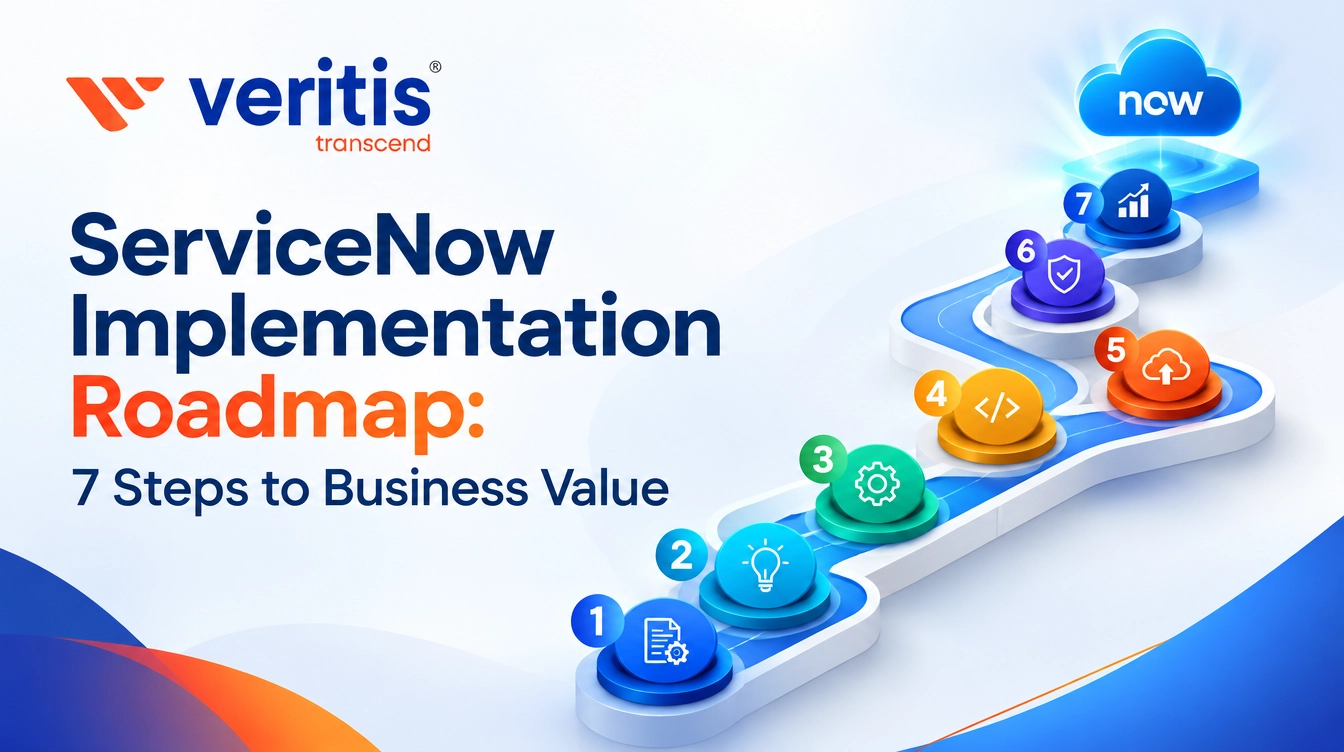
A ServiceNow implementation roadmap connects business priorities to sequenced releases, accountable owners, dependencies, and measurable outcomes. It helps leaders decide what to implement, how to prepare, and whether each release is delivering value.
Cost per request, service restoration time, and employee onboarding speed matter more than the number of workflows placed in production. A roadmap should define who owns each outcome and how you’ll measure improvement.
Optimize ServiceNow Implementation
What Should a ServiceNow Implementation Roadmap Include?
A roadmap is more than a deployment calendar or product list. It connects business outcomes, capabilities, dependencies, investment decisions, adoption, and operational readiness. A detailed project plan can translate those decisions into tasks and dates.
Keep the following elements visible throughout implementation:
| Roadmap Element | What to Document |
| Business outcomes | The problem, baseline, intended improvement, and benefit owner |
| Scope and sequencing | The workflows included in each release and what remains outside scope |
| Governance | Decision rights, approval responsibilities, and escalation routes |
| Dependencies | Required data, integrations, process decisions, and available resources |
| Readiness gates | Evidence needed to approve design, deployment, stabilization, and expansion |
| Adoption and support | Training, communications, operational ownership, and support arrangements |
| Value measurement | Metric definitions, reporting sources, review cadence, and corrective actions |
Update the roadmap when discovery changes the business case, a dependency affects sequencing, or production results indicate a better priority.
Set the Strategy Beyond ITSM
Start with business capabilities, not a product shopping list. ServiceNow’s implementation playbook recommends sequencing work according to business outcomes, process readiness, and data dependencies.
Consider capabilities such as IT Service Management for incidents and requests, IT Operations Management for service reliability, HR Service Delivery for employee cases, and Customer Service Management for customer fulfillment. Cross department workflows require shared ownership, not just shared software.
The distinction between business transformation and digital transformation matters: deploying a platform does not automatically change accountability, operating policies, or service performance.
Choose an initial workflow with a clear business problem, committed owners, usable data, available subject matter experts, and measurable success criteria. Avoid selecting scope only because a demonstration looks compelling.
Build the Roadmap in 7 Steps
ServiceNow’s Now Create framework uses Initiate, Plan, Execute, Deliver, and Close phases. The steps below add discovery and ongoing value measurement to that backbone.
1) Establish the Business Case
Document the problem, affected users, baseline, target, measurement period, and benefit owner. Include licensing, implementation, integration, training, support, and upgrade costs. Define metrics before delivery begins. For example, specify when fulfillment time starts and stops and how waiting periods are treated.
Gate: The sponsor approves the business case and discovery evidence.
2) Assign Ownership and Decision Rights
Name an executive sponsor, platform owner, process owners, data owners, and delivery lead. Clarify who approves process changes, accepts data quality, authorizes access, resolves integration failures, and signs off on business acceptance.
Gate: Approve scope, resources, decision rights, and escalation paths.
3) Prioritize Workflows and Design the Foundation
Rank workflows by measurable value, risk reduction, readiness, speed to value, and reuse. Define the complete user journey, including intake, routing, fulfillment, exceptions, closure, and measurement.
Identify security boundaries, environments, testing standards, required service relationships, and integrations. For each integration, record its owner, source of truth, access controls, failure handling, and support cost. Decide which data to migrate, clean, archive, or exclude.
Gate: Approve the backlog, design, dependencies, and acceptance criteria.
4) Configure and Demonstrate Outcomes
Deliver incrementally and demonstrate complete user journeys to business owners. Prefer standard capabilities. Require customization proposals to justify business value against maintenance and upgrade costs.
Prepare migration, support procedures, communications, and training alongside configuration. Record feedback as an accepted change, deferred request, or clarified requirement.
Gate: Owners accept the demonstrated scope and confirm readiness for validation.
5) Validate Business and Operational Readiness
Test integrations, migrated data, access permissions, exception paths, and performance requirements. Business users should complete realistic tasks during acceptance testing. Confirm cutover sequencing, recovery arrangements, support ownership, training, and acceptable defect thresholds.
Gate: Business and operational owners approve deployment and accept any remaining risks.
6) Deploy and Stabilize
Execute cutover, verify critical journeys, reconcile migrated records, and monitor production. Assign incident owners and escalation routes during hypercare. Prioritize defects that block work, compromise access, disrupt integrations, or affect data integrity.
Gate: Exit hypercare when stability criteria are met, and support teams can operate independently.
7) Measure Value and Authorize Expansion
Compare results with the original baseline. Track adoption, successful task completion, abandonment, user effort, cycle time, and cost per completed transaction. Review results alongside demand, case complexity, and other business changes.
Maintain an improvement backlog and assign a continuing benefit owner. Use operational data and user feedback to decide whether to continue, correct, scale, or retire a workflow. Where appropriate, connect ongoing operations with Veritis managed IT services.
Gate: Approve expansion only when value and operational health are demonstrated.
What Should a Roadmap Release Record Include?
Use one record per release, supported by evidence rather than lengthy status narratives. Include the outcome and scope, baseline and target, accountable owners, data and integration dependencies, delivery forecast, funding, acceptance evidence, operational handover, and value review date.
For an employee onboarding workflow, the outcome might be having approved equipment and access ready by the employee’s start date. Identify the HR data dependency, IT fulfillment owner, access approval authority, and exception process for a changed start date. Set targets from your own baseline.
How Do You Plan Timeline and Budget?
Build the timeline from scope and dependencies instead of applying a generic duration. Confirm process readiness, data quality, integration access, delivery capacity, user training, change restrictions, and recovery needs before committing to a date. If the date cannot move, make scope tradeoffs explicit. Do not compress validation or leave operational ownership unresolved.
Budget for establishing and operating the capability. Include subscriptions, discovery, configuration, integrations, data cleanup, internal staff time, training, cutover, hypercare, administration, upgrades, and ongoing support. Separate initial costs from recurring costs.
For ROI, compare finance approved benefits with total investment over the same period. Do not count the same saved time as both labor savings and additional capacity unless finance approves that treatment.
What Does a Practical ServiceNow Roadmap Template Look Like?
Use one roadmap record per release, with linked evidence rather than lengthy status narratives. The following template makes the investment decision visible without replacing the detailed project plan.
| Field | What the Release Record Should Contain |
| Outcome and scope | Business problem, affected users, included journeys, and exclusions |
| Baseline and target | Current result, intended improvement, metric definition, and reporting source |
| Accountability | Benefit owner, process owner, delivery lead, and approval authority |
| Foundation | Required data, service relationships, access controls, and integrations |
| Delivery forecast | Planned sequence, dependency dates, confidence level, and constraints |
| Funding | Approved implementation budget, recurring costs, and contingency assumptions |
| Acceptance evidence | Test results, reconciliations, training readiness, and accepted risks |
| Operational handover | Support owner, recovery procedures, documentation, and hypercare exit criteria |
| Value review | Review date, observed results, corrective actions, and expansion decision |
For an employee onboarding release, the outcome might be having approved equipment and access ready by the employee’s start date. The record should identify the HR data dependency, IT fulfillment owner, access approval authority, and exception path when a start date changes. Set the target from your baseline rather than copying another organization’s goal.
How Should Security, Data, and Adoption Shape the Roadmap?
Address security and data requirements during discovery and design. Identify the information each workflow handles, required access, audit evidence, and relevant regulatory obligations. Define roles, privileged access, service account ownership, and access removal procedures.
The Configuration Management Database (CMDB) stores configuration information and relationships. The Common Service Data Model (CSDM) offers guidance for organizing service related data. Use the workflow to determine which records and relationships are needed. Assign authoritative sources and quality checks instead of trying to populate every possible record before delivering value. For operational use cases, assess dependencies discussed in ServiceNow AIOps.
Adoption means users complete work through the new process, not merely attend training. Test representative tasks with users, then review completion, abandonment, support demand, and work still handled through email or spreadsheets. A confusing intake form or unnecessary approval may require process changes rather than more training.
How Do You Budget for ServiceNow Implementation?
Budget for the cost of establishing and operating the capability, not just configuring the first release. Separate initial investment from recurring expenditure so finance leaders can evaluate both affordability and sustained value.
Validate commercial assumptions against your actual agreement and proposed scope. Record the assumptions behind contingency, especially unresolved data quality, integration complexity, and customization decisions. A single implementation price without these boundaries is not a reliable basis for comparison.
For financial evaluation, calculate ROI as net financial benefit divided by total investment, multiplied by 100, using the same evaluation period for both. Include only benefits that finance accepts as attributable and avoid counting the same saved time as both labor savings and additional productive capacity.
| Cost Category | Questions to Resolve Before Approval |
| Subscriptions and entitlements | Which products, user types, environments, and usage terms are required? |
| Discovery and delivery | What process design, configuration, architecture, and project management effort is needed? |
| Data and integrations | Who funds cleanup, migration, interface development, and external system changes? |
| Internal capacity | How much time must process owners, reviewers, security teams, and support staff commit? |
| Adoption and transition | What training, communications, cutover support, and hypercare are required? |
| Ongoing operation | Who funds administration, monitoring, improvements, testing, and upgrades? |
Avoid Common Implementation Mistakes
1) Unclear Business Goals: Require an outcome, baseline, target, and owner before funding features.
2) Weak Governance: Clarify decision authority and maintain a record of decisions, exceptions, owners, and deadlines.
3) Excessive Customization: Simplify ineffective processes before automating them and document the lifecycle cost of exceptions.
4) Neglecting the CMDB: Assign data stewards and quality thresholds for the records the workflow needs.
Choose a Partner for Transferable Capability
Assess implementation partners on process design, architecture, integration delivery, adoption, and operational handover, not configuration capacity alone. Ask how they demonstrate business acceptance, control customization, transfer knowledge, and prepare internal teams to manage future releases.
External support does not replace internal ownership of business outcomes, data quality, access decisions, or ongoing funding.
Conclusion
The strongest roadmap is not the one with the most modules. It connects each investment decision to evidence of better business performance. Before funding the next release, confirm that the current workflow is stable, owners can explain the results, and the next use case has the necessary foundations.
Talk to Veritis to assess your ServiceNow environment and define a practical roadmap for implementation and sustained value.