Table of contents
- What is Fraud Risk Management?
- The Fraud Risk Management Process
- Fraud Risk Management Stages
- What is Financial Risk Management Software?
- Who Uses Financial Risk Management Software?
- Types of Financial Risk Management Software
- Key Features That Define Effective Platforms
- How Financial Risk Management Software Mitigates Fraud?
- Business Benefits
- How to Choose the Right Software?
- Investigating Bank Manager Fraud
- Modern Banking Fraud Examples
- Conclusion
Fraud doesn’t announce itself. It exploits gaps, adapts to controls, and compounds quietly until the damage is undeniable. For CFOs, CIOs, and enterprise risk leaders across the banking and financial sectors, the question is not about whether to invest in financial risk management software; it’s whether the platform you have is actually stopping losses or just logging them.
This article covers how modern financial risk management software works, what capabilities separate effective platforms from checkbox tools, and how to make a defensible selection decision.
What is Fraud Risk Management?
Fraud risk management is the structured discipline of detecting, preventing, and responding to fraudulent activity across an organization’s financial ecosystem.
It has evolved well beyond manual review. Today, it means integrating machine learning, behavioral analytics, and real time risk assessment to proactively identify fraud vectors before losses materialize proactively. In banking, that means anti fraud systems capable of a 360 degree view of every transaction, flagging insider fraud, account takeover, and unauthorized transfers in milliseconds rather than days.
Critically, fraud risk management cannot sit in a single department. Legal, commercial, and operational teams all generate fraud exposure. A robust program spans all of them, builds proactive case management plans, and continuously refines controls based on emerging threat patterns.
Schedule a Fraud Risk Assessment
The Fraud Risk Management Process

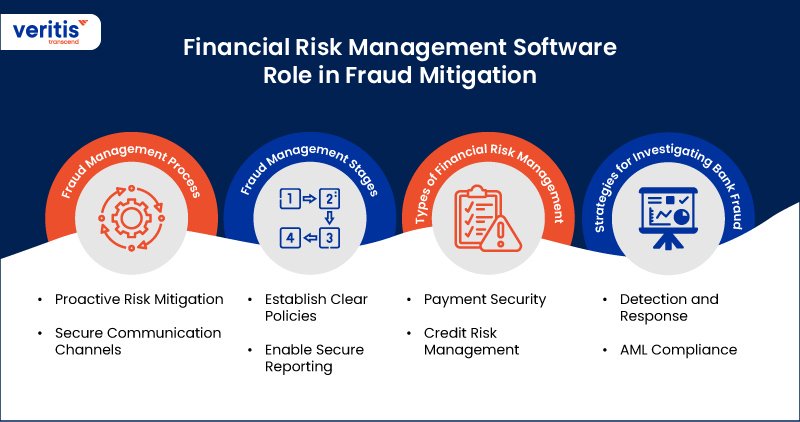
1) Proactive Risk Mitigation
Deploy advanced solutions that identify and address security threats before they become losses, not after.
2) Streamlined Process Oversight
Enhance monitoring across all organizational processes to compress detection time and accelerate response to anomalies.
3) Secure Communication Channels
Establish confidential internal reporting channels so fraud incidents surface quickly and are acted on without fear of retaliation.
4) Comprehensive Fraud Investigation
Conduct thorough, evidence based investigations using a 360 degree approach, transaction records, access logs, and behavioral data all in scope.
5) Action Plan Follow Up
Monitor the effectiveness of corrective actions continuously. Fraud tactics evolve; so must the controls designed to stop them.
Fraud Risk Management Stages
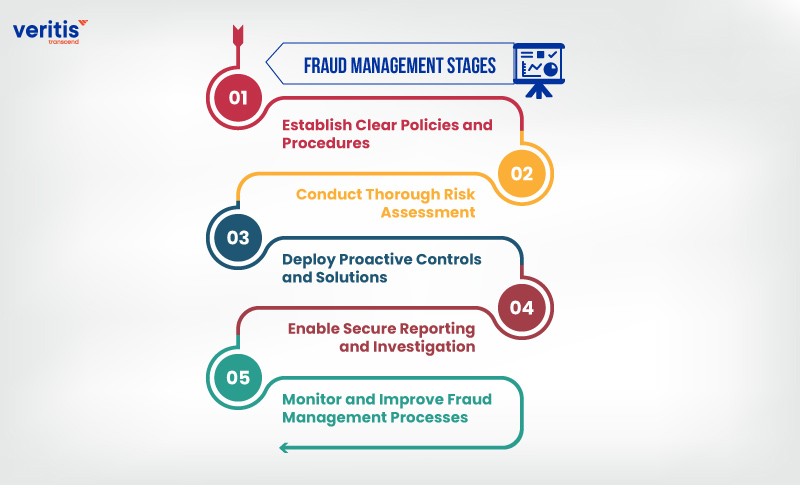
1) Establish Clear Policies and Procedures
Define fraud management policies as part of corporate governance. Align detection, reporting, and response procedures with regulatory requirements and industry standards.
2) Conduct Thorough Risk Assessment
Run ongoing assessments using data analytics, risk scoring models, and fraud intelligence feeds. Prioritize the vulnerabilities with the highest exposure. Pairing this with a structured identity and access management risk assessment surfaces insider threats that transaction monitoring alone may miss.
3) Deploy Proactive Controls and Solutions
Implement both preventive and detective controls. AI driven anomaly detection, real time monitoring, and transactional analysis should work in concert, not in silos.
4) Enable Secure Reporting and Investigation
Protect whistleblowers. Ensure every report triggers a structured investigation involving internal audit, legal, and, where required, law enforcement.
5) Monitor and Improve Continuously
Track KPIs across fraud detection rate, mean time to resolution, and false positive rate. Update strategies as new fraud patterns emerge.
Useful Link: Cybersecurity Automation Tools for Enterprise SOCs
What is Financial Risk Management Software?
Financial risk management software refers to sophisticated digital platforms designed to analyze, evaluate, and mitigate the full spectrum of financial risks an organization faces, from market volatility and credit default to operational disruption and regulatory noncompliance.
These platforms aggregate data from disparate sources, model risk exposures across business lines, and surface actionable intelligence in real time. Core capabilities typically include risk identification and scoring, scenario simulation, compliance and regulatory support, portfolio risk management, real time monitoring and alerting, and integration with enterprise data analytics stacks.
For fraud mitigation specifically, the software acts as both a detection engine and a response orchestration layer, identifying suspicious activity and routing it through a defined workflow before losses escalate.
Understanding future trends shaping IT financial management is also essential context: AI driven automation, cloud native architectures, and real time data lakes are reshaping what these platforms can deliver.
Who Uses Financial Risk Management Software?
Banks, insurers, and investment managers are the obvious users. But the software’s relevance extends across any enterprise with material financial exposure: healthcare systems managing reimbursement fraud, retailers combating payment fraud at scale, and manufacturers protecting against procurement irregularities.
The common denominator is complexity; organizations with high transaction volumes, distributed operations, or significant regulatory obligations gain the most from systematic, software driven risk management.
Connect with Our Risk Specialists
Types of Financial Risk Management Software
1) Payment Security Solutions
Mitigate payment fraud by ensuring transaction integrity, liquidity management controls, and real time authorization decisioning.
2) Investment Risk Analysis Tools
Manage portfolio level exposure across asset classes and security types. Scenario modeling supports informed decisions under market stress.
3) Credit Risk Management Platforms
Assess counterparty creditworthiness, monitor credit exposures in real time, and automate early warning triggers before default risk escalates.
4) Fraud Prevention and Detection Solutions
The most directly relevant category for this discussion. These platforms use advanced algorithms and data analytics to detect suspicious transactions, unauthorized account activity, and behavioral anomalies, protecting organizations from direct financial loss and reputational damage.
5) Compliance Management Systems
Manage regulatory risk: AML, KYC, insider trading controls, and employee conflict of interest monitoring. Native SAR generation and audit trail capabilities significantly reduce the manual compliance burden. Financial institutions that have not yet aligned identity governance and administration with their compliance management systems carry outsized regulatory exposure.
Key Features That Define Effective Financial Risk Management Software
Not all platforms are created equal. When evaluating tools against fraud mitigation as the primary objective, senior leaders should look past feature checklists and focus on the capabilities that materially reduce loss exposure.
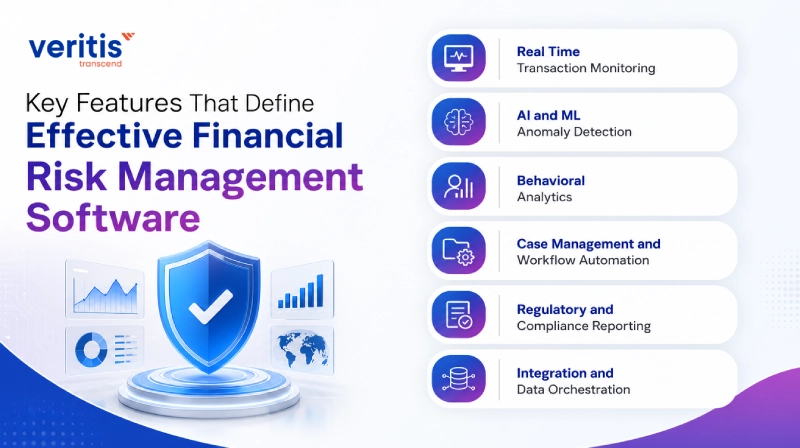
1) Real Time Transaction Monitoring
The window between a fraudulent event and its detection is where losses compound. Systems that score transactions in milliseconds, rather than in overnight batch runs, stop fraud before funds leave the institution.
2) AI and ML Anomaly Detection
Rules based engines catch known patterns; adopting machine learning models catches the ones that haven’t been seen yet. Adaptive models retrain continuously on new data to keep pace with fraudsters who deliberately probe static thresholds.
3) Behavioral Analytics
Device fingerprinting, geolocation, keystroke cadence, and login patterns build a baseline for each customer. A deviation triggers scrutiny even when valid credentials are used, a critical defense against account takeover fraud.
4) Case Management and Workflow Automation
Detection is only half the job. Structured case queues, evidence capture, and audit trails turn an alert into a defensible investigation and, where required, a regulatory filing.
5) Regulatory and Compliance Reporting
Native AML, KYC, and SAR generation reduces manual effort and the risk of missed regulatory deadlines.
6) Integration and Data Orchestration
Fraud rarely lives in one system. APIs that unify core banking, payments, CRM, and third party intelligence feeds give investigators a single, correlated view of risk. This need for unified access reinforces why the financial sector depends on robust Identity and Access Management; without it, even the best fraud platform operates with blind spots.
Useful Link: Cybersecurity for Manufacturing: A Strategic Guide to Protecting Industrial Operations
How Financial Risk Management Software Mitigates Fraud?
The value of these platforms is best understood through the fraud lifecycle, from the moment a threat emerges to the point it is resolved and prevented from recurring.
1) Prevention
Multi factor authentication, transaction velocity limits, and synthetic identity checks stop many attacks at the perimeter. Consortium data sharing flags applications that would pass a single institution review but show suspicious patterns across the industry.
2) Detection
Machine learning models evaluate hundreds of signals per transaction, assigning a risk score in real time. Organizations that deploy proactive anti fraud analytics consistently detect fraud faster and recover more of their losses than those relying on manual review, a significant gap given that the median fraud case runs undetected for roughly 12 months before discovery (Association of Certified Fraud Examiners).
3) Response
When a high risk event surfaces, automated workflows quarantine the transaction, notify the customer, and route the case to an analyst with the full evidence trail already assembled. This compresses response time from hours to minutes.
4) Continuous Learning
Every resolved case refines the model. Confirmed fraud sharpens detection thresholds; false positives are tuned out, reducing customer friction while maintaining coverage.
5) Practical illustration
A mid sized US commercial bank facing rising account takeover attempts layers behavioral analytics over its existing rules engine. The system distinguishes a legitimate customer traveling abroad from an attacker using stolen credentials, approving the first automatically, blocking the second, without manual review of either. Fraud loss falls. Customer friction falls with it.
Business Benefits of Financial Risk Management Software
For a CFO or CIO, the investment case comes down to measurable outcomes.
- Reduced Fraud Losses: Faster detection directly lowers the dollar value that leaves the organization per incident.
- Lower Operational Cost: Automation shrinks analyst hours spent triaging false positives, freeing skilled staff for genuine threats.
- Stronger Regulatory Posture: Automated AML and SAR workflows reduce the risk of fines and consent orders, costs that frequently dwarf the fraud losses themselves.
- Improved Customer Trust: Fewer wrongly declined transactions and faster fraud resolution protect the customer relationships that drive long term revenue.
- Scalability: Cloud native platforms absorb transaction volume growth without a proportional increase in headcount, a critical advantage during digital expansion or post merger integration.
Organizations scaling into cloud based financial services environments should also factor in the key benefits of cloud financial services when building a total cost of ownership model for their risk platform investment.
How to Choose the Right Financial Risk Management Software?
Selection should map to your risk profile, not a vendor’s roadmap. Five disciplined questions keep the evaluation grounded:
1) What is our dominant fraud vector? Payment fraud, account takeover, and insider fraud demand different detection architectures.
2) Does it integrate with our core systems? A platform that cannot ingest data from core banking, payments, and CRM will operate with blind spots.
3) How adaptive are the models? Ask how frequently models retrain and whether the vendor supports custom rules alongside machine learning.
4) Can it prove compliance? Confirm native support for every regulatory regime you operate under, and the auditability of every decision the system makes.
5) What is the total cost of ownership? License fees are the smallest component. Weigh implementation, tuning, and ongoing model governance.
This is where a delivery partner earns its place. Veritis’s technology advisory services and managed services help enterprises pressure test these decisions, integrate fraud platforms with legacy environments, and operationalize them so detection actually translates into prevented loss, not more alerts.
Useful Link: How Cloud Security Posture Management Tools Improve Regulatory Compliance?
Strategies for Investigating Bank Manager Fraud
Insider fraud, particularly involving privileged users such as branch or relationship managers, represents one of the highest risk scenarios for financial institutions. The combination of access, authority, and trust makes it both damaging and difficult to detect.
1) Immediate Detection and Response
Real time monitoring flags transaction anomalies, unusual account access patterns, or authorization overrides that fall outside a manager’s documented role. Automated alerts trigger investigation before funds are moved.
2) Thorough Investigation Process
Gather digital evidence, analyze transaction records, review access logs, and interview relevant personnel. A structured investigation protocol ensures nothing is overlooked and that evidence remains admissible.
3) Collaboration With Internal and External Experts
Internal audit, legal, forensic specialists, and, where thresholds are met, law enforcement all contribute. External forensic accountants bring impartiality that internal teams alone cannot provide.
4) AML Compliance and Controls
AML frameworks, KYC processes, transaction monitoring, and SAR obligations form the backbone of insider fraud detection. They impose structure on what would otherwise be judgment calls, and they create the paper trail regulators expect.
5) Digitalization and Fraud Prevention Solutions
AML compliant digital identity verification, machine learning for behavioral pattern recognition, and integrated fraud management platforms all reduce the window in which insider fraud can operate undetected.
Modern Banking Fraud: Key Examples
Fraud tactics evolve continuously. The following represent the most prevalent threats financial institutions face today.
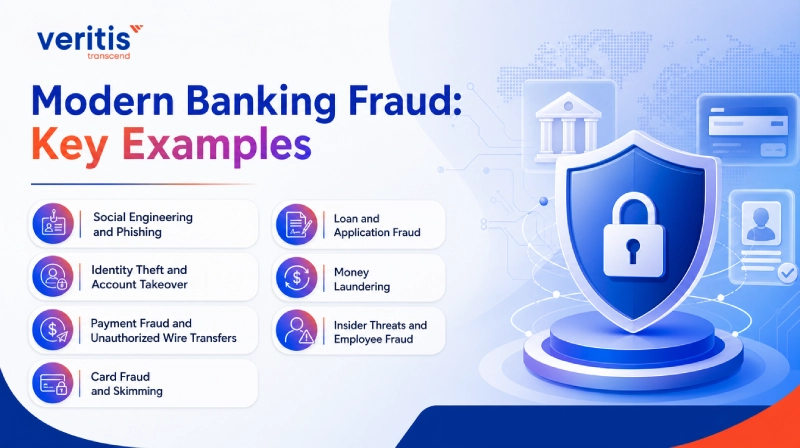
1) Social Engineering and Phishing
Fraudsters impersonate institutions or trusted contacts via phone, email, or SMS to extract credentials or trigger unauthorized transfers. Vishing (voice phishing) attacks targeting wire transfer approvals have grown substantially.
2) Identity Theft and Account Takeover
Stolen or synthetic identities are used to open accounts or seize control of existing ones. Account takeover is particularly damaging because the attacker uses valid credentials, defeating basic authentication controls.
3) Payment Fraud and Unauthorized Wire Transfers
Business email compromise (BEC) manipulates payment authorization workflows to redirect high value transfers. A single successful BEC attack at an enterprise level can run into seven figures.
4) Card Fraud and Skimming
Physical skimming at ATMs and POS terminals continues alongside card not present fraud for online transactions, an increasingly dominant attack surface as e-commerce volumes grow.
5) Loan and Application Fraud
Synthetic identities, fabricated from a mix of real and invented data, pass standard verification and obtain credit lines before disappearing. Detection requires consortium level data sharing that no single institution can replicate alone.
6) Money Laundering
Illicit funds are layered through legitimate looking transactions to obscure their origin. Financial risk management platforms with AML capabilities are the primary institutional defense.
7) Insider Threats and Employee Fraud
Privileged employees embezzle, manipulate records, or facilitate external fraud using their system access. Behavioral analytics and robust risk mitigation strategies that account for insider threat vectors are essential countermeasures.
Veritis in Practice: Risk Mitigation and Operational Visibility
Veritis partnered with a leading energy company to implement a comprehensive suite of advanced technology solutions, enhancing operational transparency, safeguarding sensitive data, and building proactive threat detection into core infrastructure. The engagement aligned IT systems with business risk objectives through modern infrastructure, intelligent monitoring, and real time data analysis.
Outcomes included significantly improved anomaly detection, reduced risk exposure, and sustained regulatory compliance, capabilities directly transferable to financial sector fraud management. This engagement illustrates how Veritis builds risk aware ecosystems that protect both data and operations.
Get Started with Fraud Risk Management
Conclusion
Fraud is not a compliance problem to be managed at the margins; it is a strategic risk that erodes capital, reputation, and customer trust simultaneously. Financial risk management software is the infrastructure that converts threat intelligence into prevented loss: real time monitoring stops fraud in flight, machine learning catches what rules miss, and automated workflows turn detection into resolution without burning out your analyst team.
The organizations that reduce fraud losses most effectively are not necessarily the ones with the largest security budgets. They are the ones that have selected platforms matched to their specific risk profile, integrated them with authoritative data sources, and operationalized them with disciplined governance.
If your current platform is generating alerts without reducing losses, the gap is usually integration, tuning, or governance, not technology. That is precisely where Veritis, recognized through the Stevie and Globee Business Awards for excellence in technology and innovation, closes the distance between a software deployment and a measurable risk outcome.
Ready to assess your fraud risk posture? Talk to a Veritis expert to discuss where your current controls fall short and what a targeted improvement roadmap looks like for your organization.