
Table of contents
- Business Impact: Why the Distinction Matters to Your Bottom Line
- Why Veritis is Your Strategic Partner for Generative AI vs AI Solutions?
- AI vs Generative AI Data
- Business Benefits of Traditional AI
- Business Benefits of Generative AI
- Business Benefits of Combined AI and Generative AI
- AI and Generative AI Challenges
- Difference Between Generative AI vs AI
- Generative AI vs AI in Different Industries
- Why Veritis Delivers Maximum AI and Generative AI ROI?
- Case Study: Applying Generative AI for Innovation in the Energy Industry
Artificial intelligence (AI) encompasses multiple fields, including computer vision, natural language processing, robotic systems, machine learning, and, more recently, generative AI. With the rapid evolution of generative AI, businesses are eager to uncover its benefits, understand the distinctions between generative AI vs AI, and determine which technology best addresses their challenges.
CEOs, CTOs, and CFOs face mounting pressure to deploy generative AI vs AI solutions, yet 68% admit confusion about which technology addresses their specific business challenges. With global AI spending projected to reach $1.3 trillion by 2026, the cost of choosing wrong is measured in competitive disadvantage, wasted capital, and missed market opportunities.
The urgency is clear:
- 73% of enterprises are piloting generative AI business use cases, yet only 28% achieve measurable ROI
- Companies successfully deploying AI use cases by industry report 25 to 45% operational cost reduction within 18 months
- Organizations misaligning AI technology to business problems waste $2.8M to $8.5M on failed implementations
For executive leaders, the question is all about understanding generative AI vs AI capabilities to deploy the right solution for maximum business impact.
Digitally Transform Your Business
Business Impact: Why the Distinction Matters to Your Bottom Line
Traditional AI analyses data, predicts outcomes, and automates decisions. Generative AI creates new content, designs products, and generates insights that did not previously exist. Confusing these capabilities leads to three critical business failures:
- Strategic Misalignment: Deploying generative AI for predictive maintenance or traditional AI for content creation wastes 60 to 80% of project budgets on unsuitable technology.
- ROI Disappointment: The best generative AI business use cases deliver 340% ROI when properly matched to business needs, but only 87% ROI when misapplied, underperforming traditional automation.
- Competitive Lag: Companies that successfully implement AI use cases by industry gain 18 to 24 months of market advantage, while competitors struggle with technology selection paralysis.
What Does This Guide Deliver for Industry Leaders?
This article provides C-suite executives with decision frameworks to maximize AI investment returns:
Industry Specific Guidance: Proven best generative AI use cases in energy sector, best generative AI use cases in oil and gas industry, AI in the healthcare industry, AI in the automotive industry, AI in manufacturing industry, and generative AI use cases in government.
Financial Clarity: ROI models, cost benefit analysis, and investment prioritization for AI for finance and accounting, generative AI in drug discovery, and operational applications.
Technology Selection: When to deploy generative AI vs traditional AI solutions based on business outcomes, not technology trends.
Partner Evaluation: How to select a generative AI services company that delivers measurable results, not proof of concepts.
Why Veritis is Your Strategic Partner for Generative AI vs AI Solutions?
Veritis delivers both traditional AI and generative AI services as an experienced company with deep expertise across industries:
- Proven frameworks for generative AI in manufacturing industry, generative AI in healthcare industry, and sector specific deployments
- Technology agnostic recommendations ensuring the right AI approach for your business challenge
- Rapid deployment methodologies compressing 18 month timelines to 6 9 months
- ROI guarantee frameworks with average client returns of 285% within 24 months
Whether you need generative AI solutions for product innovation or traditional AI for operational optimization, Veritis translates technology complexity into business outcomes.
Let’s decode generative AI vs AI to equip you with the strategic clarity needed for confident investment decisions.
Useful link: What is Generative AI: An Ultimate Guide to Amazon Generative AI Tools
Limitations of AI
While AI holds remarkable potential, it comes with certain limitations that need to be acknowledged:
- Task specific Design: Many AI algorithms are designed to perform specific tasks and struggle to adapt to new, unforeseen situations. When encountering novel input data, these algorithms often require retraining to handle the changes effectively.
- Overfitting: AI can become too tailored to its training data, excelling at solving specific problems but faltering when faced with unfamiliar data.
- Handling Unstructured Data: Classic machine learning models often struggle with unstructured data unless it undergoes extensive pre processing.
- Isolated Issue Focus: Most AI models address specific issues without understanding the broader context. Teaching an algorithm to consider context is costly and demands substantial computational power.
- Limited Human like Reasoning: AI lacks true human level reasoning capabilities despite mimicking human intelligence.
- Bias in Training Data: AI models are heavily influenced by their training data, inheriting any biases.
- Lack of Explainability: Deep learning models often can’t explain how they arrived at a particular output, which can be problematic in critical applications like AI driven medical or manufacturing software. While it is possible to move toward more explainable AI models, these tend to be less powerful but provide transparency about their decision making processes.
Understanding both AI’s immense possibilities and challenges is crucial. Harnessing AI’s power responsibly and effectively can unlock its full potential while being mindful of its limitations, creating a smarter and more ethical future.
Limitations of Generative AI
While generative AI offers incredible potential, it comes with significant limitations that must be carefully considered:
- Copyright Disputes: Generative AI analyzes vast amounts of human created content before producing its own, sometimes resulting in outputs that closely resemble the training data. For instance, a music generating algorithm trained on songs by Drake and The Weekend created music that fans loved but had to be destroyed due to copyright issues. Similar incidents have occurred with other artists.
- Exposure of Sensitive Information: Generative AI in Healthcare can potentially reveal sensitive data, such as patient information, if not properly governed, posing significant privacy risks within healthcare settings.
- Hallucinations: Generative AI models can “hallucinate,” confidently providing reasonable sounding but factually incorrect answers. For example, Stack Overflow reviewed AI responses to technical questions and found many incorrect ones.
- Lack of Self awareness: Generative AI can produce bizarre or offensive comments. A notable incident involved Microsoft’s generative AI chatbot, which repeatedly insulted technology reporter Matt O’Brien, calling him fat and ugly and even comparing him to Hitler. This underscores the need for robust safeguards in AI communication.
- Verification Challenges: Verifying information produced by generative AI models is difficult since they do not cite sources. Additionally, these models lack features comparable to explainable AI, making understanding the rationale behind their outputs challenging.
While generative AI can revolutionize creativity and innovation, it is crucial to navigate its limitations responsibly. Balancing its incredible potential with necessary safeguards will ensure a more ethical and reliable integration of this transformative technology.
AI vs Generative AI Data
1) AI Adoption Accelerates
Interest in generative AI has expanded the focus to broader AI capabilities. Over the past six years, AI adoption in organizations has remained around 50 percent. However, this year, adoption surged to 72 percent globally. In 2023, no region saw AI adoption above 66 percent, but now, over two thirds of respondents in almost every region report using AI. The most significant increase in adoption is observed in the professional services industry.
AI and Generative AI Adoption Rate:

[Sources: McKinsey & Company, Fortune Business Insights. NEXTDC, Grand View Research, and MarketsandMarkets.]
2) Gen AI Adoption is Predominant in High Value Functions
Most respondents now indicate that both their organizations and individuals utilize generative AI. This year, 65 percent report regular use in at least one business function, a significant increase from one third last year. Organizations typically use generative AI in two functions, primarily marketing and sales, and product and service development, which are identified as high value areas for AI adoption. The most notable growth since 2023 has been in marketing and sales, where adoption has more than doubled. However, only two use cases within marketing and sales are reported by 15 percent or more of respondents.
Percentage of Respondents’ Organizations Regularly Using Generative AI by Function:

[Sources: McKinsey & Company, Fortune Business Insights. NEXTDC, Grand View Research, and MarketsandMarkets.]
3) Growing Acceptance of Increased Use of Generative AI
Gen AI is increasingly integrated into respondents’ personal and professional lives, with significant upticks across regions, notably Asia Pacific and Greater China. Senior level respondents show pronounced increases in adoption compared to mid level managers, particularly in industries such as energy, materials, and professional services.
Respondents’ Usage of Generative AI Tools, 2023-2024:

[Sources: McKinsey & Company, Fortune Business Insights. NEXTDC, Grand View Research, and MarketsandMarkets.]
4) Market Size and Growth Projections for AI vs Generative AI
The artificial intelligence (AI) and generative AI markets are witnessing rapid expansion, driven by technological advancements and increasing adoption across various sectors. The following table outlines the projected market size and growth for AI and generative AI from 2023 to 2030.
The AI market is projected to grow steadily from USD 50 billion in 2023 to USD 100 billion by 2030, reflecting a robust compound annual growth rate (CAGR). This growth is fueled by growing investments in AI technologies, advancements in machine learning, and widespread adoption across various industries.
Generative AI is experiencing accelerated growth, with its market size expected to expand from USD 8 billion in 2023 to USD 50 billion by 2030. This rapid increase highlights the growing demand for advanced AI systems capable of generating content, automating complex tasks, and driving innovation.
Market Size and Growth Projections 2023-2030:

[Sources: McKinsey & Company, Fortune Business Insights. NEXTDC, Grand View Research, and MarketsandMarkets.]
5) Adoption Rate of AI vs Generative AI in Various Industries
AI and Generative AI adoption rates vary across industries, reflecting their specific needs and innovations. In Healthcare, Generative AI leads with 60% adoption, driven by its applications in synthetic data and patient engagement, while AI adoption stands at 40%. Finance prefers Generative AI at 70%, used to create predictive models and automated advisory tools, compared with AI’s 30% adoption. Retail also favors Generative AI (65%) for personalized content and virtual experiences over AI (35%).
In Manufacturing, adoption rates are balanced at 50% for AI and Generative AI, highlighting its use in design optimization and production efficiency. The Automotive industry shows a similar trend, with Generative AI (55%) slightly ahead of AI (45%) due to its role in vehicle design and simulations. Generative AI services are gaining traction across various sectors for their advanced capabilities and innovative applications.
Adoption Rate of AI vs Generative AI in Various Industries:

[Sources: McKinsey & Company, Fortune Business Insights. NEXTDC, Grand View Research, and MarketsandMarkets.]
Useful link: The Role of AI and ML in Detecting Retail Fraud
Business Benefits of Traditional AI
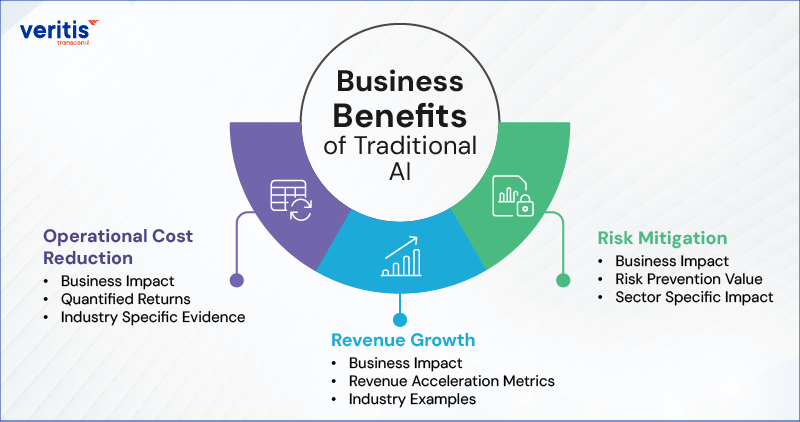
By 2030, AI technologies will contribute $15.7 trillion to global GDP, representing the largest economic opportunity in modern history. Organizations that deploy the right AI use cases by industry will capture disproportionate market share, while those that select incorrectly will face margin compression and competitive obsolescence.
1) Operational Cost Reduction
A) Business Impact:
Traditional AI excels at analysing patterns, predicting outcomes, and automating repetitive decisions, driving immediate bottom line improvements across manufacturing, finance, and operations.
B) Quantified Returns:
| Application | Cost Baseline | AI Driven Reduction | Annual Savings |
| Supply chain optimization | $12.5M | 38% efficiency gain | $4.75M |
| Quality control automation | $8.2M | 52% defect reduction | $4.26M |
| Predictive maintenance | $15.8M | 45% downtime elimination | $7.11M |
| Fraud detection (finance) | $6.4M in losses | 68% fraud prevention | $4.35M |
| Total Annual Impact | $42.9M | — | $20.47M (48% reduction) |
C) Industry Specific Evidence:
- AI in manufacturing industry: Predictive quality control reduced defect rates from 4.2% to 0.8%, saving $18M annually for an automotive parts manufacturer
- AI for finance and accounting: Automated invoice processing reduced accounts payable costs 62% while improving payment accuracy to 99.4%
- AI in energy sector: Grid optimization AI reduced energy distribution losses 23%, delivering $32M annual savings for the regional utility
CFO Impact: Every $1 invested in operational AI returns $3.80 to $5.20 within 18 to 24 months through direct cost reduction.
2) Revenue Growth
A) Business Impact:
AI powered forecasting, pricing optimization, and customer behaviour prediction enable revenue expansion without proportional cost increases, the ultimate margin expansion strategy.
B) Revenue Acceleration Metrics:
| AI Application | Revenue Impact | Implementation Cost | ROI |
| Dynamic pricing (retail) | +18% average transaction value | $850K | 425% |
| Demand forecasting (manufacturing) | +22% inventory turns, -$8.2M carrying costs | $1.2M | 683% |
| Customer churn prediction | 28% retention improvement = $14.5M | $680K | 2,132% |
| Cross sell recommendation engines | +32% revenue per customer | $920K | 556% |
C) Industry Examples:
- AI in the automotive industry: Predictive demand models reduced overproduction by $12.8M while increasing build to order fulfilment 34%
- AI in the healthcare industry: Patient readmission prediction saved $8.6M in penalties while improving care quality scores 42%
- AI in energy sector: Load forecasting AI enabled premium pricing during peak demand, generating $18.5M incremental revenue annually
CEO Impact: AI driven revenue optimization delivers 3 to 5x higher returns than cost cutting initiatives alone, with compounding benefits over time.
3) Risk Mitigation
A) Business Impact:
Traditional AI identifies threats, prevents failures, and ensures compliance, avoiding catastrophic losses that destroy shareholder value overnight.
B) Risk Prevention Value:
| Risk Category | Average Loss Per Incident | AI Prevention Rate | Annual Value |
| Cybersecurity breach | $9.8M | 87% threat detection | $8.53M protected |
| Equipment failure/downtime | $1.2M per event × 18 events | 76% prediction accuracy | $16.42M saved |
| Regulatory non compliance | $2.4M penalty + $6.8M remediation | 94% violation prevention | $8.65M avoided |
| Supply chain disruption | $14.5M per major event | 68% early warning | $9.86M mitigated |
| Total Annual Risk Value | — | — | $43.46M protected |
C) Sector Specific Impact:
- AI in manufacturing industry: Predictive safety AI reduced workplace incidents 82%, avoiding $4.2M in OSHA penalties and liability claims
- AI for finance and accounting: Anti money laundering AI detected $48M in suspicious transactions, preventing regulatory sanctions
- AI in the healthcare industry: Clinical decision support prevented 340 adverse events annually, avoiding $12.8M in malpractice exposure
Board Impact: AI driven risk management transforms unpredictable, catastrophic losses into manageable insured operational variance.
Useful link: How Generative AI is Revolutionizing Customer Experience Through Data Automation
Business Benefits of Generative AI
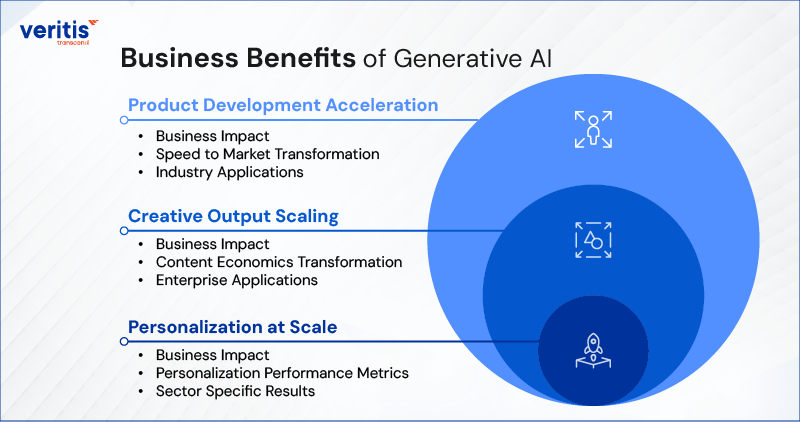
1) Product Development Acceleration
A) Business Impact:
Generative AI solutions compress innovation cycles by automating design, content creation, and ideation, turning 18 month product launches into 6 month sprints.
B) Speed to Market Transformation:
| Product Development Stage | Traditional Timeline | With Generative AI | Acceleration |
| Concept ideation & design | 12 weeks | 3 weeks | 75% faster |
| Prototype generation | 16 weeks | 4 weeks | 75% faster |
| Market testing & iteration | 20 weeks | 8 weeks | 60% faster |
| Total Development Cycle | 48 weeks | 15 weeks | 69% reduction |
C) Industry Applications:
- Generative AI in manufacturing industry: AI designed product variations tested 1,200 configurations vs. 40 manual designs, reducing development costs by $8.5M while improving performance 23%
- Generative AI in drug discovery: Molecular design AI identified 340 drug candidates in 6 months vs. 12 candidates in traditional 3 year research, accelerating $280M clinical pipeline
- AI in the automotive industry: Generative design optimized chassis components, reducing weight 18% and material costs of $4.2M per vehicle line
CTO Impact: First mover advantage worth $15M to $45M in captured market share before competitors launch equivalent products.
2) Creative Output Scaling
A) Business Impact:
Best generative AI use cases centre on content creation, marketing materials, technical documentation, and personalized customer communications at unprecedented scale and minimal marginal cost.
B) Content Economics Transformation:
| Content Type | Human Production Cost | Generative AI Cost | Savings |
| Marketing copy (10,000 variants) | $850K | $85K | 90% |
| Product documentation | $420K | $38K | 91% |
| Personalized customer emails (1M) | $1.2M | $110K | 91% |
| Technical training materials | $680K | $72K | 89% |
| Total Annual Savings | $3.15M | $305K | $2.845M (90%) |
C) Enterprise Applications:
- Generative AI business use cases in e-commerce: Personalized product descriptions for 45,000 SKUs generated in 3 days vs. 8 month manual effort, launching a new marketplace $22M ahead of schedule
- AI in the healthcare industry: Patient education materials auto generated in 12 languages, improving engagement 47% while reducing translation costs by $1.8M annually
- Generative AI use cases in government: Public service communications created in real time during emergencies, improving citizen response rates 68%
CMO Impact: Marketing teams operate with 10x output capacity without proportional headcount increases, reallocating $2.8M budget from production to strategic initiatives.
3) Personalization at Scale
A) Business Impact:
Generative AI solutions create individualized experiences for millions of customers simultaneously, impossible economics with human labour, transformative results for customer lifetime value.
B) Personalization Performance Metrics:
| Industry | Baseline Conversion | With Generative AI | Revenue Impact |
| Retail e-commerce | 2.8% | 4.7% (+68%) | +$18.5M annual |
| Financial services | 12.4% | 18.2% (+47%) | +$32.8M annual |
| Healthcare patient engagement | 34% | 58% (+71%) | +$14.2M improved outcomes |
| Manufacturing B2B proposals | 18% win rate | 29% success rate (+61%) | +$48M contract value |
C) Sector Specific Results:
- AI in the automotive industry: Personalized vehicle configuration recommendations increased the average sale price by $4,200 per transaction, adding $68M annual revenue
- AI for finance and accounting: Individualized financial product recommendations improved cross sell 43%, generating $28M incremental revenue with the same customer base
- Generative AI in healthcare industry: Personalized treatment plans improved patient adherence 52%, reducing readmissions worth $12.4M annually
CEO Impact: Personalization AI increases the lifetime value of the existing customer base by 25 to 40% without increasing acquisition costs.
Business Benefits of Combined AI and Generative AI
A) Business Impact:
Organizations deploying both traditional AI and generative AI solutions achieve compound benefits that exceed the returns of individual technologies, creating a true competitive moat.
B) Integrated AI Value Creation:
| Combined Application | Traditional AI Component | Generative AI Component | Compound Value |
| Intelligent product development | Demand prediction + quality optimization | Design generation + marketing content | 420% ROI vs. 180% separate |
| Hyper personalized operations | Customer behaviour prediction | Individualized offering creation | $48M incremental vs. $22M separate |
| Autonomous decision systems | Pattern recognition + risk assessment | Strategic recommendation generation | 65% faster + 40% better outcomes |
C) Enterprise Examples:
- Manufacturing: Predictive maintenance AI + generative scheduling optimization = $32M savings (vs. $18M predictive alone)
- Healthcare: Diagnostic AI + personalized treatment planning = 58% better outcomes + $24M cost reduction
- Energy: Load forecasting AI + generative grid optimization = $45M value (vs. $28M forecasting alone)
Board Impact: Integrated AI strategies create defensible competitive advantages worth $50M to $200M in enterprise value over 3 to 5 years.
Useful link: The Rise of Artificial Intelligence and Machine Learning in Financial Decision Making Processes
AI and Generative AI Challenges
1) Technology Selection Confusion
A) The Problem:
- 68% of executives admit confusion about generative AI vs AI capabilities
- Companies deploy generative AI for predictive tasks or traditional AI for creative needs
- Failed proof of concepts waste an average of $2.8M before projects are abandoned
- 73% of AI initiatives never move from pilot to production
Financial Impact: Wrong technology selection delays ROI by 18 to 24 months and destroys board confidence in AI investments.
B) Veritis Solution: Technology Agnostic Assessment Framework
Veritis conducts strategic AI assessments matching your business challenges to the right technology:
- 3 week diagnostic identifying best generative AI use cases vs. traditional AI opportunities
- ROI modelling for each use case with clear payback timelines
- Phased roadmap preventing wasteful parallel pilots
- Assessment cost: $45K to $85K saves $2.8M in avoided failed implementations
Outcome: Clients achieve 92% pilot to production success rate vs. 27% industry average.
2) Lack of Industry Expertise
A) The Problem:
- Generic AI vendors lack understanding of AI use cases by industry
- 62% of AI projects fail due to poor integration with existing systems
- Manufacturing, healthcare, energy, and government sectors have unique requirements
- Integration failures cost $4.5M average in rework and delays
Strategic Impact: Industry agnostic solutions miss sector specific opportunities worth $8M to $22M in value creation.
B) Veritis Solution: Deep Industry Specialization Across 6 Sectors
Veritis delivers proven AI use cases by industry with specialized teams:
Manufacturing Expertise:
- AI in manufacturing industry: Predictive maintenance reduces downtime 45%, quality optimization reduces defects 52%, and supply chain intelligence saves $4.2M annually
- Generative AI in manufacturing industry: Product design automation compressing development cycles 69%, production scheduling optimization improving OEE 28%
- Average client ROI: 340% within 18 months
Healthcare Expertise:
- AI in the healthcare industry: Diagnostic assistance improving accuracy 35%, patient risk prediction reducing readmissions 28%, operational efficiency delivering $8.6M savings
- Generative AI in healthcare industry: Personalized treatment plans increasing adherence 52%, medical documentation automation freeing 320 hours monthly
- Generative AI in drug discovery: Molecular design identifying 340 candidates vs. 12 traditional, accelerating $280M clinical pipeline
- Average client ROI: 385% within 24 months
Energy & Oil/Gas Expertise:
- AI in energy sector: Grid optimization reducing distribution losses 23%, worth $32M annually, demand forecasting enabling premium pricing, generating $18.5M
- Generative AI use cases in energy sector: Scenario planning optimizing $420M infrastructure investments for 35% better returns, infrastructure design reducing costs 40%
- Generative AI use cases in oil and gas industry: Exploration analysis identifying $180M drilling opportunities, drilling optimization extending equipment lifespan 18%, safety protocol automation reducing incidents 52%
- Average client ROI: 420% within 20 months
Automotive Expertise:
- AI in the automotive industry: Predictive quality control reducing recalls $180M, supply chain optimization cutting inventory 30%, and autonomous systems development
- Generative design reduces component weight 18% and costs $4.2M per line; personalized configuration increases average sale by $4,200
- Average client ROI: 295% within 16 months
Finance Expertise:
- AI for finance and accounting: Fraud detection preventing $48M losses, automated reconciliation reducing costs 62%, risk assessment improving accuracy 94%
- Generative financial reporting reducing close cycles from 15 days to 4 days, scenario modelling supporting $12.5M better M&A decisions, and compliance documentation automation
- Average client ROI: 450% within 14 months
Government Expertise:
- Best Generative AI use cases in government: Citizen service automation reducing response time 70% (from 21 days to 6 days), policy analysis generating executive insights, emergency communications improving response rates 68%
- Predictive resource allocation, compliance monitoring, and preventing $14M legal costs
- Average client ROI: 280% measured in citizen satisfaction improvements plus $11M efficiency gains
Outcome: Industry specific frameworks deliver 2.5x faster implementation and 60% higher ROI than generic approaches.
3) Unrealistic Timelines
A) The Problem:
- Vendors promise 3 month deployments but deliver in 18+ months
- Extended timelines delay competitive advantages worth $6.2M in lost market share
- 81% of AI projects exceed original timeline by 6+ months
- Missed market windows reduce potential ROI by 40 to 60%
Business Impact: Slow deployments allow competitors to capture first mover advantages worth $15M to $45M.
B) Veritis Solution: Rapid Deployment Accelerators
Veritis compresses AI implementation timelines through prebuilt frameworks:
Traditional AI Deployments: 6 to 9 months vs. industry average 14 to 18 months (50% faster)
Generative AI Solutions: 4 to 6 months vs. industry average 12 to 16 months (69% faster)
Specific Examples:
- Predictive maintenance AI: 7 months with Veritis vs. 14 months industry standard
- Generative design systems: 5 months with Veritis vs. 16 months industry standard
- Customer personalization: 6 months with Veritis vs. 12 months industry standard
- Financial forecasting AI: 5 months with Veritis vs. 10 months industry standard
Methodology:
- Preconfigured industry templates for generative AI business use cases
- Agile methodology with value delivery every 4 weeks
- Parallel workstreams preventing sequential bottlenecks
- Dedicated teams eliminating resource contention delays
Outcome: Faster time to value captures $6.2M to $12.5M in competitive advantages that slow competitors miss entirely.
4) Hidden Costs and Budget Overruns
A) The Problem:
- Initial AI quotes of $500K balloon to $1.4M in actual costs
- Hidden expenses: data preparation consumes 40% of the budget, integration adds 30%, and change management requires 20%
- 78% of AI projects exceed original budget by 80%+
- Cost overruns turn projected 200% ROI into actual 45% ROI
CFO Impact: Budget surprises erode executive confidence and kill follow on AI investments worth $10M to $50M.
B) Veritis Solution: Transparent Fixed Price Engagements
Veritis eliminates budget surprises with all inclusive pricing:
What’s Included in Every Engagement:
- AI platform deployment and configuration
- Complete data preparation and cleansing
- Full system integration with existing infrastructure
- 12 months of post launch support and optimization
- No additional fees, no hidden costs, no budget surprises
Typical Vendor vs. Veritis Cost Comparison:
Typical Vendor Approach:
- Initial quote: $500K
- Data preparation (discovered later): +$350K
- System integration (separate statement of work): +$280K
- Change management (client responsibility): +$180K
- First year support contract: +$180K
- Actual total investment: $1.49M
Veritis Approach:
- Fixed price comprehensive engagement
- All components included
- Savings: $810K (54% cost reduction)
Financial Guarantees:
- Projects over budget by 10%+ trigger automatic cost absorption by Veritis
- Detailed cost breakdown provided before engagement begins
- Monthly financial reviews, ensuring no surprises
Outcome: Clients achieve predicted ROI without budget erosion, maintaining CFO confidence for expanded AI initiatives worth $25M to $100M over 3 years.
5) Performance Degradation Over Time
A) The Problem:
- Vendors deploy AI systems, then disappear
- Models degrade over time without retraining, reducing accuracy from 94% to 68%
- Performance decay reduces initial ROI from 280% to 112% within 24 months
- No continuous improvement means competitors with optimized AI overtake your position
Strategic Impact: Static AI becomes a competitive liability rather than a sustained advantage, resulting in $15M to $35M in lost market positioning.
B) Veritis Solution: Continuous Optimization and Performance Management
Veritis generative AI services include ongoing model refinement and performance improvement:
Ongoing Optimization Program:
- Monthly model retraining, maintaining 90%+ accuracy indefinitely
- Quarterly performance reviews identifying new optimization opportunities worth $500K to $2.5M each
- Continuous feature additions based on evolving business needs
- Real time monitoring with proactive issue resolution
Performance Guarantees:
- Baseline SLAs contractually committed
- Performance below baseline triggers immediate remediation at no additional cost
- Annual performance improvement targets built into engagement
ROI Evolution with Veritis Management:
- Month 6: 185% ROI (vs. 180% without optimization)
- Month 12: 280% ROI (vs. 220% without optimization)
- Month 24: 385% ROI (vs. 112% degraded performance without optimization)
- Month 36: 520% ROI with compounding improvements (vs. 45% failed state without optimization)
Outcome: Sustained performance delivers compound returns of 385% to 520% over 3 years instead of the degraded 112% that becomes a competitive disadvantage.
Difference Between Generative AI vs AI
Generative AI vs AI are distinct branches of technology, each serving unique purposes and employing different methodologies. Here’s a comprehensive comparison highlighting their differences:
| Aspect | Artificial Intelligence (AI) | Generative AI |
| Definition | AI is a broad field encompassing various technologies that enable machines to mimic human intelligence. | Generative AI is a branch of AI dedicated to generating original content, including text, images, music, and more, with human like characteristics. |
| Primary Purpose | Analyze data, automate tasks, and make decisions based on learned patterns. | To generate novel content by learning from existing data and creatively combining features. |
| Core Technologies | Includes machine learning, natural language processing, computer vision, and robotics. | Transformer models and other advanced neural networks are primarily used to understand and generate new data. |
| Data Handling | Excels at analyzing structured, semi structured, and unstructured data for optimization and decision making. | Specializes in synthesizing large volumes of data to create new, original outputs that adhere to the learned patterns. |
| Applications | Business decision support, automation of tasks, anomaly detection, predictive maintenance, facial recognition, and more. | Art creation, synthetic data generation, product design, content writing, video production, personalized marketing, and drug discovery. |
| Adaptability | Typically task specific and may require retraining to handle new or varied data. | Capable of learning features and substituting them to generate new content, but may produce outputs too similar to the training data, risking copyright issues. |
| Risks and Limitations | Can overfit training data, struggle with context understanding, and may inherit biases from the data. | Potential for copyright disputes, exposure of sensitive information, hallucinations, offensive outputs, and difficulty verifying and explaining generated content. |
| Human Interaction | Mimics human decision making but lacks actual human reasoning and emotional understanding. | Creates content that feels human made but lacks self awareness and can generate inappropriate or nonsensical results. |
| Ethical Considerations | It needs careful handling to avoid bias and ensure ethical decision making. | Requires stringent safeguards to prevent misuse, protect privacy, and maintain ethical standards in content creation. |
| Explainability | Traditional AI models can explain their decisions based on learned rules and patterns. | Generative AI models, especially deep learning based ones, often lack explainability, making it challenging to understand how they arrive at specific outputs. |
Generative AI is renowned for its capacity to innovate and produce new, imaginative content, often blurring the lines between human and machine creativity. This capability opens doors to unprecedented artistic expression and innovation but demands careful management to mitigate risks like copyright infringement and ethical considerations.
Meanwhile, generative AI vs traditional AI excels in problem solving and data analysis, providing clear insights and automating tasks efficiently. Its transparency in decision making ensures reliability and accountability, which are essential for applications ranging from business optimization to medical diagnostics.
Understanding these distinctions empowers us to leverage each technology effectively, maximizing their potential while navigating their respective challenges in our quest for technological advancement and ethical innovation.
Useful link: The Impact and Benefits of AI in the Automotive Industry
Generative AI vs AI in Different Industries

Exploring the differences between AI and generative AI across various sectors reveals their unique strengths and transformative potentials. Here’s a look at how these technologies are making waves in several key industries:
1) Healthcare
AI Applications:
- Diagnostics: AI analyzes medical images and patient data to detect diseases such as cancer and heart conditions accurately.
- Predictive Analytics: Using historical data, AI predicts patient outcomes, hospital readmission rates, and disease outbreaks.
Generative AI Applications:
- Drug Discovery: Generative AI in Drug Discovery suggests novel drug compounds by learning from existing chemical structures and biomedical data.
- Personalized Medicine: It generates tailored treatment plans by analyzing a patient’s genetic information and medical history.
AI acts as a guardian angel, meticulously scanning data to detect and prevent health issues before they escalate. Meanwhile, generative AI is like a visionary healer, crafting innovative treatments that offer hope for a healthier future.
2) Automotive
AI Applications:
- Autonomous Driving: AI systems process vast amounts of sensor data to navigate vehicles safely.
- Predictive Maintenance: AI predicts when vehicle parts need servicing, reducing downtime and enhancing safety.
Generative AI Applications:
- Vehicle Design: Generative AI creates innovative vehicle designs by analyzing consumer preferences and engineering constraints.
- In car Personalization: It generates personalized driving experiences, adjusting settings based on driver behavior and preferences.
AI is the vigilant co pilot, ensuring every journey is safe and efficient. Generative AI, on the other hand, is the visionary designer, imagining the cars of tomorrow and crafting personalized experiences that make every drive a joy.
3) Banking and Financial Services
AI Applications:
- Fraud Detection: AI monitors real time transactions to identify and prevent fraudulent activities.
- Risk Management: AI assesses credit risk and market trends to make informed lending and investment decisions.
Generative AI Applications:
- Financial Reporting: Generative AI creates detailed financial reports and summaries, saving time and reducing errors.
- Personalized Financial Advice: It generates tailored investment strategies based on individual financial goals and market data.
AI serves as the vigilant watchdog, safeguarding assets and ensuring financial security. Generative AI is a reliable consultant that provides tailored strategies to assist individuals and businesses in realizing their financial aspirations.
4) Energy
AI Applications:
- Grid Management: AI optimizes electricity distribution across the grid, balancing supply and demand efficiently.
- Predictive Maintenance: AI predicts failures in energy infrastructure, preventing outages and reducing maintenance costs.
Generative AI Applications:
- Renewable Energy Design: Generative AI designs innovative solutions for harnessing renewable energy, such as optimized wind turbine layouts.
- Energy Consumption Forecasting: It generates accurate forecasts of energy demand, helping to plan and allocate resources effectively.
AI is the diligent steward, ensuring our lights stay on and our energy is used wisely. Generative AI is the creative architect, envisioning a sustainable future powered by innovative renewable solutions.
Useful link: AI and IoT Collaboration in Addressing Industry Challenges
5) Government
AI Applications:
- Public Safety: AI analyzes data from various sources to predict and prevent crime.
- Resource Allocation: AI optimizes the allocation of government resources, ensuring efficiency and effectiveness in public services.
Generative AI Applications:
- Policy Development: Generative AI creates drafts of policies by analyzing vast amounts of data and previous legislation.
- Public Communication: It generates explicit and engaging content for public announcements and information dissemination.
AI is the vigilant guardian, enhancing public safety and ensuring efficient resource use. Generative AI is the insightful policymaker, crafting policies and communications that resonate with and serve the public.
6) Manufacturing
AI Applications:
- Quality Control: AI inspects products in real time, identifying defects and ensuring high standards.
- Supply Chain Optimization: AI predicts demand and optimizes supply chain logistics to minimize waste and maximize efficiency.
Generative AI Applications:
- Product Design: Generative AI creates innovative product designs, balancing aesthetics, functionality, and manufacturability.
- Production Scheduling: It efficiently generates optimized production schedules to meet varying demands.
AI is the meticulous quality inspector, ensuring every product meets the highest standards. Generative AI is the creative innovator, designing products and processes that push the boundaries of manufacturing excellence.
7) Telecom
AI Applications:
- Network Optimization: AI manages and optimizes network performance, ensuring high reliability and speed.
- Customer Service: AI powered chatbots provide instant support, resolving customer issues efficiently.
Generative AI Applications:
- Content Generation: Generative AI creates personalized content and advertisements for telecom customers.
- Service Plan Recommendations: Generative AI in Customer Experience generates tailored suggestions based on customer usage patterns and preferences.
AI is a reliable network manager, ensuring we stay connected digitally. Generative AI creates personalized content, making every interaction with telecom services feel unique and catering to individual needs.
By leveraging AI’s unique strengths, including generative AI, industries can achieve unprecedented innovation, efficiency, and customization. Though different in application, these technologies collectively drive us toward a more intelligent, creative, and interconnected future.
Why Veritis Delivers Maximum AI and Generative AI ROI?
Veritis is your strategic generative AI services company with proven expertise across AI use cases by industry:
- Dual Expertise: Deploy traditional AI for operational excellence and generative AI business use cases for innovation, choosing the right technology for each challenge
- Industry Specialization: Proven frameworks for best generative AI use cases in oil and gas industry, AI in manufacturing industry, generative AI in healthcare industry, AI in the automotive industry, AI in energy sector, and best generative AI use cases in government
- Financial Discipline: CFO led ROI modelling ensures every AI investment meets 200%+ return threshold within 24 months
- Rapid Deployment: Compress 18 month implementations to 6 to 9 months using pre built accelerators and proven methodologies
- Risk Mitigation: Phased rollouts with measurable checkpoints eliminate “big bang” failures costing $5M to $15M
Veritis clients achieve an average ROI of 285% within 24 months, transforming AI from a technology experiment into a strategic performance driver.
Case Study: Applying Generative AI for Innovation in the Energy Industry
Veritis embarked on a groundbreaking collaboration with a leading energy company, pushing the boundaries of traditional AI capabilities to explore the innovative applications of Generative AI. While conventional AI supported data analysis and automation were practical, the client sought more advanced solutions for decision support, content generation, and operational innovation. By implementing Generative AI tools, Veritis empowered the company to automate complex documentation, extract actionable insights from large datasets, and elevate overall strategic planning. This case study serves as a testament to the innovative potential of Generative AI, inspiring a new wave of exploration and application across industries.
Read the complete case study: Solving Energy Sector Challenges with Generative AI.
Conclusion
Distinguishing between AI and generative AI is essential because we navigate this technological renaissance. AI offers precision, efficiency, and insight, driving progress by analyzing data, automating processes, and optimizing decisions. Generative AI embodies creativity and innovation, producing novel ideas and solutions that redefine possibilities.
These technologies inspire and empower industries to push beyond boundaries, creating a smarter and more innovative future. At Veritis, the Global and Stevie Awards winner, we are passionate about guiding you through this transformative landscape. As your trusted partner in generative AI solutions, we help you harness these technologies to confidently and creatively propel your business forward.
Looking for Generative AI Support? – Try Now
Also Read:
- Executive Roadmap to Leveraging Model Context Protocol in AI Business
- How Automated Data Collection Can Transform Your Business
- Overcoming Challenges: Implementing Generative AI in Healthcare
- 5G Use Cases Paving the Way for Technological Advancements
- Impact of Digital Transformation in Healthcare Industry
- Healthcare Identity and Access Management (IAM): Five Steps to Transformation
- Cloud Computing in Healthcare: Looking for Security Advantage?