For years, HR transformation sat at the intersection of aspiration and ambiguity. Organizations knew their service delivery was broken but struggled to put a dollar figure on fixing it. That ambiguity has largely dissolved. Independent research now puts the financial return on purpose built ServiceNow HRSD Solutions at a level that demands serious executive attention.
A Forrester Total Economic Impact study commissioned by ServiceNow modeled a composite organization of 35,000 employees and found $21.62 million in benefits against $6.02 million in costs over three years, a net present value of $15.6 million, and an ROI of 259%. Payback began within 6 months of go live. For any C-suite leader weighing a technology investment in an environment of compressed margins and heightened scrutiny of operating budgets, that ratio deserves a place in the boardroom conversation.
Organizations implementing ServiceNow HRSD services typically report:
- 25 to 40% reduction in HR case resolution time
- 20 to 35% lower cost per HR transaction
- 30% improvement in employee self service adoption
- Up to 50% faster onboarding cycle times
But ROI is not automatic. The organizations that capture it share one trait: they treat the ServiceNow HR service delivery process as an operating model redesign, with the platform as its backbone. Those that approach it as a ticketing upgrade routinely underperform. The distinction between these two cohorts is the gap this article is designed to close.
This is where a trusted partner matters. Veritis has established itself as a recognized name among ServiceNow HRSD implementation specialists, guiding enterprises through complete transformation with a focus on measurable business outcomes rather than technology for its own sake.
Start Your HRSD Transformation
Why HR Leaders Are Investing in ServiceNow HR Service Delivery?
The Business Case for Modern HRSD
Traditional HR environments struggle with:
- Siloed ticketing systems
- Manual onboarding and offboarding
- Disconnected compliance tracking
- High service desk workloads
- Limited reporting visibility
A structured ServiceNow HR service delivery implementation replaces fragmented systems with a centralized platform designed for automation, analytics, and employee engagement.
The ROI Drivers
- Operational Efficiency: Automated case routing reduces manual HR workload by up to 30%.
- Improved Employee Experience: Consumer grade self service portals increase satisfaction and reduce dependency on HR staff.
- Compliance Assurance: Role based access and audit trails mitigate regulatory risk.
- Scalability: Cloud native infrastructure supports workforce growth without proportional HR headcount increases.
Through strategic ServiceNow Consulting Services and phased ServiceNow implementation, enterprises transform HR from administrative overhead to strategic enabler.
Useful link: How Are ServiceNow Solutions Across Industries Transforming Modern Enterprises?
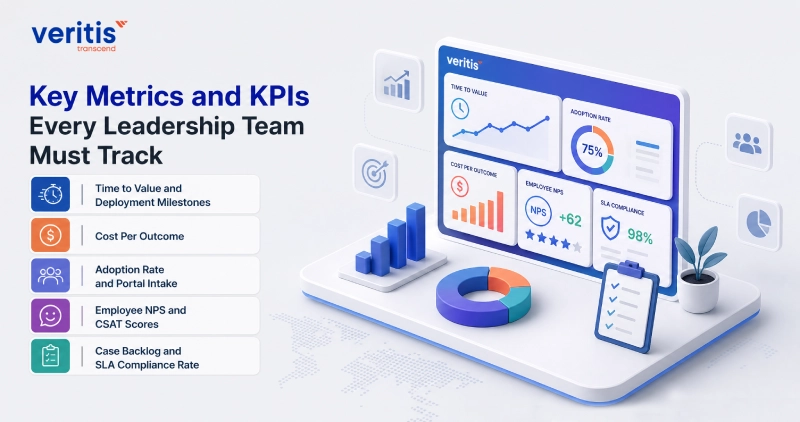
Key Metrics and KPIs Every Leadership Team Must Track
1) Time to Value and Deployment Milestones
Organizations with 3,000 to 5,000 employees and multi country operations should plan for an 18 to 24 month roadmap to full maturity. However, basic gains in case visibility and SLA attainment are typically observable within 3 to 6 months of go live. More substantial improvements in cost per case and deflection rates take 9 to 18 months to mature as virtual agent, generative AI features, and lifecycle event templates are progressively deployed.
Meaningful time to value benchmarks for a well executed ServiceNow HRSD implementation include:
- Case resolution time reduced by up to 50% within 12 months, driven by agent workspace tooling and AI assisted case summarization
- Mean time to resolution (MTTR) for routine HR inquiries drops by 30 to 35% once Now Assist’s generative capabilities are activated
- First contact resolution (FCR) rate improving to 70% or above as the knowledge base matures and virtual agent coverage expands
2) Cost Per Outcome
The unit economics of HR case management shift materially after HRSD implementation. Organizations deploying self service portals supported by a governed knowledge base report immediate reductions of 30 to 40% in direct HR agent inquiries.
One well documented enterprise deployment achieved a self service rate exceeding 76%, with roughly 80% of common HR queries resolved from the knowledge base without agent intervention. When an agent handles cases, labor costs run $15 to $25 per case in most large organizations; deflecting even 40% of annual volume across a workforce of 10,000 produces seven figure savings.
3) Adoption Rate and Portal Intake
Target adoption metrics for ServiceNow HR delivery services should aim for 80% or higher portal intake within 12 months of go live. Organizations that fail to reach this threshold typically find that email based case submission remains a parallel channel, undermining both cost reduction and data quality. Adoption rate is a leading indicator; it predicts whether downstream improvements in deflection and resolution will materialize.
4) Employee NPS and CSAT Scores
Employee Net Promoter Score for HR services is among the most strategically undervalued metrics in the C-suite. Research consistently shows that employees who rate their HR experience highly are more engaged, more productive, and less likely to leave.
Forrester’s composite organization noted measurable improvements in employee CSAT scores, a benefit not captured in the core ROI calculation, meaning the 259% figure understates the total value. Target NPS improvements of 15 to 20 points over an 18 month horizon as a reasonable initial benchmark.
5) Case Backlog and SLA Compliance Rate
The SLA compliance rate should exceed 90% within 6 months of go live for standard case categories. A persistent backlog or declining SLA performance signals either under scoping of the knowledge base or insufficient adoption of automated routing, both of which are correctable through Performance Analytics for HRSD.
Useful link: 10 Enterprise ServiceNow Use Cases Delivering Measurable ROI
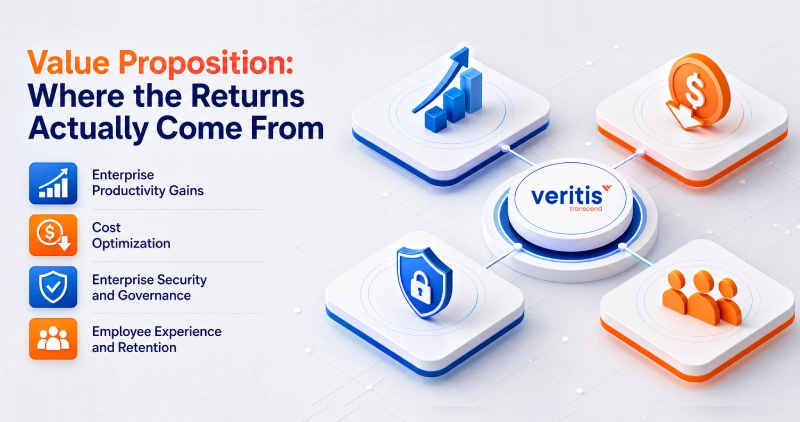
Value Proposition: Where the Returns Actually Come From
1) Productivity Gains Across the Enterprise
A well designed ServiceNow HR service delivery process streamlines case management, document workflows, and approvals.
Impact Areas:
- Automated onboarding workflows integrate IT, payroll, and security teams
- AI powered knowledge bases deflect repetitive inquiries
- Case prioritization improves resolution times
- Mobile first access empowers hybrid workforces
Enterprises leveraging ServiceNow HR delivery services report reclaiming thousands of hours from HR staff annually.
Example benchmark
A 10,000 employee organization reducing average HR case handling time from 4 days to 2.5 days can save an estimated $1.2M annually in operational costs.
2) Cost Optimization and Resource Efficiency
With hr service delivery services and solutions, organizations shift from reactive support to proactive automation.
Financial Impact Levers:
- Reduced manual processing
- Lower email based service volume
- Consolidated legacy systems
- Optimized HR staffing models
Organizations implementing ServiceNow HRSD solutions often see the cost per HR ticket drop from $12 to $18 to under $9 within the first year. By engaging HRSD implementation specialists, companies avoid costly rework and accelerate measurable gains.
3) Security, Compliance, and Governance
HR data is among the most sensitive enterprise information.
A secure ServiceNow HR service delivery implementation ensures:
- Role based access controls
- Data encryption at rest and in transit
- Audit ready reporting
- Policy driven workflows
Through ServiceNow HRSD consulting & solutions, leadership can embed compliance directly into HR operations, which is critical for organizations operating across multiple regulatory environments (GDPR, HIPAA, SOC 2).
Veritis leverages experienced ServiceNow experts and certified ServiceNow professionals to ensure security architecture aligns with enterprise governance standards.
4) Enhanced Employee Experience and Retention
The benefits of HRSD extend beyond efficiency. Modern employees expect Amazon like digital experiences at work.
Experience Enhancements:
- Single portal for HR requests
- Real time status tracking
- Personalized knowledge articles
- Automated lifecycle event management
Organizations improving HR service responsiveness report:
- 15 to 25% increase in employee NPS
- 10% reduction in early stage employee churn
- Faster time to productivity for new hires
These gains translate directly into workforce stability and reduced hiring costs.
Schedule a ServiceNow HRSD Consultation
Strategic Use Cases for HRSD
Effective use cases for HRSD extend across the employee lifecycle
1) Onboarding & Offboarding
- Automated task orchestration across HR, IT, and facilities
- Identity provisioning integration
2) Case & Knowledge Management
- AI powered routing
- Self service resolution
3) Employee Relations
- Secure issue tracking
- Escalation workflows
4) Compliance Tracking
- Policy acknowledgment tracking
- Automated audit reporting
A tailored ServiceNow hr service delivery solutions roadmap ensures these use cases align with organizational maturity and digital strategy.
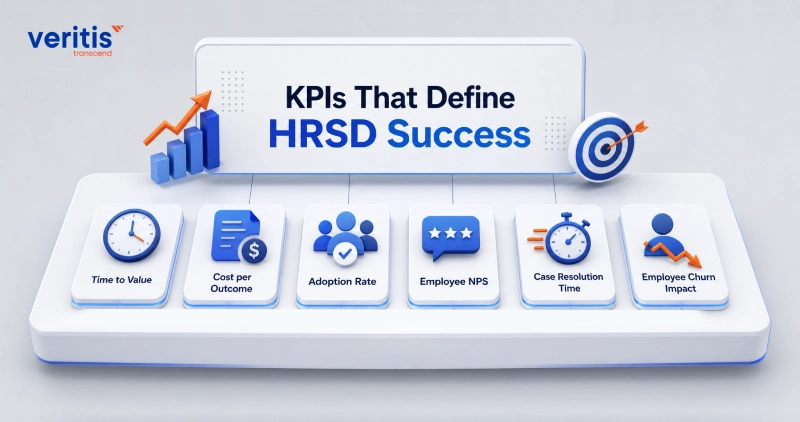
KPIs That Define HRSD Success
C-suite leaders must track measurable performance indicators to validate ROI.
Core Human Resources Service Delivery (HRSD) Metrics
1) Time to Value
- Target: < 6 months post implementation
- Measured by adoption and workflow stabilization milestones
2) Cost per Outcome
- Reduction in cost per HR case
- Decrease in manual processing labor
3) Adoption Rate
- Self service utilization > 70% within the first year
- Knowledge deflection rate > 25%
4) Employee NPS
- Target increase: +10 points post deployment
5) Case Resolution Time
- 25 to 40% improvement benchmark
6) Employee Churn Impact
- Track attrition rates pre and post HRSD implementation
Through a structured ServiceNow transformation, dashboards provide real time analytics for executive oversight.
Useful link: Why Enterprises Invest in ServiceNow Consulting Services?
Implementation Blueprint for Leadership
Phase 1: Strategic Assessment
- Evaluate existing human resource service delivery maturity
- Identify automation gaps
- Align KPIs with business outcomes
Engage HRSD experts and trusted ServiceNow consulting services partners to build a transformation roadmap.
Phase 2: Structured ServiceNow HRSD Implementation
- Configure standardized workflows
- Integrate ITSM and identity management
- Develop governance frameworks
Partnering with a proven ServiceNow HR service delivery company ensures technical rigor and minimal disruption.
Phase 3: Optimization & Scale
- Continuous improvement cycles
- Advanced analytics enablement
- AI powered enhancements
Organizations leveraging experienced ServiceNow professionals and scalable ServiceNow staffing solutions sustain long term performance improvements.
Realistic Benchmarks: What Mature Deployments Actually Look Like
For context and planning purposes, industry validated ranges for ServiceNow HRSD implementations at scale include:
- Case deflection via self service: 30 to 80% depending on knowledge base maturity and virtual agent configuration
- Reduction in HR case resolution time: 35 to 50% within 12 months
- Legacy system consolidation savings: $800,000 to $1.5 million over 3 years for organizations with 3 or more legacy HR portals
- Contractor and IT labor redeployment: $1.0 to $1.5 million over 3 years for organizations previously dependent on third party workflow development
- Overall 3 year ROI: 200 to 265% for enterprise organizations, based on Forrester TEI methodology
These figures are not theoretical ceilings. They reflect documented outcomes from properly scoped, phased ServiceNow HRSD implementations, and they underscore why demand for qualified HRSD implementation specialists has grown faster than the certified talent supply across the ServiceNow ecosystem.
Useful link: How Do Automotive Enterprises Benefit From ServiceNow Consulting Services?
Why Veritis for ServiceNow HRSD?
Veritis delivers enterprise grade ServiceNow HRSD solutions engineered for measurable ROI.
As a trusted provider of ServiceNow solutions, Veritis combines strategic advisory with hands on execution across complex, multi geography deployments.
What Differentiates Veritis?
- Certified HRSD implementation specialists
- Deep experience in ServiceNow HRSD implementations
- Proven ServiceNow transformation frameworks
- Scalable ServiceNow solutions
- Executive aligned KPI tracking
From initial strategy through ServiceNow HR service delivery implementation, Veritis ensures organizations maximize the full benefits of HRSD while maintaining compliance and operational resilience.
Conclusion
Modern enterprises cannot scale with outdated HR service models. ServiceNow HRSD solutions convert HR operations into a measurable, data driven value engine, improving productivity, reducing costs, improving compliance, and optimizing the employee experience.
Through comprehensive ServiceNow HRSD services, guided by seasoned HRSD experts, organizations achieve sustainable ROI and long term workforce agility.
Veritis stands ready to deliver secure, scalable ServiceNow HRSD consulting & solutions tailored to your enterprise objectives. Transform HR from an operational necessity to a competitive advantage with Veritis and industry leading ServiceNow HRSD solutions.