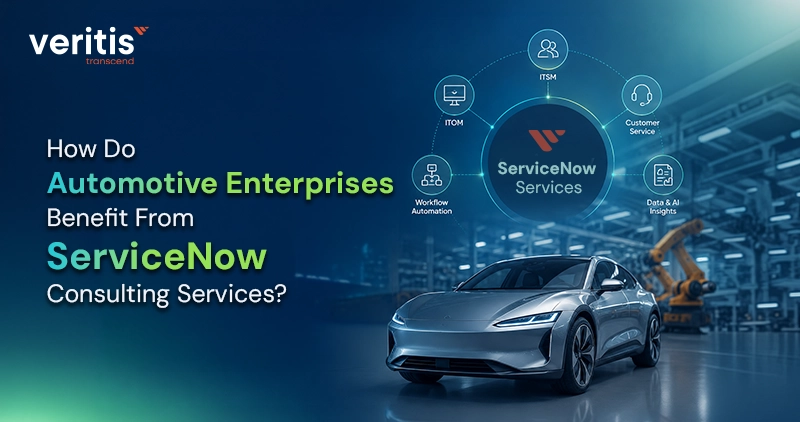
The automotive industry is moving from manufacturing led operations to software defined business models. Connected vehicles, dealer networks, recalls, supplier coordination, and digital service expectations are putting serious pressure on CIOs to create faster, more connected enterprise workflows. That’s where ServiceNow for automotive industry transformation becomes important, especially when supported by the right ServiceNow implementation services across industries.
- Software Defined Vehicle Growth: Software defined vehicles are expected to account for at least 90% of the new vehicle market by 2029.
- Automotive Software Expansion: The global automotive software and electronics market is on track to reach $462 billion by 2030.
- ADAS Complexity: Vehicles equipped with Level 2 ADAS are expected to account for 52% of total vehicle sales by 2030, raising the need for stronger software, service, and data workflows.
- Recall Demands: In 2025, there were 997 recalls for vehicles, car seats, tires, RVs, and other equipment, with more than 29 million vehicles recalled in the United States.
- Fragmented Operations: Automotive enterprises still manage critical work across ERP, PLM, CRM, MES, DMS, dealer portals, supplier systems, and regional IT tools, which creates delays, manual handoffs, and limited end to end visibility.
ServiceNow is becoming a strategic workflow layer for automotive enterprises. It helps CIOs connect systems, automate handoffs, and improve visibility across IT, dealers, suppliers, manufacturing, and customer service. Veritis helps organizations implement, integrate, and optimize ServiceNow industry services and solutions that convert fragmented operations into connected, scalable workflows.
Connect with a ServiceNow Consultant
The Stats Behind the New Automotive Operating Model
The next phase of automotive transformation is not only about connected vehicles. It is about the cost of delay, downtime, software complexity, and disconnected execution across the enterprise. For CIOs, these numbers show why workflow modernization now belongs in the boardroom.
- $2.3 million per hour: Every unproductive hour can cost automotive manufacturers around $2.3 million, making faster issue detection, escalation, and resolution a business priority.
- $695 million per year: A large automotive production line can lose up to $695 million annually from idle time, showing the financial impact of operational downtime.
- 100 million plus lines of code: A high end production vehicle can contain more than 100 million lines of software code, increasing the need for stronger service, security, update, and incident workflows.
- 90% plus OEM commitment: More than 90% of automotive OEMs are committed to zonal architecture, while 80% have already started migrating, adding another layer of platform and integration complexity.
- 195% ROI over three years: A Forrester study commissioned by ServiceNow found that modernizing IT Service Management with ServiceNow delivered 195% ROI over three years, along with 20% higher IT productivity and 25% fewer P1 incidents.
These figures show that automotive enterprises cannot afford slow, fragmented workflows. Veritis helps CIOs modernize automotive operations with ServiceNow consulting services for industries that connect IT, manufacturing, dealers, suppliers, and customer service through structured, automated workflows.
Why Legacy Automotive Workflows Are Breaking Down?
Automotive enterprises were built around specialized systems. ERP manages finance. PLM supports product data. MES runs manufacturing operations. CRM manages customer relationships. DMS supports dealer activity. Each system has value, but the most critical automotive challenges now move across all of them.
The breakdown happens when critical work depends on manual handoffs between disconnected teams and tools:
- A recall needs coordination across quality, legal, dealers, suppliers, service teams, and customer communication.
- A dealer issue may begin as a service request but quickly involve warranty, parts, finance, field service, and customer support.
- A plant floor disruption may require IT, OT, engineering, maintenance, and supplier teams to work from the same operational view.
- A connected vehicle incident may begin with telemetry but require cybersecurity review, service action, customer notification, and over the air update planning.
- A supplier quality issue may affect production schedules, compliance, customer delivery, and executive reporting.
This is why automotive CIOs are rethinking ServiceNow’s role. The value is not only in replacing ticketing tools. It is in creating a workflow layer that connects people, systems, data, and decisions across the enterprise. Veritis helps organizations approach this shift with ServiceNow industry services and solutions that align platform design with automotive operations rather than IT service management.
Use Cases in the Automotive Enterprise
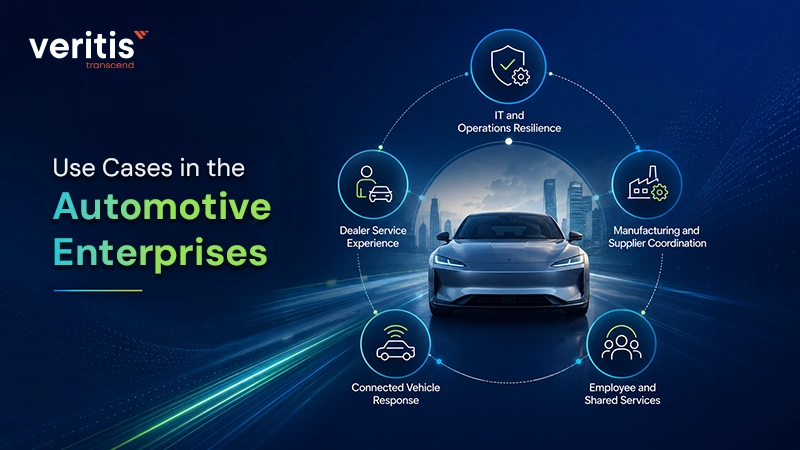
1) IT and Operations Resilience
ServiceNow solutions help automotive enterprises unify incidents, changes, assets, and service requests across complex IT and operations environments.
- Executive outcome: Faster recovery, stronger uptime, and better operational control.
- Business impact: Reduced downtime risk and improved service reliability.
- Leadership priority: Keep critical operations running without fragmented escalation.
- CIO value: Unified visibility across incidents, assets, changes, and service requests.
- Enterprise gain: Greater stability across IT, production, and service operations.
2) Dealer Service Experience
ServiceNow workflows for the automotive industry can help OEMs replace fragmented dealer support with a more connected service experience.
- Executive outcome: Faster dealer support and stronger after sales performance.
- Business impact: Improved dealer satisfaction and better customer service continuity.
- Leadership priority: Replace scattered dealer support with one connected service channel.
- CIO value: Clear visibility into dealer issues, warranty cases, and escalation trends.
- Enterprise gain: Stronger OEM to dealer coordination and faster service resolution.
3) Manufacturing and Supplier Coordination
ServiceNow implementation services can connect manufacturing, supplier, quality, engineering, and IT/OT workflows into a more governed operating model.
- Executive outcome: Faster supplier response and stronger production continuity.
- Business impact: Lower disruption risk across plants, suppliers, and quality teams.
- Leadership priority: Connect manufacturing, engineering, procurement, and supplier workflows.
- CIO value: Shared visibility across IT, OT, plant floor events, and quality escalations.
- Enterprise gain: Better control over supplier issues, production risks, and engineering changes.
4) Connected Vehicle Response
ServiceNow platform services can help convert vehicle signals, software issues, and cybersecurity events into enterprise workflows.
- Executive outcome: Faster action on vehicle signals, software issues, and service risks.
- Business impact: Stronger customer protection and better digital service readiness.
- Leadership priority: Convert vehicle data into governed enterprise workflows.
- CIO value: Connect telemetry, cybersecurity, service, engineering, and OTA workflows.
- Enterprise gain: Faster response across connected vehicle operations and customer support.
5) Employee and Shared Services
ServiceNow services and solutions can simplify internal support across HR, IT, facilities, finance, and operations.
- Executive outcome: Better employee experience and faster internal service delivery.
- Business impact: Higher productivity and reduced internal service friction.
- Leadership priority: Simplify support across HR, IT, facilities, finance, and operations.
- CIO value: Unified service access, knowledge management, and workflow automation.
- Enterprise gain: Faster onboarding, simpler support, and improved workforce efficiency.
Talk to Our ServiceNow Experts
The Business Case for ServiceNow in Automotive
1) Cost Control and Tool Rationalization
Business case: Reduce the cost of fragmented tools, duplicate workflows, and manual service processes.
Automotive enterprises often manage IT, dealer support, manufacturing issues, supplier escalations, and customer service through disconnected systems. ServiceNow helps consolidate workflows into a single operating layer, reducing complexity and improving control.
Executive decision point: Can ServiceNow replace fragmented processes with a more governed and scalable workflow model?
2) Operational Resilience
Business case: Protect production, service continuity, and enterprise response speed.
When downtime can create significant financial exposure, faster detection, escalation, and resolution become business priorities. ServiceNow connects incidents, assets, changes, IT operations, and service workflows so teams can respond with greater speed and accountability.
Executive decision point: Can the platform reduce operational disruption and improve response across plants, dealers, suppliers, and IT teams?
3) Productivity and Service Efficiency
Business case: Improve output without proportionally increasing headcount.
ServiceNow automates routing, approvals, service requests, knowledge access, case handling, and routine workflows. This helps IT, service, dealer support, field teams, and shared services reduce manual effort and focus on higher value work.
Executive decision point: Can ServiceNow improve productivity across multiple business functions, not IT?
4) Risk, Governance, and Compliance
Business case: Create stronger control over change, incidents, recalls, cybersecurity events, and service processes.
Automotive operations require traceability, accountability, and faster cross team coordination. ServiceNow helps create governed workflows with clear ownership, audit trails, approvals, and escalation paths.
Executive decision point: Can ServiceNow improve visibility and control across high risk automotive workflows?
5) Dealer and Customer Experience
Business case: Improve service consistency across dealers, customers, field teams, and after sales operations.
Dealer and customer service delays affect brand trust, loyalty, and revenue. ServiceNow helps create connected service workflows for dealer requests, warranty cases, customer issues, field service, and knowledge access.
Executive decision point: Can ServiceNow help improve dealer responsiveness and customer service performance?
6) Readiness for Software Defined Vehicles
Business case: Build a workflow foundation for connected vehicles, OTA updates, cybersecurity response, and digital services.
As vehicles become more software defined, automotive enterprises need workflows that connect vehicle data to service teams, engineering, cybersecurity, customer support, and business operations. ServiceNow gives leaders a platform to turn signals into action.
Executive decision point: Can ServiceNow support the operating model required for connected and software defined automotive services?
Business Benefits of ServiceNow for Automotive Enterprises
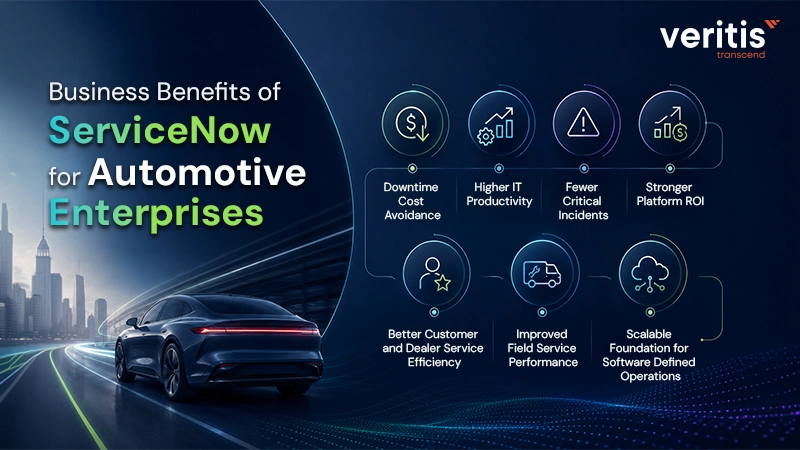
For automotive executives, ServiceNow should be measured by business outcomes: downtime avoided, productivity gained, critical incidents reduced, service efficiency improved, and ROI delivered across complex operations. Veritis brings ServiceNow solutions across industries to help leaders connect business priorities with measurable workflow performance.
1) Downtime Cost Avoidance
Metric: Automotive downtime can cost manufacturers about $2.3 million per hour.
At $2.3 million per hour, even a small delay in detecting, escalating, or resolving an issue can become a board level cost. ServiceNow helps connect incidents, assets, changes, and operational workflows so teams can act faster across IT, OT, plants, and suppliers.
Executive Outcome: Lower downtime exposure and stronger production continuity.
2) Higher IT Productivity
Metric: ServiceNow ITSM modernization has shown 20% higher IT productivity.
A 20% productivity gain gives CIOs more capacity without expanding teams at the same rate. ServiceNow reduces manual routing, duplicate work, and status chasing across service requests, incidents, changes, and enterprise support.
Executive Outcome: More output from existing IT teams and lower operating pressure.
3) Fewer Critical Incidents
Metric: ServiceNow ITSM modernization has shown 25% fewer P1 incidents.
A 25% reduction in P1 incidents means fewer high severity disruptions affecting production, dealer support, employee services, and customer facing operations. ServiceNow improves control through structured change, faster routing, and better operational visibility.
Executive Outcome: Reduced business disruption and stronger service reliability.
4) Stronger Platform ROI
Metric: ServiceNow ITSM modernization has shown 195% ROI over three years.
A 195% three year ROI gives executives a stronger financial argument for workflow modernization. The return comes from tool consolidation, productivity gains, reduced incidents, and less manual service effort across enterprise operations.
Executive Outcome: A clearer investment case for ServiceNow enterprise solutions.
5) Better Customer and Dealer Service Efficiency
Metric: ServiceNow Customer Service Management has shown 170% ROI, 18% more case deflection, and 20% greater efficiency over three years.
With 18% more case deflection and 20% higher efficiency, dealer and customer service teams can resolve more requests with less manual effort. For automotive enterprises, this supports faster warranty processing, better escalation control, and stronger after sales service.
Executive Outcome: Faster dealer response and improved customer service economics.
6) Improved Field Service Performance
Metric: ServiceNow Field Service Management has shown nearly 400% ROI, 16% higher field service efficiency, and 20% to 30% lower travel time.
A 16% gain in field service efficiency and 20% to 30% lower travel time can directly improve service margins. ServiceNow supports smarter scheduling, work order visibility, routing, parts coordination, and field execution.
Executive Outcome: Better field productivity and stronger after sales profitability.
7) Scalable Foundation for Software Defined Operations
Metric: Software defined vehicles are expected to account for at least 90% of the new vehicle market by 2029.
When 90% of new vehicles are software defined, automotive enterprises need workflows that integrate telemetry, OTA updates, cybersecurity events, service cases, and customer communications. ServiceNow consulting services can help CIOs build that operating foundation.
Executive Outcome: Stronger readiness for connected vehicles and digital service models.
Conclusion
ServiceNow solutions in automotive are more than an IT modernization investment. It is a way to reduce costs, improve resilience, strengthen governance, and prepare for software defined operations. Veritis helps automotive enterprises turn ServiceNow into business value through strategy, implementation, integration, and workflow modernization built around measurable outcomes. Partner with Veritis to build a connected ServiceNow roadmap for automotive transformation.