Technology now sits at the center of business performance. For CEOs, CIOs, CTOs, and CFOs, IT impacts revenue, customer experience, operational resilience, and the pace of innovation. Yet many enterprises still run service operations through disconnected tools, manual handoffs, and reactive support models. Choosing the right IT Service Management platform, including ServiceNow ITSM Solutions, is a business decision tied to efficiency, risk control, and enterprise scale.
There is a number that every executive should have committed to memory: $16.03 billion. That is the current size of the global cloud ITSM market in 2026, projected to reach $45.08 billion by 2033 at a 15.9% CAGR, according to Persistence Market Research. It is growing not because IT departments are buying more software, but because enterprise leaders are finally recognizing that IT Service Management (ITSM) is not an infrastructure conversation. It is a business performance conversation.
When IT services fail, when incidents cascade, when changes break production systems, or when service desks drown in unresolved tickets, the damage is measured not in support costs but in revenue disruption, loss of workforce productivity, and erosion of customer trust.
The organizations pulling away from their competitors in 2026 are those that have improved IT Service Management (ITSM) from a back office function to a strategic enterprise capability, powered by AI, governed by proven frameworks, and executed through best in class ServiceNow ITSM tools.
This guide delivers a comprehensive, executive calibre breakdown of everything you need to know, from foundational definitions to framework selection, core process design, tool evaluation, and the measurable benefits that justify investment at scale.
Get Started with ServiceNow ITSM
What is IT Service Management (ITSM)?
ITSM (IT Service Management) helps organizations manage IT services in a consistent, business focused way, from service delivery and support to automation, governance, and continuous improvement. Unlike traditional IT operations, which focus on infrastructure, ITSM focuses on services and on how technology enables outcomes.
At its core, IT Service Management (ITSM) ensures:
- Predictable service delivery
- Reduced downtime and disruption
- Governance and compliance alignment
- Measurable performance metrics
- Continuous service optimization
Modern ITSM enterprise environments extend beyond IT into HR, facilities, finance, and shared services, creating a unified service experience across the organization.
ITSM Frameworks
Not all ITSM frameworks are created equal. Selecting the right one depends on your organizational maturity, compliance requirements, and strategic objectives.
1) ITIL (Information Technology Infrastructure Library)
The most widely adopted framework globally, ITIL 4 introduces a Service Value System (SVS) that aligns IT delivery with agile and DevOps principles. Over 750,000 organizations worldwide operate under ITIL guidance.
2) COBIT (Control Objectives for Information Technologies)
Preferred by governance heavy industries, financial services, healthcare, and government, COBIT bridges IT management and enterprise risk and compliance mandates.
3) MOF (Microsoft Operations Framework)
Purpose built for Microsoft environments, MOF delivers lifecycle based service management with tightly integrated tooling, ideal for Microsoft centric enterprises.
4) FitSM (Federated IT Service Management)
A lightweight, accessible framework designed for federated IT organizations and mid market enterprises seeking ITSM adoption without heavy implementation overhead.
5) SIAM (Service Integration and Management)
Critical for enterprises managing multivendor ecosystems, SIAM provides governance models that coordinate service delivery across complex supplier landscapes and is increasingly relevant as cloud and SaaS proliferation accelerates.
Leading enterprises do not choose one framework exclusively. They architect a hybrid governance model, often with ITIL as the operational spine, COBIT for risk oversight, and SIAM for vendor orchestration.
6) ISO/IEC 20000
The international standard for IT service management certification. Organizations achieving ISO/IEC 20000 certification demonstrate auditable, benchmark quality ITSM processes, a competitive differentiator in regulated markets.
Useful link: ServiceNow Solutions Across Industries: Transforming Business Operations
Core ITSM Processes
Effective ITSM processes determine whether the strategy translates into measurable results.
1) Incident Management
Objective: Restore service operations as quickly as possible.
Best in class organizations reduce Mean Time to Resolution (MTTR) by 50 to 70% through automation, AI based routing, and knowledge driven resolution.
Automating ticket categorization alone can eliminate 20 to 30% of manual workload.
2) Problem Management
Objective: Identify root causes and prevent recurring incidents.
Companies that institutionalize problem management reduce repeat incidents by up to 60%, significantly lowering support costs.
3) Change Management
Objective: Ensure controlled, low risk deployment of changes.
Uncontrolled change remains the #1 cause of service disruption. Mature change governance models reduce failed changes by nearly 50%.
4) Configuration Management
Objective: Maintain a centralized Configuration Management Database (CMDB).
Accurate CMDBs improve impact analysis and reduce resolution time by up to 35%.
5) Asset Management
Objective: Tracks hardware, software, and licenses across their lifecycle.
Enterprises that leverage integrated asset visibility reduce software overspending by 15 to 25%.
Useful link: Why Enterprises Choose ServiceNow Consulting Services?
ServiceNow ITSM Benefits
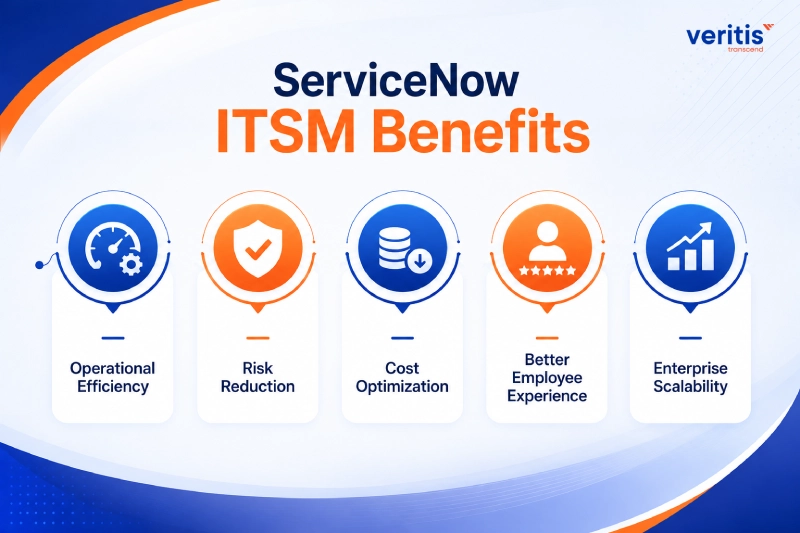
A modern IT Service Management (ITSM) solution is more than a ticketing platform. It helps enterprises standardize service delivery, automate repetitive work, reduce operational risk, and improve the employee experience.
1) Operational Efficiency
ITSM software automates routine workflows, reduces manual effort, and can lower support overhead by up to 40%.
2) Risk Reduction
Standardized change, incident, and governance processes help reduce outages, compliance gaps, and service disruption.
3) Cost Optimization
Integrated ServiceNow ITSM solutions reduce tool sprawl, improve asset utilization, and help IT teams control service delivery costs.
4) Better Employee Experience
Self service portals and AI driven virtual agents help employees get faster answers while reducing ticket volume by up to 30%.
5) Enterprise Scalability
An enterprise ITSM approach supports global operations, M&A integration, and long term digital transformation.
For executives evaluating ITSM investment, the ROI case is:
- Up to 40% reduction in IT support costs through self service automation and AI deflection
- 30% to 50% reduction in MTTR with AI enhanced incident management
- 25% improvement in IT staff productivity through automated workflow management
- 60% to 70% reduction in change related outages through structured change management
- 35% improvement in SLA compliance within 12 months of ITSM maturity programs
Talk to a ServiceNow ITSM Expert
Top 10 IT Service Management (ITSM) Tools
Before choosing among the best IT Service Management (ITSM) tools, it helps to understand what IT Service Management (ITSM) is. In simple terms, ITSM (IT Service Management) is a systematic approach to managing IT services through standardized ITSM processes, automation, governance, and continuous improvement.
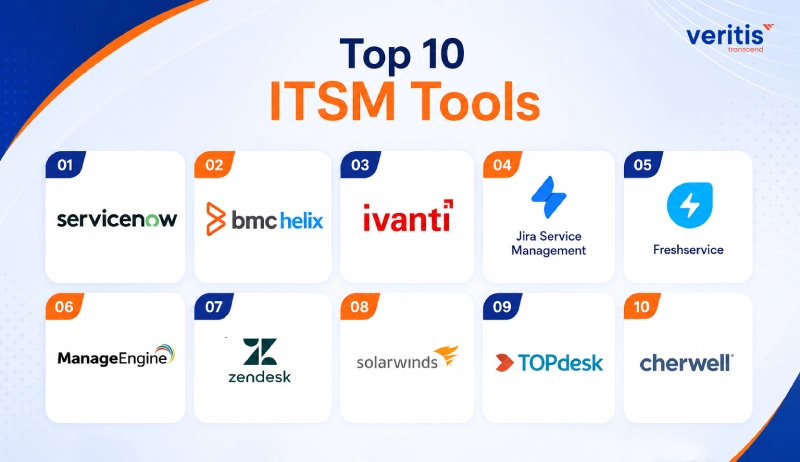
The right IT Service Management (ITSM) software helps enterprises improve service delivery, reduce manual effort, and align IT operations with business outcomes. Below are leading ServiceNow ITSM services and IT service management (ITSM) companies for enterprise and midmarket needs.
The ServiceNow ITSM tool market is stratified. Choosing the wrong tier or the wrong platform within the right tier is expensive.
Here is the definitive evaluation framework for 2026:
1) ServiceNow ITSM
Best for global enterprises and Fortune 500 organizations
A) Strategic Value
ServiceNow is the most enterprise oriented platform on the list. It is typically selected when ITSM is part of a broader enterprise workflow and transformation agenda.
B) Platform Consideration
It is a strong fit for organizations looking to replace multiple legacy ITSM tools with a single standardized platform across regions, departments, and business units.
C) AI and Automation Strength
- Now Assist
- AI agents
- Otto style workflow support
- Strong automation and workflow orchestration
D) Enterprise Scale Profile
- Typically suitable for 1,000+ users
- Strong fit for multi region, multi business unit environments
E) Business Impact Indicators
- High automation potential
- Reduced manual triage and routing
- Faster incident resolution
- Lower ticket handling effort
- Strong standardization across service processes
- Supports enterprise transformation initiatives
F) Executive Consideration
Best suited when the goal is platform consolidation and enterprise operating model transformation.
2) BMC Helix ITSM
Best for large enterprises and legacy modernization programs
A) Strategic Value
BMC Helix is well suited to organizations that need to modernize established ITSM environments while preserving operational continuity.
B) AI and Automation Strength
- Cognitive automation
- Process optimization
- Strong enterprise service management capability
C) Enterprise Scale Profile
- Commonly suited for 500+ users
- Works well in large, process heavy environments
D) Business Impact Indicators
- Improved modernization path for legacy IT operations
- Enhanced workflow consistency
- Better support for complex change and incident structures
3) Ivanti Neurons for ITSM
Best for organizations prioritizing IT asset management and ITSM integration
A) Strategic Value
Ivanti is compelling where ITSM and endpoint or asset management need to operate as a unified model.
B) AI and Automation Strength
- Predictive intelligence
- Connected asset service workflows
- AI assisted operations
C) Enterprise Scale Profile
- Commonly suited for 300+ users
D) Business Impact Indicators
- Better asset to service correlation
- Faster issue diagnosis
- More efficient lifecycle management
- Improved operational visibility
4) Jira Service Management
Best for Agile and DevOps native organizations
A) Strategic Value
Jira Service Management works well when IT and engineering must operate as a single delivery system.
B) AI and Automation Strength
- Virtual agents
- Automation rules
- Strong integration with development workflows
C) Enterprise Scale Profile
- Commonly suited for 50 to 500 users
- Particularly effective in high collaboration environments
D) Business Impact Indicators
- Faster collaboration between IT and engineering
- Better alignment between incidents, changes, and delivery pipelines
- Reduced handoff friction
5) Freshservice
Best for midmarket organizations seeking fast deployment
A) Strategic Value
Freshservice is often chosen by organizations that want a modern ITSM platform with a quick implementation path and strong usability.
B) AI and Automation Strength
- Freddy AI engine
- Service desk automation
- Self service improvements
C) Enterprise Scale Profile
- Commonly suited for 50 to 300 users
D) Business Impact Indicators
- Fast implementation
- Lower administrative complexity
- Good usability and adoption potential
- Strong fit for teams seeking quick operational wins
Useful link: 10 Enterprise ServiceNow Use Cases That Reduce Costs and Increase ROI
6) ManageEngine ServiceDesk Plus
Best for value driven enterprise deployments
A) Strategic Value
ManageEngine is attractive to organizations seeking solid ITSM capabilities at a more cost disciplined price point.
B) AI and Automation Strength
- Zia AI assistant
- Workflow automation
- Practical operational support
C) Enterprise Scale Profile
- Commonly suited for 100 to 500 users
D) Business Impact Indicators
- Strong cost to capability ratio
- Solid fit for structured service operations
- Useful for organizations balancing budget discipline with service maturity
7) Zendesk for Service
Best for customer facing IT service operations
A) Strategic Value
Zendesk is particularly effective when service operations need to serve both employees and customers.
B) AI and Automation Strength
- Answer Bot
- AI triage
- Omnichannel service workflows
C) Enterprise Scale Profile
- Commonly suited for 50 to 500 users
D) Business Impact Indicators
- Strong case management
- Improved responsiveness
- Better experience for service consumers
- Good fit for supporting heavy operations
8) SolarWinds Service Desk
Best for midmarket organizations with strong asset management needs
A) Strategic Value
SolarWinds Service Desk offers practical ITSM and asset visibility for organizations seeking operational clarity.
B) AI and Automation Strength
- Predictive recommendations
- Service automation
- Asset aware support
C) Enterprise Scale Profile
- Commonly suited for 50 to 300 users
D) Business Impact Indicators
- Simplified service management
- Better asset tracking
- More efficient support processes
9) TOPdesk
Best for higher education, government, and healthcare
A) Strategic Value
TOPdesk is well suited to regulated and service intensive environments that require standardization and transparency.
B) AI and Automation Strength
- Self service automation
- Workflow standardization
- Service desk efficiency tools
C) Enterprise Scale Profile
- Commonly suited for 100 to 500 users
D) Business Impact Indicators
- Improved service consistency
- Better request handling
- Strong fit for regulated operational environments
10) Cherwell by Ivanti
Best for highly customized enterprise workflows
A) Strategic Value
Cherwell is suited to organizations with unique operational processes and a need for flexible configuration.
B) AI and Automation Strength
- AI powered analytics
- Custom workflow support
- Adaptive service processes
C) Enterprise Scale Profile
- Commonly suited for 300+ users
D) Business Impact Indicators
- Workflow flexibility
- Support for unique business processes
- Better fit for complex organizational requirements
Conclusion
Strong ITSM gives organizations a clearer way to run IT, resolve issues faster, and keep services moving without unnecessary complexity.
Veritis helps enterprises convert ITSM into a strategic advantage. With 20+ years of enterprise technology expertise, 600+ successful projects, and deep ServiceNow specialization, Veritis designs, implements, and optimizes ServiceNow ITSM services and solutions that improve visibility, strengthen governance, and deliver measurable business outcomes.
For organizations serious about modernization, Veritis is the partner to lead ServiceNow ITSM transformation with confidence, scale, and impact.