The unprecedented speed of technological advancement underscores the need for organizations to leverage innovative technologies to outperform competitors. In this environment, artificial intelligence in business has emerged as a critical lever for sustainable growth and differentiation. Chief Technology Officers (CTOs) play a pivotal role in guiding the use of artificial intelligence in business, helping organizations convert innovation into measurable outcomes. With an understanding of the evolving technology domain, CTOs enable enterprises to identify new opportunities where the application of artificial intelligence in business can drive long term value.
CTOs are crucial in shaping an organization’s technology strategy and maintaining a competitive edge. By staying ahead of emerging trends, they evaluate the usage of artificial intelligence in business across core functions and identify disruptive technologies that can be operationalized. Take the case of, the growing use of artificial intelligence in business, particularly through AI and machine learning, is transforming how organizations operate, enabling smarter decision making, faster execution, and scalable innovation. When properly aligned, the benefits of artificial intelligence in business extend beyond efficiency to resilience and growth.
According to an IBM survey, IT professionals identified shifting enterprise demands following the pandemic as a primary driver for accelerating the application of artificial intelligence in business. The study found that 43% of respondents increased the usage of artificial intelligence in business initiatives in response to operational disruptions. These findings reinforce how artificial intelligence in business has moved from experimentation to necessity.
As technology continues to advance, the use of artificial intelligence in business is becoming foundational to modern enterprise strategy. AI for IT Operations is now a key enabler, helping organizations automate processes, enhance operational efficiency, and reduce downtime. From customer service to supply chain optimization, real world examples of artificial intelligence in business demonstrate how AI is reshaping operations, improving efficiency, and unlocking new growth opportunities. At the same time, the expanding application of artificial intelligence in business presents challenges that CEOs and CTOs must strategically address.
This discussion explores the evolving role of artificial intelligence in business, the challenges leaders face, practical examples of artificial intelligence in business, and proven best practices to help CEOs and CTOs maximize the benefits of artificial intelligence in business at scale.
Request a Personalized Consultation
What Is Artificial Intelligence (AI) in Business?
Companies must adapt strategies, leverage data, and navigate evolving customer preferences to sustain growth. As a result, traditional approaches often fall short in addressing modern challenges. This is where artificial intelligence in business creates new growth opportunities by transforming how organizations use data. Through advanced analytics and intelligent automation, the use of artificial intelligence in business enables companies to extract deeper insights from customer data and respond with speed and precision.
As organizations embrace the application of artificial intelligence in business, they can boost revenue, enhance customer experience, and drive efficiency through intelligent software systems. The expanding usage of artificial intelligence in business allows enterprises to move beyond reactive decision making and adopt predictive, insight driven strategies that support long term growth.
Evolving customer expectations and increasing data complexity continue to challenge traditional growth models. The use of artificial intelligence in business addresses these challenges by unlocking actionable insights from vast data sets, automating routine processes, and enabling a more comprehensive understanding of customer behavior. As a result, the benefits of artificial intelligence in business include stronger engagement, improved operational performance, and faster innovation cycles. To remain competitive, adopting AIOps solutions and expanding the application of artificial intelligence in business has become essential in a rapidly changing market.
AI Applications in Business
The application of artificial intelligence in business spans multiple functional areas, enabling organizations to modernize operations and decision making. Common examples of artificial intelligence in business include:
- Customer service
- Business intelligence
- Targeted marketing
- Product recommendation and predictive analytics
- Natural language processing
These examples of artificial intelligence in business highlight how AI driven solutions deliver automation, enhance customer experience, increase revenue potential, and strengthen security. As the usage of artificial intelligence in business continues to expand, organizations are increasingly realizing the strategic and operational benefits of artificial intelligence in business across the enterprise.
Do Companies Need to Use AI?
Labor intensive and inefficient human functions continue to drive the complexity of modern operations, making artificial intelligence in business increasingly essential. In the twenty first century, data has become the primary driver of decision making, and the use of artificial intelligence in business allows organizations to convert that data into meaningful insights. Through advanced analytics and automation, the application of artificial intelligence in business enables companies to uncover growth opportunities and implement strategies that accelerate performance.
In a highly competitive environment, the expanding usage of artificial intelligence in business is not optional. Organizations must remain proactive to keep pace with market demands, evolving customer expectations, and operational complexity. Understanding customer behavior at scale is one of the most substantial benefits of artificial intelligence in business, allowing leaders to make faster, more informed decisions.
Artificial intelligence software has established itself as a powerful enabler, reshaping how enterprises operate and compete. The growing use of artificial intelligence in business offers a multiple range of opportunities for companies to enhance customer experience, optimize operations, and drive sustainable growth. As the application of artificial intelligence in business continues to mature, real world examples of artificial intelligence in business demonstrate how AI delivers measurable value across industries.
Useful link: How AI Adoption Will Transform Your Business
Opportunities and Applications of Artificial Intelligence in Business

The expanding use of artificial intelligence in business continues to redefine how enterprises compete, operate, and grow. The application of artificial intelligence in business is not experimental. It is embedded across customer engagement, operations, security, and quality management. The following areas represent the most impactful and future ready examples of artificial intelligence in business heading into 2026.
1) AI for Customer Experience, Service, and Support
Customer experience remains one of the most mature and high value areas for the use of artificial intelligence in business. Organizations increasingly rely on AI powered chatbots, virtual assistants, and intelligent service platforms that leverage natural language processing and machine learning. These systems understand intent, resolve issues in real time, and continuously improve through learning.
Beyond automation, AI driven recommendation engines analyze preferences, customer behavior, and historical data to personalize interactions and product suggestions. This usage of artificial intelligence in business enables companies to deliver faster resolutions, deeper engagement, and consistent service quality. Among the strongest benefits of artificial intelligence in business is the ability to scale personalized experiences without increasing operational cost.
2) AI for Targeted and Predictive Marketing
Marketing has evolved significantly with the growing application of artificial intelligence in business. AI analyzes customer data, behavioral signals, and contextual insights to deliver personalized messaging across digital and physical channels. This use of artificial intelligence in business improves campaign precision, optimizes spend, and increases conversion rates.
Advanced marketing platforms now combine predictive analytics, customer segmentation, and real time decisioning. The usage of artificial intelligence in business also enables hyper personalization by integrating geolocation, browsing behavior, and individual preferences. These are practical examples of artificial intelligence in business that directly impact revenue growth and customer loyalty.
3) Smarter and Adaptive Supply Chains
Supply chain modernization is one of the fastest growing applications of artificial intelligence in business as organizations seek resilience and agility. AI driven demand forecasting, inventory optimization, and logistics planning help enterprises anticipate disruptions and respond proactively.
Machine learning models analyze historical data, market trends, and external signals to optimize sourcing and distribution. The use of artificial intelligence in business within supply chains reduces waste, improves fulfillment accuracy, and enhances cost efficiency. These examples of artificial intelligence in business are becoming critical as global supply networks grow more complex.
4) Smarter Operations and Intelligent Automation
Operational efficiency remains a key driver for the usage of artificial intelligence in business. AI enabled automation is now embedded within enterprise applications, enabling intelligent process execution across functions. Tasks such as customer call routing, inventory tracking, workflow optimization, and anomaly detection are increasingly automated.
The application of artificial intelligence in business allows organizations to move beyond rule based automation toward adaptive, self learning systems. One of the most visible benefits of artificial intelligence in business is the ability to scale operations while improving speed, accuracy, and decision quality.
5) Secure and Resilient Operations
Security is a growing priority in the artificial intelligence in the business ecosystem. Organizations leverage AI to detect threats, analyze behavioral patterns, and respond to risks in real time. AI systems monitor endpoint devices, networks, and user activity to identify anomalies and prevent breaches.
This use of artificial intelligence in business strengthens cybersecurity posture while reducing response times. The application of artificial intelligence in business for security also enables AI risk management, helping enterprises protect data, ensure compliance, and maintain operational continuity.
6) AI Enabled Quality Control and Quality Assurance
Manufacturing and industrial sectors increasingly rely on the usage of artificial intelligence in business to enhance quality control. AI powered machine vision and deep learning models inspect products with high precision, identifying defects that human inspection may miss.
These examples of artificial intelligence in business improve consistency, reduce rework, and lower operational costs. The benefits of artificial intelligence in business in quality assurance include faster inspection cycles, higher accuracy, and improved customer satisfaction, making this application highly relevant through 2026 and beyond.
Useful link: All You Need to Know about Artificial Intelligence as a Service (AIaaS)
Challenges of Implementing Artificial Intelligence in Business
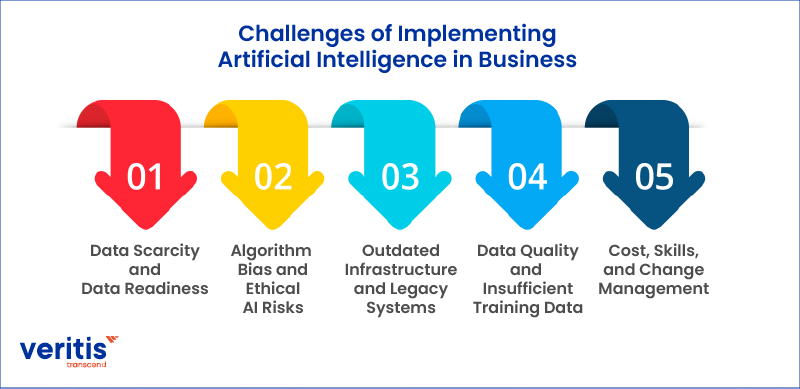
While the benefits of artificial intelligence in business are well documented, successful adoption requires overcoming several structural, technical, and organizational challenges. As the usage of artificial intelligence in business increases across industries, enterprises must address these obstacles to unlock sustainable value from the application of artificial intelligence in business.
1) Data Scarcity and Data Readiness
One of the most common barriers to the adoption of artificial intelligence in business is data scarcity. AI models, particularly those depend on machine learning, require large volumes of relevant, high quality data for training and continuous improvement. Many organizations struggle with fragmented data sources, unstructured formats, and limited historical data, which limit the use of artificial intelligence at scale in business.
Veritis Solution:
Veritis helps organizations establish data readiness by designing modern data architectures, enabling data integration, cleansing, and governance. Through structured data pipelines and AI ready data frameworks, Veritis ensures enterprises have the foundation required to enhance the application of artificial intelligence in business with confidence.
2) Algorithm Bias and Ethical AI Risks
Algorithm bias remains a critical concern in the usage of artificial intelligence in business. When AI systems are trained on incomplete or biased datasets, they may reinforce existing inequities and produce unfair or unreliable outcomes. This challenge directly impacts trust, compliance, and long term adoption of artificial intelligence in business.
Veritis Solution:
Veritis addresses bias through responsible AI practices, including dataset validation, bias detection, and model governance. By aligning ethical AI principles with enterprise objectives, Veritis enables fair, transparent, and compliant examples of artificial intelligence in business across customer facing and internal systems.
3) Outdated Infrastructure and Legacy Systems
Many organizations lack the infrastructure needed to support the application of artificial intelligence in business. Legacy systems often cannot handle the scale, speed, and processing demands required for AI driven analytics and automation. Without modernization, the use of artificial intelligence in business remains limited and inefficient.
Veritis Solution:
Veritis modernizes enterprise environments through cloud native architectures, scalable data platforms, and AI optimized infrastructure. This enables organizations to process large data volumes efficiently and expand the usage of artificial intelligence in business across operations, security, and analytics.
4) Data Quality and Insufficient Training Data
Beyond availability, poor data quality is a significant obstacle to realizing the benefits of artificial intelligence in business. Inaccurate, inconsistent, or biased data leads to unreliable AI outcomes and weak decision making. This challenge is particularly common in early stage examples of artificial intelligence in business initiatives.
Veritis Solution:
Veritis implements data quality management, validation frameworks, and continuous monitoring to ensure AI models are trained on representative, high quality datasets. By starting with manageable use cases and scalable models, Veritis helps organizations refine the application of artificial intelligence in business while reducing risk.
5) Cost, Skills, and Change Management
The cost of implementing and scaling artificial intelligence in business can be high. Investments in tools, infrastructure, talent, and ongoing training are required. Additionally, organizations often underestimate the change management effort required to integrate AI into daily operations.
Veritis Solution:
Veritis takes a value driven approach to AI adoption, helping enterprises prioritize AI use cases with clear ROI. By leveraging modular architectures, phased implementation, and upskilling strategies, Veritis reduces upfront costs while maximizing the long term benefits of artificial intelligence in business.
Overcoming these challenges is vital for organizations seeking to scale the use of artificial intelligence in business beyond experimentation. With the right strategy, governance, and execution partner, the application of artificial intelligence in business becomes a sustainable driver of innovation and growth.
At Veritis, we help enterprises navigate complexity, mitigate risk, and realize measurable outcomes from the usage of artificial intelligence in business.
Best Practices for CEOs and CTOs
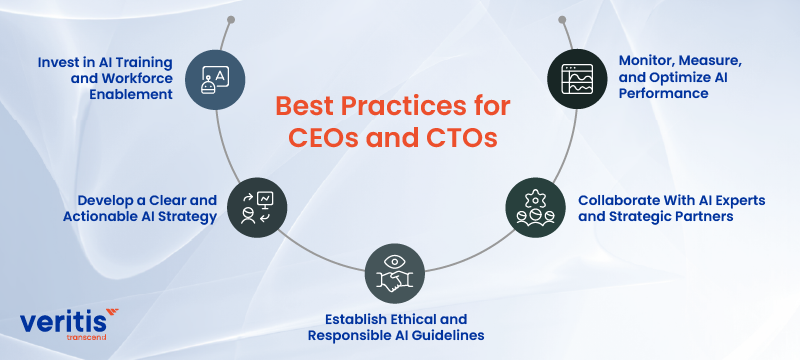
To achieve the benefits of artificial intelligence in business and overcome adoption challenges, CEOs and CTOs must approach AI with strategic discipline. The use of artificial intelligence in business requires more than technology investment. It demands leadership, governance, and continuous alignment with business objectives. The following best practices help leaders maximize value from the application of artificial intelligence in business.
1) Invest in AI Training and Workforce Enablement
Leadership teams must invest in building internal capabilities to support the usage of artificial intelligence in business. Training allows employees with the skills needed to understand AI systems, interpret insights, and make informed decisions. A knowledgeable workforce is essential for scaling artificial intelligence in business responsibly.
Beyond technical skills, AI training increases awareness of risks, limitations, and ethical considerations. One of the long term benefits of artificial intelligence in business is realized when teams can confidently adopt AI automation tools while maintaining control and accountability.
2) Develop a Clear and Actionable AI Strategy
Successful AI adoption starts with a well defined strategy. CEOs and CTOs should outline clear objectives, prioritize high value examples of artificial intelligence in business, and identify the infrastructure and resources required. A structured approach ensures the use of artificial intelligence in business aligns with organizational goals.
An effective AI strategy prevents fragmented initiatives and ensures the consistent application of artificial intelligence in business across departments. This alignment is critical for achieving measurable outcomes and long term scalability.
3) Establish Ethical and Responsible AI Guidelines
As the usage of artificial intelligence in business expands, ethical considerations become increasingly important. Leaders must establish clear guidelines that address algorithm bias, data privacy, transparency, and security. Responsible governance strengthens trust and ensures sustainable adoption of artificial intelligence in business.
By embedding ethics into the application of artificial intelligence in business, organizations can mitigate risk, meet regulatory expectations, and protect both customers and employees. These practices directly support the broader benefits of artificial intelligence in business.
4) Collaborate With AI Experts and Strategic Partners
Collaborating with experienced AI specialists accelerates adoption and reduces risk. External experts bring industry knowledge, proven frameworks, and real world examples of artificial intelligence in business that help organizations avoid common pitfalls.
For CEOs and CTOs, working with trusted partners ensures the use of artificial intelligence in business is grounded in best practices, technical rigor, and organizational readiness. This collaboration enables smarter decision making and faster value realization.
5) Monitor, Measure, and Optimize AI Performance
Ongoing monitoring is essential to maximize the benefits of artificial intelligence in business. Leaders must continuously evaluate AI performance against defined business metrics, not just technical outputs. This ensures the use of artificial intelligence in business delivers measurable impact.
Regular evaluation allows organizations to refine models, adjust strategies, and scale successful applications of artificial intelligence in business. Proactive optimization ensures AI initiatives remain aligned with evolving business priorities.
For CEOs and CTOs, success with artificial intelligence in business depends on strategic clarity, responsible governance, and disciplined execution. When approached correctly, the application of artificial intelligence in business becomes a powerful driver of innovation, efficiency, and competitive advantage.
At Veritis, we partner with executive teams to turn AI strategy into measurable business outcomes through proven frameworks and enterprise ready execution.
Useful link: AI Powered, ML Driven – The New DevOps Trend!
Industry Specific AI Use Cases
1) Healthcare
A) AI Enabled Data Analysis and Diagnoses
AI systems analyze vast volumes of patient data, including medical records, lab findings, and imaging scans, to identify trends and provide accurate diagnoses.
B) Personalized Treatment Planning
AI algorithms utilize patient data, including genetic information and treatment history, to create personalized treatment regimens tailored to specific illnesses and patient needs.
C) AI Assisted Drug Discovery and Development
AI expedites drug discovery by analyzing extensive biological and chemical data, facilitating the identification of promising drug candidates, and optimizing the development process.
2) Financial Services
A) Fraud Detection Using AI
AI algorithms analyze transactional data, detect suspicious patterns, and flag potential fraud cases, aiding in identifying fraudulent activities and facilitating further investigation.
B) AI Powered Risk Assessment and Wealth Management
AI powered tools evaluate investment risks, offer personalized financial advice, and develop wealth management strategies aligned with individual goals and risk tolerance.
C) AI Driven Trading and Market Analysis
AI algorithms analyze market data, news articles, and social media sentiments to identify trends, facilitate informed trading decisions, and offer investment strategy insights.
3) Industrial Maintenance
A) Predictive Maintenance Through AI
AI systems monitor and analyze data from industrial machinery to predict malfunctions, plan proactive maintenance, and minimize downtimes.
B) Efficiency Optimization With AI
By increasing productivity, AI algorithms help analyze production data, identify bottlenecks, and optimize manufacturing processes, resulting in greater efficiency and reduced waste.
4) Transportation
A) Self Driving Vehicles Powered by AI
The role of AI in autonomous vehicles cannot be overstated, as it enables them to effectively perceive and interpret their surroundings, make informed driving decisions, and significantly enhance road safety.
B) AI Driven Traffic Management
AI algorithms can enhance traffic flow, reduce congestion, and improve transportation efficiency by analyzing real time traffic data from multiple sources, such as sensors and cameras.
C) Logistics Optimization Through AI
The optimization of route planning, load balancing, and supply chain management can be achieved using AI, which results in more efficient delivery schedules, reduced costs, and enhanced customer satisfaction.
5) Retail
A) Personalized Customer Experiences Powered by AI
Artificial intelligence software systems can analyze client data, such as purchase history and preferences, to provide personalized product recommendations and tailored shopping experiences.
B) AI Based Inventory Management
AI systems can analyze sales data, demand trends, and external factors to optimize inventory levels, eliminate stockouts, and reduce carrying costs.
C) Price Optimization Using AI
AI powered pricing systems may analyze market dynamics, rival pricing, and customer behavior to improve price strategies, increase sales, and maximize profitability.
These instances show how AI is being applied in specific sectors, and as technology advances, the range of potential applications grows.
Useful link: AI Reshaping Future of Data Center Industry – Google Shows How?
Case Study: Driving Business Agility in Automotive with AI Powered Operations
A prominent automotive enterprise turned to Veritis to integrate AI into its IT operations, aiming to enhance system efficiency and support executive level decision making.
Challenge: The organization faced operational slowdowns due to reactive issue handling and lacked real time insights across its IT environment.
Solution: Veritis implemented an AIOps solution powered by artificial intelligence and machine learning, enabling predictive monitoring, faster incident response, and data driven insights for leadership.
Results:
- Enhanced visibility for IT leaders to make proactive decisions
- Significant reduction in downtime through intelligent automation
- More substantial alignment between technology and business goals
This case illustrates how AI enables CEOs and CTOs to overcome operational challenges, capitalize on opportunities, and drive strategic growth through more informed technology leadership.
Read the Full Case Study: Transforming Automotive Operations with AIOps
Final Thoughts
With artificial intelligence software, companies can boost revenue, increase productivity, and improve the customer experience. First, however, addressing issues such as data shortages, algorithmic bias, and infrastructure constraints is necessary.
CEOs and CTOs should invest in AI training, develop comprehensive strategies, set ethical standards, collaborate with experts, and track results. Healthcare, finance, business, transportation, and retail are just a few sectors that AI is revolutionizing operations and delivering individualized experiences. The commercial landscape will continue to change as AI advances.
Veritis, the Stevie Award winner, provides customized AIOPS services developed by our in house experts. We focus on delivering efficient, cost effective solutions tailored to your requirements. Collaborating with us ensures a sustainable, enduring solution that meets your unique requirements.
Got Questions? Schedule A Call
Also Read:
- 10 Ways Artificial intelligence (AI) is Transforming DevOps
- 12 Best Features for Work Management Software That Matter Most
- All You Need to Know About How Digital Transformation Managed Services Accelerate Business
- How Does AI Work and How Can it Help Leaders Make Better Decisions
- 6 Ways AIOps Optimizes Cloud Security
- Anomaly Detection with MI & AI : An Introduction