Table of contents
- What Are Cloud Service Providers?
- Key Criteria for Selecting the Top Cloud Service Providers
- Top Cloud Service Providers in 2026
- Top Cloud Service Providers Comparison: AWS vs Azure vs Google Cloud Services Comparison
- Which Cloud Provider is Best for Your Industry?
- Real World Use Cases of Top Cloud Service Providers
- Why Most Enterprises Need a Cloud Consulting Partner?
- Managed Cloud Services: Why They Are Crucial for Enterprises?
- Top Cloud Service Providers Comparison Based on SLAs and Uptime
- How to Choose the Right Cloud Strategy (Decision Framework)?
- How Veritis Helps Enterprises Succeed in the Cloud?
- Case Study: Multi Cloud Governance and Cost Optimization
The cloud has moved from a technology convenience to the backbone of digital transformation. The global cloud services market is heading to exceed $1 trillion in revenue by 2026, a growth rate that outpaces every other industry sector. For executives charting a long term competitive advantage, the question is not at all “Should we move to the cloud?” but “Which top cloud service providers should we engage to sustain an agile, cost effective IT foundation?”
Key pain points that keep leaders reticent to commit fully include:
- Cloud Spends: Spiralling out of control, 82% of enterprises report difficulty managing and budgeting for multi cloud environments.
- Complexity: Multi cloud, over 70% of enterprises operate a hybrid or multi cloud stack across three or more public cloud service providers.
- Skill Scarcity: Only 28% of IT staff possess comprehensive, tier 3 certifications across the leading platforms.
These constraints reinforce that top cloud service providers are not a commodity; they are the fulcrum of a resilient digital strategy. Executives must evaluate provider strengths not on price tags, but on how well each platform aligns with regulatory demands, data sovereignty, integration with existing on prem workloads, and the potential for rapid innovation.
What Are Cloud Service Providers?
At a high level, cloud platforms fall into three layers:
| Layer | Example Services | Typical Enterprise Need |
| IaaS | Virtual machines, object, and block storage | Scale the compute layers |
| PaaS | Managed runtimes, CI/CD pipelines | Accelerate application delivery |
| SaaS | Email, CRM, ERP → Azure 365, Salesforce | Reduce infrastructure ops |
Deployment models shape how an enterprise cloud providers map workload:
| Deployment | Definition | Why Enterprises Mix Them? |
| Public Cloud | Services delivered over the Internet (AWS, Azure, GCP) | Scale, elasticity, pay as you go |
| Private Cloud | Dedicated infrastructure (on prem or hosted) | Strict compliance, data sovereignty |
| Hybrid Cloud | Integrated public + private environments | Flexibility, workload level placement |
| Multi Cloud | Simultaneous use of two+ public CSPs | Avoid vendor lock in, leverage best of breed services |
Because over 70% of large cloud solutions for enterprises deploy workloads across multiple clouds, distinguishing between public cloud service providers and their enterprise cloud providers is crucial for a coherent strategy.
Schedule a Cloud Consultation Today
Key Criteria for Selecting the Top Cloud Service Providers
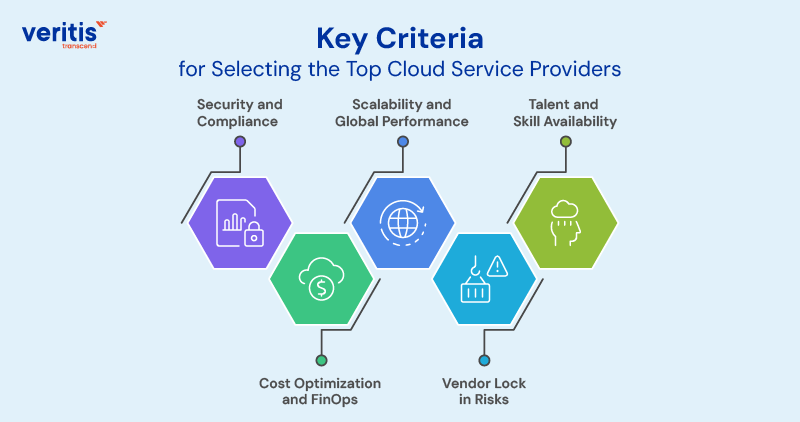
When evaluating top cloud service providers, executives should use a matrix that covers security and compliance (zero trust, HIPAA, GDPR), cost optimization and FinOps (hidden costs, cost reduction plans), global performance (auto scaling, region density), vendor lock in risk, and the skill ecosystem that can deliver next gen workloads.
1) Security and Compliance
A modern cloud platform must implement Zero Trust architecture, enforce identity centric controls, and deliver regulatory certifications, including HIPAA, SOC 2, ISO 27001, GDPR, and PCI DSS.
2) Cost Optimization and FinOps
Hidden costs, data transfer, snapshots, and backup retention can exceed what a pay as you go model predicts. A robust balance of reserved instances and savings plans reduces expenditure by 30% to 45% for steady state workloads.
3) Scalability and Global Performance
Auto scaling shards the risk of capacity bottlenecks. In 2026, AWS had 33 regions, Azure had 60+ geographies, and GCP had 35 regions. For latency sensitive workloads, rung level Sieg distributions matter.
4) Vendor Lock in Risks
Dependency on proprietary services, AWS Lambda, Azure Functions, and GCP Cloud Functions, creates migration friction. Embeddable Kubernetes, Terraform, and Open API standardization mitigate lock in.
5) Talent and Skill Availability
Given that the K factor is 28%, many organizations now turn to a trusted partner to close the skills gap. Veritis, a leading cloud consulting partner, can audit your current talent inventory, design customized SRE/DevOps roadmaps, and deliver tailored training programs that accelerate skill attainment and reduce time to value for your cloud initiatives.
Transition: Executives should consider partnering with Veritis, one of the best cloud consulting providers, which can benchmark your top cloud service providers comparison and architect a strategy that aligns seamlessly with your enterprise cloud providers’ architecture.
Useful link: Which AWS Cloud Management Tools Should You Use to Manage Your Business
Leading Top Cloud Service Providers in 2026
| Provider | 2026 Market Share | Key Strengths | Typical Enterprise Fit |
| Amazon Web Services (AWS) | 31% | Broad catalogue, largest ecosystem, groundbreaking compute innovations | High scale e commerce, SaaS, and workloads requiring the largest ability to spin up resources |
| Microsoft Azure | 23% | Deep integration with Windows Server, Office 365, Dynamics 365, and hybrid operating systems | Enterprises already invested in the Microsoft ecosystem, regulated industries |
| Google Cloud Platform (GCP) | 10% | AI, ML, big data stack; open source contributions | Data heavy, analytics, AI centric organizations |
AWS vs Azure vs Google Cloud market share figures illustrate a subtle shift. At the same time, AWS remains the leader, Azure’s hybrid market penetration and GCP’s AI suite have significantly narrowed the gap.
Evaluating Per Provider Value
- AWS: High scalability, extensive partner network; ideal for startups, SaaS, and applications with heavy traffic spikes.
- Azure: Excels in hybrid strategies and aligns closely with legacy Windows infrastructure.
- GCP: Dominates in ML, AI, and analytics workloads; fits data centric cloud solutions for enterprises interested in open source stacks.
Choosing a provider is thus a carefully balanced decision based on industry specific constraints and the maturity of your internal skill set.
Top Cloud Service Providers Comparison: AWS vs Azure vs Google Cloud Services Comparison
| Feature | AWS | Azure | GCP |
| Performance | Avg. 2.3 ms for EC2 in US East | Avg. 2.7 ms for VMs in US East | Avg. 2.5 ms for Compute Engine in US East |
| Security Certifications | 30+ (HIPAA, GovCloud, ISO 27017) | 30+ (SOC 2, ISO 27001, FedRAMP) | 25+ (ISO 27018, PCI DSS) |
| Customer Satisfaction (Net Promoter Score) | 56 | 53 | 61 |
| Pricing Model | Spot, Savings Plans, Managed Services | Reserved Instances, Azure Spot | Committed Use Discounts, Preemptible VMs |
| Strengths | Breadth of services; largest consumer base | Hybrid tools; deep Microsoft ecosystem | AI/ML; data analytics; open source |
| Weaknesses | Pricing complexity; steep learning curve | Slightly fewer niche services vs AWS | Smaller global footprint; region coverage < AWS |
| Ideal Use Cases | High traffic web services, SaaS platforms | Enterprise ERP, regulated workloads | Data pipelines, ML/AI, large scale analytics |
| Industry Best Fit | E-commerce, gaming marketplaces | Finance, HR, telecommunications | Research, pharma, fintech analytics |
| Learning Curve | High | Medium High | Medium |
Cloud consulting partners routinely refresh the above cloud service providers comparison to reflect the fast moving evolution in pricing, new service launches, evolving compliance requirements, and the latest AWS vs Azure vs Google Cloud market share insights, along with a comprehensive AWS vs Azure vs Google Cloud Services comparison.
Which Cloud Provider is Best for Your Industry?
| Industry | Recommended CSP(s) | Rationale | Example Use Case |
| Healthcare | Azure and Hybrid | HIPAA ready, Azure Policy integrating on prem SQL server | Telehealth data capture in multiple states |
| Financial Services | AWS and Multi cloud | Extensive compliance certifications; cross cloud redundancy | Low latency payments platform |
| Manufacturing | Azure and Edge (Azure IoT Central) | PLC integration, edge analytics, Digital Twin | Predictive maintenance for CNC machines |
| Automotive | Azure | Edge to cloud pipeline, ADAS simulation | Connected vehicle data ingestion |
| Energy and Utilities | Azure | Geo local compliance, Azure Sphere for edge | Solar farm data aggregation |
| Retail and E-commerce | AWS | Auto scaling, CloudFront CDN | Seasonal spike handling |
| Government | Azure and AWS (Hybrid) | FedRAMP, Sovereign clouds | Public sector citizen portal |
| AI and Data Centric Companies | GCP | Vertex AI, BigQuery, TPU acceleration | Real time anomaly detection |
The table reflects that the AWS vs Azure vs Google Cloud Services comparison must account for regulatory, technical, and cultural nuances.
Useful link: 5 Key Benefits of Implementing Cloud Financial Services for Your Business
Real World Use Cases of Top Cloud Service Providers
1) AWS for E-commerce
Problem: Scaling to 15× traffic during peak seasons.
Solution: Leveraged Amazon Aurora Serverless, Elastic Load Balancing, and Amazon CloudFront to provision compute automatically during demand spikes, while Savings Plans and Reserved Instances trimmed reserve costs.
Outcome: 38% reduction in peak season spend, 99.99 % uptime, and ability to launch new features in under 30 days.
2) Microsoft Azure for Healthcare
Problem: Encrypting PHI across multiple hospital sites.
Solution: Adopted Azure Confidential Compute for data at rest and Azure Policy for continuous compliance, while Azure Arc unified on prem and cloud SQL databases.
Outcome: 99.9% uptime, 100% HIPAA compliance within 90 days, and a 45% drop in audit red flags.
3) Google Cloud for AI/ML
Problem: Processing 5 PB of log data daily for anomaly detection.
Solution: Built BigQuery ETL pipelines, leveraged Vertex AI for model training, and slotted GPU accelerated TPU v4 for inference.
Outcome: 2.3× faster model training, 15% lower TCO than a comparable AWS deployment, and a 40 % increase in detection accuracy.
These real world success stories underscore that there is no one size fits all AWS vs Azure vs Google Cloud services comparison; an engaging mix must also consider the latest AWS vs Azure vs Google Cloud market share data and the unique priorities of each enterprise.
Why Most Enterprises Need a Cloud Consulting Partner?
| Statistic | What Does it Mean? | Implication for Strategy |
| 30 to 60% of cloud spend is wasted | Inefficient rightsizing, underutilized resources | Need a sound FinOps led life cycle management |
| 85% of cloud breaches stem from misconfigurations | Lack of deep security expertise | Mandatory policy as code governance and audits |
| 70% of migrations miss timelines and budgets | Over ambitious roll outs, underestimated complexity | Need orchestrated migration frameworks |
Placing a cloud consulting partner, such as Veritis, one of the industry’s leading cloud service providers, at the core of your cloud journey eliminates the friction points outlined below:
1) Migration Complexity: Guided discovery and incremental lift and shift transitions powered by Veritis’ proven methodology.
2) Security Misconfiguration Risk: Continuous compliance checks with CSPM tools, and automated policy as code driven by Veritis’ security framework.
3) Cost Overruns: Real time FinOps dashboards, automated rightsizing, and dynamic cost optimization scripts that Veritis runs as part of its managed service offering.
4) Multi Cloud Governance: Unified policy engines that span AWS, Azure, and GCP, delivered by Veritis’ cross vendor orchestration platform.
5) Skill Gaps: Multi vendor certification blueprints and dynamic knowledge transfer initiatives directly from the Veritis talent team.
Veritis brings these capabilities together into a single, cohesive offering: a cloud consulting partner, a managed cloud services provider, and a cloud modernization services library that accelerates solution rollouts and integrates smoothly with any enterprise cloud ecosystem. With an up to date understanding of the AWS vs Azure vs Google Cloud market share and the broader ecosystem of public cloud service providers, Veritis helps you select the right mix of platforms and services. As your partner, Veritis delivers strategic guidance, operational execution, and continuous stewardship that every enterprise needs to thrive in a multi cloud world.
Managed Cloud Services: Why They Are Crucial for Enterprises?
A managed cloud services provider continuously moves beyond onboarding to enablement.
- 24/7 Monitoring and Incident Response: Immediate alerts, automated rollback, and holistic dashboards.
- Cost Optimization: FinOps as a Service, right size automation.
- Security and Compliance: CSPM (cloud security posture management) integration, policy as code enforcement.
- Performance Tuning: Micro benchmarking, autoscaling rules, storage tier analysis.
- DevOps Automation: CI/CD pipelines, IaC compliance, automated roll through.
Veritis is a managed cloud services provider that delivers these capabilities through a unified platform built on leading public cloud service providers. Our cloud managed services offerings enable enterprises to treat the cloud as an operating system, allowing internal teams to focus on strategic growth and higher value initiatives.
This is where our cloud consulting partner and managed cloud services provider roles converge, creating a single vendor that future proofs your operations while freeing up your IT spend and skill streams.
Useful link: Cloud Computing Market Share Analysis: Strategic Takeaways for Business Leaders
Top Cloud Service Providers Comparison Based on SLAs and Uptime
| Provider | Core SLA Guarantee | Real World Uptime (2025 Q3) | Key Notes |
| AWS | 99.99 % for EC2, RDS, S3 | 99.97% | Advanced health checks, global edge recovery |
| Azure | 99.95 % for VMs, SQL Databases | 99.93% | Integrated Azure Arc for unified visibility |
| GCP | 99.95 % for Compute Engine, Cloud Storage | 99.94% | Deep learning focused uptime guarantees |
These metrics demonstrate that, while AWS may claim a slightly higher SLA, all three leading top cloud service providers maintain the same high reliability baseline. Choosing a provider, however, must still factor in the cost model and compliance pedigree for critical workloads.
How to Choose the Right Cloud Strategy (Decision Framework)?
1) Single Cloud vs Multi Cloud vs Hybrid
| Strategy | Pros | Cons | Typical Use Case |
| Single Cloud | Simplicity, lower overhead | Vendor lock in, single point of failure | MVP, small to mid size cloud solutions for enterprises |
| Multi Cloud | Best of breed, risk diversification | Complex governance, higher latency | Global reach, regulatory compliance |
| Hybrid | Data sovereignty, legacy integration | Network complexity, management overhead | Regulatory heavy, on prem legacy workloads |
2) Typical Enterprise Cloud Migration Roadmap
1) Assessment: Inventory, dependency mapping, cost baseline, SOC 2 readiness.
2) Planning: Architecture blueprint, governance policy, migration wave prioritization.
3) Migration: lift and shift, re platform, refactor via IaC.
4) Optimization: FinOps, rightsizing, cost drift mitigation.
5) Continuous Management: Managed services, automated compliance, performance reviews.
3) Cloud Cost Optimization Strategy
- FinOps Discipline: Cross functional budget ownership, real time billing insights.
- Right Sizing: Deploy cost analysis scripts, use AWS Cost Explorer, Azure Cost Management, and GCP Billing Reports.
- Governance: Tagging mandates, budget alerts, and auto shutdown of idle VMs.
A structured cloud strategy can reduce operating spend inefficiency by up to 40%.
How Veritis Helps Enterprises Succeed in the Cloud?
| Service Area | What Veritis Delivers? | Value to Your Enterprise |
| Cloud Strategy Consulting | Market driven provider recommendation, hybrid architecture design | You’ll occupy a cloud consulting partner like Veritis that turns strategy into measurable milestones |
| Migration Services | End to end lift and shift, re platform, API gateway integration | Faster time to value, lower risk migration trajectory |
| Managed Cloud Services | 24/7 monitoring, FinOps as a service, CSPM integrations | Your cloud becomes a 24/7 operating system, freeing your internal talent |
| Cost Optimization | Custom FinOps dashboards, savings plan negotiation | Real time visibility, 25 to 45% reduction in spend. |
| Security and Compliance | Zero trust design, audit readiness, breach response playbooks | Certified to meet HIPAA, SOC 2, ISO 27001, and GDPR. |
Because Veritis is a dedicated cloud consulting partner and managed cloud services provider, we are uniquely positioned to handle both the cloud modernization services you need and the continuous, performance driven stewardship you expect from the best cloud consulting providers.
Case Study: Multi Cloud Governance and Cost Optimization
Client Overview
The client is a large enterprise operating across North America and Europe, supporting more than 15 million end users through mission critical digital platforms. With aggressive expansion plans and strict regulatory requirements, the organization was running a complex hybrid and multi cloud environment across three leading public cloud service providers. Rapid growth, combined with distributed teams and evolving compliance mandates, necessitated stronger governance, cost discipline, and operational consistency.
Problem
- Cloud spend is increasing by over 30% year over year
- Limited visibility into usage, resulting in overprovisioned and idle resources
- Repeated audit observations due to inconsistent security configurations
- Fragmented governance across AWS, Azure, and GCP environments
Solution
- Implemented a centralized multi cloud governance framework
- Deployed FinOps dashboards with automated rightsizing and cost controls
- Enforced policy as code and Zero Trust security architecture
- Integrated 24/7 monitoring with unified identity and access management
Results
- 32% reduction in cloud operating costs within six months
- 99.98% uptime across production workloads
- 100% audit readiness for regulatory assessments
- 40% faster deployment of new cloud workloads
Conclusion
The cloud ecosystem is not a rallying point for convenience; it has become a cornerstone of business resilience. There is never a single best cloud consulting providers that satisfies all requirements. Instead, a balanced architecture built on a cloud service providers comparison of the leading public cloud service providers, tempered with a cloud modernization services strategy, is crucial.
Selecting a cloud consulting partner, ideally the best cloud consulting providers that also serve as a managed cloud services provider, makes the difference between surfing the wave and skyrocketing your competitive advantage.
Planning a cloud migration or optimization? Talk to Veritis, your trusted cloud consulting partner, today to build a custom, ROI driven cloud strategy that aligns with your organization’s unique ambitions.