Table of contents
- Why AWS Cloud Migration Is Essential for Business Growth
- Understanding the AWS Cloud Migration Process
- Key AWS Cloud Migration Strategies
- AWS Cloud Migration Tools and Services
- Overcoming Challenges in AWS Cloud Migration
- The Role of Cloud Migration Consulting Services
- Core Benefits of AWS Cloud Migration
- How AWS Cloud Migration Compares to Azure and GCP
- Case Study: AWS Cloud Adoption for a Leading Airline
- Why Choose Veritis for AWS Cloud Migration?
- Conclusion
Enterprises that complete a well governed AWS cloud migration consistently report lower infrastructure costs, faster time to market, and measurable competitive advantage. This guide covers every stage of the journey, from strategy and tooling to real world outcomes, giving IT leaders the insights needed to plan migrations with confidence.
Why AWS Cloud Migration Is Essential for Business Growth?
AWS cloud migration has become a strategic priority for enterprises that want to scale efficiently and remain competitive. AWS provides more than 200 fully featured services spanning computing, analytics, storage, databases, CI/CD pipelines, and artificial intelligence, making it suitable for businesses of every size and sector.
Migrating to AWS enables organizations to achieve several critical objectives:
- Increased Productivity: Automating repetitive processes frees teams to focus on high value work.
- Reliable, Consolidated Data Centers: AWS storage solutions improve data security, accessibility, and governance.
- Operational Flexibility: A scalable infrastructure simplifies integration after mergers or acquisitions.
- Enhanced Infrastructure Capacity: Businesses can adjust resources to meet demand without heavy capital expenditure.
- Cost Optimization: Pay as you go pricing eliminates unnecessary on premises hardware spend.
- Faster Time to Market: Advanced computing capabilities accelerate product development and service delivery.
With these advantages, it is no surprise that thousands of organizations worldwide rely on AWS cloud migration to drive meaningful growth.
Book a Call with Our AWS Experts
Understanding the AWS Cloud Migration Process
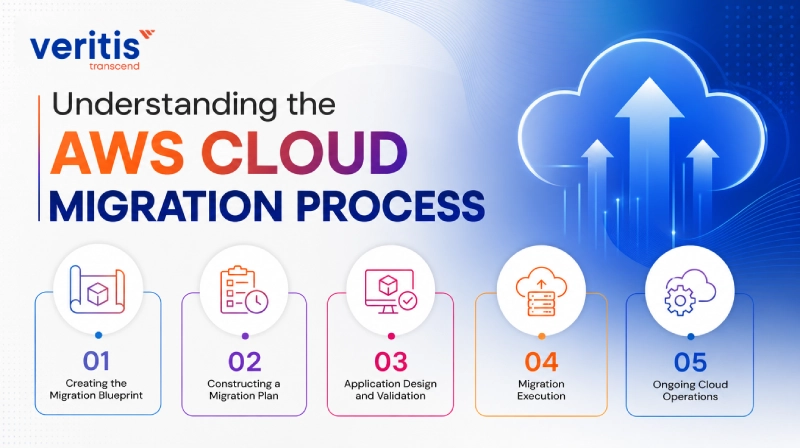
A successful migration to AWS follows a structured, five phase approach tailored to each organization’s environment and goals.
Phase 1: Creating the Migration Blueprint
The foundation of any migration project is a clear business framework. This involves auditing existing IT infrastructure, identifying applications and data sets for migration, and aligning migration objectives with broader business strategy. A well defined blueprint prevents scope creep and keeps every stakeholder aligned.
Phase 2: Constructing a Migration Plan
With the blueprint approved, teams map the interdependencies between applications and systems, then select the right AWS cloud migration strategies for each workload. Detailed planning at this stage reduces the risk of disruption during execution.
Phase 3: Application Design and Validation
Teams design, migrate, and validate individual applications to confirm they perform optimally in the AWS environment. AWS provides six common application migration strategies, known as the 6 Rs, giving teams a proven framework for every scenario.
Phase 4: Migration Execution
Migration begins with critical workloads and scales progressively. AWS cloud migration tools and consulting services automate repetitive tasks, reduce downtime, and lower overall cloud migration risk. Expert guidance during this phase ensures alignment with long term business objectives.
Phase 5: Ongoing Cloud Operations
Post migration, the focus shifts to continuous optimization. Regular monitoring, cost management, and iterative improvements keep the AWS environment aligned with evolving business needs and maximize return on investment.
Key AWS Cloud Migration Strategies
Choosing the right strategy is critical to a smooth and cost effective migration. Understanding common cloud migration challenges before selecting a strategy allows teams to account for complexity early.
1) Forklift (Lift and Shift) Migration Strategy
This approach moves entire systems to AWS with minimal code changes. It suits stateless, self contained, or tightly coupled applications where speed is the priority. The trade off is that it may not fully exploit AWS’s native elasticity and scalability features.
2) Hybrid Migration Strategy
The hybrid approach migrates system components incrementally. It suits complex environments with multiple interdependent applications, allowing teams to test and optimize each component before full cutover. This strategy takes longer but significantly reduces post migration errors and business disruption.
For a step by step breakdown of moving workloads off physical hardware, see 5 Steps for a Successful On Premise to Cloud Migration.
Useful link: Top 7 AWS Cost Optimization Tools
The 6 Rs Framework
Beyond these two core strategies, evaluate every workload against the 6 Rs, the migration decision model popularized by AWS and derived from Gartner’s original 5 Rs research. Mapping each application to one of these paths before execution is the single most effective way to control cost, risk, and timeline.
| Strategy | Description | Best for |
| Rehost (Lift and Shift) | Move to AWS with no code changes | Large scale, time sensitive migrations |
| Replatform (Lift, Tinker, and Shift) | Minor optimizations, e.g., move to Amazon RDS | Capturing early gains with modest effort |
| Repurchase (Drop and Shop) | Replace licensed app with SaaS equivalent | Removing on premises maintenance overhead |
| Refactor (Re architect) | Redesign as cloud native with microservices or serverless | Highest long term scalability and performance |
| Retire | Decommission redundant or unused applications | Reducing migration scope and ongoing cost |
| Retain (Revisit) | Keep workloads on premises for now | Compliance constraints or recent capital investment |
A disciplined 6 Rs assessment turns a vague “move to the cloud” mandate into a workload by workload plan with clear ownership, sequencing, and expected outcomes. The AWS Cloud Adoption Framework provides additional governance structure that complements this model.
AWS Cloud Migration Tools and Services
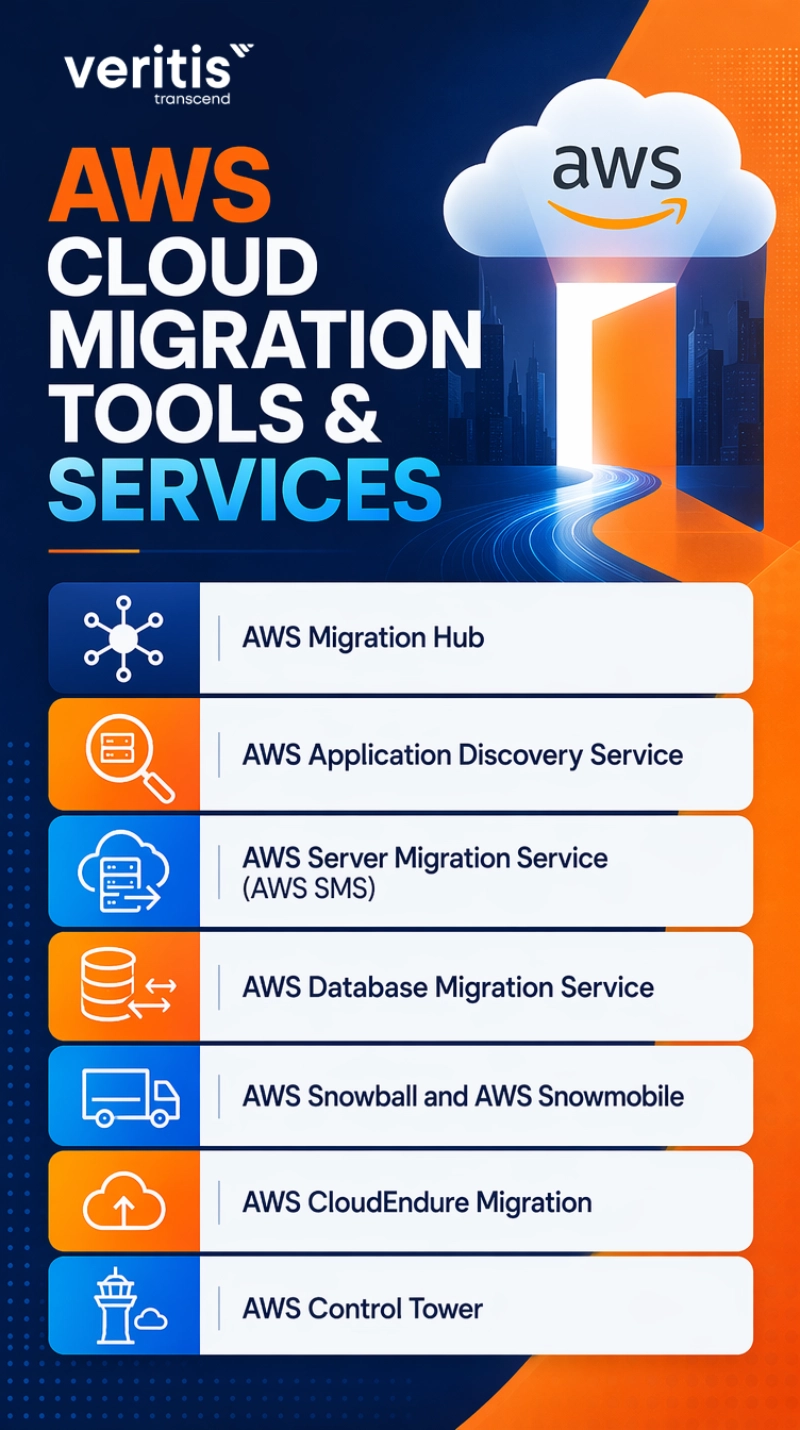
AWS offers a complete suite of migration tools designed to simplify every stage of the journey.
- AWS Migration Hub: A centralized dashboard for tracking migration progress across all applications, providing full visibility into status and blockers.
- AWS Application Discovery Service: Gathers detailed configuration, usage, and behavior data from on premises data centers to inform migration planning.
- AWS Application Migration Service (AWS MGN): The primary lift and shift service that automates the conversion and replication of source servers to run natively on AWS with minimal downtime, superseding the earlier Server Migration Service and CloudEndure Migration.
- AWS Database Migration Service (AWS DMS): Supports both commercial and open source database migrations, enabling continuous replication with minimal downtime for homogeneous and heterogeneous migrations.
- AWS Snowball and AWS Snow Family: Provide secure, large scale physical data transfer solutions for organizations migrating petabytes of data to AWS.
- AWS Control Tower: Establishes a secure, well governed multi account AWS environment from day one, reducing configuration risk.
Used together, these tools create a structured, automated migration workflow that minimizes manual effort and operational risk. Teams looking to extend their toolkit should also review the leading AWS cloud management tools that support day two operations after migration is complete.
For enterprises that want this workflow designed, executed, and governed end to end, Veritis delivers it through its dedicated Migration Services practice.
Overcoming Challenges in AWS Cloud Migration
Even well planned migrations encounter obstacles. Recognizing common cloud migration challenges in advance allows teams to address them proactively.
1) Defining Clear Business Goals
Without specific, measurable objectives, migration efforts risk drifting off course. Define success metrics, cost savings, performance benchmarks, and time to market targets before the project begins.
2) Building Internal AWS Knowledge
Teams unfamiliar with AWS can slow the migration and increase error rates. Structured training, AWS certification programs, and hands on labs close the skills gap quickly.
3) Data Security and Compliance
Protecting sensitive data in transit and in the cloud is non negotiable. AWS provides encryption, identity management, and compliance frameworks including HIPAA, GDPR, and SOC 2, but organizations must also actively configure and monitor these controls.
4) Cost Visibility and Budget Management
Cloud costs can grow unexpectedly without proper governance. AWS Cost Explorer, Budgets, and tagging strategies give finance and engineering teams the visibility needed to stay on track. Pairing these native controls with proven AWS cost optimization tools helps prevent bill shock after go live.
5) Minimizing Application Downtime
Downtime during migration directly impacts revenue and customer experience. Phased migration, blue green deployments, and comprehensive rollback plans reduce this risk substantially.
6) Managing Legacy System Complexity
Older applications with undocumented dependencies can stall migration projects. A thorough discovery and dependency mapping exercise during Phase 1 prevents surprises during execution.
Addressing these challenges systematically through experienced cloud migration consulting services separates successful migrations from costly ones.
The Role of Cloud Migration Consulting Services
Cloud migration consulting services offer the expertise and independent perspective most internal teams lack when approaching a large scale migration for the first time. Experienced consultants:
- Assess existing infrastructure objectively and identify migration readiness gaps.
- Design a tailored AWS cloud migration strategy aligned to business goals.
- Select and configure the right mix of AWS migration tools.
- Manage risk throughout the project lifecycle.
- Optimize the cloud environment post migration to maximize ROI.
Partnering with a specialist consulting firm reduces the likelihood of cloud migration failure, shortens delivery timelines, and ensures the business captures the full value of its AWS investment from day one.
Core Benefits of AWS Cloud Migration
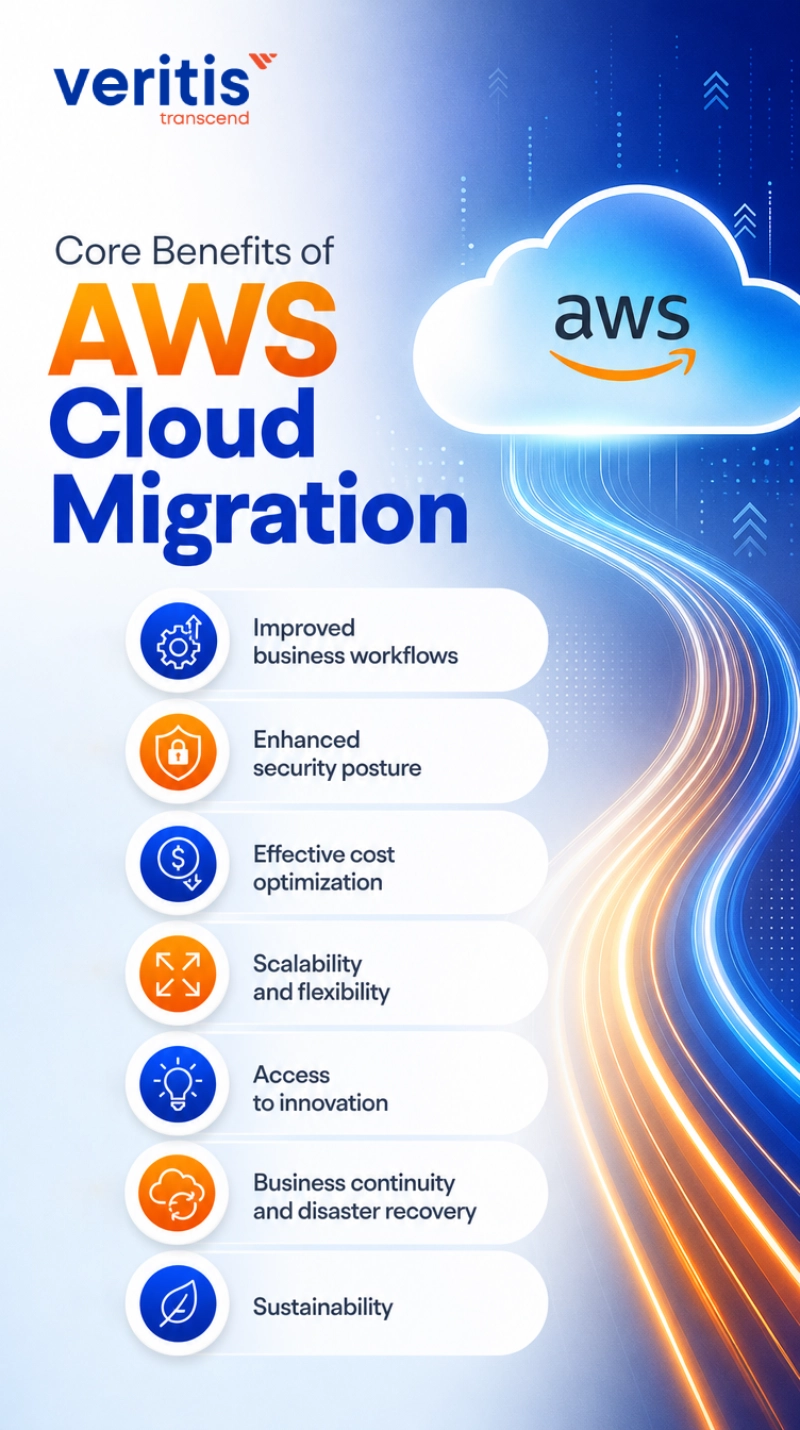
Organizations that complete a well executed AWS cloud migration consistently report measurable improvements across several dimensions.
- Improved Business Workflows: Automation and streamlined processes increase team output without increasing headcount.
- Enhanced Security Posture: AWS’s shared responsibility model, combined with native security services, provides enterprise grade protection for data and applications.
- Effective Cost Optimization: Pay as you go pricing and right sizing tools reduce wasted spend compared to fixed on premises infrastructure.
- Scalability and Flexibility: Resources scale up or down in minutes, allowing companies to respond to market changes without infrastructure constraints.
- Access to Innovation: AWS’s AI, machine learning, and data analytics services enable teams to build differentiated products and services faster.
- Business Continuity and Disaster Recovery: Multi region architecture and automated failover keep operations running even during unexpected disruptions.
- Sustainability: AWS’s energy efficient infrastructure and carbon reduction commitments support corporate environmental goals.
How AWS Cloud Migration Compares to Azure and GCP
AWS is the market leader, but enterprise decisions often involve a three way comparison before committing to a primary cloud provider. The key differentiators for most organizations are service depth, pricing model, and ecosystem maturity.
- AWS offers the broadest global footprint, the widest managed services catalog, and the deepest partner ecosystem, making it the default choice for enterprises prioritizing breadth and reliability.
- Azure is the strongest option for organizations already invested in Microsoft 365 and Windows Server workloads, with native Active Directory integration and hybrid connectivity through Azure Arc.
- GCP leads on data analytics and machine learning infrastructure, particularly for organizations already using Google Workspace or BigQuery heavy workloads.
For a detailed side by side evaluation of pricing and services, see the AWS vs Azure vs GCP cloud cost comparison and the AWS vs Azure vs GCP migration breakdown infographic. For a focused two way comparison, the AWS vs Azure cloud overview covers the most common enterprise decision points.
For most mid to large US enterprises undergoing digital transformation, AWS’s combination of service depth, compliance certifications, and partner maturity makes it the lowest risk platform for a primary cloud migration.
Case Study: AWS Cloud Adoption for a Leading Airline
Cloud migration solutions are not simply an infrastructure upgrade. They are a strategic move that delivers lasting improvements in efficiency, scalability, and service reliability. For a comparable real world example from a different sector, see the cloud migration and IT infrastructure support case study from the multimedia industry.
Challenge: A major airline operated on a traditional IT setup that lacked agility and created high operational overhead. As passenger volumes and operational complexity grew, the airline needed flexible, automated infrastructure that could scale on demand and support continuous service delivery.
Veritis Solution: Rather than applying a generic template, Veritis designed a tailored AWS migration strategy focused on infrastructure automation and orchestration. Leveraging native AWS services and automation frameworks, Veritis transitioned the airline from manual infrastructure management to a fully orchestrated, cloud based environment. The solution included an enterprise grade public cloud architecture with automated provisioning and management pipelines.
Business Impact:
- Automated infrastructure management: Reduced manual intervention and accelerated deployment cycles significantly.
- Scalable cloud environment: AWS architecture supported business growth without adding operational complexity.
- Improved service continuity: Orchestrated workflows enhanced system reliability and minimized downtime.
- Operational efficiency: Optimized resource utilization lowered overall costs across the organization.
This initiative shows how combining AWS cloud migration with infrastructure automation delivers tangible, measurable gains, particularly in sectors like aviation, where reliability and scalability are mission critical.
[Explore the full case study: Infrastructure Automation and Orchestration for Airlines Client]
Why Choose Veritis for AWS Cloud Migration?
Veritis is a trusted AWS cloud migration partner with more than 21 years of market presence and over 600 successfully delivered projects. Our AWS Certified cloud consultants deliver fully managed AWS hosting, comprehensive infrastructure management, and 24/7 support, all customized to your specific business needs. As a Texas based IT consulting firm and AWS Partner, Veritis serves mid to large enterprises across regulated and high growth industries.
What Sets Veritis Apart:
- End to end service: From migration blueprint to post migration optimization, Veritis manages every phase of your AWS journey through its dedicated Migration Services practice.
- Certified expertise: Our consultants hold certifications across AWS, Azure, and GCP, ensuring you receive advice grounded in real world, multi cloud experience.
- Database migration specialization: Veritis delivers zero disruption migrations from legacy databases including Oracle, SQL Server, MySQL, PostgreSQL, and NoSQL into AWS managed services such as RDS, Aurora, and DynamoDB, using the AWS Database Migration Service framework with a focus on 100% data integrity.
- Cloud native Kubernetes migration: In 2026, Veritis launched Veritis EKS Launchpad on AWS Marketplace, a professional services offering that migrates enterprise Kubernetes workloads to Amazon EKS, EKS Anywhere, and AWS Outposts. It includes customized architecture assessments, security hardening to CIS benchmarks, GitOps and CI/CD integration, and full stack observability.
- Extended AWS portfolio: Beyond migration, Veritis provides capacity expansion, disaster recovery failover, DevOps on AWS automation, governance, and multi cloud consulting spanning AWS, Azure, and GCP.
- Award winning delivery: Veritis is a Stevie Award and Globee Business Award winner, recognized for excellence in technology services and client satisfaction.
- Customized strategies: No two migrations are identical. Veritis builds a strategy around your architecture, risk tolerance, and business goals.
Useful link: AWS Storage Gateway: A Bridge to Hybrid Cloud Storage
Conclusion
Enterprises that want to accelerate business growth with AWS cloud migration need more than the right tooling. They need a disciplined methodology, a clear 6 Rs workload assessment, and an experienced partner who has navigated the complexity before.
As a trusted cloud migration company, Veritis brings the tools, expertise, and proven methodology needed to migrate data, applications, and entire infrastructure environments while maximizing the return on your AWS investment. Our cloud migration strategy aligns technical execution with business priorities, helping enterprises reduce risk, control costs, and achieve long term value.
The strategic takeaway for IT leaders is straightforward. Migration success is decided long before workloads move. Enterprises that pair a disciplined 6 Rs assessment with an experienced partner consistently avoid the planning gaps, dependency surprises, and cost overruns that derail first time migrations.
Ready to migrate to AWS? Contact Veritis today to receive a customized cloud migration plan.