Table of contents
Artificial Intelligence (AI) has become a game changer in the ever shifting digital security landscape, introducing advanced techniques to combat evolving threats. Integrating AI into cybersecurity is not merely a trend but a strategic imperative for countless organizations, revolutionizing defense mechanisms against cyber threats.
According to a groundbreaking report by MarketsandMarkets, the global AI in cybersecurity market is set to skyrocket from USD 8.8 billion in 2020 to an astonishing USD 38.2 billion by 2026, with a CAGR of 23.3%. This surge is propelled by the urgent need to counteract the rising tide of cyber threats amid a shortage of skilled cybersecurity professionals.
In this dynamic field of digital fortification, the collaboration between AI and cybersecurity stands as a formidable force. As the virtual battleground expands and adversaries grow more sophisticated, AI and cybersecurity become beacons of innovation and resilience. The statistics underscore this narrative of evolution, projecting that the global AI market is on track to reach a monumental USD 1.5 trillion by 2025 (Source: Statista). The investment landscape reflects this momentum, with over 25% of 2023 funding for US based startups going to AI companies (Source: Crunchbase).
Internally, AI is already making waves: 65% of companies have integrated it into operations, and an additional 74% are actively testing its potential applications (Source: Deloitte). This disruptive force extends across sectors, promising widespread innovation in healthcare, finance, manufacturing, and retail (Source: McKinsey & Company). The World Economic Forum predicts a wave of job creation, potentially yielding millions of new opportunities, underscoring the transformative impact of AI.
Shifting the focus to cybersecurity, the urgency for robust defenses is highlighted by a projected USD 300 billion global cybersecurity market by 2027 (Source: Gartner). The rising cost of data breaches, averaging USD 4.35 million per incident (Source: IBM), emphasizes the need for innovative AI cybersecurity solutions.
Enter AI: a catalyst for enhancing cybersecurity, not just for detecting and preventing attacks but also for identifying and remediating vulnerabilities (Source: Forbes). The demand for skilled cybersecurity professionals is set to surge by 33% by 2030 (Source: U.S. Bureau of Labor Statistics), underscoring the critical role these experts play in fortifying our digital future.
Embark on a journey through the domains where cutting edge algorithms meet the relentless challenges of cyberspace. This blog unwraps the symbiotic relationship between AI and cybersecurity, offering insights into their profound impact on safeguarding our digital frontiers.
What is the Significance of AI in Cybersecurity?
In the dynamic field of cybersecurity, the pillars of modern defense systems are built on data collection and AI algorithms. These advanced technologies enable automated decision making and evaluation, providing a broader range of protection against malicious activity than traditional AI cybersecurity solutions. Instead of relying on slow malware databases, AI cybersecurity takes a proactive approach by continuously monitoring devices for signs of suspicious behavior.
Looking ahead, Gartner, a prominent IT research firm, warns that 60% of digital businesses face substantial losses due to insufficient management of cybersecurity risks. This ominous forecast has compelled businesses to recognize the urgent need for effective risk management strategies. Consequently, 79% of executives worldwide now prioritize cybersecurity risk management as a top concern.
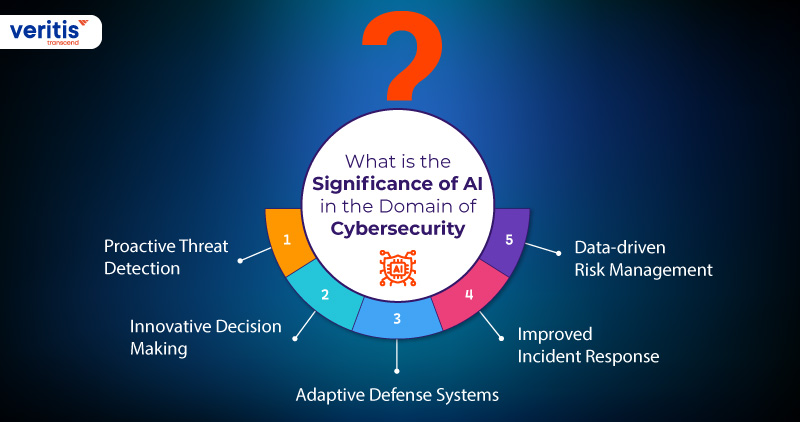
The surge in high profile AI security breaches has catalyzed organizations to accelerate AI adoption and embrace the potential of data driven, AI fueled cybersecurity solutions. These groundbreaking methods provide a multitude of advantages, including:
1) Proactive Threat Detection
Harnessing AI in cybersecurity real time monitoring capabilities empowers organizations to detect and respond to threats swiftly, minimizing the potential impact of breaches. Unlike traditional reliance on outdated signatures, AI systems continuously scrutinize data streams, adeptly identifying even the most nuanced indicators of malicious activity.
2) Innovative Decision Making
AI cybersecurity algorithms excel at processing large volumes of data and making informed decisions in real time. This capability enables organizations to automate essential AI security processes, including incident response and risk assessment, freeing up valuable time and resources for proactive threat hunting.
3) Adaptive Defense Systems
In a domain where cyber threats constantly evolve, organizations require defense systems that can adapt accordingly. AI powered solutions, with their capacity to learn and adjust to novel attack patterns, significantly enhance their capability to identify and thwart emerging threats. This adaptive approach ensures that organizations remain proactive in the ever changing cybersecurity terrain.
4) Improved Incident Response
The swift proliferation of cyber threats demands an agile and effective incident response. Leveraging AI algorithms enables organizations to automate incident detection, analysis, and containment, reducing response times and mitigating potential damage.
5) Data Driven Risk Management
By integrating AI and data analytics, organizations can gain deeper insights into their AI security posture and vulnerabilities. AI in cybersecurity: Comprehensive analysis of large datasets enables pattern identification, highlights potential cybersecurity risks, and provides actionable intelligence critical to effective AI risk management.
Useful link: What is Generative AI: An Ultimate Guide to Amazon Generative AI Tools
Applying AI in Cybersecurity
Artificial intelligence in cybersecurity is exceptionally well suited to tackle some of the most challenging issues, and cybersecurity undoubtedly falls within this category. Given the constant evolution of cyber attacks and the surge in device proliferation, machine learning and artificial intelligence in cyber security applications become instrumental in “keeping up with the bad guys.” This involves automating threat detection and responding more efficiently than conventional software driven approaches.
Simultaneously, cybersecurity introduces distinct challenges:
- An extensive attack surface
- Thousands of devices per organization
- Numerous attack vectors
- Significant shortages in the number of proficient security professionals
- Overwhelming volumes of data have surpassed the scale manageable by humans
A self learning, AI driven cybersecurity posture management system can address numerous challenges. Existing technologies enable practical training for such a system, allowing it to collect data autonomously and continuously from various information systems within your enterprise. Subsequently, this data is analyzed to correlate patterns across millions to billions of signals about the enterprise attack surface.
The outcome is a heightened level of intelligence that supports human teams across a spectrum of cybersecurity categories, encompassing:
1) IT Asset Inventory
IT Asset Inventory involves compiling a comprehensive, accurate list of all devices, users, and applications that have access to information systems. The process includes categorizing and measuring artificial intelligence in business, which significantly improves inventory management.
2) Threat Exposure
Threat Exposure involves recognizing that hackers, like anyone else, follow trends that change regularly. AI cybersecurity companies’ systems can offer real time insights into global and industry specific threats. This facilitates crucial prioritization decisions based on potential threats to your enterprise and the likelihood that specific methods will be used in an attack.
3) Evaluating the Effectiveness of Controls
Evaluating the effectiveness of controls is crucial to understanding the impact of the security tools and processes implemented to maintain a robust artificial intelligence security posture. AI cybersecurity companies play a pivotal role in assessing the strengths and identifying gaps within your information security program.
4) Breach Risk Prediction
Breach risk prediction involves considering IT asset inventory, threat exposure, and control effectiveness. AI Automation tools and AI based systems can anticipate the most probable scenarios and locations of potential breaches. This insight enables strategic planning for allocating resources and tools to address vulnerabilities. Prescriptive guidance from artificial intelligence in cybersecurity analysis helps you configure and optimize controls and processes to enhance your organization’s cyber resilience.
5) Incident Response
Incident Response involves leveraging AI powered systems to enhance contextual understanding and swiftly prioritize and respond to artificial intelligence security alerts. This enables prompt responses to incidents, identification of root causes, mitigation of vulnerabilities, and preemption of future issues.
Useful link: Overcoming Challenges: Implementing Generative AI in Healthcare
Benefits of AI in Cybersecurity
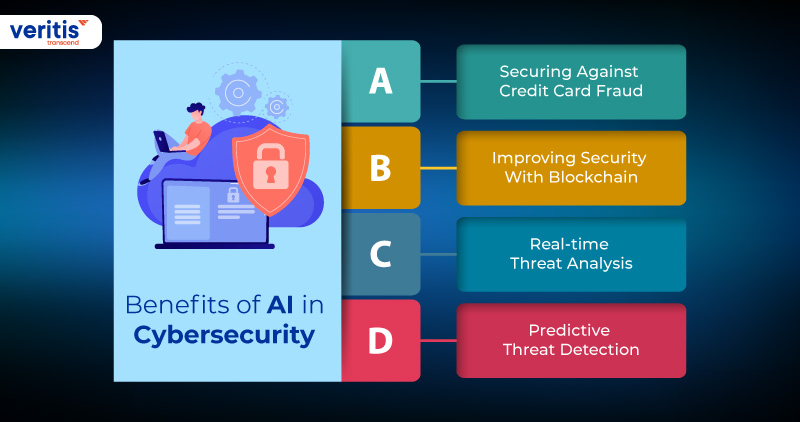
Implementing AI in Cybersecurity can yield significant advantages. This section will explore some of the key benefits.
1) Securing Against Credit Card Fraud
AI driven cybersecurity solutions, powered by AIOps services, play a pivotal role in thwarting credit card fraud. These intelligent systems can swiftly identify unusual activities, such as transactions from unfamiliar devices or atypical spending patterns, helping validate the legitimacy of credit card holders. Additionally, machine learning algorithms guide users in choosing robust, secure passwords and issue warnings when their selections do not meet recommended best practices. Together, these measures strengthen defenses against fraudulent activities.
2) Improving Security With Blockchain
The advent of cryptocurrencies, including Bitcoin and Ethereum, has highlighted the innovative possibilities inherent in Blockchain technology. As a secure, decentralized foundation for storing transaction records, Blockchain’s utility extends beyond finance, with applications in areas such as medical records and security management. Leveraging Artificial Intelligence in Finance, organizations can use Blockchain to identify and remediate potential vulnerabilities related to criminal identity, thereby safeguarding the integrity and security of sensitive data. The inherently distributed nature of Blockchain makes tampering with stored information nearly impossible, providing a substantial boost to AI driven financial and cybersecurity efforts.
3) Real Time Threat Analysis
The escalating volume of online content makes manually examining every website for potential threats overwhelming. Here’s where the strength of AI for cybersecurity comes to the forefront. Implementing AI powered solutions enables organizations to analyze and categorize website visits in real time, distinguishing visitors by threat level. This capability facilitates prompt responses to suspicious or malicious activities. With AI at the helm, organizations can navigate the expansive digital landscape with agility, ensuring swift and effective responses to emerging threats.
4) Predictive Threat Detection
By harnessing a blend of conventional threat intelligence and state of the art machine learning algorithms, AI for cybersecurity is transforming the threat detection landscape. It allows organizations to identify potential risks and vulnerabilities in their data proactively. AI’s ability to analyze large datasets enables it to identify anomalies and gaps that might go unnoticed by human reviewers. This early awareness equips organizations to respond promptly to threats, securing their digital infrastructure without tipping off potential perpetrators.
Useful link: AIOps Use Cases: How Artificial Intelligence is Reshaping IT Management
How Hackers Abuse AI
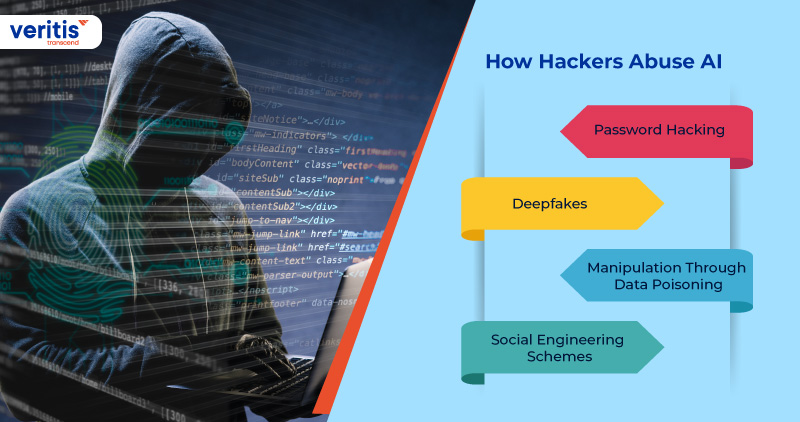
Regrettably, cybercriminals display unwavering persistence and resourcefulness. Let’s examine various methods through which they leverage AI to their advantage:
1) Password Hacking
Cybercriminals use AI to refine algorithms for decrypting passwords. The improved algorithms enable swifter and more precise password guessing, enhancing hackers’ efficiency and profitability. This trend may lead to increased focus on password hacking by cybercriminals.
2) Deepfakes
This deception exploits AI’s ability to manipulate visual or audio content effortlessly, creating an appearance of authenticity. This encompasses the use of fabricated audio and video to impersonate someone else. The manipulated content can be rapidly disseminated online, including on prominent social media platforms, inducing consumer stress, fear, or confusion.
Cybercriminals can employ deepfakes alongside social engineering, extortion, and other tactics.
3) Manipulation Through Data Poisoning
Hackers engage in “poisoning,” modifying the training data used by an AI algorithm to influence the decisions it ultimately makes. The algorithm is exposed to misleading information, resulting in erroneous output.
Moreover, detecting data poisoning can prove challenging and time intensive. Consequently, when discovered, the damage may be extensive.
4) Social Engineering Schemes
Social engineering schemes involve manipulating individuals psychologically to elicit sensitive information or induce security lapses. These include fraudulent activities such as phishing, vishing, and business email compromise.
AI facilitates the automation of numerous processes in social engineering attacks, creating more personalized, sophisticated, and compelling messages to deceive unsuspecting victims. This empowers cybercriminals to execute more attacks in less time and with a higher likelihood of success.
Conclusion
In recent years, the indispensable role of AI has become increasingly evident in enhancing the capabilities of human information security teams. Faced with the challenge of securing a dynamic enterprise attack surface, traditional human efforts alone are insufficient. AIOps solutions deliver crucial analysis and threat identification, enabling artificial intelligence and cybersecurity professionals to take prompt action, reducing breach risk, and elevating overall security posture.
In the security domain, AI proves invaluable by efficiently identifying and prioritizing cybersecurity risks, promptly detecting malware within networks, guiding incident response, and preemptively detecting intrusions before they manifest.
Veritis, a distinguished recipient of the Stevie and Globee Business awards, is a leading expert in delivering tailored AI cybersecurity solutions to your organization’s unique requirements. Leveraging AI, Veritis empowers cybersecurity teams to establish potent human machine partnerships that transcend the limitations of conventional approaches. This synergy broadens our understanding of cybersecurity and enriches our lives, shaping a security landscape greater than the sum of its parts.
Looking for Support? Schedule A Call
Also Read:
- A Guide to APIOps, the Collaborative Approach for API Production
- AI Reshaping Future of Data Center Industry – Google Shows How?
- AIOPS Solutions: Enhancing DevOps with Intelligent Automation for Optimized IT Operations
- All You Need to Know about Artificial Intelligence as a Service (AIaaS)
- 10 Ways Artificial intelligence (AI) is Transforming DevOps
- How AI Adoption Will Transform Your Business