Release cycles that once took quarters now take days. For enterprise IT leaders under pressure to accelerate innovation without sacrificing stability, the question is not whether to modernize the software delivery pipeline; it’s how fast you can do it without breaking what already works. Azure DevOps Services answers that question with a unified, enterprise grade platform that collapses planning, building, testing, and deploying into a single, auditable workflow.
This guide covers everything senior technology and business leaders need to evaluate, implement, and scale Azure DevOps, including where most organizations stall and how to avoid those traps.
What is Azure DevOps and Why Does It Matter to the C-Suite?
Azure DevOps is Microsoft’s comprehensive suite of development tools purpose built to manage the entire software development lifecycle. Originally launched as Visual Studio Team Services (VSTS), the platform has matured into a cloud native, tool agnostic ecosystem that supports teams of any size, across any cloud, using any language or framework.
For CTOs, Azure DevOps tools mean embedding continuous integration and delivery into every project, cutting time to market and reducing deployment risk. For CFOs, the platform’s usage based pricing model converts unpredictable capital expenditure into manageable operational cost. For CIOs, Azure DevOps services provide the governance scaffolding required to enforce compliance at scale without slowing delivery teams down.
Microsoft describes the platform as one that “spans the breadth of the development lifecycle to help developers ship software faster and with higher quality.” That is not a feature claim; it is a business outcome with measurable financial implications.
Schedule an Azure DevOps Consultation
The Business Case: What Azure DevOps Solves
Before evaluating any platform, executives need to understand the cost of inaction. Organizations that have not modernized their delivery pipelines commonly face:
- Slow release cycles: Manual handoffs between development, QA, and operations teams adding weeks to every release
- High change failure rates: Insufficient automated testing leading to production incidents that erode customer trust
- Siloed teams: Disconnected tools creating visibility gaps between business stakeholders and engineering
- Compliance drift: Ad hoc processes that cannot produce the audit trails regulators and customers demand
- Talent friction: Developers spending more time on toolchain maintenance than on product innovation
Azure DevOps addresses each of these directly. Its integrated architecture eliminates the tool sprawl that creates silos, and its native automation capabilities replace error prone manual steps with auditable, repeatable pipelines.
Five Core Azure DevOps Services and What They Deliver
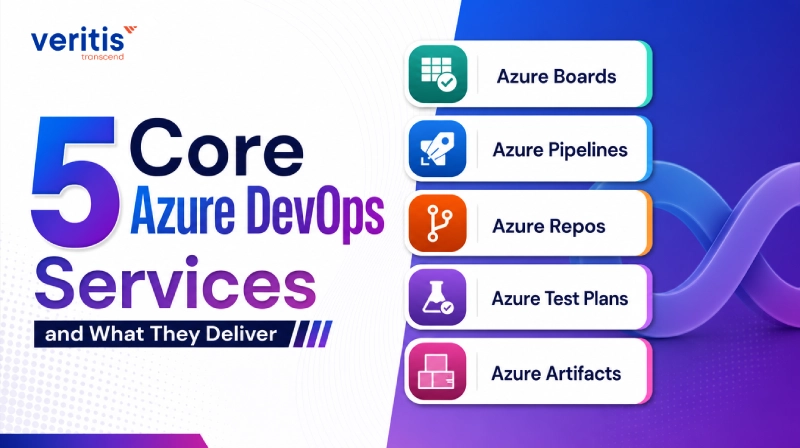
Understanding the platform starts with its five integrated components. Each addresses a distinct phase of the software delivery lifecycle.
1) Azure Boards: Strategic Planning at Every Scale
Azure Boards provides agile planning tools, sprints, backlogs, Kanban boards, and custom dashboards that give both engineering teams and business stakeholders real time visibility into delivery progress. Advanced analytics and custom reporting allow portfolio managers to track velocity, identify blockers, and forecast release dates with confidence.
For enterprises managing multiple product lines simultaneously, Azure Boards acts as the single source of truth for work status, eliminating the status meeting overhead that drains executive time.
2) Azure Pipelines: CI/CD for Any Language, Any Cloud
Azure Pipelines is the engine at the center of a smart test automation framework with CI/CD pipelines. It enables teams to build, test, and deploy continuously across any language, platform, or cloud environment, including hybrid and multi cloud architectures.
Key enterprise advantages:
- Free CI/CD for unlimited periods with support for 10 parallel jobs per open source project
- Built in approval gates and compliance checkpoints that satisfy audit requirements
- Native integration with GitHub, Jenkins, and container registries
- Scalable agent pools that handle enterprise level build volumes without infrastructure bottlenecks
For development organizations managing dozens of microservices, Azure Pipelines transforms deployment from a high risk event into a routine, automated operation.
3) Azure Repos: Enterprise Grade Version Control
Azure Repos delivers unlimited, cloud hosted private Git repositories with the collaboration features distributed enterprise teams require: structured pull requests, mandatory code reviews, branch policies, and fine grained access controls.
At scale, version control discipline is a governance issue as much as a technical one. Azure Repos enforces the development standards that prevent security vulnerabilities and technical debt from compounding over time.
4) Azure Test Plans: Quality Gates That Protect Production
Azure Test Plans supports both planned and exploratory testing, giving QA teams the tools to validate application behavior systematically before every release. By integrating testing directly into the delivery pipeline, organizations reduce the production defect rate that drives emergency response costs and reputational damage.
For enterprises subject to regulatory compliance requirements, Azure Test Plans generates the test evidence needed to satisfy auditors without creating manual documentation overhead. This aligns directly with a shift left DevOps approach, catching defects earlier in the cycle, where they cost a fraction of what they do in production.
5) Azure Artifacts: Secure Package Management at Enterprise Scale
Azure Artifacts provides fully integrated package management, supporting NuGet, npm, Maven, and Python, and connecting seamlessly with CI/CD pipelines. Teams can create, host, and share packages from both public and private sources, ensuring dependency management is both streamlined and secure.
For large organizations with multiple development teams sharing common libraries, Azure Artifacts eliminates the version conflict and supply chain security risks that unmanaged package dependencies introduce.
Useful link: Future of DevOps: Top DevOps Trends in 2026 and Beyond
Azure DevOps Integration: The Technology Ecosystem
Azure DevOps tools do not operate in isolation. Their value multiplies when connected to the broader toolchain that enterprise environments already rely on.
1) Infrastructure Automation
Modern DevOps extends well beyond application code. Azure DevOps integrates natively with leading infrastructure automation tools, making it the control plane for your entire delivery environment:
- Ansible: Automates cloud provisioning, configuration management, and application deployments across hybrid environments
- Terraform: Manages infrastructure as code, bringing the same repeatability and auditability to infrastructure that pipelines bring to application code
- Chef Automate: Builds, deploys, and manages infrastructure and applications with full transparency
- Puppet Enterprise: Automates the complete lifecycle of Azure infrastructure, both cloud and on premises
This infrastructure automation layer is where organizations often find the largest immediate efficiency gains. Combining Azure DevOps pipelines with robust automation services and tools eliminates the manual provisioning steps that introduce delays, inconsistencies, and compliance gaps.
2) Jenkins Integration
For organizations with existing Jenkins based build automation, Azure DevOps integrates directly, centralizing build orchestration while preserving existing investments. Teams can scale deployments based on project demand without re architecting their entire toolchain.
3) AI and ML Driven DevOps
The next frontier for Azure DevOps is intelligence. AI powered, ML driven DevOps capabilities, including predictive pipeline failure detection, automated test selection, and anomaly based deployment monitoring, are rapidly becoming table stakes for high performing engineering organizations. Azure DevOps’ integration with Azure Machine Learning and GitHub Copilot positions enterprises to adopt these capabilities without platform migrations.
How Azure DevOps Drives Cloud Efficiency?
Cloud adoption without delivery automation creates its own inefficiencies, with teams spending more time managing environments than shipping features. Azure DevOps resolves this by embedding pipeline governance directly into cloud workflows.
Cloud automation is driving DevOps efficiency across industries by reducing the manual intervention required at every stage of infrastructure provisioning and application deployment. Azure DevOps serves as the orchestration layer, connecting cloud resources, automated pipelines, and governance controls into a single, auditable workflow that executives can actually measure.
Get Started with Azure DevOps Services
What Enterprises Miss When Implementing Azure DevOps?
Most Azure DevOps implementations that underperform share a common pattern: the organization deploys the tools but does not redesign the process around them. Technical capability without organizational alignment produces limited results.
The five areas where enterprise implementations most commonly stall:
1) Governance without flexibility: Overly rigid pipeline policies that slow teams down rather than enabling them
2) Incomplete migration: Leaving critical workflows in legacy tools, preventing the visibility and automation benefits from fully materializing
3) Insufficient training: Teams adopting only the features they already understand, missing high value capabilities
4) No baseline metrics: Inability to measure improvement because pre implementation performance was never captured
5) Tool integration gaps: Azure DevOps configured in isolation rather than connected to the full development and infrastructure toolchain
Avoiding these failure modes requires both technical depth and organizational change management, which is precisely where an experienced Azure DevOps consulting partner delivers disproportionate value.
Veritis Azure DevOps Consulting: The Implementation Approach
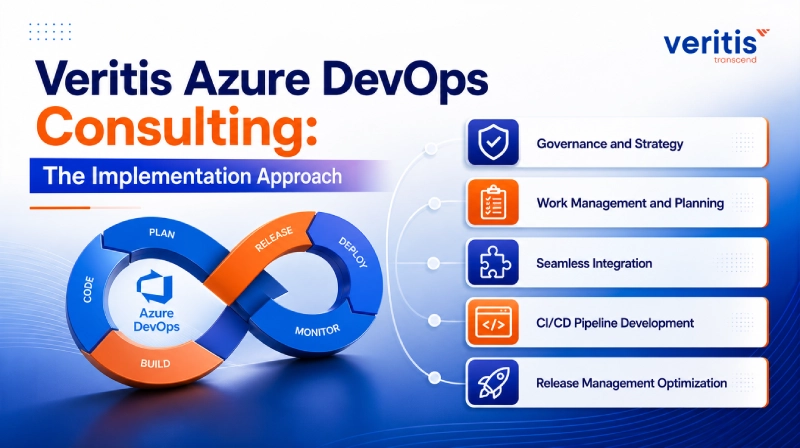
As a trusted DevOps services and solutions partner with over a decade of enterprise delivery experience, Veritis structures every Azure DevOps engagement around five implementation pillars:
1) Governance and Strategy
Before writing a single pipeline, Veritis establishes the governance framework, aligning team structures, role definitions, and tooling decisions with your organization’s compliance requirements and strategic objectives. This ensures Azure DevOps tools are configured to enforce standards from day one, not retrofitted after incidents occur.
2) Work Management and Planning
Effective DevOps starts with organized, visible work. Veritis configures Azure Boards to reflect your actual delivery processes, not a generic template, establishing the sprint cadences, backlog structures, and reporting dashboards that give leadership real time delivery visibility.
3) Seamless Integration
Azure DevOps tools must connect to your existing ecosystem. Veritis handles complex integrations, applications, data pipelines, testing frameworks, and infrastructure automation, ensuring the platform becomes a force multiplier rather than another silo to manage.
4) CI/CD Pipeline Development
Building enterprise grade pipelines requires more than technical configuration. Veritis designs pipelines that balance speed with compliance, automated quality gates, security scanning, approval workflows, and rollback procedures that give executives confidence in every deployment.
5) Release Management Optimization
Veritis tailors release management processes to your specific delivery methodology, whether you are running SAFe at the portfolio level, Scrum at the team level, or a hybrid model that reflects the realities of a large enterprise. The result is greater speed and reliability across the entire software delivery lifecycle.
Business Benefits Delivered
| Outcome | What It Means in Practice |
| Faster time to market | Release cycles measured in days, not weeks |
| Higher deployment frequency | More frequent, lower risk releases |
| Reduced change failure rate | Fewer production incidents |
| Improved mean time to recovery | Faster resolution when incidents occur |
| Full audit traceability | Compliance evidence generated automatically |
| Cloud and platform agnostic | No lock in; works across AWS, Azure, and GCP |
Use Case: Azure DevOps for the Data Analytics Industry
To illustrate the business impact of smart planning and accelerated execution, consider Veritis’s engagement with a leading data analytics firm managing complex, multi environment deployments across a distributed engineering organization.
The challenge: build cycles were slow, deployment processes were manual and error prone, and the organization lacked the pipeline visibility needed to make confident release decisions.
The Veritis approach: implementing Azure Pipelines with full CI/CD automation, integrating Azure Boards to provide portfolio level visibility, and connecting the entire workflow to the organization’s existing infrastructure automation toolchain.
The outcome: faster build cycles, measurably improved deployment efficiency, and a governance framework that satisfied both internal risk requirements and external audit obligations. Full details are available in our DevOps Solutions for Data Analytics Industry case study.
Useful link: Azure DevOps Services: Plan Smart, Build Fast and Execute at a New Speed
Azure DevOps Services: What’s Coming Next
For enterprise leaders making three to five year platform decisions, the trajectory of Azure DevOps matters as much as its current capabilities. Key developments to evaluate:
- GitHub Actions integration: deeper convergence between Azure DevOps and GitHub Actions gives organizations flexibility in how they build and orchestrate pipelines
- AI assisted development: GitHub Copilot and Azure AI integrations are bringing code generation, test generation, and pipeline optimization capabilities directly into the developer workflow
- Enhanced security scanning: native application security testing embedded in pipelines reduces the gap between DevOps and DevSecOps
- Improved analytics: richer delivery metrics and forecasting capabilities are giving engineering leaders the data they need to make capacity and investment decisions
Organizations that build their delivery platform on Azure DevOps today are well positioned to adopt these capabilities incrementally, without the platform migrations that competing solutions would require.
Conclusion: The Strategic Insight Before You Move Forward
Azure DevOps is not a technology decision; it is an operating model decision. Organizations that treat it as a tool purchase realize marginal gains. Organizations that use it to redesign how software is planned, built, and delivered realize transformational gains. Partnering with an experienced DevOps services company helps ensure the difference comes not from the platform alone, but from the discipline and expertise applied during implementation.
Veritis brings over a decade of enterprise DevOps delivery experience, deep Azure platform expertise, and the organizational change management capability that separates successful transformations from expensive tool deployments. Our Azure DevOps consulting services are designed to get your organization to measurable outcomes, faster release cycles, lower failure rates, and full compliance traceability, on a timeline that respects the complexity of enterprise environments.
Contact Veritis today to begin your Azure DevOps transformation with a consulting team that has done this before, at scale, and can show you the results.