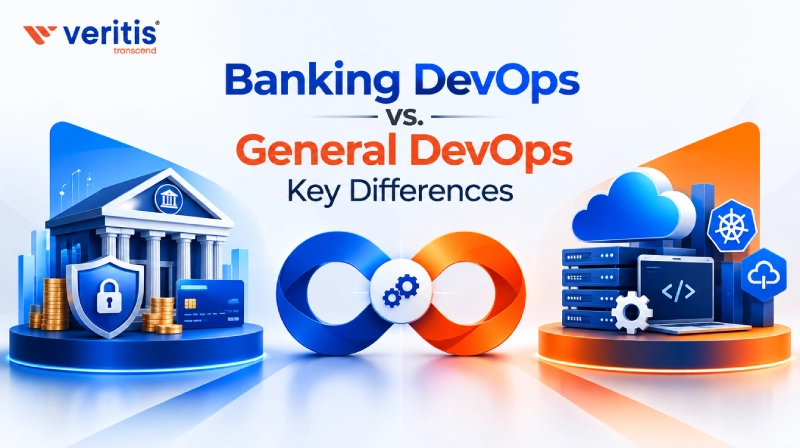
Release speed, reliability, and recovery matter to every software organization. Banks must improve these outcomes while protecting financial transactions, customer information, and critical operations.
Banking DevOps uses the same core practices as general DevOps, including automation, continuous integration and delivery, infrastructure as code, and shared ownership. The difference is the rigor of the controls: banks need clear authorization, restricted access, traceable evidence, and tested business recovery.
How Does Banking DevOps Compare With General DevOps?
Here, “general DevOps” refers to software delivery in a relatively unregulated environment. Other regulated sectors may also require rigorous controls.
| Dimension | General DevOps | Banking DevOps |
| Delivery goal | Release software quickly and reliably | Improve delivery while protecting customers and critical operations |
| Change control | Team approval and automated checks | Risk based authorization, appropriate independence, and retained evidence |
| Production access | Team ownership may include direct access | Restricted privileges and controlled deployment identities |
| Security | Protect applications and infrastructure | Also protect pipelines, artifacts, test data, and suppliers |
| Resilience | Restore application availability | Recover critical banking operations and verify transaction integrity |
| Success measures | Delivery speed and reliability | Delivery performance, control effectiveness, and business recovery |
The goal is not to slow every release. It is to make releases controlled, recoverable, and demonstrably authorized.
1) Match Controls to Regulatory Scope
Banking requirements depend on the institution, jurisdiction, business activity, data, and service criticality. The FFIEC DevOps guidance recognizes automated delivery while highlighting risks such as unsecured repositories, misconfigured automation, and vulnerable system images.
Relevant obligations vary. The EU’s Digital Operational Resilience Act (DORA) has applied since January 17, 2025, to specified financial entities. Its scope includes ICT risk, incident management, resilience testing, and third party risk. PCI DSS applies to systems in or affecting the cardholder data environment; it is not a banking law covering every system.
Start with a control register that maps each applicable obligation to the affected system, owner, delivery control, evidence source, and exception process.
2) Use Risk Based Change Management
Not every release needs the same level of review. Define release paths for routine, material, and emergency changes, with objective criteria based on customer impact, data sensitivity, financial calculations, dependencies, and recovery complexity.
Routine changes can follow approved workflows with automated checks and documented authorization. Material changes may need additional business, security, or risk review. Emergency changes should use restricted access, record actions, define recovery steps, and receive follow up review.
Automated checks can reduce waiting, but they do not automatically satisfy requirements for independent approval. Set stop conditions before deployment and do not let teams lower a change’s risk classification simply to release faster.
3) Share Ownership Without Granting Unrestricted Access
Teams can own services without having unrestricted ability to change code, approve it, alter pipeline controls, deploy to production, and delete evidence.
Use protected branches, required reviews, separate pipeline administration, narrowly scoped deployment identities, strong authentication, and time limited emergency access. Make privileged actions visible and review exceptions independently.
Application teams should own service behavior and release readiness. Platform teams should manage shared delivery tools. Security and risk teams should define control expectations, while business owners assess customer and operational impact.
Banking teams also need practical automation, infrastructure, security, and troubleshooting capabilities. Veritis’ guide to DevOps engineering skills outlines the skills delivery teams need.
4) Secure the Delivery Chain and Test Recovery
Protect code, dependencies, build systems, artifacts, test environments, and deployment credentials. Useful controls include code and dependency scanning, secret detection, approved artifact repositories, integrity checks, and documented vulnerability exceptions.
Treat test data as sensitive. FFIEC guidance calls for production data copied to testing to receive equivalent protection. Synthetic data can reduce exposure while supporting realistic test scenarios.
Recovery testing should verify business outcomes, not just infrastructure availability. For payment services, test interrupted transactions, safe retries, duplicate prevention, downstream failures, and reconciliation after restoration. A code rollback may not reverse a posted transaction or repair an incompatible database change, so recovery plans should also cover data restoration and corrective business actions.
5) Capture Evidence and Prepare for Incidents
A release should leave a traceable record connecting the change request, code review, build artifact, test results, authorization, deployment, and production verification. Capture evidence during delivery, protect its integrity, and retain it according to applicable obligations and policy.
Incident response should include technical recovery and regulatory decision making. Covered US banking organizations must notify their primary federal regulator as soon as possible and no later than 36 hours after determining that a qualifying notification incident occurred. This deadline does not apply to every security alert.
Define who assesses notification criteria, preserves the decision timeline, coordinates with legal and compliance teams, and communicates with service providers.
How Do You Build a Banking DevOps Pipeline?
Use this eight step pattern as a starting point, then tailor it to the institution’s obligations and services:
a) Identify the business service, data, dependencies, applicable controls, and owners.
b) Classify the change by impact, security exposure, and recovery complexity.
c) Review code and configuration through protected, traceable workflows.
d) Build and protect artifacts using controlled identities and approved dependencies.
e) Run appropriate functional, security, performance, integration, and recovery tests.
f) Authorize promotion and bind approval to the artifact and target environment.
g) Deploy with bounded exposure, monitoring, and a tested recovery path.
h) Verify business behavior and retain release evidence.
For a payment release, verification might include matching the deployed artifact to its approval, checking transaction outcomes and duplicate detection, and confirming that recovery procedures remain available before expanding rollout.
How Should Banks Choose Platforms and Measure Results?
No single platform is required for banking DevOps. Evaluate tools based on whether teams can separate approval and administration, trace production artifacts to tests and authorization, protect secrets, support existing systems, recover the platform, and export evidence.
For Microsoft’s toolchain, see Veritis’ Azure DevOps guide. Choose platforms to support the control model rather than treating a tool as a substitute for governance.
Track delivery speed alongside control and recovery outcomes:
| Outcome | Useful measures |
| Delivery flow | Change lead time, deployment frequency, approval waiting time |
| Release stability | Change failure rate, incidents caused by changes, recovery time |
| Control effectiveness | Unauthorized changes, control bypasses, overdue exceptions |
| Audit readiness | Evidence completeness and retrieval time |
| Business resilience | Recovery results, reconciliation exceptions, dependency test outcomes |
Conclusion
Begin with one representative service. Establish a baseline, address its largest control and recovery gaps, automate repeatable requirements, and expand when results show both better delivery and effective controls. Veritis’ DevOps services can support delivery automation, infrastructure, security, and operational processes.