Banking identity and access management (IAM) must connect identity to customer relationships, financial authority, transaction risk, and regulatory oversight. Banks use many of the same IAM technologies as other enterprises, but they must apply them to actions with direct financial consequences.
A secure sign in alone does not establish that a user should change a beneficiary, approve a payment, or access a customer’s financial information. Banking IAM must help verify who is acting, what they are authorized to do, under which conditions, and whether the decision can be reconstructed later.
This article focuses on US banking requirements. Specific obligations depend on an institution’s charter, regulator, activities, and jurisdiction.
Banking IAM vs. Enterprise IAM
| Area | General enterprise IAM | Banking IAM |
| Main focus | Access to business systems and data | Access plus authority over accounts, transactions, and customer information |
| Authorization | Application and role permissions | Account scope, transaction type, limits, and approval authority |
| Risk assessment | Identity, device, and application risk | Identity and session risk combined with fraud and transaction signals |
| Governance | Whether users still need access | Whether users hold conflicting financial permissions |
| Evidence | Who accessed a system? | Who had authority, what action they took, which controls applied, and what happened |
Banking IAM is not a separate set of technologies. Its distinguishing feature is connecting identity controls to financial authority and enforceable transaction decisions.
What Capabilities Does Banking IAM Include?
Banking IAM is a coordinated set of services and controls. No single platform necessarily governs every identity or financial action.
These functions must connect. CIAM can authenticate a customer without deciding which accounts they may access. IGA can approve an entitlement without confirming that an application enforces it correctly.
Banking IAM Capabilities and Responsibilities
| Capability | Primary responsibility | Banking example |
| Customer identity and access management (CIAM) | Customer registration, authentication, sessions, and recovery | Restoring account access while preserving identity checks |
| Workforce IAM | Employee and contractor accounts and access lifecycle | Removing access when an employee leaves |
| Identity governance and administration (IGA) | Access approvals, reviews, and entitlement policies | Identifying a user who can both initiate and approve a payment |
| Privileged access management (PAM) | Administrative credentials and elevated access | Granting temporary administrative access to a banking application |
| Application authorization | Enforcing business permissions | Checking account scope, payment limits, and approvals |
| Machine identity management | Workload identities, certificates, and service permissions | Revoking credentials when a payment integration is retired |
Regulatory Requirements Make Identity a Business Control
Banks must connect IAM controls to their documented security and risk programs. A platform purchase alone does not establish compliance.
The Interagency Guidelines Establishing Information Security Standards, issued under the Gramm-Leach-Bliley Act, call for a written information security program with safeguards appropriate to the bank’s size, complexity, and activities. The guidelines identify access controls, segregation of duties, and dual control as measures banks should consider based on risk. They do not require two approvers for every transaction.
The Customer Identification Program requires banks to believe they know a customer’s true identity reasonably. That is distinct from authenticating a returning user or authorizing a particular transaction.
The FFIEC guidance on authentication and access discusses risk management for customers, employees, third parties, service accounts, applications, and devices. It is supervisory guidance, not a blanket legal requirement to apply MFA to every interaction. Banks should assess controls against their risk profile and applicable obligations.
Protecting Banking Transactions and Customer Accounts
The most consequential decisions often happen after sign in. A legitimate customer may be deceived into making a payment, an employee may hold conflicting permissions, or an attacker may exploit account recovery.
1) Protect the Full Customer Access Lifecycle
Account takeover controls should cover sensitive events beyond initial login, including:
- Adding or replacing an authenticator
- Changing contact information
- Resetting credentials through customer support
- Registering a new device
- Creating a beneficiary or requesting payment release
A strong sign in method offers limited protection if an attacker can bypass it through a weaker recovery process. Banks should prioritize phishing resistant authentication for sensitive access and evaluate the security of enrollment and recovery journeys. See Veritis’ guide to passwordless authentication benefits and challenges.
2) Keep Authentication Separate from Fraud Detection
Authentication helps verify who is making a request. It does not prove that a payment is legitimate. A customer can sign in correctly and still be manipulated into paying a scammer.
IAM should work with fraud systems that assess signals such as device changes, unusual behavior, new beneficiaries, and transaction context. Depending on risk, a bank may allow an action, request more verification, restrict it, or refer it for review.
3) Authorize the Actual Transaction
Payment authorization should apply to the specific recipient, amount, and action. Permission to access an application should not automatically grant payment release authority. A changed transaction should require a new authorization decision.
For example, a corporate banking workflow may let one user view assigned accounts, another create a payment, and an independent approver authorize it when policy requires. The release service should verify permissions and approvals before execution.
Control Combinations of Employee Permissions
Employees may misuse legitimate access, so banks need to review combinations of permissions, not only individual roles. Potential conflicts include creating and approving the same payment, or administering access and independently certifying it.
Role based access can provide a foundation, but financial permissions may also depend on account scope, transaction limits, and temporary responsibilities. The goal is to enforce appropriate financial authority without creating an unnecessarily complex role catalog.
Different Identities Need Different Lifecycle Controls
Banks manage customers, employees, contractors, third parties, privileged users, and machine identities. These populations need coordinated governance, but not identical lifecycle processes.
- Customers: Connect digital access to customer and account relationships. Treat access termination, account closure, and required record retention as separate events.
- Employees: Update permissions when responsibilities change and remove obsolete access, rather than accumulating entitlements.
- Privileged Users: Govern administrative access separately, with accountable owners, limited elevation, and review of sensitive activity.
- Machine Identities: Assign an owner and purpose to each service account, certificate, or API credential. Define how it is stored, monitored, rotated, and revoked.
- Third Parties: Give vendor identities a named sponsor, defined scope, and termination conditions. Outsourcing does not remove the bank’s responsibility for access oversight.
Architecture, APIs, and Resilience
Banking IAM spans customer channels, workforce systems, payment applications, core banking, cloud workloads, and external providers. SSO can improve consistency, but each application still needs to enforce its business permissions.
Legacy systems may not support modern federation or prompt revocation. For each critical application, document how identity is mapped, where permissions are enforced, and how changes and logs are handled. Address gaps with tested compensating controls and a remediation owner.
APIs introduce another authorization question: what may an application do on behalf of a customer or system? Successful application authentication should not grant unrestricted account access. Validate the requested scope, account permissions, token, and revocation behavior. Permission to view account information should not imply permission to initiate payments.
Banks should also test identity service outages, policy failures, delayed provisioning, and emergency access. Define which actions remain available and under what controls. Avoid improvised bypasses that could weaken authorization during an incident. Veritis’ cloud disaster recovery strategy guide covers planning for cloud service disruption.
A Practical IAM Modernization Roadmap
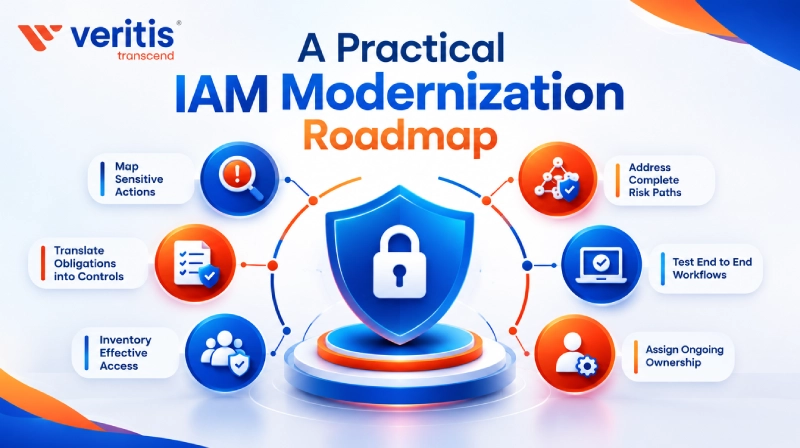
1) Map Sensitive Actions
Identify activities such as releasing payments, changing beneficiaries, resetting authenticators, and administering critical systems.
2) Translate Obligations into Controls
Record applicability, ownership, evidence, testing methods, and approved exceptions.
3) Inventory Effective Access
Include local application permissions, privileged accounts, vendors, service credentials, and emergency access.
4) Address Complete Risk Paths
For example, assess weak recovery together with beneficiary creation and payment release.
5) Test End to End Workflows
Include role changes, denied requests, revoked sessions, failed dependencies, and evidence retrieval.
6) Assign Ongoing Ownership
Coordinate security, fraud, operations, compliance, application owners, and audit.
Measure whether controls work, not only whether a platform is deployed. Useful measures include the time to remove effective access, unresolved permission conflicts, standing privileged access, machine identities with accountable owners, protection of sensitive recovery and payment actions, and completeness of audit evidence.
Conclusion
Banking IAM must do more than verify a login. It must connect each identity to the right financial authority, enforce that authority across customer and employee systems, and provide evidence that controls worked. Banks can strengthen this foundation by assessing high risk access paths, testing permissions and recovery processes, and reviewing access as roles and relationships change.
Veritis provides identity and access management services to help organizations assess and strengthen IAM across their environments. Contact Veritis to discuss your banking IAM requirements.