Cloud transformation is the redesign of technology, processes, and responsibilities to achieve business goals using cloud capabilities. It goes beyond moving applications. It changes how an organization delivers services, manages costs, governs risk, and supports operations.
A successful transformation should improve business performance, not just increase the number of workloads running in the cloud. Useful measures include cost per transaction, release lead time, service availability, and recovery time.
Consult our Cloud Consulting Expert
Cloud Transformation vs. Cloud Migration
Cloud migration moves applications, data, or infrastructure to another environment. Cloud transformation also changes how teams build, operate, secure, and fund those services.
For example, moving an application to cloud virtual machines is a migration. Automating its deployment and adopting a managed database is modernization. Giving a product team responsibility for release speed, reliability, security, and cost per transaction is part of transformation.
Migration can be a necessary first step, but a new hosting location alone does not change an organization’s operating model.
How Cloud Transformation Can Change Business Operations
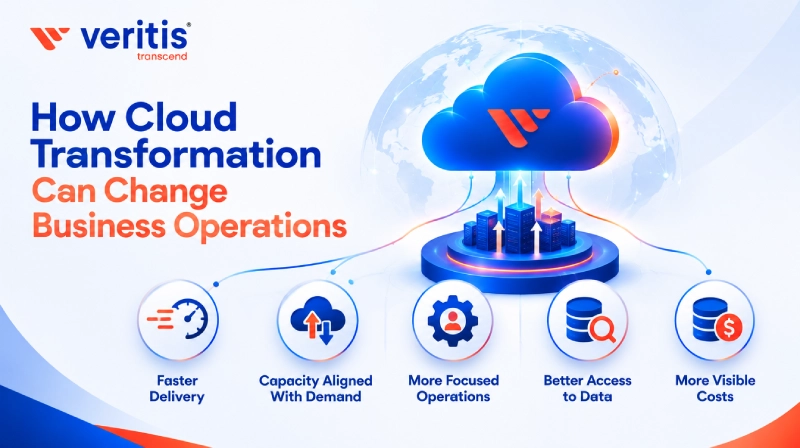
Cloud capabilities can support faster provisioning, flexible capacity, shared data platforms, and more transparent spending. The benefits depend on how well the technology fits the workload and how teams use it.
1) Faster Delivery
Automated environments and deployment pipelines can reduce manual setup and release effort.
2) Capacity Aligned With Demand
Elastic resources can help manage variable workloads, provided application and database dependencies can scale too.
3) More Focused Operations
Managed services can reduce some infrastructure tasks, while the organization retains responsibility for access, configuration, data, and incident response.
4) Better Access to Data
Cloud platforms can support analytics and AI workloads, but data quality, ownership, and permissions still need attention.
5) More Visible Costs
Consumption billing helps teams link resource use to business activity, but it also introduces spending variability.
Cloud investment is expected to keep growing in 2027. Gartner forecasts worldwide Infrastructure as a Service (IaaS) spending will reach $367 billion, up 25.7% from 2026. It also projects AI-optimized IaaS spending will rise 56.5% to $66.1 billion. These are forecasts, not measured business benefits; the return on cloud investment will depend on how effectively organizations manage workload choices, costs, security, and operations.
Choose Cloud Models Based on Requirements
Service models define what the provider manages. Deployment models define where services operate. Application architecture defines how the workload is structured.
| Decision | Options | What to consider |
| Service model | IaaS, PaaS, SaaS, serverless | Control, customer responsibilities, operating effort, and service limits |
| Deployment model | Public, private, hybrid, multicloud | Data location, connectivity, security, recovery, and operational complexity |
| Application architecture | Layered, microservices, event driven, containers | Dependencies, scaling needs, team ownership, resilience, and maintenance |
IaaS provides computing, storage, and networking while the customer manages operating systems, applications, data, and configuration. PaaS provides managed platform components, allowing teams to focus more on code and data. SaaS delivers a complete application, while the customer remains responsible for users, access, configuration, and business processes. Serverless reduces server management, but customers still own application behavior, permissions, dependencies, and cost controls.
Hybrid and multicloud approaches can meet specific business needs, but they add integration, identity, skills, and governance requirements. They are not automatically more resilient or less expensive.
Choose an architecture that addresses a real constraint. Microservices can support independent delivery and scaling, but they add challenges in distributed data, testing, and observability. Containers and Kubernetes are useful for some workloads, but are not prerequisites for cloud transformation.
Veritis cloud consulting services can help assess workload requirements, service models, and target architectures.
Build a Business Case That Includes the Full Cost
Compare realistic options over the same evaluation period: retaining the current environment, migrating selected components, modernizing applications, or replacing them with SaaS.
Include:
- Transition costs: Discovery, migration, integration, remediation, training, testing, and parallel operations.
- Ongoing costs: Cloud services, software, support, security, networking, and labor.
- Consumption exposure: Idle resources, changing demand, data transfer, logging, and purchasing commitments.
- Exit costs: Data export, application changes, contract terms, and transition support.
Separate costs that will disappear from those that will remain. Savings are not realized while source infrastructure, licenses, or contracts continue running.
A useful measure is: Cost per successful business transaction = attributable service cost ÷ successful transactions
Define the cost boundary and transaction consistently. A higher cloud bill may still make business sense if transaction volume grows faster and service quality remains within target.
For ROI, compare net financial benefits with the total investment over a defined period. Distinguish actual cash savings from released staff capacity, and avoid counting the same benefit twice.
Execute Cloud Transformation in 8 Steps
| Step | Action | Evidence of progress |
| Define outcomes | Set business goals, baselines, owners, and decision rights. | Approved business case and success measures |
| Assess workloads | Inventory applications, data, dependencies, licenses, and recovery needs. | Validated portfolio and dependency map |
| Choose a path | Retire, retain, replace, rehost, replatform, or refactor each workload. | Documented decision, cost, and risk |
| Establish a foundation | Configure identity, network, logging, security, backups, and cost allocation. | Tested deployment patterns and assigned owners |
| Run a representative pilot | Test a workload with meaningful dependencies and operational requirements. | Business acceptance and updated migration plan |
| Migrate in controlled waves | Use runbooks, testing, monitoring, cutover authority, and rollback plans. | Validated transactions and stable service |
| Transfer ownership | Train teams and confirm support, incident, and recovery responsibilities. | Accepted runbooks and demonstrated team readiness |
| Optimize continuously | Review architecture, costs, reliability, and controls after each wave. | Funded improvement backlog and recurring reviews |
Map business services, not just servers. A successful server migration can still leave a business process unavailable if you miss an identity service, batch job, or external interface.
Veritis cloud migration services can support workload assessment, migration planning, and execution.
Embed Security, Recovery, and Financial Management
1) Security by Design
Build security and compliance into cloud architecture and delivery from the start. Provider certifications support due diligence but don’t prove your configurations meet every requirement.
2) Clear Ownership
Document who is responsible for identity, configuration, patching, encryption, backups, incident response, and compliance evidence. Map each obligation to its control owner and evidence source.
3) Strong Access and Data Controls
Use centralized identity, multifactor authentication, least privilege access, managed secrets, and appropriate data protection. Review cloud security automation best practices to apply controls consistently.
4) Recovery That is Tested
Set recovery time and recovery point objectives for each critical service. Test restoration, identity access, application dependencies, and operating procedures. Connect technical recovery plans with business priorities through a cloud disaster recovery strategy.
5) Financial Management
FinOps brings engineering, finance, and business teams together to manage cloud spending. Assign owners to accounts and shared services, allocate costs consistently, and review consumption against business value. Address waste before making long-term purchasing commitments.
Manage Common Transformation Risks
1) Spending rises without business value
Track unit costs and verify that source infrastructure and licenses are retired.
2) Dependencies are missed
Validate application maps with owners and test complete business transactions.
3) Teams are not ready to operate services
Require knowledge transfer and recovery exercises before handover.
4) Architecture becomes too complex
Choose the simplest design that meets workload requirements.
5) Modernization remains unfinished
Fund the work, set acceptance criteria, and assign owners after migration.
Business continuity planning should cover people, communications, suppliers, and technical recovery. Evaluate business continuity management software against governance and evidence requirements, not as a replacement for tested procedures.
Measure Cloud Transformation Success
| Outcome | Useful measure | What to check |
| Financial efficiency | Cost per transaction or active customer | Keep allocation and service quality consistent |
| Faster delivery | Time from approved change to production | Separate waiting time from implementation time |
| Reliable service | Successful transaction rate and recovery time | Measure customer journeys, not only infrastructure |
| Predictable spending | Forecast variance and unallocated costs | Explain demand changes before treating variance as waste |
| Effective recovery | Recovery test results | Use exercise evidence, not architecture assumptions |
| Stronger controls | Material exceptions and remediation time | Consider severity and exposure, not only counts |
Record each metric’s baseline, target, data source, owner, and review cadence. Interpret measures together: lower spending is not an improvement if failed transactions increase.
Conclusion
Cloud transformation delivers value when technology decisions support measurable business outcomes. Start with the right workloads, build in security and cost controls, and track results across delivery, reliability, and spending. Veritis can help assess your environment and define a practical path forward through its cloud consulting services.