Cloud identity management controls how people and automated workloads access applications, cloud services, infrastructure, and data. It helps organizations manage identities across cloud and hybrid environments while reducing excessive permissions and manual access work.
A strong program covers the full identity lifecycle, from account creation to access changes and removal. This guide outlines the core capabilities, implementation priorities, provider options, and metrics enterprises can use to assess progress.
Explore Cloud Identity Solutions
Cloud Identity Management Fundamentals
1) Definition and Scope
Cloud identity management applies identity and access management (IAM) practices to cloud and hybrid environments. It answers three questions: who is requesting access, what they can do, and under what conditions access is allowed.
Identity as a Service (IDaaS) describes a way of delivering identity capabilities through a provider. Cloud identity management is the broader discipline. Organizations may use IDaaS while retaining internal directories, governance tools, and native cloud permission systems.
2) Identity Populations
Different identities need different policies and lifecycle controls:
- Workforce: Employees and contractors accessing business applications and infrastructure.
- Customers: Users registering for and accessing customer applications, often managed through customer identity and access management (CIAM).
- Partners: Suppliers, dealers, and service providers.
- Workloads: Applications, deployment pipelines, containers, and automated services.
A workforce login platform does not automatically govern customer accounts or workload permissions. Define each population’s requirements before selecting technology.
3) Related Identity Terms
| Term | What it describes | Enterprise role |
| IAM | The discipline of managing identities and access | Defines policies and controls across systems |
| Cloud identity management | Identity management for cloud and hybrid environments | Connects identities, applications, and cloud resources |
| IDaaS | Identity capabilities delivered as a provider service | Changes how identity technology is hosted and operated |
| Native cloud IAM | Identity and authorization controls within a cloud platform | Manages permissions to that platform’s resources |
4) How an Access Request Works
A typical request follows this sequence:
a) A person or workload requests access.
b) An identity provider verifies the identity, potentially using multifactor authentication.
c) Policies assess context such as device compliance or resource sensitivity.
d) A trusted assertion or token is issued to the application.
e) The application or cloud service authorizes specific actions.
f) Relevant activity is logged for monitoring and investigation.
5) Authentication and Authorization
Authentication verifies an identity. Authorization determines what that identity can do. Confirming that a user works in finance, for example, does not mean they should approve payments or administer production systems.
A successful login also does not prove that an application is secure. Applications must validate identity tokens and enforce their own access boundaries.
Core Capabilities and Controls
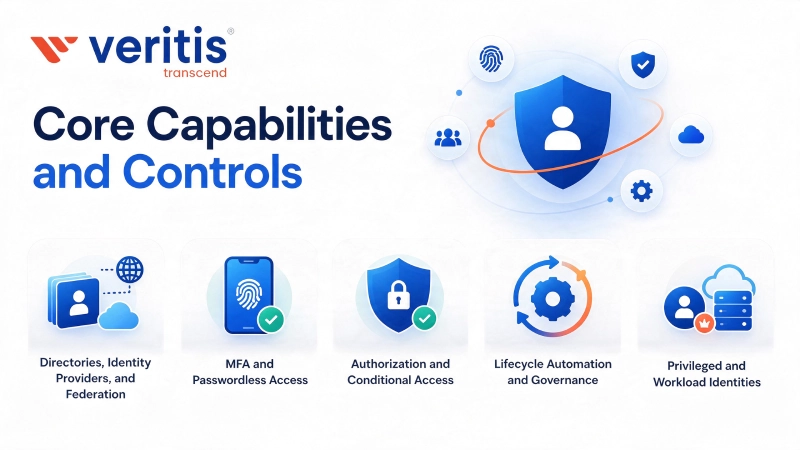
1) Directories, Identity Providers, and Federation
Directories store identity records, groups, and attributes. Identity providers (IdPs) authenticate users and share trusted identity information with applications. The NIST Digital Identity Guidelines distinguish identity proofing, authentication, and federation. Enterprises should define which system owns each attribute, such as employment status or device compliance.
Single sign on (SSO) lets users access multiple applications without repeatedly authenticating. Federation allows an application to trust authentication performed by an external IdP. Common protocols include SAML 2.0 and OpenID Connect (OIDC). OAuth 2.0 supports delegated authorization; it is not, by itself, an authentication protocol.
2) MFA and Passwordless Access
Multifactor authentication (MFA) requires distinct authentication factors. Passwordless methods replace passwords with other authenticators and qualify as MFA when they combine distinct factors.
Cryptographic methods such as FIDO2/WebAuthn passkeys and security keys can provide phishing resistant authentication when implemented appropriately. Review enrollment and account recovery as carefully as login. A strong authenticator offers limited protection if an attacker can replace it through a weak recovery process.
3) Authorization and Conditional Access
Authorization determines what an identity can access and which actions it may perform. Role based access control assigns permissions through defined roles. Attribute based access control evaluates identity, resource, action, or environment attributes.
Conditional access can consider signals such as device compliance or suspicious activity. Policies may block a request, require stronger authentication, or limit a session. Apply least privilege by granting only the access needed for the time it is justified.
4) Lifecycle Automation and Governance
Identity lifecycle management covers account creation, role changes, suspension, and removal. Design three workflows:
- Joiner: Create approved access when someone starts.
- Mover: Reassess permissions when responsibilities change.
- Leaver: Disable access and address application accounts and active sessions when someone leaves.
Mover workflows are easy to overlook. Adding permissions without removing outdated ones leads to privilege accumulation.
Governance determines whether access should exist, who approved it, and when it should be reviewed. Capabilities can include access requests, periodic reviews, separation of duties, expiration for temporary access, and evidence of approval and removal.
5) Privileged and Workload Identities
Protect administrative access with controls such as temporary elevation, approval, stronger authentication, and detailed logging. Applications and automated processes should use dedicated identities, not shared employee accounts or embedded permanent credentials.
The AWS IAM security best practices recommend federation, temporary credentials, and least privilege. Apply ownership and lifecycle controls to service accounts, API credentials, certificates, and AI agents as well as human users.
Benefits and Risks to Manage
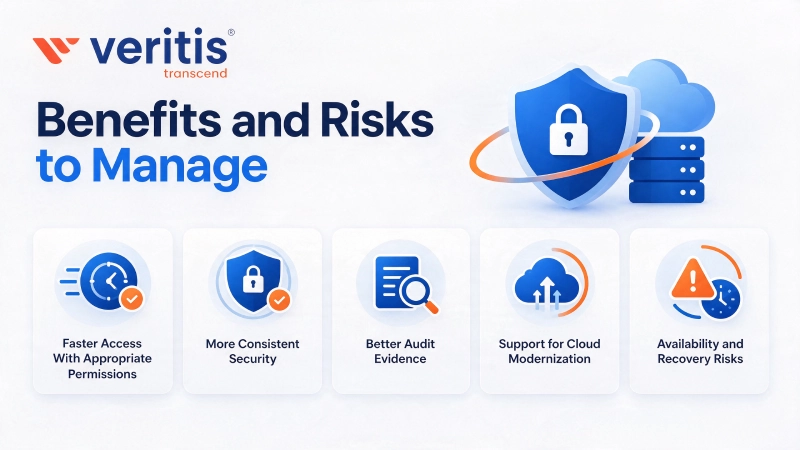
1) Faster Access With Appropriate Permissions
Automated provisioning can reduce manual handoffs and help employees get the access they need sooner. Predefined access packages can standardize common requirements without granting broad permissions to everyone.
2) More Consistent Security
Centralized authentication and policy controls make it easier to apply MFA and access requirements across connected applications. Coverage depends on integrations and whether alternative login paths remain available.
3) Better Audit Evidence
Access approvals, reviews, and activity logs help explain who had access and why. An identity platform can support compliance work, but buying a product does not establish compliance with a regulation or standard.
4) Support for Cloud Modernization
A consistent identity layer can support application modernization and cloud migration. Include identity design in cloud migration planning, rather than postponing it until after applications move.
5) Availability and Recovery Risks
A central IdP can improve control, but it also becomes a critical dependency. Protect administrator access, review configuration changes, and test emergency access and recovery procedures. Include identity services in business continuity exercises and document dependencies when evaluating business continuity management software.
Offboarding and legacy integration also need attention. Disabling a central account may not terminate every application session or remove every local account. Inventory exceptions, assign owners, and test the complete removal process.
Provider Options
The right provider depends on the identity population, application environment, and operating requirements. This is a market overview, not a product ranking.
| Provider | Relevant Products or Capabilities | Common Consideration |
| Microsoft | Entra ID, Entra External ID | Fit with Microsoft centered environments and existing licensing |
| Okta and Auth0 | Workforce identity and customer identity | Mixed application estates or developer focused customer login |
| Ping Identity | PingOne and related identity services | Complex enterprise or hybrid requirements |
| Google Cloud | Cloud Identity, Identity Platform, Google Cloud IAM | Workforce, customer, and cloud resource controls are separate functions |
| AWS | IAM Identity Center, Cognito, AWS IAM | Workforce access, customer login, and resource permissions have distinct roles |
| JumpCloud and IBM | Directory, access, and hybrid identity capabilities | Mixed operating systems or complex hybrid environments |
| SailPoint and Transmit Security | Governance or customer identity capabilities | Often complement rather than replace an SSO and MFA platform |
Native cloud IAM usually remains necessary even when workforce authentication is centralized. Verify current features, product packaging, and pricing with providers.
Useful link: The CISO Roadmap to Cloud Identity Management Excellence
Implementation Roadmap
1) Set Ownership and Outcomes
Assign owners across security, infrastructure, HR, application teams, and compliance. Define a measurable goal, such as reducing onboarding delays or removing persistent administrator access, and record the baseline.
2) Inventory Identities and Access Paths
Identify users, workloads, directories, applications, cloud accounts, privileged roles, and authentication methods. Look for orphaned accounts, shared credentials, local logins, and service accounts without owners.
3) Define the Target Architecture and Policies
Choose authoritative identity sources and document how attributes flow between systems. Set federation boundaries, role and approval rules, MFA requirements, least privilege controls, and recovery procedures. Avoid migrating legacy groups without reviewing whether their permissions are still needed.
4) Pilot and Automate Lifecycle Workflows
Test a representative set of applications, including modern, legacy, and administrative systems. Validate normal access, denied requests, recovery, role changes, offboarding, and service disruption.
Connect joiner, mover, and leaver events to provisioning workflows. Where supported, replace permanent workload credentials with temporary ones. Teams building these controls into delivery pipelines can draw on DevOps engineer skills and practices.
5) Expand, Measure, and Improve
Roll out in controlled waves. Monitor access failures and exceptions, schedule reviews, test emergency accounts, and investigate provisioning errors. Retire redundant login paths only after validating continuity and support readiness.
Veritis cloud consulting services can help align identity architecture with cloud and infrastructure modernization.
Metrics for Evaluating Results
Set a baseline before implementation and assess access speed, control coverage, operational effort, and residual risk.
| Metric | How to measure it | What it shows |
| Time to approved access | Time from approval or start date to usable access | Whether access fulfillment is improving |
| Offboarding completion time | Time from termination to verified removal across in scope systems | Whether removal meets risk requirements |
| MFA enforcement coverage | Accounts with enforced MFA divided by in scope accounts | Whether MFA is enforced |
| Automated lifecycle coverage | Applications with tested provisioning and removal divided by in scope applications | How much work remains manual |
| Standing privileged access | Identities with persistent administrative permissions | Where temporary elevation may reduce exposure |
| Orphaned accounts | Accounts without a valid owner or business relationship | Whether records and ownership are current |
| Review remediation time | Time from an access removal decision to verified removal | Whether governance decisions are enforced |
Report coverage separately for critical applications and privileged identities. Access review completion alone does not prove effective governance; also track permissions removed, unresolved exceptions, and remediation time.
Useful link: Cloud Transformation: A Complete Guide to Business Value
Conclusion
Cloud identity management helps enterprises control access across users, applications, and workloads while supporting cloud modernization. Start with a clear inventory, apply least privilege, automate identity lifecycle tasks, and review access continuously. Veritis can help assess your identity environment and build a practical roadmap for secure cloud operations.
Contact Veritis to assess identity and access gaps and plan secure cloud and infrastructure modernization.