Most enterprises don’t fail at cloud because the technology is hard. They stall because no one has mapped which cloud computing services actually solve the business problem in front of them and which ones inflate the monthly bill. If you’re a CIO or CFO staring at a modernization roadmap, the question isn’t whether to move to cloud. It’s which capabilities earn their place, how fast they pay back, and how you govern them before scale exposes every gap in your architecture.
This guide breaks down the core service categories, where each delivers measurable value, what questions enterprise leaders should be asking before they commit, and how a seasoned partner sequences deployment. Hence, you modernize without straining the budget or compromising compliance.
Get Started with Cloud Services
The 3 Foundational Services Offered by Cloud Computing
Every cloud strategy sits on three foundational models, each trading a degree of control for a degree of convenience. Understanding where that trade off lands for each workload is the first decision an enterprise IT leader must get right.
1) Infrastructure as a Service (IaaS)
IaaS delivers compute, storage, and networking on demand. You retain control of the operating system, middleware, and applications; the provider manages the physical hardware, virtualization layer, and data center operations.
Best fit: Migrating legacy workloads, scaling burst capacity without a capital data center refresh, and running workloads that require OS level configuration control.
Enterprise consideration: IaaS gives the most flexibility but places operational responsibility for patching, hardening, and availability engineering squarely on your team. Without disciplined governance, that flexibility becomes sprawl.
Leading providers: AWS EC2, Microsoft Azure Virtual Machines, Google Compute Engine.
2) Platform as a Service (PaaS)
PaaS abstracts the infrastructure layer entirely. Managed runtimes, databases, CI/CD pipelines, and middleware are provided and maintained by the vendor. Your engineering teams ship features instead of patching servers.
Best fit: Accelerating application delivery, reducing operational drag on development teams, and supporting agile DevOps workflows.
Enterprise consideration: PaaS accelerates delivery but can introduce vendor lock in at the framework level. Evaluate portability before committing a core platform to a proprietary runtime.
Leading providers: AWS Elastic Beanstalk, Azure App Service, Google App Engine.
3) Software as a Service (SaaS)
SaaS delivers fully managed applications over the web. The vendor owns and operates the full stack infrastructure, platform, application, and data management, and you consume these capabilities through a browser or an API.
Best fit: Standardized business functions CRM, ERP, collaboration, HR where differentiation comes from configuration and integration, not custom code.
Enterprise consideration: Fastest time to value, lowest operational burden, least control over the underlying stack. Integration architecture and data portability agreements matter more than the feature list.
Our take: The category label matters far less than the workload fit. We’ve watched enterprises over invest in PaaS elegance for applications that a straightforward IaaS lift and shift would have run efficiently and vice versa. Match the service to the workload’s lifecycle and risk profile, not to the trend cycle.
Useful link: Types of Cloud Computing Services: SaaS, PaaS, IaaS, and FaaS
Specialized Services Offered by Cloud Computing: Where Compounding Returns Live
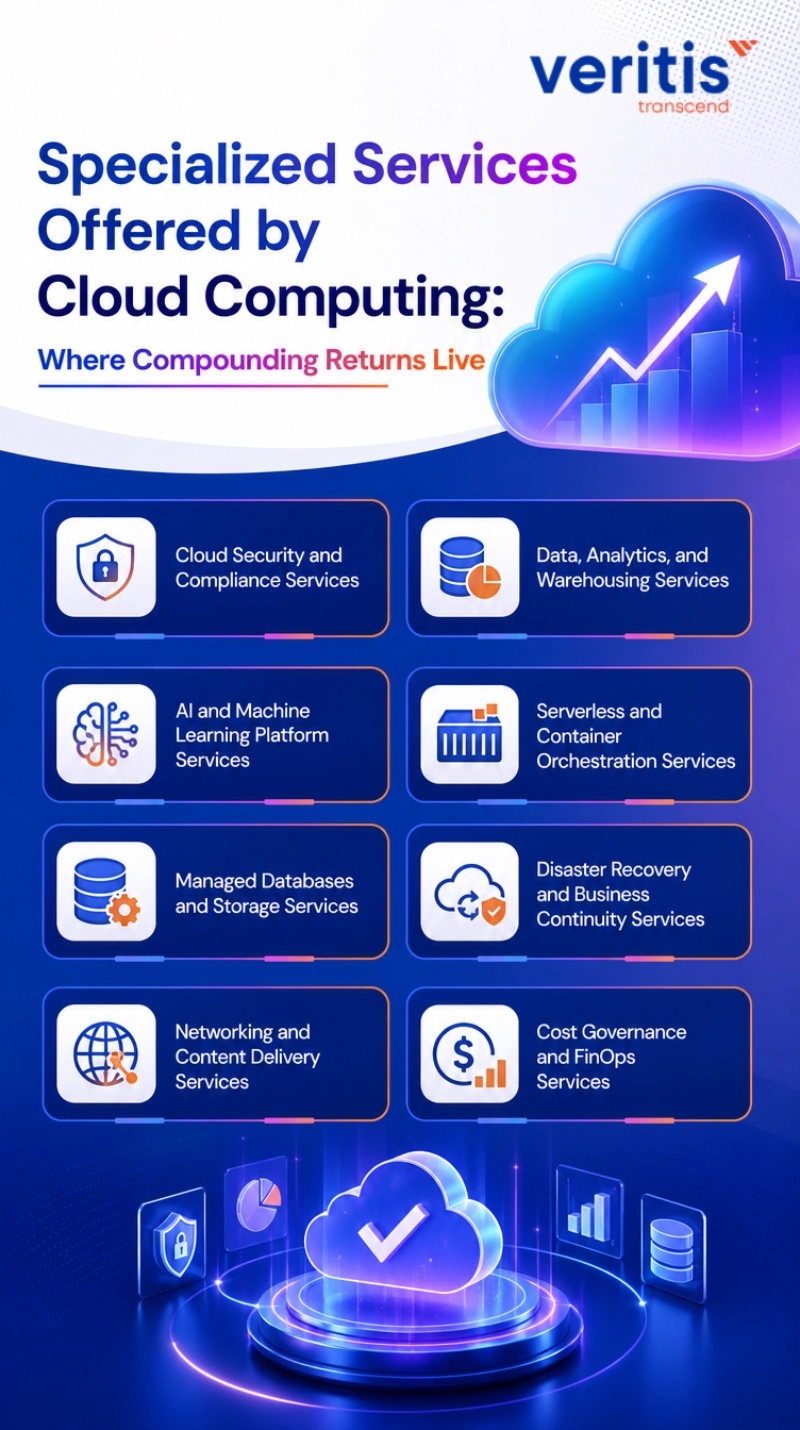
The headline models get the attention, but the compounding returns the ones that move EBITDA and reduce operational risk usually come from the specialized layers built on top of IaaS, PaaS, and SaaS.
1) Cloud Security and Compliance Services
Encryption at rest and in transit, identity and access management (IAM), cloud security posture management (CSPM), threat detection, and continuous compliance monitoring. For regulated industries financial services, healthcare, government these services determine whether you can operate in the cloud at all.
The security issues in cloud computing that derail enterprise programs are rarely exotic. They’re misconfigurations, over permissioned identities, and gaps between what your policy says and what your environment actually does. Managed security services close that distance continuously rather than at audit time.
Key capabilities: IAM, CSPM, SIEM integration, encryption key management, compliance as code frameworks (SOC 2, HIPAA, FedRAMP, PCI DSS).
2) Data, Analytics, and Warehousing Services
Cloud native data warehouses, streaming pipelines, lakehouse architectures, and embedded BI platforms that turn scattered operational data into decisions leadership can act on in hours, not quarters.
The shift from on premises data warehousing to cloud analytics is one of the clearest ROI stories in enterprise IT: reduced licensing cost, elastic query capacity, and the ability to correlate data sources that never sat in the same room before.
Key capabilities: Cloud data warehouses (Snowflake, BigQuery, Redshift), streaming ingestion (Kafka, Kinesis), BI platforms (Looker, Power BI), data governance and cataloging.
3) AI and Machine Learning Platform Services
Pre built model APIs, managed training infrastructure, MLOps tooling, and foundation model access that shorten the path from experiment to production. Enterprises don’t need to build GPU clusters to run serious machine learning; they need a clear use case strategy and the engineering discipline to operationalize models at scale.
The intersection of AI in cloud computing is reshaping how enterprises approach everything from demand forecasting to fraud detection to customer service automation. The critical distinction is between pilots that impress a board deck and production deployments that change a cost structure.
Key capabilities: Managed ML platforms (SageMaker, Azure ML, Vertex AI), pre trained model APIs, vector databases for RAG architectures, model monitoring and drift detection.
4) Serverless and Container Orchestration Services
Serverless functions (AWS Lambda, Azure Functions, Google Cloud Run) and container orchestration platforms (Kubernetes, managed via EKS, AKS, GKE) let engineering teams deploy and scale workloads without provisioning or managing servers.
Best fit: Event driven workloads, microservices architectures, batch processing, and API backends where traffic is variable and predictable idle time would waste reserved capacity.
Enterprise consideration: Serverless significantly reduces operational overhead but requires a rethink of application architecture. Container orchestration at enterprise scale demands platform engineering investment; the tooling is powerful but not self managing.
5) Managed Databases and Storage Services
Managed relational databases (RDS, Azure SQL, Cloud SQL), NoSQL stores (DynamoDB, Cosmos DB, Firestore), object storage (S3, Azure Blob, GCS), and in memory caches (ElastiCache, Azure Cache for Redis) replace the operational burden of running database infrastructure with a metered, maintained service.
Key benefit: High availability, automated backups, read replicas, and version management handled by the provider, freeing DBA capacity for schema design and query optimization rather than patching and failover drills.
6) Disaster Recovery and Business Continuity Services
Geo redundant backup, automated failover, and recovery orchestration without the capital cost of a second physical site. Cloud native DR compresses recovery time objectives (RTO) and recovery point objectives (RPO) in ways that on premises architectures rarely achieve at comparable cost.
Enterprise consideration: DR is not a set and forget service. Runbook currency, failover testing cadence, and data replication lag need to be actively governed, especially as application landscapes evolve.
7) Networking and Content Delivery Services
Virtual private clouds (VPCs), dedicated interconnects (AWS Direct Connect, Azure ExpressRoute), software defined WANs, and global content delivery networks (CDNs) that make cloud workloads perform as though they’re local, regardless of where users or branch offices are located.
Key capabilities: Private connectivity, DDoS mitigation, latency optimization through edge PoPs, and network segmentation for multi tenant or compliance sensitive environments.
Understanding the boundary between edge computing and cloud computing matters here; decisions about where compute runs (centralized cloud vs. distributed edge nodes) directly shape your networking architecture and latency profile.
8) Cost Governance and FinOps Services
CloudWatch cost anomaly detection, rightsizing recommendations, reserved instance and savings plan management, tag enforcement, and third party FinOps platforms (Apptio Cloudability, CloudHealth) that keep consumption tied to value rather than drift.
Cost governance is not a monthly reporting exercise. Done correctly, it’s a continuous feedback loop between engineering decisions and financial outcomes one that keeps a cloud program commercially viable as it scales.
Transform Your Business with Cloud
Cloud Deployment Models: A Decision Framework
Service selection and deployment model are separate but interlocked decisions. The same IaaS or PaaS services can be consumed across four deployment architectures, each with different cost, compliance, and operational implications.
| Deployment Model | Description | Best Fit |
| Public Cloud | Resources shared across tenants; managed entirely by the provider | Variable workloads, SaaS adoption, cost optimized dev/test |
| Private Cloud | Dedicated infrastructure; operated on premises or in a colocation facility | Regulated data, low latency requirements, maximum control |
| Hybrid Cloud | Integration of public and private environments via secure connectivity | Legacy modernization, burst capacity, phased migration |
| Multi Cloud | Workloads distributed across two or more public cloud providers | Avoiding single vendor lock in, geographic reach, best of breed services |
For most mid to large enterprises, the answer is hybrid or multi cloud, not because it’s architecturally elegant, but because the real enterprise IT estate is never uniformly suited to a single model. The governance and integration layer that ties these environments together is where programs succeed or stall.
Staying current on cloud computing trends shaping enterprise IT is essential as deployment models evolve; sovereign cloud, confidential computing, and distributed cloud are reshaping what “private” and “public” mean in practice.
Industry Applications: Where These Services Deliver Measurable Outcomes
Cloud services don’t deliver value in the abstract. They deliver value in context where a specific capability meets a specific operational or competitive problem.
- Financial services: Cloud native data platforms accelerate fraud detection model retraining from weeks to hours. Compliance as code frameworks significantly reduce audit preparation cycles. Cloud computing in fintech is reshaping core banking, payments, and lending infrastructure at a pace that legacy on premises architectures cannot match.
- Healthcare: Managed analytics and AI inference on de identified patient data create clinical decision support tools without standing up dedicated GPU infrastructure. Cloud computing in healthcare introduces complexity around HIPAA and data residency, but managed compliance services make those requirements tractable rather than prohibitive.
- Manufacturing and supply chain: Streaming IoT data from production lines into cloud analytics pipelines enables predictive maintenance and yield optimization. Cloud computing’s role in supply chain management is moving from visibility dashboards to autonomous inventory decisions.
- Automotive: Connected vehicle platforms, OTA update infrastructure, and digital twin simulations run on cloud infrastructure at a scale that on premises cannot economically support. The benefits of cloud computing in the automotive industry extend from R&D throughput to post sale service revenue.
- Government and public sector: Sovereign cloud options, FedRAMP authorized services, and air gapped deployment models are expanding what cloud adoption in the government sector looks like, from permitting systems to intelligence workloads.
Useful link: 9 Keys to Selecting a Right Cloud Managed Services Provider (MSP)
How to Evaluate and Select Cloud Services: A Framework for IT Leaders
Enterprise cloud decisions fail less often on technology than on process. Here is the evaluation sequence that consistently produces better outcomes:
1) Workload Inventory and Classification
Categorize every application by latency sensitivity, data residency requirements, change velocity, and cost profile. Not every workload belongs in the cloud, and not every cloud workload belongs on the same service model.
2) Total Cost of Ownership Modeling
Lift and shift to IaaS does not automatically reduce cost. Model the full picture: compute, storage, egress, licensing, operational labor, and governance tooling before committing.
3) Compliance and Data Residency Mapping
Identify which regulatory frameworks apply to each workload before selecting a provider region or deployment model. Retrofitting compliance is significantly more expensive than designing for it.
4) Vendor Assessment Beyond Pricing
Evaluate SLA depth, support tier responsiveness, ecosystem maturity, and the provider’s roadmap alignment with your industry vertical, not just the per unit price of compute.
5) Integration and Exit Planning
Understand what it takes to move data and applications out before you move them in. Data portability, API standards, and contractual exit rights matter as much as onboarding.
6) Governance Framework First
Establish tagging standards, cost allocation policies, security baselines, and change management processes before workloads scale. Governance retrofitted at scale costs multiples of governance built in from day one.
How Veritis Converts Cloud Services into Outcomes?
Choosing the right services is step one. Sequencing and governing them is where enterprise programs succeed or drift.
Veritis’s cloud service line pairs migration and modernization expertise with disciplined cost management, security engineering, and managed operations. Hence, the services offered by cloud computing translate into measurable results, not just a larger vendor invoice. Our approach follows a clear line: assess the current environment, map workloads to the right service models, prioritize by business impact, and put governance in place before scale, not after.
That sequencing is how modernization stays predictable: on cost, on timeline, and on compliance.
The Bottom Line
The services offered by cloud computing are only as valuable as the strategy behind them. The enterprises that win aren’t the ones with the most services enabled; they’re the ones that matched each capability to a business outcome, sequenced deployment by impact, and governed it from day one.
A sprawling cloud footprint without that discipline is just a larger, more complex IT bill. A focused, well governed cloud program is a structural advantage in cost, in speed, and in resilience.
Ready to move from options to a plan? Book a consultation with Veritis to assess your current environment, identify the highest impact cloud services for your workloads, and define a clear, cost disciplined path forward.