DevOps is a set of procedures and a collaborative mindset to streamline operations and enhance IT infrastructure. Many firms worldwide are eager to complete this digital transformation, as adopting DevOps methodologies and processes dramatically improves software delivery and maintenance. The main issue is that it’s not always viable, let alone practical, to create an internal DevOps team. Before a corporation profits from an internal DevOps team, it must undergo a protracted and expensive cultural change, since DevOps engineers are expensive and can only function efficiently when they adhere to DevOps principles and ethos.
Your development and operations teams’ silos are broken down through the use of DevOps services. You can use it to speed up software delivery, automate processes, implement changes successfully and on schedule, and improve the dependability of the process.
When you think about all the difficulties in creating your own DevOps engineers team, DevOps outsourcing as a managed service makes a lot of sense, especially for startups and business owners. You can get specialized skills through outsourcing, like marketing, graphic design, or legal counsel, without incurring the financial and administrative costs of bringing these services in house.
The best solution for the problems above is to outsource DevOps implementation. This blog post will cover every aspect of DevOps outsourcing, including its advantages and approaches to outsourcing. It will also cover how to get started, how to make it work well, and how to choose the best DevOps partner based on your requirements.
What is DevOps Outsourcing?

A distribution strategy for a collection of tools called DevOps as a Service encourages communication between a company’s operations staff and software development team. In this delivery model, the DevOps as a Service provider offers many tools that cover different facets of the overall process and links these tools so they may function as a single entity. An internal best of breed toolchain strategy, in which the DevOps team employs a disjointed collection of independent technologies, is the antithesis of DevOps as a Service.
Every activity during the software delivery process should be traceable, in line with the DevOps as a Service philosophy. The DevOps as a Service technology enables the organization to effectively use continuous integration (CI) and continuous delivery (CD) to create business value. , DevOps engineers inform the developer group when an issue is found in the production environment.
If done right, outsourcing DevOps can give businesses rapid access to highly qualified personnel knowledgeable in DevOps transformation and implementation, without the hassle and expense of setting up in house DevOps teams.
Useful link: What is DevOps Services?
How does DevOps as a Service work?
The DevOps methodology for software development emphasizes the culture and procedures that enable the development and operations teams to function as a single unit. The two departments’ cooperation will be improved in order to accelerate the software development lifecycle (SDLC).
As a result, there is no single best technique for DevOps outsourcing, and every project requires a customized strategy. The DevOps as a Service provider will review the project’s scope of work and reach an individual case by case agreement on services.
The vendor can work with you as a partner and support testing, delivery pipelines, continuous development, and integration in multiple ways.
Below are a few Approaches for Outsourcing DevOps:
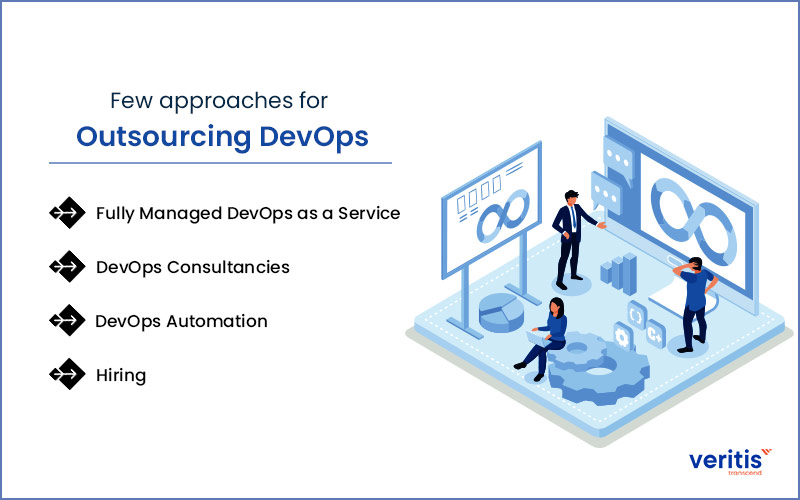
1) Fully Managed DevOps as a Service:
End to end DevOps services are included. Here, the outsourcing provider collaborates with your own staff to develop, test, and deploy cloud based infrastructure and applications continuously and automatically. The DevOps engineers assist your business in creating procedures from the beginning (including the four continuous stages of the DevOps workflow) and in implementing DevOps practices that work with your current infrastructure and user needs.
2) DevOps Consultancies:
Here, the DevOps engineers evaluate your current procedures, give advice on how to make them better, and assist in putting the required changes into place so that you can achieve your business objectives the DevOps way.
3) DevOps Automation:
To speed up results and establish a trustworthy automated testing environment, you can outsource the DevOps automation strategy to a company.
4) Hiring:
The vendor also offers the option to hire dedicated DevOps engineers for a protracted project. Let’s look at the services that DevOps as a Service allows you to outsource to have a better understanding. Standard offshore and nearshore outsourcing partners provide services across a variety of fields. The specs can be adjusted to align with the clients’ organizational objectives, project requirements, application structure, team structure, and financial constraints.
DevOps is becoming a widely used capacity for agility. However, enterprises struggle to implement DevOps practices effectively. One of the primary causes is the lack of DevOps expertise, as well as the high cost of hiring, training, and addressing skill shortages. These problems, however, may be resolved through DevOps outsourcing, particularly for startups seeking to adopt DevOps and Agile for rapid, secure development. Let’s talk about some more of its advantages below.
Useful link: Why Should You Adopt DevOps and What are the Benefits it Offers?
DevOps as a Service Advantages
Organizations without internal DevOps experience or the funding to hire or educate staff with such capabilities may find DevOps as a Service appealing. However, the DevOps outsourcing strategy also obscures the challenges of managing the flow of data and information throughout the toolchain. Without understanding how the entire toolchain works, the various people and teams participating in the DevOps process may use simple interfaces to get the tooling they need.
A developer might use source code management tools, a tester could examine application performance management tools, and the IT operations team could make changes using configuration management tools, all utilizing the same DevOps as a Service offering. DevOps as a Service seeks to enhance collaboration, monitoring, administration, and reporting by combining specific DevOps tools components into a single overall solution. A firm may adopt a more flexible approach to its markets and introduce new goods and services as markets evolve, leveraging an efficient DevOps as a Service strategy. Traditional development and deployment procedures can coexist with DevOps and DevOps as a Service.
Recruitment is made simpler and more affordable by outsourcing DevOps. As outsourcing businesses offer experienced specialists with all the necessary credentials in one location, you can skip the drawn out and expensive hiring procedure.
Additionally, there is no need to invest time or resources in training an internal workforce. Also, hiring a remote staff reduces certain financial concerns because the outsourced business will pay for any taxes, software licensing, office rent, and other expenses.
Companies that outsource have more experience, having tested and evaluated multiple methods and solutions. They have experience in many different fields thanks to their extensive project experience.
Additionally, outsourcing companies closely monitor their staff members’ technical abilities and ensure they stay current with emerging technologies by enrolling them in online courses and granting them certifications.
Access to experts like database administrators and site reliability engineers is another benefit of outsourcing DevOps. Obtaining experts with uncommon or specialized skills may be more challenging when building an internal team of DevOps engineers, if finding DevOps engineers is already challenging. The ability to pick from a variety of DevOps talent through outsourcing allows you to spread your responsibilities more effectively and assign specialists to challenging jobs.
DevOps as a Service Disadvantages
In discussions about DevOps as a Service, it is assumed there is consensus on a single, comprehensive toolchain for DevOps implementation that meets the demands of any company, much less one that a provider might supply in a managed services model. From software development through deployment to production, most DevOps toolchains include some form of CI/CD pipelines and monitoring capabilities, though needs and preferences may differ across businesses.
Compared to specialized study and the selection of best of breed technologies integrated into it, a DevOps managed services model may limit an organization’s options for tools and specific capabilities. DevOps service providers may provide fewer options for specific tools, whether their own or those of partners.
Trade offs between speed and security, as well as a service provider’s capacity to meet availability and reliability standards, are other potential issues with a DevOps as a Service model. To keep expenditures in check, a company must closely monitor how it uses services and related technologies.
Useful link: Pros and Cons of DevOps Methodology and its Principles
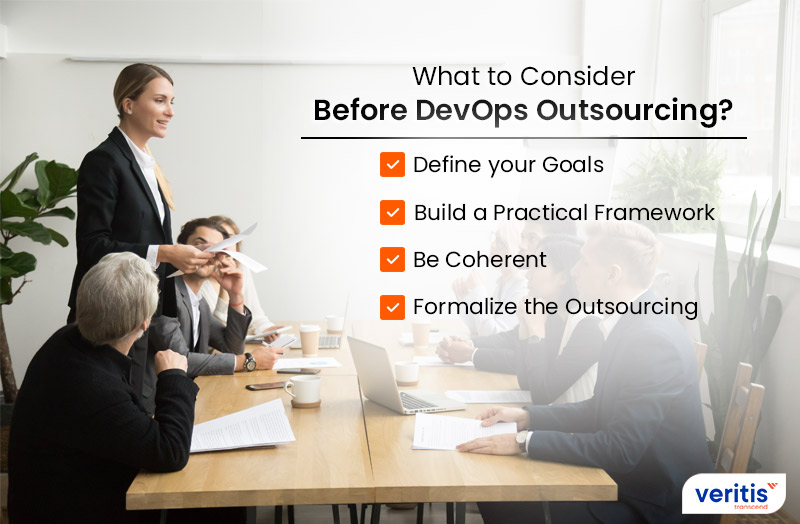
What to Consider Before DevOps Outsourcing?
DevOps outsourcing, or DevOps as a Service, is quite different from traditional outsourcing arrangements. DevOps is a broad and complex topic; therefore, there is no single solution that works for everyone. Here is a step by step guide to getting started with DevOps, choosing the right partner, and making it successful for efficient DevOps outsourcing.
1) Define your Goals
DevOps outsourcing is not just about outsourcing the responsibilities and reducing costs but also about increasing productivity and amplified agility. Along with these, the organization has various other goals that you want to be solved by DevOps.
It would be better to list the objectives you want the DevOps solution to address. This would help you communicate better with the DaaS provider. Additionally, this process would help you select your DaaS provider as your criteria would be clear. The criteria, or key performance indicators (KPIs), can range from scalability to 24×7 support.
This step also allows the DaaS provider and you to be on the same page regarding the DevOps project’s requirements. Additionally, the deadlines and other essential project milestones will be shaped by this step.
2) Build a Practical Framework
DevOps depends heavily on teamwork; therefore, outsourcing needs a governance architecture that identifies the key players, procedures, and tools. The client is familiar with the application, customer persona, and end goals, whereas the DevOps services provider brings an outside view of the business needs. So, using TOM (Targeted Operating Model) to reduce disparities and build teams with the same mentality may create a successful partnership.
Using interconnected elements such as roles and duties, reviews, organizational structure, people, processes, and tooling, you can use TOM to design a governance framework. Additionally, you may select the most effective governance components and incorporate them into the model to achieve better DevOps outsourcing results.
3) Be Coherent
The secret to effective outsourcing, and DevOps, is no different: communication. You must confirm that your DevOps partner has an effective communication strategy in place as well as effective communication capabilities. By talking with them through various channels and observing how professional they are, you can evaluate their abilities.
Once you’ve chosen a vendor, collaborate with them to create a communication plan that outlines the work, timeframes, each party’s roles, and how required modifications or upgrades will be implemented.
4) Formalize the Outsourcing
Once you’ve chosen a vendor, it’s time to formalize your agreement with a contract. Because a DevOps firm may offer a range of solutions, it comes down to cooperation and pricing models. We have covered the DevOps outsourcing models in great detail in the following part to assist you in making the best decision.
However, DevOps lacks a defined scope when used alongside agile development. It takes a distinct tack on contracting and cooperation methods, as well as on the outsourcing scoping process. The shift from closed scope to open scope contracting has had the greatest impact.
There are two types of contracts: Closed scope and open scope. A closed scope contract considers functional and technical designs and definitions of result oriented services, tools, and roles. It is predicated on (more or less) unchanging circumstances and managed work practices.
Innovation, operations, and culture are all incorporated within open scope contracts. It considers a stream of value creation, delivery, and management that is in line with the constantly shifting demands of the market and users.
If you take into account the dynamic nature of software engineering with DevOps, constantly shifting requirements, cultural change, etc., you can also think about T&M (Time and Material) contracts as an alternative to fixed price agreements. In conclusion, create a value driven outsourcing agreement with the vendor that outlines the DevOps roadmap and provides flexibility for future changes.
Capping it Off
DevOps is the approach that most growing companies are adopting. Given its potential, most organizations are implementing the methodology and ingraining DevOps tools into their work culture. However, given the paradigm shift it brings in, most companies can’t cope with the changes it brings. That’s why Stevie Award winner Veritis is the preferred choice for DevOps consulting services. We have provided services and solutions to emerging and Fortune 500 companies. So, reach out to us and walk away with a DevOps solution that suits you best.
Got Questions? Schedule A Call
Additional Resources: