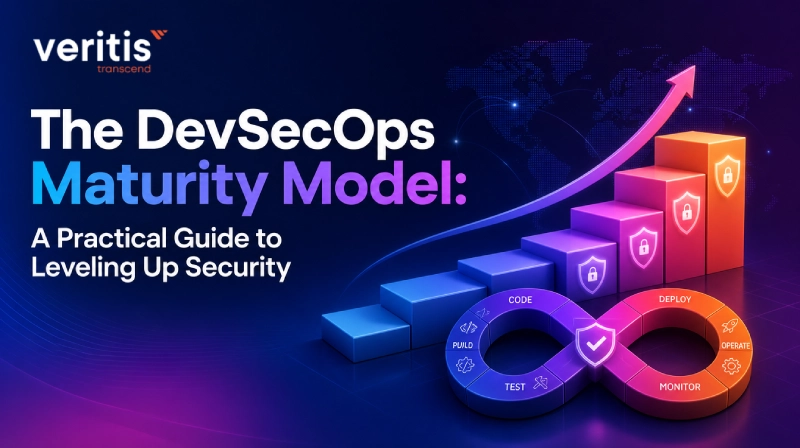
Most teams don’t wake up one morning with a fully mature DevSecOps practice. They get there in messy, uneven steps: a scanner bolted on here, a policy gate added there, a security champion who quietly changes how a squad thinks about risk. A DevSecOps maturity model gives that messy journey a shape. It tells you where you are, what “better” actually looks like, and which move earns the biggest payoff next.
This guide breaks the model down into stages you can recognize in your own organization, explains how the major frameworks compare, offers a way to assess yourself honestly, and gives you a concrete action plan for the climb.
What Does the DevSecOps Maturity Model Actually Measure?
At its core, a maturity model is a diagnostic. It measures how deeply security is woven into the way you build and ship software, not how many tools you own. Two companies can run identical scanners and end up in wildly different places because one treats findings as a checkbox and the other treats them as engineering work.
Good models look across a handful of dimensions:
- Culture and ownership: Is security “the security team’s job,” or does everyone hold a piece of it?
- Automation: Are checks manual and occasional, or continuous and pipeline native?
- Process integration: Does security show up at the start of design, or only at a release gate?
- Measurement: Can you quantify risk, mean time to remediate, and coverage?
The 4 Stages of DevSecOps Maturity
Different frameworks use different labels, but they tend to describe the same climb. Here’s a clean, practical version you can map to your own organization.
Stage 1: Reactive (Ad Hoc)
Security happens after the fact. Pen tests arrive late, vulnerabilities are discovered in production, and fixes are firefighting. There’s little automation and no shared ownership. Developers and security teams operate in separate silos with minimal communication. Most organizations start here; there’s no shame in it, only opportunity.
Typical signs you’re here: no security in the CI/CD pipeline, findings tracked in spreadsheets, security reviews that happen days before launch.
Stage 2: Managed (Repeatable)
Basic scanning is in place. SAST or dependency checks run in CI, someone tracks findings, and there are written policies. The work is still siloed and often noisy, but it’s consistent. You’ve stopped relying on heroics.
Typical signs you’re here: automated scans run, but results pile up unreviewed, security is consulted late in sprints, no formal threat modeling process.
Stage 3: Defined (Integrated)
Security is designed in. Threat modeling happens during planning, guardrails are built into the pipeline, secrets management is standardized, and developers get feedback where they work. Security champions embed in teams. False positives shrink because tuning is deliberate.
Typical signs you’re here: security criteria appear in Definition of Done, developers own and close their own findings, infrastructure as code is scanned automatically.
Stage 4: Optimized (Self Improving)
Metrics drive decisions. Risk is measured, remediation is fast and largely automated, and the system continuously improves. Security enables speed rather than blocking it. Retrospectives include security outcomes alongside delivery metrics. This is the destination, though “arriving” really means never stopping.
Typical signs you’re here: mean time to remediate is tracked and trending down; security KPIs appear in engineering dashboards; the team regularly experiments with new controls and retires those that don’t add value.
Our take: The biggest mistake we see is teams chasing Stage 4 tooling while their culture is still stuck at Stage 1. A world class scanner on a team that ignores its output is just expensive theater. Culture and process usually need to mature alongside the tech, not after it.
Major DevSecOps Maturity Frameworks Compared
You don’t have to build a model from scratch. Several well established frameworks can serve as your starting point. Understanding how they differ helps you choose the right lens for your organization.
1) OWASP DSOMM (DevSecOps Maturity Model)
The OWASP DevSecOps Maturity Model is one of the most comprehensive open source frameworks available. It organizes practices across five dimensions: culture, static depth, dynamic depth, intensity, and consolidation, and maps more than 100 individual activities to four maturity levels. Its strength is granularity: you can pinpoint exactly which practices are missing at a very detailed level. The trade off is that the breadth can feel overwhelming for smaller teams starting out.
2) BSIMM (Building Security in Maturity Model)
BSIMM takes a data driven approach. Rather than prescribing a target state, it describes what hundreds of real software security programs actually do, organized into 12 practices and four domains (governance, intelligence, SSDL touchpoints, deployment). It’s most useful as a benchmarking tool, comparing your program against peers in your industry. The limitation: it’s observational rather than prescriptive, so it tells you what others do but not necessarily what you should do next.
3) NIST Cybersecurity Framework (CSF)
The NIST CSF isn’t a DevSecOps specific model. Still, its five functions, Identify, Protect, Detect, Respond, and Recover, map cleanly onto the stages above and are widely recognized in regulated industries. Organizations that need to demonstrate compliance often anchor their DevSecOps roadmap to the NIST CSF because it speaks the language of auditors and risk committees.
Choosing the Right Framework
| Framework | Best for | Key Strength | Potential Gap |
| OWASP DSOMM | Teams wanting a detailed activity checklist | Granular, open source | Can feel overwhelming |
| BSIMM | Benchmarking against industry peers | Real world data | Descriptive, not prescriptive |
| NIST CSF | Regulated industries and compliance focused orgs | Auditor friendly language | Not DevSecOps native |
| Custom / internal | Mature programs with unique context | Fits your culture | Requires investment to build |
Key Practices at Each Maturity Stage
Knowing the stages is useful. Knowing the concrete practices that move you between them is what matters operationally.
1) Moving from Stage 1 to Stage 2
- Add one automated security scan (SAST or SCA) to your CI pipeline, even if noisy at first.
- Assign a named owner for security findings on each development team.
- Document a basic secure coding standard and share it in onboarding.
- Run your first threat modeling session on a high risk feature.
2) Moving from Stage 2 to Stage 3
- Tune scanner rules to reduce false positives to a manageable level.
- Introduce security champions: developers who receive extra training and bridge the gap with security teams.
- Embed security acceptance criteria into your Definition of Done.
- Centralize secrets management (e.g., a secrets vault rather than environment variables in code).
- Add DAST and container scanning alongside existing SAST.
3) Moving from Stage 3 to Stage 4
- Define and track security KPIs: mean time to remediate, vulnerability escape rate, coverage.
- Automate remediation for known, low risk vulnerability classes where possible.
- Run regular adversarial exercises (red team, bug bounty) to find what automation misses.
- Feed findings back into developer training, so the same classes of bugs stop recurring.
- Treat security retrospectives as a standard part of your engineering rhythm.
Useful link: Why DevSecOps Tools Are Essential for Modern Software Development
How to Assess Your Organization?
You don’t need a consultant to run a first assessment. You need honesty and evidence.
Step 1: Rate Each Dimension
Score culture, automation, process integration, and measurement independently on the four stage scale. Use observable evidence, pipeline configs, ticket data, incident records, not aspirations. Surveying developers and security engineers separately often reveals instructive gaps between perceived and actual maturity.
Step 2: Find Your Weakest Link
Maturity is gated by your lowest dimension, not your highest. Strong automation with zero developer buy in still fails. The weakest dimension is always the one you should focus on first, even if it feels less exciting than buying a new tool.
Step 3: Pick One Advancement per Quarter
Trying to jump two stages everywhere at once burns teams out. Small, shipped improvements compound faster than ambitious programs that stall. Set a quarterly goal that moves one dimension forward by one stage.
Step 4: Instrument as You Go
If you can’t measure remediation time today, making it visible is itself a gain in maturity. Every stage transition should leave behind a metric that you weren’t tracking before.
Step 5: Revisit the Assessment Regularly
A point in time assessment goes stale quickly. Build a lightweight quarterly review into your engineering calendar. Teams that track their maturity over time consistently outperform those that treat it as a one off exercise.
A practical first move: Get one meaningful security check running in the pipeline with tuned, low noise results, and pair it with a named owner on the dev side. That single change often pulls two dimensions forward at once.
Common Pitfalls to Avoid
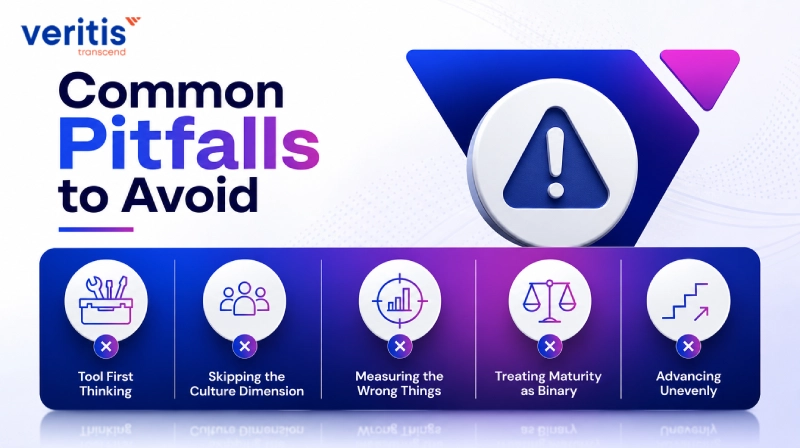
Even teams that understand the model well can stumble. These are the mistakes we see most often.
1) Tool First Thinking
Buying a platform before defining the problem it should solve. Tools accelerate a good process; they don’t replace one.
2) Skipping the Culture Dimension
Automation without developer buy in creates alert fatigue and ignored findings. Invest in security champions and shared ownership early.
3) Measuring the Wrong Things
Counting the number of scans run is less useful than counting the rate at which critical findings are closed. Choose metrics that reflect risk reduction, not activity.
4) Treating Maturity as Binary
You’re not “done” at Stage 4. The threat landscape shifts, your architecture changes, and new team members arrive. Maturity is a continuous practice.
5) Advancing Unevenly
A Stage 4 automation capability sitting on a Stage 1 culture is fragile. Aim for balanced progress across all dimensions.
Conclusion
A DevSecOps maturity model isn’t a report card to feel bad about; it’s a map. It turns a vague ambition (“we should be more secure”) into a sequence of concrete, achievable moves. Whether you anchor on OWASP DSOMM, BSIMM, NIST CSF, or a custom internal model, the underlying logic is the same: locate yourself honestly, strengthen your weakest dimension first, and treat maturity as a habit rather than a milestone.
The teams that ship securely at speed didn’t get lucky; they climbed the ladder one deliberate rung at a time, and they never stopped measuring the climb.