Greater risk of disruptions, increasingly volatile consumer preferences, fast-paced product launches, and global competition are inevitable elements of the present-day market landscape. In order to stay competitive, organizations must reimagine their business processes, especially Supply Chain Management.
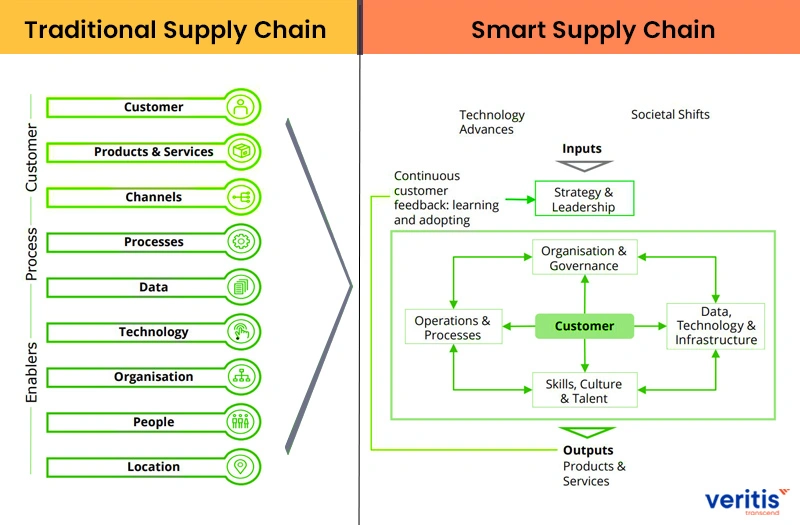
Businesses need to consider shifting from the traditional and linear supply chain models to smarter, digital supply chain networks. All while optimizing costs and improving efficiency in a highly competitive global environment.
Amid the gamut of technologies available today, cloud computing solutions has emerged as a real game-changer for businesses to innovative Supply Chain Management (SCM), rapidly and efficiently.
Cloud computing can connect information across planning, sourcing, manufacturing, inventory, logistics, and distribution. Its value depends on how well applications, data, people, and processes work together. Moving applications to the cloud alone does not guarantee better supply chain performance.
What is Cloud Supply Chain Management?
Cloud supply chain management uses cloud applications and infrastructure to coordinate supply chain activities. It can connect enterprise resource planning, warehouse, transportation, procurement, and supplier systems, giving authorized teams and partners access to shared operational information.
Different cloud service models support different needs. Software as a service provides business applications, while platform and infrastructure services support integrations, data management, and existing workloads. Organizations can use more than one model based on their application, integration, and security requirements. Learn more about the different types of cloud computing services.
Talk to Our Cloud Migration Expert
How Cloud Can Transform Supply Chain Management?
Cloud helps organizations innovate processes at every level of their supply chain, from planning and sourcing to manufacturing, logistics, and distribution, glean new insights for decision-making and automate activities. It helps build stronger, smarter supply chains.
Cloud enables a connected, intelligent, scalable, and rapid supply chain, which drives unprecedented visibility, resiliency, agility, and flexibility across businesses.
1) Connected supply chain
By leveraging structured and unstructured data generated across the supply chain, cloud solutions improve the connectivity of the supply chain network. This helps companies to easily connect with their suppliers, vendors, and customers. Cloud also facilitates dynamic provisioning, multi-tenancy, improved server utilization, and datacenter efficiency.
Benefits of the connected supply chain:
- Real-time visibility
- Seamless collaboration
- Next-gen operating models
Connectivity is most useful when teams share consistent information about orders, products, locations, and shipment status. For example, a delayed shipment should update its expected arrival and identify affected customer orders so planners and service teams can respond without relying on separate spreadsheet exchanges.
Cloud integration can connect existing applications through APIs, messaging, managed connectors, or scheduled data transfers. The right method depends on how quickly the business needs information. Teams should define which system owns each record, how failed transfers are handled, and who can access each dataset.
Organizations do not need to move every system to the cloud at once. Hybrid cloud services can connect existing infrastructure with cloud capabilities, based on application dependencies, recovery needs, and operational risk.
2) Intelligent supply chain
The cognitive intelligence and predictive analytics offered by cloud computing help organizations gain right information for decision-making, at the right time. While intelligence enables proactive decision-making ‘on the go,’ the analytics help spot potential risks. Cloud offers actionable insights that make digital supply chains intelligent.
Benefits of the intelligent supply chain:
- Reduced disruption mitigation time
- Improved automation
- Enhanced innovation
Analytics are most valuable when they connect a signal to a decision. Cloud platforms can combine order history, supplier performance, stock availability, and transportation events to help teams assess service risks and compare responses.
For example, descriptive analytics can explain what happened, predictive analytics can estimate what may happen, and prescriptive analytics can help compare possible actions, such as reallocating inventory or changing a transport route. Purchasing commitments and other material decisions should remain within approved business rules and human approval processes.
3) Scalable supply chain
As cloud-based solutions operate on a flexible, usage-based model, the network, storage, and capacity needed across the supply chain can be scaled up or down as per customer demands and market conditions.
Benefits of the scalable supply chain:
- Maximum efficiency
- Enterprise-level flexibility
- Improved customer experience
- Optimized costs
Cloud scalability can help systems handle seasonal order peaks, additional suppliers, new facilities, and larger planning datasets. However, more computing capacity cannot create warehouse space, supplier capacity, or transportation availability. Enterprises should test complete workflows under peak demand and monitor resource use, storage growth, data transfer charges, and licensing terms.
A structured method to cloud cost optimization and management can help teams connect resource consumption with business ownership.
4) Rapid supply chain
With cloud computing, businesses can now operate their supply chain models at speed, successfully in a volatile market. It enables faster planning and execution, resulting in reduced time to market. By moving to the cloud, organizations can gain better access to resources and information, enhancing flexibility and responsiveness to market conditions.
Benefits of the rapid supply chain:
- Quick response to supply chain disruptions
- Proactive threat prevention
- Ability to repurpose resources at scale
Cloud applications can reduce repeated data entry, manual status checks, and reconciliation between disconnected systems. A supplier delivery exception, for example, can trigger a planner review and notify the receiving team. Businesses should measure the result through operational outcomes such as exception resolution time, inventory accuracy, order processing time, and delivery performance. Faster software deployment alone does not prove better customer service or lower operating costs.
Practical Cloud Use Cases in Supply Chain Management
Cloud capabilities can support several everyday supply chain activities:
- Logistics teams can bring shipment status, carrier updates, delivery appointments, and exceptions into a shared workspace.
- Inventory teams can consolidate stock information across locations and use replenishment alerts, allocation rules, and site transfers.
- Planners can combine demand history, current orders, supplier lead times, and other signals to compare supply and production scenarios.
- Procurement teams can use supplier workflows to review purchase order acknowledgments, delivery updates, and exceptions.
- Manufacturing teams can connect production plans, material availability, quality records, and maintenance information. Cloud and edge computing can serve different needs, with processing near equipment supporting local response requirements and cloud services supporting broader coordination. Learn more about edge computing and cloud computing.
- Returns and traceability workflows can link product identifiers, shipment records, and quality findings to support investigations and recalls.
- A cloud control tower can bring together exceptions from planning, suppliers, inventory, and logistics, helping teams assess impact and assign response owners.
Security in Cloud Supply Chain Management
Cloud services can provide identity management, encryption, audit logging, and managed security capabilities. These controls still need to be configured and monitored correctly. Cloud security is a shared responsibility, and companies remain accountable for their users, data, configurations, and integrations.
Key priorities include least privilege access for employees and partners, data protection, monitoring, tested recovery procedures, and review of retention and compliance requirements. These cloud computing security practices should cover the entire connected workflow, including partner access and integration credentials.
How Should Enterprises Implement Cloud Supply Chain Management?
A successful implementation starts with an operational problem, not a platform purchase. Enterprises can begin by identifying a workflow affected by delays, errors, or excess inventory and recording a performance baseline.
Next, assess the applications, data quality, integration gaps, access controls, and site connectivity involved. Select an architecture that supports operational needs, then pilot a complete workflow with normal transactions, exceptions, failures, and user approvals.
Before expanding, compare results with the baseline and account for changes in demand, product mix, and other initiatives. Training, support, and governance should scale alongside the technology.
Now is the time for action!
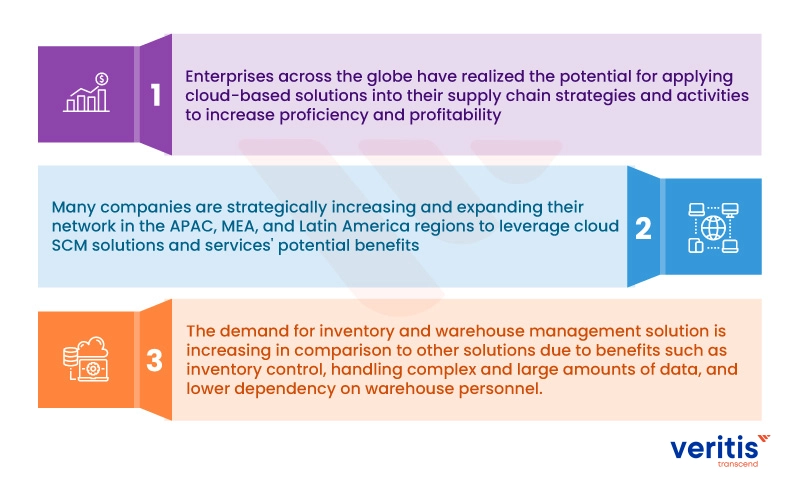
The global SaaS based supply chain management market was valued at USD 10.4 billion in 2025, according to IMARC Group’s 2026 report. The report projects the market will reach USD 33.5 billion by 2034, growing at a CAGR of 13.2% from 2026 to 2034. This outlook reflects continued investment in cloud delivered tools for inventory, procurement, demand planning, and logistics. Explore the benefits of cloud computing and how they can support supply chain transformation.
However, enabling an end-to-end cloud vision for supply chain management requires more than the ability to procure cloud solutions. To realize real ROI from your cloud investment, you will likely need assistance throughout your cloud journey. Veritis can help.
Case Study: Enabling Cloud Driven Supply Chain Agility in the Electronics Industry
Veritis partnered with a global electronics manufacturer to migrate legacy virtual machines to the cloud and implement DevOps practices across its IT infrastructure. A key goal was to enhance supply chain responsiveness and system integration. With cloud-enabled DevOps automation, the client experienced immediate benefits, including faster deployment cycles, real-time system updates, and improved collaboration among logistics, manufacturing, and IT teams, thereby strengthening the end-to-end supply chain.
This case study serves as a compelling example of how strategic collaboration between cloud computing and DevOps can revolutionize supply chain operations in fast-paced industries, such as the electronics sector.
Read the complete case study: Implementing DevOps for IT Infra and VM to Cloud Migration in the Electronics Industry.
How can Veritis help?
Based out in Texas, USA, Veritis focuses on helping clients harness the cloud to stay ahead in the complex digital landscape. With a host of cloud services, from strategy and implementation to migration, modernization, and management, we help organizations drive innovation and transform complex environments into smart digital businesses. Let’s Talk!
Cloud supply chain ROI should be demonstrated through operational outcomes, not assumed from migration completion. Useful measures include inventory accuracy, on time and in full delivery, exception resolution time, order processing time, and total operating cost.