One of the most widely discussed technological developments since the Internet of Things (IoT) is edge machine learning (Edge ML), with good reason. The network still needed to prepare to handle the explosion of smart devices linked to the cloud that came with the emergence of IoT. However, companies ignored significant cloud computing concerns, including security, due to network congestion. Edge ML is the fix.
What exactly is Edge ML then? Edge ML is a method for lowering dependency on cloud networks by allowing intelligent devices to analyze data locally (either utilizing local servers or at the device level) using machine learning and deep learning techniques. The word “edge” refers to processing performed by deep and machine learning algorithms at the device or local level, closest to the components that collect data. This is the foundation of machine learning at the edge, also commonly referred to as machine learning on the edge and edge computing machine learning.
The ability to process specific data locally enables screening of data sent to the cloud while enabling real time data processing and response. Edge devices continue to transmit data to the cloud as needed, strengthening overall machine learning edge computing workflows.
Artificial intelligence is the study of enabling robots to perform tasks typically regarded as requiring intelligence. Machine learning, which allows machines to learn new tasks independently, falls under that category. A division of machine learning is deep learning.
It involves teaching robots to analyze data in a way that closely mirrors how the human brain acquires new knowledge. Depending on the application, Edge ML uses machine learning and deep learning algorithms to analyze data locally. MLOps services are crucial for efficiently deploying machine learning models in Edge ML, managing them at scale, and updating them continuously to deliver optimal performance. This is especially important when organizations look to understand what is edge ml in practical deployment scenarios.
Talk To Our Machine Learning Expert
What is Edge ML?
Let’s understand ML and Edge before we dive into what is edge ML? Artificial intelligence (AI) is a subset that can perform perceptual tasks far more quickly than humans. Edge computing physically moves computing services closer to the user or data source, forming the base for edge machine learning and edge ML applications.
These computing services are available on what we refer to as edge devices, which are computers that enable real time raw data collection and processing for quicker, more accurate analysis. The Internet of Things, for instance, may run machine learning models locally through edge computing.
Unlike conventional infrastructure devices, edge computing machine learning devices examine incoming data as it arrives, deciding what to route to more powerful cloud-based algorithms and what to process locally. For instance, you might ask your smart device for information that is not time sensitive, and it will provide the answer. This process doesn’t require the device to send the information to the cloud server, as it processes the query locally. This methodology represents machine learning edge computing, as it stores the required information and answers queries in real time.
To support this ecosystem, MLOps services help deploy, monitor, and manage models efficiently, ensuring edge machine learning systems remain optimized and continuously updated.
Useful link: AI-Powered, ML-Driven – The New DevOps Trend!
Why Should You Use Edge ML?
Edge machine learning is groundbreaking. Processing data locally addresses security concerns by keeping user data out of the cloud and reducing load on cloud networks. Additionally, it enables real time data processing, which is essential for technologies like autonomous vehicles and medical equipment, and is not achievable with conventional intelligent devices powered by the cloud. This is why many organizations are shifting to edge machine learning for safer, faster performance, with AWS Machine Learning Tools used as needed.
As client expectations rise, so does the need for quick, secure processing power. Every business customer engagement now involves a variety of hybrid technologies and touchpoints that require quick access to the tools, information, and software needed to power novel experiences and deliver a satisfying user experience from start to finish. This shift has accelerated the adoption of edge ML approaches and capabilities across industries.
In the past, this processing involved sending datasets to remote clouds over networks, which often struggled to operate at full capacity due to the long distances the data had to traverse. This may lead to problems ranging from latency to security lapses. With machine learning edge computing, much of this processing now happens directly where the data is generated, giving organizations clearer differentiation in areas such as the difference between deep learning and machine learning when applied at the edge.
Edge computing, combined with MLOps services and solutions, enables you to move artificial intelligence and machine learning powered applications closer to data sources such as sensors, cameras, and mobile devices. This allows you to gather insights more quickly, spot patterns, and take immediate action without relying entirely on traditional cloud networks. This is one of the core advantages of edge machine learning and the reason businesses are increasingly adopting what is edge ML as a strategic capability, guided by MLOps Best Practices to maintain consistency and performance.
Useful link: Understanding the Differences Between Deep Learning and Machine Learning
How to Strategize Edge ML?
To create a uniform application and operations experience throughout your whole architecture through a shared, horizontal platform, edge computing is a crucial component of an open hybrid cloud strategy and the foundation for edge machine learning deployments. An edge strategy becomes even more impactful when combined with machine learning at the edge, enabling intelligent processing at scale.
An edge strategy goes even further, enabling cloud environments to reach locations too remote to maintain continuous connectivity with the data center. While a hybrid cloud strategy enables organizations to run the same workloads across their data centers and public cloud infrastructure (e.g., AWS, Azure, and GCP), an edge strategy goes further.
A dependable edge computing solution can be managed using the MLOPS tools and processes as the centralized infrastructure, yet can operate independently in a disconnected mode, as edge computing sites often have little to no IT manpower. This is essential for machine learning on the edge and machine learning edge computing environments that must operate securely and reliably, even with intermittent connectivity.
A workable plan should be able to handle duties like:
- It should be consistent when distributing core models to edge servers, enabling machine learning at the edge for faster local intelligence.
- Possess adaptable architecture that can provide dependable connections for edge computing machine learning.
- Automate deployment processes, leveraging MLOps services and solutions to streamline model rollout.
- Manage and automate infrastructure changes and deployments from your primary data center to far flung peripheral sites, powering scalable edge machine learning.
- At scale, provide, manage, and upgrade software applications across your infrastructure while supporting ongoing edge ML implementation efforts.
- Carry on business as usual at remote edge sites, even when internet access is spotty, which is critical for machine learning on the edge.
Applications of Edge Machine Learning
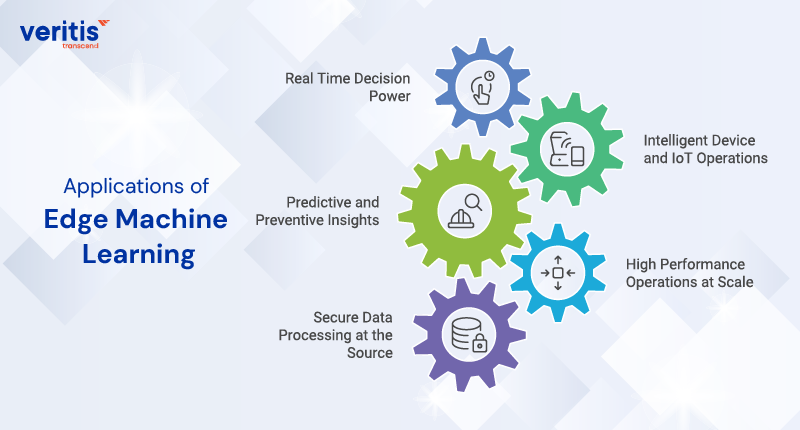
1) Real Time Decision Power
Enterprises use edge machine learning to act on data as soon as it is created. Instead of waiting for cloud round trip decisions, decisions are made at the point of action. This improves safety, speed, and operational continuity. Veritis enables this with secure model deployment, automated updates through MLOps services, and unified governance across edge and cloud environments.
2) Intelligent Device and IoT Operations
Modern device ecosystems need instant intelligence. Edge ML and edge machine learning enable sensors, cameras, and machinery to analyze data locally. This removes latency, protects sensitive information, and increases system uptime. Veritis helps clients build industrial grade IoT frameworks by combining MLOps solutions with reliable Enterprise cloud services integration.
3) Predictive and Preventive Insights
Industries with zero tolerance for delays rely on edge computing machine learning to anticipate events before they disrupt operations. From failure prediction in manufacturing to anomaly detection in finance and healthcare, edge computing for machine learning reduces risk and enhances reliability. Veritis designs architectures that deliver these insights consistently, even in remote or low connectivity environments.
4) High Performance Operations at Scale
As workloads grow, enterprises need intelligence that scales without increasing cloud dependency. Machine learning at the edge unlocks faster throughput and stronger performance across distributed operations. Veritis provides a unified operating model that enables leaders to manage hundreds or thousands of edge locations with consistency, security, and cost visibility.
5) Secure Data Processing at the Source
Executives want data processed securely, locally, and with minimal exposure. Edge ML becomes a strategic advantage when sensitive information is processed at the edge rather than transmitted across networks. Veritis strengthens these deployments with enterprise level cloud consulting services, automated lifecycle management, and FinOps cloud cost management to ensure long term efficiency.
Benefits of Edge Machine Learning
1) Intelligence Without Waiting for the Cloud
Edge machine learning enables decisions in real time as data is produced.
- Removes dependency on fragile network paths
- Powers instant responses in critical operations
- Strengthens continuity using machine learning on the edge
Veritis equips enterprises with scalable architectures that make intelligence available everywhere.
2) Lower Operational Costs Through Local Processing
By analyzing data at the source, organizations avoid unnecessary data transfer and storage fees.
- Reduces cloud traffic volume
- Optimizes infrastructure spend with edge ML and edge computing machine learning
- Minimizes waste through targeted processing
Veritis integrates automated governance frameworks using MLOps services and MLOps solutions to sustain long term cost efficiency.
3) Stronger Data Security and Regulatory Confidence
Sensitive information remains on the device or local compute node rather than crossing networks.
- Limits exposure
- Reduces breach risk
- Supports compliance in finance, healthcare, and government
Veritis strengthens this with enterprise security patterns and end to end cloud consulting services aligned with compliance mandates.
4) High Reliability in Low Connectivity Environments
Edge computing with machine learning keeps applications running even when cloud access is unavailable.
- Ensures uptime for remote plants, retail stores, and distribution hubs
- Avoids outages caused by network instability
- Supports always on intelligence
Veritis blends edge and Enterprise cloud services into a unified architecture that operates consistently across every location.
5) Scalable Intelligence Across Distributed Operations
Enterprises can run the same models across thousands of devices, branches, and field sites.
- Standardizes intelligence across the entire footprint
- Brings automation directly to the edge
- Simplifies rollout with centralized control
Veritis provides a unified operating model that scales what is edge ML from pilot to full enterprise deployment.
Challenges in Edge Machine Learning
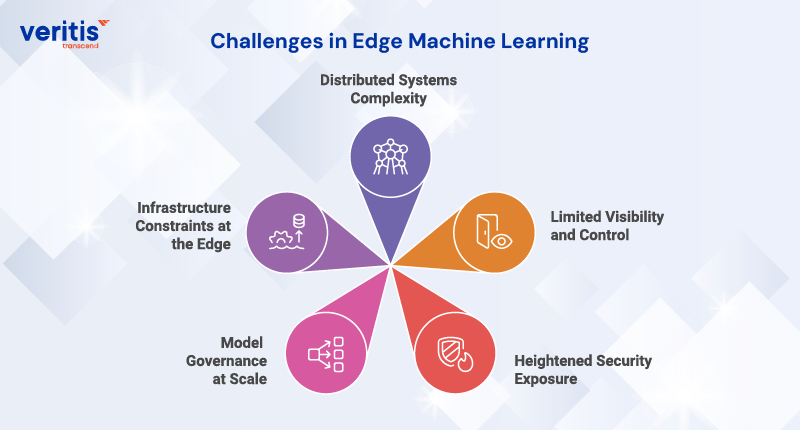
1) Distributed Systems Complexity
Enterprises struggle to manage thousands of edge locations with different hardware, connectivity, and conditions. This makes deploying and governing edge machine learning and edge ML environments highly complex.
2) Limited Visibility and Control
Traditional tools cannot track performance across remote devices. Leaders lack clarity on how edge based machine learning models behave across distributed operations.
3) Heightened Security Exposure
Edge deployments increase risk at the physical and device levels. Securing machine learning edge computing environments consistently across locations remains a persistent challenge for CIOs and CISOs.
4) Model Governance at Scale
Maintaining accuracy across hundreds of models requires automation. Without robust MLOps services and solutions, version control, retraining, drift management, and compliance become difficult to manage.
5) Infrastructure Constraints at the Edge
Edge sites often operate with limited compute and storage resources and unreliable networks. Running edge computing machine learning efficiently requires optimized models and robust deployment frameworks.
Case Study: Building Scalable MLOps Pipelines for Financial Institutions
A prominent financial institution collaborated with Veritis to enhance its machine learning operations by implementing scalable MLOps pipelines on edge devices, optimizing real time data processing and decision making through machine learning at the edge.
Challenge: The financial institution struggled to deploy machine learning models at scale across its network of edge devices. They needed an efficient way to process vast amounts of financial data locally, ensuring real time insights without relying solely on centralized cloud infrastructure. This made it essential to explore edge ML and edge computing machine learning strategies.
Solution: Veritis, with its expertise, designed and deployed scalable MLOps pipelines that enabled machine learning models to run directly on edge devices. By leveraging edge computing with machine learning, the institution could process data locally, improving speed and reducing latency while maintaining robust, scalable model management supported by MLOps services and solutions.
Results:
- Faster data processing and real-time insights at the edge
- Reduced latency in decision-making for financial transactions
- Improved scalability of machine learning operations without compromising performance
This case highlights how edge machine learning, when paired with MLOps frameworks, is transforming industries such as finance by delivering enhanced performance, scalability, and faster decision-making at the edge.
Read the full success story: Building Scalable MLOps Pipelines for Financial Institutions
Capping It Off
Edge ML is an emerging field, and it takes an able oarsman to steer you through the waters of this field. Join forces with Stevie Award winner Veritis to unlock the best in edge ML. Based in Texas, we have advised and managed services for various companies. In addition to MLOps services, we ensure seamless deployment and management of your AI models, leveraging machine learning at the edge within your environment. So, contact us and get an edge machine learning solution for your infrastructure powered by enterprise grade MLOps solutions.