Cloud technology has quietly become the backbone of how modern organizations operate. From startups running their entire infrastructure online to global enterprises migrating decades old systems, the shift to the cloud is no longer a question of “if” but “how fast.” Yet many businesses still weigh the move without a clear picture of what they actually stand to gain.
This article examines the key advantages cloud technology offers organizations, covering cost, scalability, security, collaboration, resilience, and sustainability, so you can understand why the cloud has become the default choice for competitive companies.
What is Cloud Technology?
Cloud computing provides on demand access to computing services, servers, storage, databases, software, and analytics over the internet rather than from physical hardware you own and maintain on site. Instead of buying and running your own data center, you access resources on demand from a cloud provider and pay for what you use.
This model removes the burden of managing physical infrastructure and shifts it to specialized providers, freeing organizations to focus on their actual work rather than the machinery behind it.
Talk to a Cloud Technology Expert
The 3 Main Cloud Service Models
Understanding the advantages of cloud technology is easier once you know the three primary service models available:
- IaaS (Infrastructure as a Service): Rent virtualized computing infrastructure, servers, networking, and storage, on demand. Examples: AWS EC2, Microsoft Azure Virtual Machines.
- PaaS (Platform as a Service): A ready made environment for developing, testing, and deploying applications without managing the underlying infrastructure. Examples: Google App Engine, Heroku.
- SaaS (Software as a Service): Ready to use software accessed via a web browser. Examples: Microsoft 365, Salesforce, Slack.
Most organizations use a combination of all three depending on their needs.
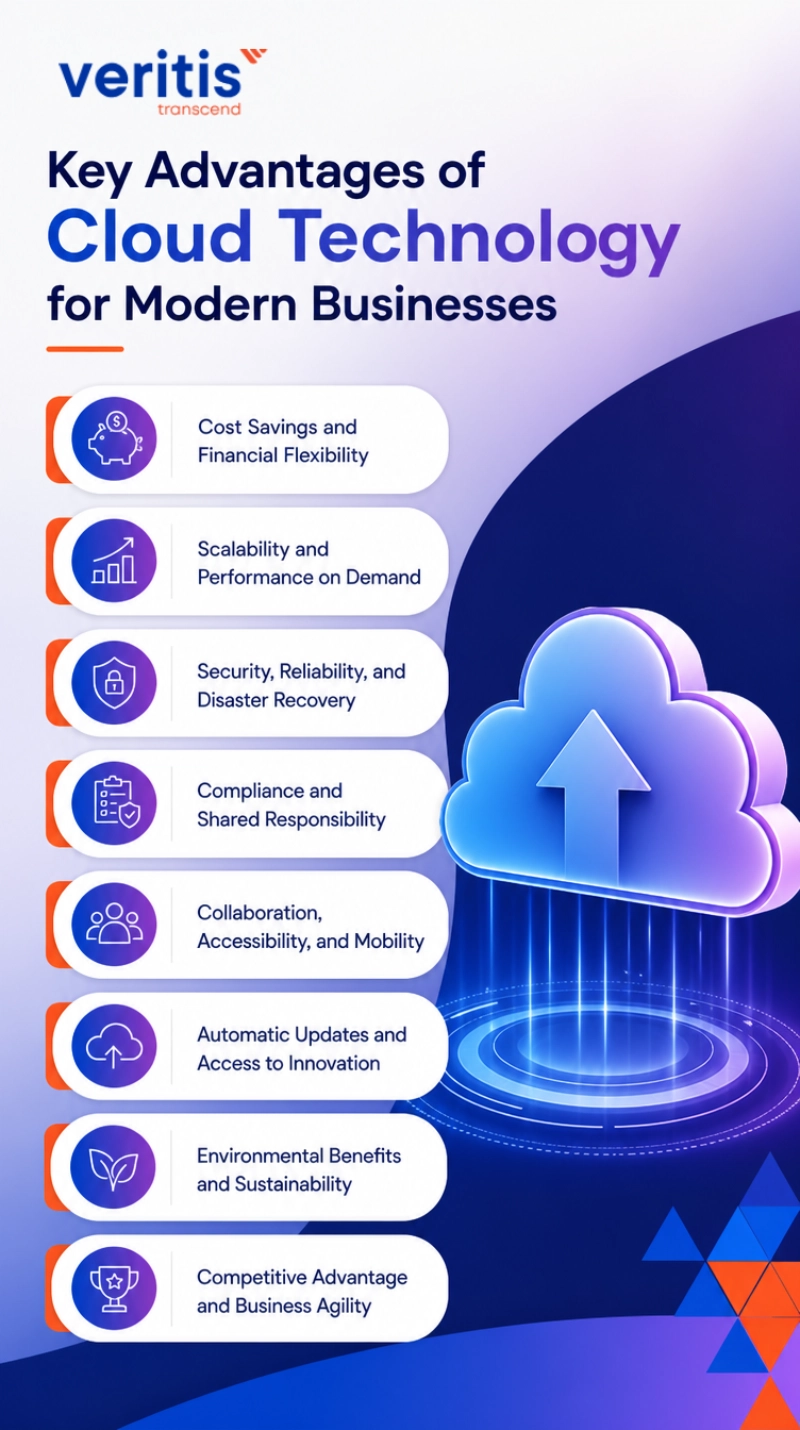
Key Advantages of Cloud Technology for Modern Businesses
1) Cost Savings and Financial Flexibility
One of the most immediate advantages of cloud technology is the reduction in upfront costs. Traditional IT requires heavy capital investment in servers, hardware, and the space to house them, along with ongoing spending on maintenance, upgrades, and energy.
The cloud replaces this with a predictable operating expense. Key financial benefits include:
- No large capital outlay for hardware or data centers
- Pay as you go pricing so you only pay for the resources you consume
- Lower maintenance costs, since the provider handles updates and repairs
- Reduced energy and real estate expenses tied to on premise servers
This converts unpredictable, lumpy IT spending into a manageable, scalable cost, especially valuable for smaller businesses that cannot afford large infrastructure investments.
2) Scalability and Performance on Demand
Business needs rarely stay constant. Traffic spikes, seasonal demand, and rapid growth can overwhelm fixed infrastructure. Cloud technology solves this with elastic scalability: you can increase or decrease resources almost instantly to match demand.
This means you are never paying for idle capacity during quiet periods, nor scrambling for hardware during a surge. Providers also operate globally distributed data centers, so applications and content can be delivered closer to users, resulting in faster performance.
Our take: Scalability is where the cloud earns its keep. The ability to spin up resources in minutes, rather than waiting weeks for hardware procurement, is often the single change that lets a growing company move at the speed its market demands.
3) Security, Reliability, and Disaster Recovery
A common myth is that the cloud is less secure than on premise systems. In practice, leading cloud providers invest far more in security than most individual organizations ever could, offering encryption, access controls, continuous monitoring, and dedicated security teams.
Equally important is resilience. Cloud platforms are built with redundancy across multiple locations, which means:
- Automatic backups protect against data loss
- Disaster recovery is faster and more reliable than manual, on site processes
- High uptime guarantees keep services available even if one server or region fails
For businesses, this translates into business continuity, the confidence that a hardware failure, outage, or unexpected event will not bring operations to a halt.
4) Compliance and Shared Responsibility
Cloud security follows a shared responsibility model. The provider secures the underlying infrastructure; you are responsible for securing your data, user access, and applications running on top of it. Most major providers, including AWS, Azure, and Google Cloud, hold certifications such as ISO 27001, SOC 2, and GDPR compliance, making it easier for customers to meet their own regulatory obligations.
Useful link: The Future of Technology and the Cloud Computing Role in Edge AI
5) Collaboration, Accessibility, and Mobility
Since cloud services rely on internet connectivity, teams can work from anywhere with a connection. Files, applications, and data are available across devices and locations, enabling genuinely mobile and remote work.
This accessibility drives better collaboration. Numerous users can collaborate on the same documents simultaneously and on projects in real time, with changes synced instantly. For distributed and hybrid workforces, the cloud is not just a convenience; it is the foundation that makes modern working models possible.
6) Automatic Updates and Access to Innovation
With cloud technology, software and security updates are handled by the provider and rolled out automatically. This keeps systems current without the disruption of manual patching and ensures you are always running the latest, most secure versions.
Beyond reducing maintenance overhead, the cloud provides access to advanced capabilities such as analytics, machine learning, and automation without requiring significant upfront investment. This enables organizations of all sizes to adopt technologies that were once available only to large enterprises.
7) Environmental Benefits and Sustainability
Cloud technology carries a meaningful environmental advantage that is often overlooked. Shared cloud infrastructure is inherently more energy efficient than many separate on-premises data centers because large providers can optimize hardware utilization across thousands of customers simultaneously.
Major cloud providers have made significant sustainability commitments:
- Microsoft Azure targets being carbon negative by 2030.
- Google Cloud operates on matched renewable energy and aims to run on 24/7 carbon free energy by 2030.
- AWS is working toward 100% renewable energy across its global infrastructure.
For businesses with environmental, social, and governance (ESG) goals, migrating to the cloud can meaningfully reduce their carbon footprint compared with running dedicated on premise hardware.
8) Competitive Advantage and Business Agility
Beyond the operational benefits, the advantages of cloud technology compound into a broader strategic edge: agility. Cloud native businesses can test new products, enter new markets, and adapt to customer needs faster than competitors tied to legacy infrastructure.
- Faster time to market: Development and testing environments can be spun up in minutes, compressing product development cycles.
- Global reach: A startup in one country can serve customers worldwide without building physical infrastructure abroad.
- Experimentation at low cost: Teams can trial new tools or architectures, then decommission them without sunk hardware costs.
This agility is increasingly a competitive necessity rather than a nice to have.
Potential Disadvantages to Consider
A balanced view of the advantages of cloud technology requires acknowledging real trade offs:
- Ongoing costs can grow: Pay as you go pricing is cost efficient when managed carefully, but unmonitored usage can lead to bill surprises.
- Internet dependency: Cloud services require reliable connectivity. Outages or poor bandwidth directly affect access.
- Vendor lock in: Migrating away from a provider’s proprietary tools can be complex and costly.
- Data sovereignty: Depending on your industry and jurisdiction, storing data in overseas cloud regions may raise compliance concerns.
None of these are deal breakers for most organizations, but they are worth factoring into a migration strategy.
Conclusion
The advantages of cloud technology extend well beyond simple cost savings. It offers financial flexibility, effortless scalability, robust security, reliable disaster recovery, and accessibility that powers remote collaboration, all while keeping systems up to date, reducing environmental impact, and making innovation within reach of every organization.
For businesses of any size, moving to the cloud is not all about keeping up with technology trends. It is about building a more agile, resilient, and future ready foundation for growth. The businesses gaining the most are those that treat the cloud not as a cost to manage, but as a strategic advantage to leverage.