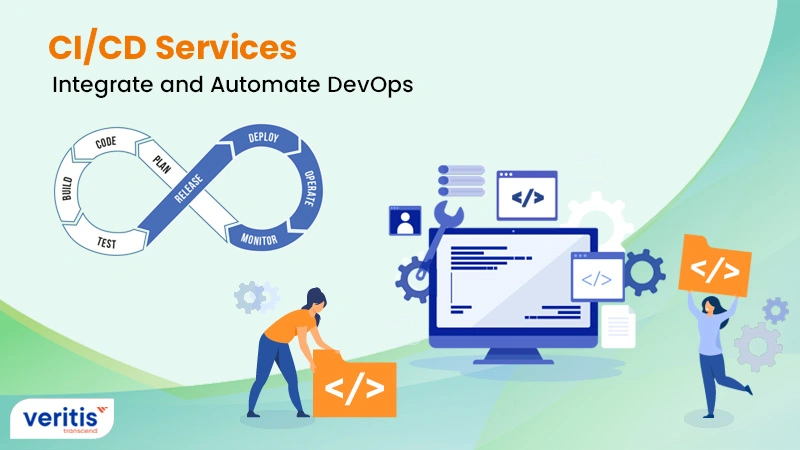
Software teams that ship slowly do not lose on speed alone; they lose on revenue, talent, and market position. That is the business reality driving enterprise adoption of CI CD services. Continuous Integration and Continuous Delivery pipelines compress release cycles from weeks to hours, cut defect escape rates, and give engineering leaders a measurable handle on delivery performance. For CTOs and CIOs navigating digital transformation, CI/CD is not a developer convenience; it is a strategic capability.
For technology leaders, the ability to integrate DevOps CI/CD pipeline practices is a strategic enabler that drives predictable software delivery, enhances governance, and supports enterprise wide digital transformation initiatives. This guide covers what CI CD services deliver, how to select the right tools, how to build security in from the start, and how to measure the return on investment your board expects.
What Are CI CD Services and Why Do They Matter?
Continuous Integration (CI) automates the integration of code changes from multiple developers into a shared repository, compiling it, and running automated tests, typically within minutes of every commit. Continuous Delivery (CD) extends that automation through staging environments and release preparation, so a validated artifact is always ready to deploy. Continuous Deployment goes one step further: code that clears every automated gate ships to production without a manual approval step.
Consider a practical example. A fintech team merging 30 to 40 commits per day cannot afford to build and test every change manually. A well tuned CI/CD pipeline compiles the code, runs unit and integration tests, scans for vulnerabilities, and automatically promotes the artifact to production, often in under 15 minutes. That is the difference between shipping once a quarter and shipping several times a day.
For teams building a strong DevOps testing culture, CI/CD is the infrastructure that makes disciplined testing operationally feasible at scale.
CI vs. Continuous Delivery vs. Continuous Deployment: Key Differences
One of the most common questions enterprise teams face is where continuous integration ends and continuous delivery or deployment begins. The distinction is straightforward once you focus on how far automation extends toward production.
| Practice | What Does it automate? | Human Approval Before Production? | Best For |
| Continuous Integration | Code merges, builds, and automated tests | N/A, stops before release | Every team starting a DevOps journey |
| Continuous Delivery | CI + release preparation and staging deployment | Yes, a manual release gate is required | Regulated industries need governance controls |
| Continuous Deployment | Everything in CD plus automatic production release | No, fully automated | Mature teams with strong test coverage and observability |
For most organizations, the practical path is CI first, continuous delivery next, and continuous deployment only after test automation and observability are mature enough to trust an unattended release.
Useful Link: Kanban vs Scrum: ROI, Efficiency, and Enterprise Impact
CI/CD Pipeline Security: Building a DevSecOps Foundation
A fast pipeline that ships insecure code simply ships problems faster. Modern CI CD services demand a shift left security posture, where checks run continuously rather than as a final gate before release.
Veritis embeds the following controls directly into the pipeline:
- Static and dynamic testing (SAST/DAST) to catch vulnerabilities in source code and running applications.
- Software composition analysis (SCA) to flag risky open source dependencies and license issues.
- Secrets scanning to prevent API keys, tokens, and credentials from being committed to version control.
- Container and image scanning before artifacts are pushed to a registry is a critical safeguard explored in depth in our overview of container security use cases within secure DevOps practices.
- Policy as code and signed artifacts to enforce compliance and verify provenance before every deployment.
Fixing a defect in production costs significantly more than catching it at the commit stage. Embedding security as a pipeline stage rather than an afterthought reduces both remediation cost and regulatory exposure.
Best CI/CD Tools for Enterprise Environments
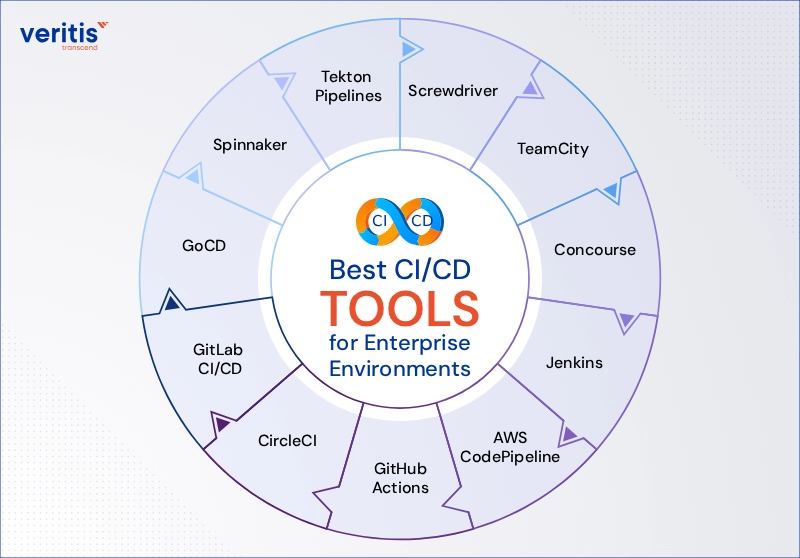
With dozens of platforms available, tool selection is one of the highest leverage decisions in any CI/CD implementation. Veritis delivers customized CI CD services built around your existing environment, cloud strategy, and team maturity, rather than a default vendor preference.
Kubernetes Native Pipelines
1) Tekton Pipelines
Tekton Pipelines provides a standardized, cloud native CI/CD experience for Kubernetes workloads. It is the right choice when container portability and infrastructure as code discipline are non negotiable.
2) Spinnaker
Spinnaker is purpose built for multicloud deployments across AWS, Azure, and Google Cloud. Organizations running workloads across multiple providers gain consistent deployment semantics without rebuilding pipelines per cloud.
Visibility and Modeling
3) GoCD
GoCD excels at visualizing complex dependency chains across the delivery pipeline. It is especially beneficial for organizations that need to release multiple services in a coordinated and sequential manner, and where stakeholders need real time insight into pipeline state.
Developer Centric Platforms
4) GitLab CI/CD
GitLab CI/CD continues to lead as an all in one platform combining source control, CI/CD, container registry, and built in DevSecOps. Its Auto DevOps feature automatically applies best practice pipeline configuration, and native SAST/DAST integration makes it a strong choice for teams with compliance obligations.
5) CircleCI
CircleCI is a cloud native platform optimized for rapid build and test cycles. Reusable configuration packages (“orbs”) significantly reduce setup time, and their parallelism model scales efficiently for large monorepos.
6) GitHub Actions
GitHub Actions integrates directly into GitHub repositories, making it the lowest friction option for teams already on that platform. Its marketplace ecosystem covers most common pipeline tasks without custom scripting.
AWS Native Delivery
7) AWS CodePipeline
AWS CodePipeline, combined with CodeBuild and CodeDeploy, provides a fully managed CI/CD stack for AWS centric environments. Organizations that have already committed to AWS benefit from native IAM integration, CloudWatch observability, and minimal operational overhead. For a more comprehensive understanding of how this approach aligns with your overall strategy, refer to our detailed guide on AWS DevOps services and automation.
Self Hosted and Flexible
8) Jenkins
Jenkins remains the most widely deployed open source CI server, offering maximum configurability and an extensive plugin ecosystem. It rewards teams that can dedicate engineering capacity to its maintenance.
9) Concourse
Concourse defines pipelines entirely as code, making it a strong fit for teams that prioritize auditability and reproducibility.
10) TeamCity
TeamCity from JetBrains delivers robust build pipelines with sophisticated feedback loops, distributed testing, and flexible project configuration reuse, well suited to complex enterprise delivery environments.
11) Screwdriver
Screwdriver is a highly efficient CI/CD tool that automates builds, tests, and deployments. Veritis implements Screwdriver to empower agile teams. It reduces the complexities of traditional CI/CD pipelines while allowing for rapid iteration and continuous deployment, ensuring that your CI/CD process remains fast and responsive.
Useful Link: What are the Types of Cloud Computing Services?
How to Choose the Most Suitable CI/CD Tool?
Selecting a CI/CD platform is less about picking the “best” tool and more about matching capabilities to your organization’s environment and maturity. When Veritis advises enterprise clients, we weigh five factors:
- Deployment target.Kubernetes native workloads favor Tekton or Spinnaker; AWS centric environments benefit from CodePipeline; multicloud strategies call for Spinnaker or GitLab.
- Team maturity and operational capacity.Managed platforms such as CircleCI or GitLab CI/CD reduce operational burden; self hosted Jenkins offers control for teams that can maintain it.
- Security and compliance requirements.Prioritize tools with built in SAST/DAST, secrets management, and audit logging when operating in regulated industries such as financial services or healthcare.
- Scalability requirements.Look for parallel execution, distributed builds, and pipeline as code so your pipeline grows with your codebase and team.
- Total cost of ownership.Balance license or consumption fees against the engineering time required to operate and evolve the platform.
A short proof of concept, running two candidate tools against a real repository for a sprint, typically reveals the right fit faster than any feature comparison spreadsheet.
CI/CD Implementation: The 4 Stages
A disciplined implementation follows a consistent sequence regardless of the selected toolchain.
Stage 1: Commit
Developers integrate new features and code changes into the shared repository. Automated feedback immediately checks code quality, runs unit tests, and flags integration issues. The goal is a sub ten minute feedback loop so developers stay in flow.
Stage 2: Build
Once the code passes the commit stage checks, the pipeline compiles, packages artifacts (typically Docker images), and pushes them to a registry. Immutable, versioned artifacts form the foundation of reliable, repeatable deployments.
Stage 3: Test
Artifacts move through alpha (developer integration testing) and beta (wider functional and performance testing) environments. Automated functional, integration, performance, and security scans run in parallel where possible. Manual exploratory testing supplements automated checks at the beta stage for complex applications.
Stage 4: Production Deployment
Artifacts that clear all testing gates are deployed to production either automatically in continuous deployment or after a release manager’s approval in continuous delivery. Blue green or canary deployment strategies limit the blast radius, and automated rollback triggers protect uptime if anomalies surface post release.
Key CI/CD Metrics: Measuring What Matters
You cannot improve what you do not measure. The industry standard DORA metrics provide a proven framework for evaluating CI/CD performance and communicating pipeline value to executive stakeholders.
- Deployment Frequency: How often you release to production. Elite performing teams deploy on demand, often multiple times per day.
- Lead Time for Changes: The elapsed time from code commit to production. High performers measure this in hours; low performers measure in weeks or months.
- Change Failure Rate: The percentage of deployments that cause a production incident. Elite teams sustain a 0–15% range.
- Mean Time to Restore (MTTR): How quickly teams recover from a production failure. Mature pipelines with automated rollback recover in under an hour.
Tracking these metrics converts CI/CD investment into a measurable business outcome rather than a vague promise of “faster software.”
Business Benefits of CI CD Services
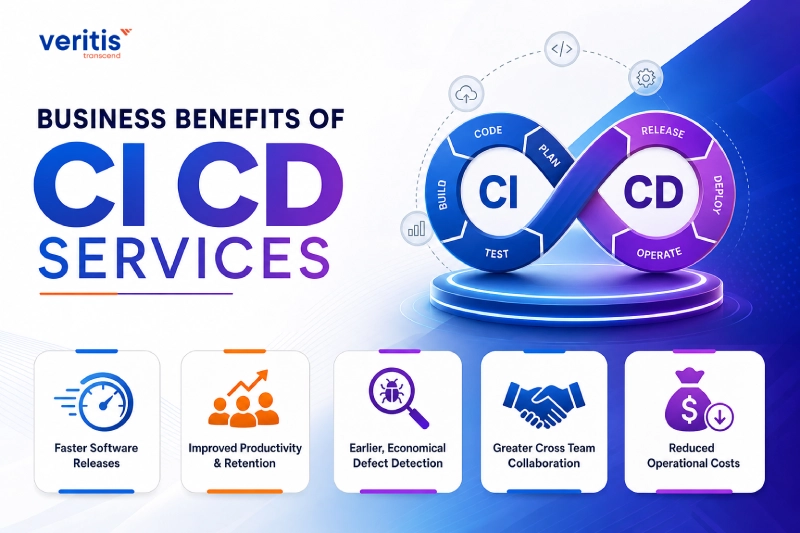
1) Faster Software Releases
Automated pipelines eliminate the manual handoffs that slow release cycles. Teams that previously shipped monthly commonly achieve weekly or daily cadences after a well executed CI/CD implementation, without adding headcount.
2) Improved Productivity & Retention
Removing manual build, test, and deployment toil lets engineers focus on feature work. Reduced context switching and faster feedback loops measurably improve developer satisfaction, a factor that matters to CFOs calculating recruitment and attrition costs.
3) Earlier, Economical Defect Detection
Automated testing at the commit stage catches defects when they are cheapest to fix. The cost to remediate a vulnerability found in production is orders of magnitude higher than catching it during code review or a CI scan.
4) Greater Cross Team Collaboration
A shared pipeline with visible quality gates aligns development, QA, operations, and security teams around common objectives. CI/CD dissolves the handoff friction that has historically separated these functions. Teams exploring how AI is further accelerating DevOps collaboration will find that CI/CD pipelines provide the data foundation those AI capabilities require.
5) Reduced Operational Costs
Automation eliminates repetitive manual work across the build, test, and release cycle, freeing engineering capacity for higher value activities. Combined with faster defect resolution and fewer production incidents, mature CI/CD pipelines consistently improve the ROI of engineering investments.
Useful Link: How Cloud Automation is Driving DevOps Efficiency?
CI/CD Best Practices
Adopting the right tools is only half the challenge. Disciplined CI/CD practices determine whether the pipeline delivers sustained value.
- Commit small and often. Frequent, small merges reduce integration conflicts and make failures easier to isolate and fix.
- Automate everything repeatable. Builds, tests, security scans, and deployments should require zero manual steps.
- Keep the build fast. Target under 10 minutes for commit stage feedback; use caching and parallelism to get there.
- Treat pipeline configuration as code. Version pipeline definitions alongside the application for full auditability.
- Fail fast, fix first. A broken build should be the team’s top priority; never build on a red pipeline.
- Deploy with safety nets. Blue green and canary deployment strategies, combined with automated rollbacks, limit the blast radius of any problematic release.
- Avoid the common traps. See our analysis of common mistakes DevOps practitioners should avoid for a practical checklist of implementation pitfalls.
Veritis CI CD Service Offerings
Veritis delivers end to end CI CD services that span strategy, implementation, and ongoing optimization, enabling development and operations teams to ship software rapidly and securely.
CI/CD Design Services
- Tooling definition and selection aligned to your environment
- CI/CD strategy and roadmap design
CI/CD Implementation Services
- Current infrastructure analysis and bottleneck identification
- Technology stack selection and configuration
- End to end pipeline implementation across build, test, and deployment stages
- Ongoing maintenance and performance optimization
CI/CD Consulting Services
- Pipeline auditing and maturity assessment
- DevSecOps integration and compliance alignment
- Executive level consulting and delivery oversight
Veritis also provides expertise in managed CI/CD services across AWS, Azure, and Google Cloud, as well as platforms such as GitLab, CircleCI, and Atlassian Bamboo, integrated to align with your cloud strategy and governance requirements. For organizations on Google Cloud, our guide to DevOps implementation on Google Cloud outlines how pipeline design intersects with platform specific tooling.
Get Started with CI/CD Services
Overcoming Common CI/CD Adoption Challenges (Image)
Adopting CI/CD at enterprise scale is a strategic move, but it brings predictable hurdles. Veritis has observed the following challenges recur across engagements and has developed proven approaches to address each.
1) Confusing Continuous Delivery with Continuous Deployment
Teams that skip the maturity steps and attempt full continuous deployment before test automation is solid end up with unstable pipelines and eroded confidence. The fix is a phased adoption plan with clear quality gates at each stage.
2) Underestimating Culture Change
CI/CD requires development, QA, security, and operations teams to share ownership of the pipeline. Without deliberate change management, territorial friction stalls implementation regardless of the tooling chosen.
3) Bolting Security on After the Fact
Security checks added late in the pipeline do not shift left; they simply run later, slowing down releases. Embedding SAST, DAST, and secrets scanning from day one avoids this trap entirely.
4) Neglecting Pipeline Maintenance
A CI/CD pipeline is a software system that degrades without maintenance. Flaky tests, outdated dependencies, and accumulated configuration debt erode trust in the pipeline over time.
5) Ignoring Metrics
Teams that deploy CI/CD without measuring DORA metrics cannot demonstrate business value to leadership, which puts the investment at risk when budget cycles tighten.
The Strategic Case for CI CD Services
CI/CD is not a technology project with a defined end date. It is an ongoing operational capability that compounds in value as test coverage deepens, security controls mature, and deployment frequency increases. Organizations that treat CI/CD as a strategic investment, measure it with DORA metrics, evolve it alongside their architecture, and embed security from the start consistently outperform peers in delivery speed, software quality, and engineering efficiency.
Teams that embrace agility gain a competitive advantage that ships better software, faster, with fewer incidents. CI CD services are how enterprise organizations build that capability at scale.
Ready to accelerate your software delivery? Veritis’ CI/CD experts will assess your current pipeline maturity, identify the highest leverage improvements, and develop a roadmap that supports your business objectives. Contact our team to start the conversation.