Quantum computing is moving from theory to enterprise reality faster than anyone expected. Error rates are improving, qubit counts are climbing, and hyperscalers are releasing the latest quantum computing developments at an unprecedented pace. The future of quantum computing is not about a distant conversation; it is already influencing investment decisions, security planning, and competitive strategy across industries.
What makes this shift more significant is the convergence of AI and quantum computing, enabling breakthroughs that classical systems can’t deliver. From optimization and financial modeling to cybersecurity, drug discovery, and material simulation, advances in quantum computing are expanding the applications of quantum computing and driving rapid growth in the projected quantum computing market size 2030. Enterprises that act early will benefit long before the technology reaches full maturity.
This is where Veritis supports Fortune 500 leaders. As cloud first adoption becomes the pathway to quantum, organizations need stronger foundations built on Emerging Cloud Technologies, modern Enterprise Cloud Services, and strategic cloud consulting services. Veritis helps executives prepare their architectures, data, and security frameworks for quantum era readiness, because the real question is not “Is quantum computing the future?” but “Are we ready for it?”
Talk to a Quantum Computing Expert
Why Quantum Computing Matters for Business Leaders?
Quantum is not a future experiment. It is becoming a strategic inflection point. As the future of quantum computing accelerates, the pressure on leaders is shifting from awareness to readiness. Enterprises that understand this shift early will lead the next performance frontier.
The shift matters because the latest quantum computing developments are already influencing how enterprises model risk, optimize operations, and secure data. As advances in quantum computing expand the applications of quantum computing and the projected quantum computing market size 2030 grows, leaders must prepare for the convergence of AI and quantum computing through modern enterprise cloud services, emerging cloud technologies, and expert cloud consulting services.
Useful link: Cloud Computing Market Share Analysis: Strategic Takeaways for Business Leaders
Understanding the Fundamentals: How Quantum Differs From Computing?
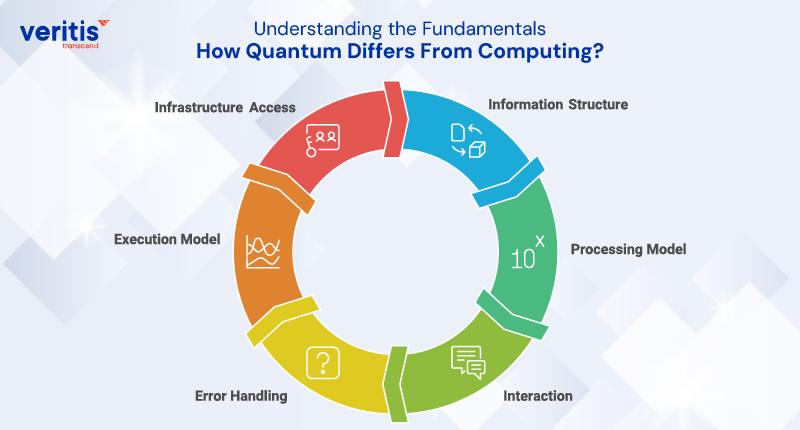
To understand the future of quantum computing, leaders must first grasp why quantum systems depart from classical limits. The difference is not about incremental. It is architectural, mathematical, and transformational at scale.
1) Information Structure: Bits Vs. Qubits
1.1 Classical Bits
- Represent either 0 or 1.
- All processing is sequential and deterministic.
1.2 Quantum Qubits
- Can exist as 0, 1, or both simultaneously (superposition).
This single principle underpins most advances in quantum computing.
2) Processing Model: Linear Vs. Exponential
2.1 Classical Computing
- Power grows linearly. More cores = incremental gains.
2.2 Quantum Computing
- Power grows exponentially as qubits increase.
This exponential jump explains why executives now ask, “Is quantum computing the future of complex problem solving?”
3) Interaction: Independent Vs. Entangled States
3.1 Classical Approach
- Bits do not influence one another.
3.2 Quantum Entanglement
- Qubits share a linked state. A change in one can instantly influence another.
This enables computational shortcuts impossible for classical machines and shapes the future of quantum computing in optimization, cryptography, and modeling.
4) Error Handling: Stable Vs. Probabilistic
4.1 Classical Machines
- Stable, predictable, minimal noise.
4.2 Quantum Machines
- Probabilistic, highly sensitive to the environment.
This is why the latest developments in quantum computing emphasize improved error correction.
5) Execution Model: Deterministic Vs. Probabilistic Outcomes
5.1 Classical Results
- Single deterministic answer.
5.2 Quantum Results
- Multiple potential outcomes are calculated simultaneously.
Quantum extracts the most probable “best” answer, valuable for complex simulations and applications of quantum computing in finance, chemistry, and logistics.
6) Infrastructure Access: Local Hardware Vs. Cloud Based Quantum
6.1 Classical Infrastructure
- Owned, managed, or cloud hosted.
6.2 Quantum Infrastructure
Primarily accessed via cloud:
- Quantum as a Service
- Hybrid cloud pipelines
- Quantum simulators on leading hyperscalers
This aligns quantum with Cloud Computing Trends, emerging cloud technologies, and enterprise adoption through cloud consulting services and enterprise cloud services.
Key Opportunities of Quantum Computing for Enterprises
Quantum is not incremental progress. It is a strategic multiplier. The future of quantum computing enables capabilities that redefine what enterprises can optimize, predict, and secure.
1) Supply Chain and Operations
Quantum evaluates vast variables at once, enabling optimized routing, reduced bottlenecks, and faster cycle times. This is driven by advances in quantum computing that outperform classical systems in high complexity calculations.
2) Risk, Pricing, and Portfolio Intelligence
Quantum enhances risk modeling accuracy, stress testing, and portfolio optimization.
Analysts link this capability to the rising quantum computing market size 2030, especially in banking and capital markets.
3) Quantum Enhanced AI Models
The convergence of AI and quantum computing allows faster training, deeper simulations, and more accurate forecasts. This is becoming one of the most transformative applications of quantum computing for enterprise decision making.
4) Molecular and Material Simulation
Quantum simulates chemical and atomic structures with unmatched precision, shortening R&D timelines and improving design outcomes. This aligns with the latest quantum computing developments in healthcare, energy, and advanced manufacturing.
5) Quantum Safe Security and Cloud Integration
Quantum exposes classical encryption vulnerabilities, creating urgency for quantum safe architectures. Enterprises will adopt these capabilities through Emerging Cloud Technologies, modern Enterprise Cloud Services, and strategic cloud consulting services aligned with Cloud Computing Trends.
Useful link: Cloud Computing Trends: Challenges, Benefits, and Future Outlook
Quantum Computing in Financial Modeling and Risk Analysis
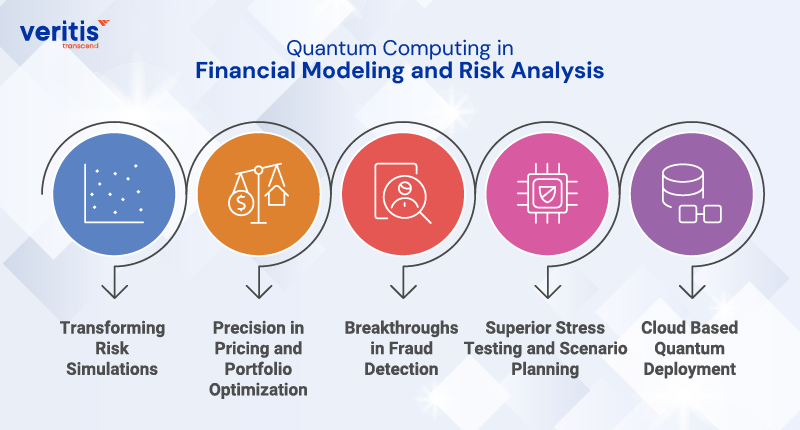
Quantum is entering finance for one reason: classical systems are reaching their limits. As volatility rises and models grow more complex, the future of quantum computing gives institutions a new way to calculate risk, price assets, and respond to fast moving markets.
1) Transforming Risk Simulations
Quantum algorithms can evaluate thousands of market paths simultaneously instead of sequentially.
This compresses heavy Monte Carlo workloads that normally take hours.
Why it Matters: Faster VaR, faster stress tests, and the ability to react in the same window that markets move.
2) Precision in Pricing and Portfolio Optimization
Quantum processors handle large variable sets and constraints in parallel. This improves derivatives valuation, XVA adjustments, and multifactor portfolio optimization.
Enterprise Impact: Cleaner pricing accuracy, more efficient hedging, and stronger daily P and L discipline. This is a core driver behind the rising quantum computing market size 2030 projections.
3) Breakthroughs in Fraud Detection
When AI and quantum computing combine, models capture deeper patterns across millions of transactions.
Outcome: Fewer false negatives, quicker anomaly recognition, and a measurable reduction in fraud related losses.
4) Superior Stress Testing and Scenario Planning
Quantum explores extreme market conditions that classical engines struggle to compute.
Benefit: Boards and regulators get richer, more defensible stress test outputs.
5) Cloud Based Quantum Deployment
No bank will deploy quantum hardware directly. They will access it through cloud platforms integrated with enterprise cloud services and guided by expert cloud consulting services.
Strategic Value: A practical, scalable onramp aligned with emerging cloud technologies and modern cloud computing trends.
Get Your Quantum Roadmap Assessment
Quantum for Drug Discovery and Healthcare Innovation
Quantum computing is reshaping biomedical research by enabling simulations and insights that classical systems cannot achieve. The future of quantum computing allows atomic level molecular modeling, accelerating drug discovery, improving prediction accuracy, and reducing dependency on trial and error experimentation.
With advances in quantum computing, researchers can explore millions of compound variations in parallel, shorten early discovery cycles, and uncover new possibilities in personalized medicine through the convergence of AI and quantum computing. These breakthroughs position quantum as one of the most impactful applications of quantum computing in healthcare.
Quantum also drives innovation in biomaterials, medical device design, and next generation drug delivery systems, supporting the expanding quantum computing market size 2030 across biotech and medtech. Adoption will happen through cloud based access integrated with Enterprise Cloud Services, guided by expert cloud consulting services, and powered by Emerging Cloud Technologies aligned with evolving Cloud Computing Trends.
Quantum won’t replace traditional research; it will accelerate it, giving healthcare organizations the precision and speed needed to deliver better treatments and outcomes.
Quantum Enhanced Cybersecurity
Quantum is about to redraw the cybersecurity domain. As the future of quantum computing accelerates, current encryption standards lose their long term reliability. Attackers can capture sensitive data today and decrypt it later using quantum machines, turning classical security models into liabilities. This is why global leaders are moving toward post quantum cryptography, quantum safe standards, and security architectures designed to withstand both classical and quantum threats. At the same time, the convergence of AI and quantum computing is exploring faster, deeper threat detection, scanning patterns that classical systems miss, and strengthening one of the most urgent applications of quantum computing in modern security.
Enterprises will adopt these protections through cloud driven security frameworks rather than on-prem hardware. Providers are already embedding quantum ready encryption, identity controls, and zero trust models into enterprise cloud services. Combined with emerging cloud technologies, expert cloud consulting services, and evolving cloud computing trends, organizations can modernize their defenses while positioning for growth in the expanding quantum computing market size 2030. The message for leadership is clear: quantum brings new risks, but also the strongest path to securing the next decade.
Useful link: What is Cloud Security Posture Management?
Quantum Computing for Supply Chain Optimization and Predictive Analytics
Quantum is giving supply chain leaders a way to make complexity computable. Instead of analyzing variables one at a time, the future of quantum computing processes entire networks simultaneously, routes, suppliers, costs, risks, and timing, turning operational noise into clear visibility. This shift enables faster recovery decisions during disruptions, more accurate cost to serve modeling, and predictive responses based on live conditions such as weather, port delays, demand spikes, and geopolitical risks.
When AI and quantum computing work together, forecasting becomes far more precise, improving demand planning, capacity allocation, SKU level accuracy, and supplier risk modeling. These advancements are a major reason analysts connect supply chain transformation to the growing quantum computing market size 2030 and the expanding applications of quantum computing in global operations.
Enterprises will access these capabilities through cloud platforms rather than on-prem hardware. Quantum optimization engines delivered through enterprise cloud services, emerging cloud technologies, and guided cloud consulting services give supply chain teams a practical, scalable path to experiment with and deploy quantum enhanced models.
As cloud computing trends evolve, quantum becomes an embedded capability within existing systems, strengthening resilience, exposing hidden vulnerabilities, and enabling leaders to proactively reconfigure networks. In a world where supply chains move faster than traditional planning cycles, quantum delivers a decisive strategic advantage.
Challenges and Solutions of Quantum Computing
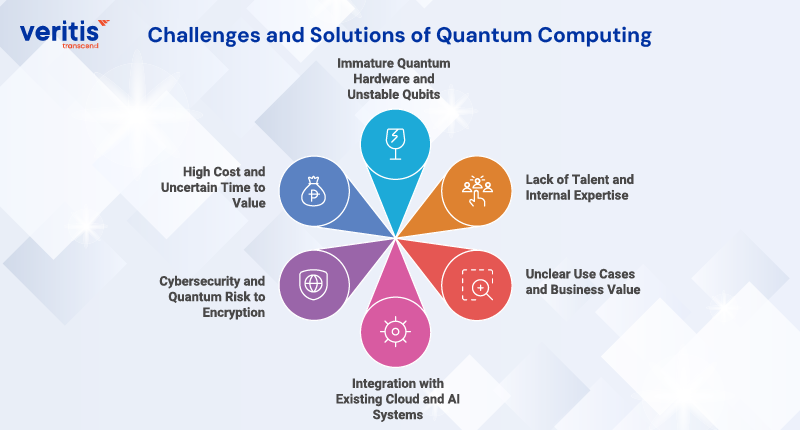
Quantum is advancing quickly, but enterprise adoption is still slowed by a mix of technical, financial, and organizational barriers. Below is a leadership focused breakdown of the real challenges and the exact role Veritis plays in solving each one.
1) Immature Quantum Hardware and Unstable Qubits
The Challenge
Quantum systems today are fragile. Error rates remain high, environments are sensitive, and commercially reliable machines are still emerging.
Why This Matters for Leaders:
- Hard to predict ROI timelines
- Limited real world enterprise workloads
- Risk of betting on the wrong ecosystem or vendor
Veritis Approach
Quantum Ready Architecture Advisory:
Veritis helps enterprises prepare today without waiting for perfect hardware, designing modular cloud architectures that plug into quantum services the moment they mature. You stay ahead without overcommitting.
2) Lack of Talent and Internal Expertise
The Challenge
Quantum skills are scarce. Most enterprises don’t have quantum scientists, and traditional enterprise teams lack exposure to this field.
Why This Matters for Leaders:
- Slows experimentation
- Risks poor decision making
- Limits your ability to evaluate vendor claims
Veritis Approach
Specialized Quantum + Cloud Enablement Team:
Veritis brings a blended team across cloud, AI, security, and quantum aligned engineering, acting as your extended R&D function. Your teams get capability without needing in house quantum hires.
3) Unclear Use Cases and Business Value
The Challenge
Many executives know quantum is powerful, but don’t know where it fits or when it becomes ROI positive.
Why This Matters for Leaders:
- Innovation stalls
- Quantum becomes a buzzword, not a strategy
- Capital allocation becomes risky
Veritis Approach
Quantum Value Assessment and Use Case Blueprint:
Veritis maps your industry, workloads, and constraints to high value quantum opportunities, risk modeling, routing, simulation, optimization, healthcare R&D, and more. You get clarity, a roadmap, and a business ready justification.
4) Integration with Existing Cloud and AI Systems
The Challenge
Quantum won’t live in isolation. It must connect to cloud platforms, data pipelines, AI models, and enterprise systems.
Why This Matters for Leaders:
- Integration complexity delays adoption
- Security and compliance risks increase
- Costs spike without the right architecture
Veritis Approach
Quantum Integrated Enterprise Cloud Services:
Veritis builds quantum ready foundations across AWS, Azure, and Google Cloud, ensuring that data pipelines, security controls, and AI systems integrate seamlessly with quantum workflows. You get future proof infrastructure without disruption.
5) Cybersecurity and Quantum Risk to Encryption
The Challenge
Quantum threatens classical encryption. Data encrypted today could be decrypted in the future, a major risk for regulated industries.
Why This Matters for Leaders:
- Compliance exposure
- Long term data theft risk
- Weak security posture for future audits
Veritis Approach
Quantum Safe Security Framework:
Veritis uses PQC standards, Zero Trust models, secure key management, and cloud native encryption to ensure your systems are ready before quantum decryption becomes a reality. Your organization becomes quantum resilient by design.
6) High Cost and Uncertain Time to Value
The Challenge
Quantum investments can appear expensive with unclear payoff horizons.
Why This Matters for Leaders:
- Hard to justify board level budgets
- Fear of early commitment
- Risk of investing too late or too early
Veritis Approach
Pilot Driven, Low Risk Quantum Adoption:
Veritis creates small, controlled, cloud based quantum pilots that demonstrate value early, without incurring heavy infrastructure costs. You get validated ROI before scaling.
Optimize with Quantum Computing Today
Future of Quantum Computing
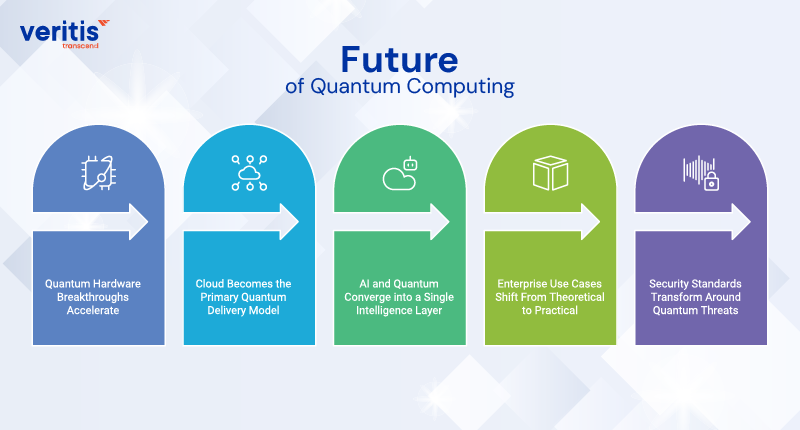
Quantum is not a technology race. It’s a timing race. Enterprises that prepare early will lead. Those who wait will chase. Below is a future preparedness blueprint designed specifically for forward looking executives.
1) Quantum Hardware Breakthroughs Accelerate
- Rapid increases in qubit count across superconducting, trapped ion, and photonic systems
- Lower error rates through advanced error correction codes
- Stable multiqubit entanglement across longer durations
- Hardware roadmaps from IBM, Google, IonQ, Rigetti, and PsiQuantum
- Industrial prototypes reaching early “quantum utility” milestones
Executive line: These shifts indicate when quantum transitions from experimental to commercially dependable.
2) Cloud Becomes the Primary Quantum Delivery Model
- Expansion of Quantum as a Service on AWS Braket, Azure Quantum, and Google Quantum AI
- Integration of quantum endpoints into enterprise cloud workloads
- Growth in hybrid classical quantum orchestration frameworks
- Cloud native PQC (Post Quantum Cryptography) is embedded by default
- Quantum simulators scaling to millions of qubits for pre deployment testing
Executive line: Cloud, not hardware, defines when enterprises can adopt quantum at scale.
3) AI and Quantum Converge into a Single Intelligence Layer
- Quantum accelerated AI training and optimization algorithms
- New hybrid models combining classical GPUs with quantum processors
- Faster combinatorial search and sampling for large language models
- Quantum enhanced forecasting for risk, demand, and scientific research
- Vendor announcements linking AI acceleration to advances in quantum computing
Executive line: The AI systems that outperform competitors will be the first to integrate quantum into their core workflows.
4) Enterprise Use Cases Shift From Theoretical to Practical
- Pilots in drug discovery, supply chain optimization, and material simulation
- Quantum enabled risk modeling in banking and insurance
- Energy grid optimization and carbon neutral planning
- Manufacturing and chemistry breakthroughs via quantum simulation
- Rising enterprise adoption aligned with the quantum computing market size 2030 forecasts
Executive line: Quantum becomes relevant when it solves real, high value computational bottlenecks, not when hardware matures.
5) Security Standards Transform Around Quantum Threats
- Global mandates for PQC adoption (NIST, NSA, EU, ISO)
- Migration patterns from RSA/ECC to quantum safe algorithms
- Increased investment in quantum resistant identity and key management systems
- Zero Trust architectures updated for quantum era threats
- Cloud providers embedding PQC across Enterprise Cloud Services
Executive line: The countdown to quantum safe security defines when organizations must act, not when quantum attacks arrive.
7 Strategies for Quantum Computing
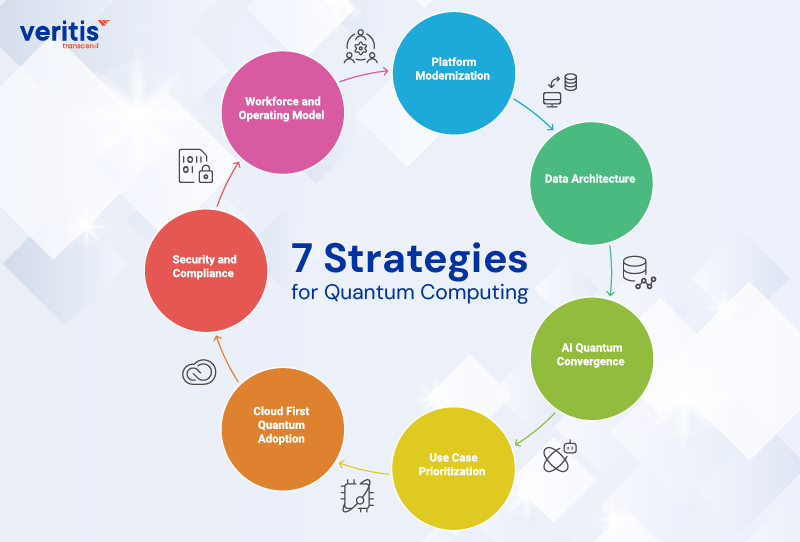
Each pillar contains straight, executive strategies backed with your required keywords naturally embedded.
1) Platform Modernization Strategy
Strategy Goal: Make your IT estate quantum compatible
Actions:
- Migrate legacy workloads to modern cloud native platforms.
- Implement scalable data fabrics that integrate with Enterprise Cloud Services.
- Adopt Emerging Cloud Technologies that support hybrid quantum classical workflows.
Why: Quantum capacity will be delivered through cloud platforms aligned with evolving Cloud Computing Trends and cloud consulting services.
2) Data Architecture Strategy
Strategy Goal: Build a data environment that quantum can actually use
Actions:
- Establish unified data governance and quality pipelines.
- Create low latency data layers for quantum assisted AI.
- Map enterprise data domains to future applications of quantum computing (optimization, simulation, forecasting).
Why: Quantum amplifies accuracy only when the data architecture is mature.
3) AI Quantum Convergence Strategy
Strategy Goal: Position AI teams to take advantage of quantum acceleration
Actions:
- Integrate AI and quantum computing roadmaps under a unified intelligence strategy.
- Identify AI models that could benefit from quantum optimization or quantum sampling.
- Build joint AI + quantum proof of concept pipelines using the latest quantum computing developments.
Why: AI will be the first enterprise function deeply accelerated by the future of quantum computing.
4) Use Case Prioritization Strategy
Strategy Goal: Identify where quantum gives a real advantage
Actions:
- Conduct a quantum value scan across all business units.
- Prioritize areas with high computational intensity
- Risk modeling
- Supply chain optimization
- Predictive analytics
- Drug discovery
- Material simulation
Validate feasibility based on advances in quantum computing and projections for the quantum computing market size 2030.
Why: Not every workflow benefits from quantum. You invest where the curve breaks.
5) Cloud First Quantum Adoption Strategy
Strategy Goal: Adopt quantum through the cloud, not hardware.
Actions:
- Establish partnerships with AWS Braket, Azure Quantum, and Google Quantum AI.
- Use quantum simulators to train teams without hardware investment.
- Integrate quantum endpoints into existing architectures using Enterprise Cloud Services.
Why: Scalable quantum capacity will come from cloud ecosystems before hardware matures.
6) Security and Compliance Strategy
Strategy Goal: Protect the enterprise against quantum era threats early.
Actions:
- Begin phased adoption of post quantum cryptography.
- Integrate quantum safe key management and lifecycle encryption.
- Modernize identity systems to withstand quantum decryption capabilities.
Why: Long term encrypted data is already at risk in a world where quantum computing is the future. has shifted to “when does the threat become real?”
7) Workforce and Operating Model Strategy
Strategy Goal: Build organizational readiness without hiring quantum scientists.
Actions:
- Upskill cloud, data, and AI teams on quantum workflows.
- Create a cross functional Quantum Readiness Taskforce.
- Establish partnerships with academic labs and quantum vendors.
Why: Talent scarcity is real, and leadership must prepare teams before quantum scales.
Partnering with Quantum Ecosystem Providers
Quantum innovation is moving too fast for enterprises to operate on their own. Succeeding in this space requires ecosystem leverage, not internal reinvention.
Below is a fresh, premium framework showing how top enterprises form the right alliances.
1) Platform Partnerships
Focus: Access to Quantum Capability
Enterprises collaborate with hyperscalers and quantum hardware leaders to tap into early stage systems without investing in physical infrastructure.
Strategic Outcome:
Instant access to cloud hosted quantum platforms that evolve alongside advances in quantum computing and the latest quantum computing developments.
2) Algorithm and Software Alliances
Focus: Quantum Application Development
Partnerships with quantum software firms help enterprises explore use cases in optimization, simulation, and AI acceleration.
Strategic Outcome:
Faster identification of enterprise grade applications of quantum computing, aligned with business value, not experimentation.
3) AI Quantum Innovation Partners
Focus: Convergence Acceleration
Vendors working at the intersection of AI and quantum computing help enterprises test hybrid workflows and next gen predictive models.
Strategic Outcome:
A forward looking intelligence layer that positions enterprises for the future where is quantum computing future becomes a competitive reality.
4) Research Collaborations
Focus: Long Horizon Innovation
Partnerships with universities, research labs, and national programs give enterprises visibility into breakthrough science.
Strategic Outcome:
Early insight into scalable architectures, qubit breakthroughs, and the direction of the quantum computing market size 2030.
5) Cloud Integration Partners
Focus: Deployment and Architecture
Cloud engineering partners help integrate quantum endpoints into existing cloud environments, aligning adoption with Cloud Computing Trends, Enterprise Cloud Services, and Emerging Cloud Technologies.
Strategic Outcome:
Seamless access to quantum capabilities without disrupting classical systems.
Useful link: Cloud Security Automation: Best Practices, Strategy, and Benefits
Quantum Computing Use Cases
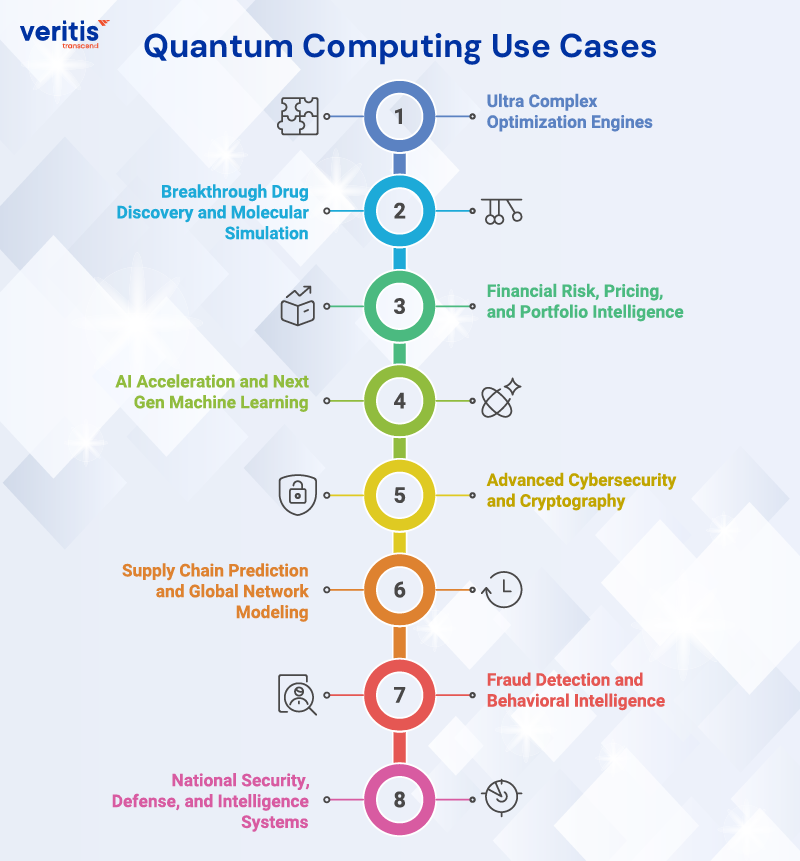
Below are the most commercially relevant, C-suite aligned, future-ready quantum use cases shaping the future of quantum computing, built on real enterprise demand signals.
1) Ultra Complex Optimization Engines
Where Classical Systems Break:
Routing, scheduling, inventory balancing, grid management, and workforce allocation.
Quantum Advantage:
Simultaneous evaluation of millions of possible outcomes.
Why it Matters:
Transforms logistics, aviation, retail, energy, and manufacturing. One of the strongest applications of quantum computing.
2) Breakthrough Drug Discovery and Molecular Simulation
Where Classical Systems Fail:
Accurate simulation of chemical compounds and protein folding.
Quantum Advantage:
Atomic level modeling at unprecedented speed.
Why it Matters:
Massive opportunity across pharma, biotech, and materials science, powered by advances in quantum computing and the latest quantum computing developments.
3) Financial Risk, Pricing, and Portfolio Intelligence
Where Classical Models Slow Down:
Monte Carlo simulations, XVA adjustments, and derivatives pricing.
Quantum Advantage:
Faster probability estimation and deeper scenario modeling.
Why it Matters:
Banks and insurers will be major drivers of the quantum computing market size 2030.
4) AI Acceleration and Next Gen Machine Learning
Where AI Hits Limits:
Training large models, searching complex spaces, and simulation heavy workloads.
Quantum Advantage:
Quantum assisted optimization + sampling → faster, smarter AI.
Why it Matters:
The convergence of AI and quantum computing will redefine enterprise intelligence, forecasting, and automation.
5) Advanced Cybersecurity and Cryptography
Where Classical Security Weakens:
Long term encrypted data, identity systems, and key exchange.
Quantum Advantage:
Quantum safe encryption and next level threat detection.
Why it Matters:
Boards are already planning for the moment when quantum can break classical cryptography, a core part of the future of quantum computing.
6) Supply Chain Prediction and Global Network Modeling
Where Classical Models Scale Poorly:
Complex, dynamic, multitier networks.
Quantum Advantage:
Live, multivariable modeling for forecasting and rebalancing.
Why it Matters:
Reduces disruption impact and increases resilience in global industries.
7) Fraud Detection and Behavioral Intelligence
Where Patterns Hide:
Large transaction sets, emerging fraud signatures.
Quantum Advantage:
Quantum enhanced pattern recognition + AI driven inference.
Why it Matters:
Enterprises gain stronger predictive defense capabilities as Cloud Computing Trends converge with quantum.
8) National Security, Defense, and Intelligence Systems
Where Classical Compute Hits Walls:
Signal decryption, satellite modeling, multi scenario simulation.
Quantum Advantage:
Unmatched computational reach.
Why it Matters:
A core driver of global investment in what is the future of quantum computing.
Conclusion
Quantum computing is getting closer to real enterprise impact, and the leaders who prepare now will have a clear advantage when the technology breaks into the mainstream. Most organizations are not trying to “go quantum” today; they’re strengthening the foundations that will let them adopt it smoothly when the time is right.
This is exactly where Veritis supports Fortune 500. We help them modernize cloud environments, tighten data and security foundations, and explore early opportunities without unnecessary risk. The goal is not to chase hype. It’s to make sure your enterprise is ready when quantum becomes practical. The shift is coming. The successors will be the ones who planned for it. Veritis helps you be one of them.