Operational security controls turn security policies into repeatable daily practices. They define who performs security tasks, when the work happens, and what evidence confirms it was completed.
Security technology alone cannot ensure protection. Patches may be delayed, access may remain after a person leaves, alerts may lack an owner, and backups may never be tested. Operational controls connect people, procedures, and technology so safeguards work during routine operations and incidents.
Explore Security Control Solutions
Operational Security Control Fundamentals
1) Definition and Purpose
Operational security controls are safeguards carried out primarily through people and repeatable procedures, often supported by technology. The NIST definition emphasizes controls executed by people, such as incident handling, training, change approval, backup testing, and physical access procedures.
Every control should identify the risk addressed, its scope, its owner, its trigger or schedule, the evidence required, and the response when it fails. A written procedure without ownership or verification does not demonstrate protection.
2) Management, Operational, and Technical Controls
These control types work together:
- Management controls set direction and accountability, such as security policies and risk acceptance.
- Operational controls put those requirements into practice, such as access reviews and restoration tests.
- Technical controls enforce protection through systems, such as encryption and network filtering.
For privileged access, management defines the approval policy, operations reviews and revokes access, and technology enforces authentication and permissions.
3) Control Purposes
Controls may prevent, detect, correct, or help recover from security events.
| Strategy | Description | Best for |
| Rehost (Lift and Shift) | Move to AWS with no code changes | Large scale, time sensitive migrations |
| Replatform (Lift, Tinker, and Shift) | Minor optimizations, e.g., move to Amazon RDS | Capturing early gains with modest effort |
| Repurchase (Drop and Shop) | Replace licensed app with SaaS equivalent | Removing on premises maintenance overhead |
| Refactor (Re architect) | Redesign as cloud native with microservices or serverless | Highest long term scalability and performance |
4) Operational Security, OPSEC, and OT Security
Enterprise operational security controls govern routine cybersecurity practices across business systems. Operations security (OPSEC) protects sensitive information from adversarial observation and inference. Operational technology (OT) security protects systems that monitor or control physical processes.
An enterprise may address all three. This guide focuses on enterprise operational controls, including the additional care required when business technology connects to industrial environments.
5) Prioritize Controls by Business Risk
Start with services whose compromise could interrupt operations, expose sensitive data, affect safety, or violate obligations. Assess exposure, business impact, existing protection, recoverability, and operational constraints.
A peer reviewed analysis of 18 empirical studies found that a reduced attack surface and faster patching were consistently strong predictors of fewer cyber incidents. This supports prioritizing controls that close relevant attack paths, while maintaining detection, training, and recovery practices.
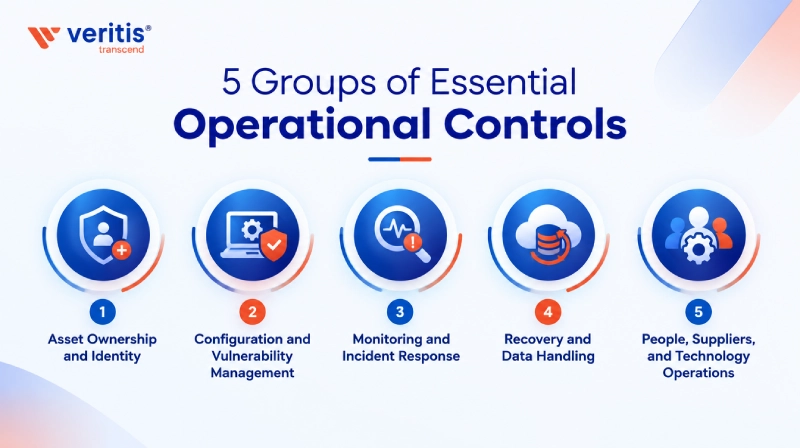
5 Groups of Essential Operational Controls
1) Asset Ownership and Identity
Maintain an inventory of infrastructure, applications, endpoints, data stores, dependencies, and service identities. Record each asset’s owner, business purpose, sensitivity, and support status. Reconcile discovery results against procurement, cloud, and deployment records.
Define access processes for employees, contractors, service accounts, applications, and AI agents. Apply least privilege, appropriate multifactor authentication, periodic reviews, and timely access removal. Include privileged and dormant accounts in reviews.
Keep evidence of: Inventory reconciliation, access approvals, revocation timestamps, and privileged access reviews.
2) Configuration and Vulnerability Management
Set approved configuration baselines and monitor changes. Production changes should include risk assessment, testing, authorization, implementation records, and rollback instructions. Review emergency changes afterward.
Treat vulnerability scans as inputs to remediation, not proof that remediation is complete. Prioritize findings by exploitation, exposure, asset importance, and business impact. Verify that fixes reach affected systems. Document compensating safeguards and expiration dates when immediate remediation is not possible.
Keep evidence of: Baseline versions, approvals, validation scans, remediation records, and exception decisions.
3) Monitoring and Incident Response
Define which events must be collected, protected, retained, and investigated. Prioritize identity systems, critical applications, cloud administration, endpoints, and backup infrastructure.
Assign alert owners, severity criteria, investigation procedures, and escalation paths. Incident plans should specify who can isolate systems, disable identities, preserve evidence, contact suppliers, and authorize restoration. Exercise realistic scenarios such as credential theft, ransomware, and cloud account compromise.
Keep evidence of: Telemetry coverage, investigations, escalation records, response exercises, and corrective actions.
4) Recovery and Data Handling
Set recovery time and recovery point objectives with business owners. Protect backups from unauthorized deletion or encryption, restrict backup administration, and test restoration in an isolated environment. Validate application dependencies, identity services, data integrity, and business readiness. A successful backup job alone does not prove recoverability.
Define how data is classified, accessed, stored, shared, retained, and deleted. Include exports, removable media, test environments, and AI tools. Encryption does not replace access control or secure disposal.
Keep evidence of: Restoration results, achieved recovery objectives, classification records, and disposal verification.
5) People, Suppliers, and Technology Operations
Align onboarding, role changes, departures, and training with job responsibilities. Make training practical: administrators need privileged access and emergency guidance; developers need secure release practices.
Review suppliers that access sensitive data, privileged systems, or essential services. Document responsibilities for access, incident notification, remediation, recovery, and contract termination. Outsourcing execution does not transfer enterprise accountability.
For cloud and software delivery, connect source changes, build artifacts, deployment identities, configuration, and runtime activity. Give automated agents distinct identities, limited permissions, auditable actions, and clear human approval requirements for high impact tasks.
Teams can strengthen delivery practices through relevant DevOps engineering skills.
Useful link: Why DevOps Skills Matter for Security Leaders
Map Controls to Relevant Frameworks
Frameworks use different structures, so map operational practices to each framework’s requirements rather than forcing them into a single category.
| Framework | How it supports operational security |
| NIST Cybersecurity Framework 2.0 | Organizes outcomes across Govern, Identify, Protect, Detect, Respond, and Recover |
| NIST SP 800 53 Revision 5 | Provides control families covering training, configuration management, incident response, and contingency planning |
| ISO/IEC 27001:2022 | Provides a security management system and reference controls across organizational, people, physical, and technological themes |
| CIS Controls and Benchmarks | Help prioritize defensive practices and technical configuration baselines |
| CISA, DISA STIGs, and MITRE ATT&CK | Offer implementation guidance, defense requirements for relevant contexts, and adversary techniques for testing |
The NIST Cybersecurity Framework 2.0 describes outcomes rather than prescribing a product or universal checklist. NIST SP 800 53 and ISO/IEC 27001 also have distinct structures and scopes. Maintain one control register mapped to applicable obligations to reduce duplicated evidence collection.
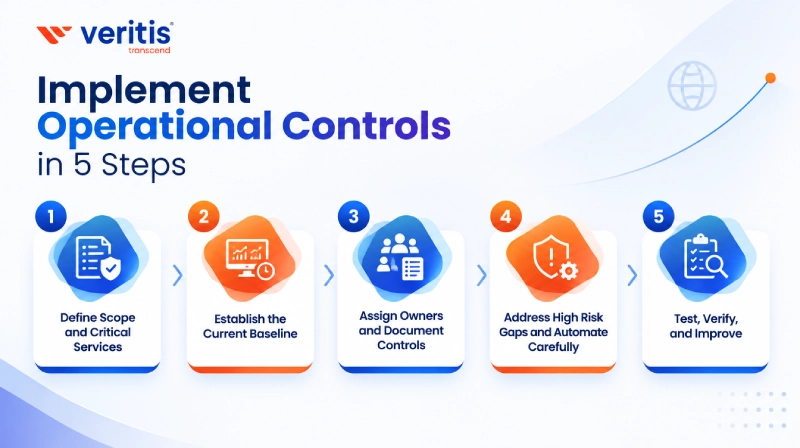
Implement Operational Controls in 5 Steps
1) Define Scope and Critical Services
Select the business services and risks to address first. Document dependencies, sensitive data, obligations, and plausible compromise scenarios. For industrial environments, include safety and operational reliability.
2) Establish the Current Baseline
Compare written procedures with actual execution. Sample access removals, remediation tickets, incident records, and restoration tests. Separate missing controls from controls that exist but run inconsistently.
3) Assign Owners and Document Controls
Identify the business risk owner, control operator, supporting technology owner, and independent reviewer. Record each control’s scope, trigger, procedure, evidence, performance measure, and exception process.
4) Address High Risk Gaps and Automate Carefully
Prioritize exposed unsupported systems, uncontrolled administrator access, missing critical telemetry, and untested recovery. Automate stable procedures once authority, inputs, exceptions, and rollback are clear. Automatic evidence collection may be low risk; automatic production access removal requires careful validation.
5) Test, Verify, and Improve
Test control design, coverage, and operating effectiveness. Verify that remediation corrected the underlying issue. Reassess controls after significant architecture changes, supplier transitions, or incidents.
Set Control Frequency and Measure Results
Control schedules should reflect risk, service importance, and applicable obligations. Separate how often a control runs from how often its effectiveness is independently checked.
| Execution pattern | Examples | Scheduling consideration |
| Event triggered | Access removal, incident escalation, emergency change review | Define the trigger, response deadline, and escalation |
| Continuous or automated | Telemetry collection, configuration drift detection | Monitor collection failures and assign responders |
| Scheduled | Access recertification, inventory and exception reviews | Set intervals based on privilege, sensitivity, and obligations |
| Exercise based | Restoration tests, incident and supplier exercises | Repeat for critical scenarios and after material changes |
Track coverage, execution, and outcomes separately. Useful measures include:
- Critical assets with validated owners.
- Time to revoke access after a departure.
- Age of unresolved high risk vulnerabilities.
- Critical services producing required security telemetry.
- Time from detection to incident containment.
- Restoration tests that meet approved recovery objectives.
- Expired exceptions and recurring control failures.
Fewer alerts do not always mean lower risk; they may indicate weaker detection or missing telemetry. Define metric denominators and exclusions, so reported coverage reflects the systems that matter.
Conclusion
Operational security controls make security policies work in daily operations. Assign clear owners, prioritize controls by business risk, and verify that procedures produce reliable results. Veritis can help assess operational gaps and build a practical path toward stronger security and resilience.