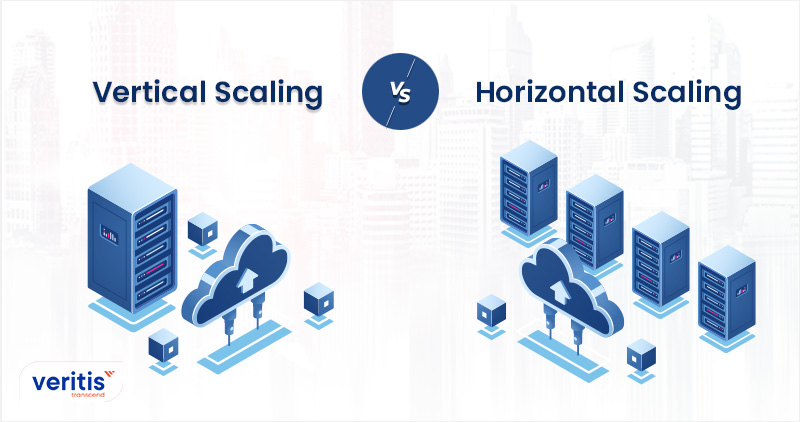
Deciding between vertical and horizontal scaling depends on your organization’s needs and infrastructure. Vertical scaling, also known as scaling up, increases the capacity of an existing server and provides a quick solution for immediate performance boosts in stateful workloads. In contrast, horizontal scaling, or scaling out, adds more servers to handle increased demand, offering greater scalability and resilience suitable for stateless applications. Organizations increasingly adopt hybrid and AI native infrastructures to maximize performance and cost efficiency.
Change and Scalability in Business
Change is a critical factor that shapes an enterprise’s future. While change fosters growth, enterprises either have to expend many resources or shed some non essential systems. In traditional businesses, coping with change is a major challenge, as companies must implement changes quickly, which not everyone can do smoothly.
To summarize, organizations must add or shed servers to handle changes in demand. While this is a complex task for traditional legacy businesses, enterprises that have integrated IT infrastructure services can scale seamlessly.
But why is scalability so closely tied to cloud computing solutions? Regardless of your sector, scalability is one of the key aspects you’ll encounter when working with the cloud. While scalability makes the cloud outclass traditional setups, it also involves certain intricacies.
This blog explores the intricacies of scalability, including vertical and horizontal scalability, examples of each, and guidance on picking the best option for your needs.
What is Scalability?
During peak periods, you need more resources to capitalize on the demand. Once demand peaks, you’re left with unused resources that metaphorically collect dust. In day to day life, it is like having an unmown lawn. To maintain it, you get a lawnmower and restore the lawn’s beauty. But once the job is done, you must tuck away the lawnmower until the next mowing session.
Instead, you don’t keep the lawnmower in the cloud and don’t want it around unless you need it. You can borrow tools from your neighbors to do the job. Once the job’s done, you can return it, so you don’t have to own a resource you only need at certain times.
The same applies to the cloud; you need to allocate extra resources when needed and pay only for what you use. These resources can range from extra storage to additional RAM power. Effectively, scalability allocates resources as needed and, during lean periods, sheds excess resources to conserve costs.
Cloud scalability is lucrative for businesses because it provides instant availability. While spikes are predictable, sudden, unexpected surges in traffic can occur, demanding a rapid response with minimal latency and no downtime. Thankfully, IT cloud service providers make the required resources available immediately.
Now that we’ve explored scalability, let’s examine vertical and horizontal scaling.
Useful Link: Amazon Redshift Vs Azure Synapse Analytics: Difference Between Top Data Warehouses
What is Vertical Scaling?
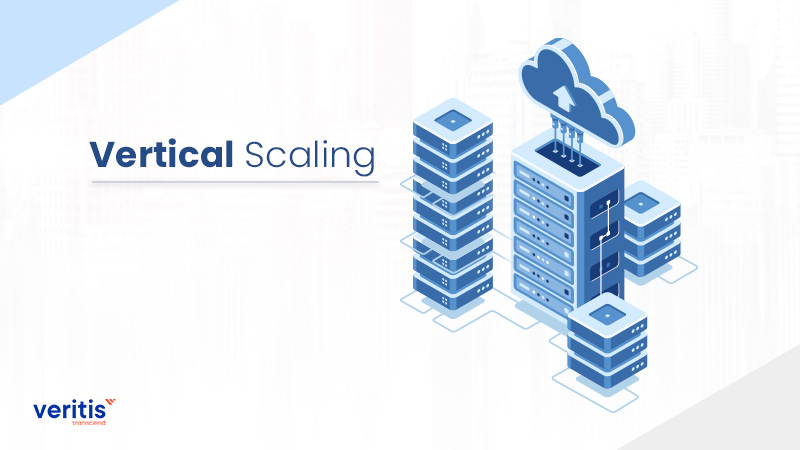
Vertical scaling refers to the up-scaling process where your infrastructure’s computational capacity is boosted to mitigate the new requirements. This process, called scale-up, allows you to retain the resources in the existing logical unit. As a result, the infrastructure’s network capacity, storage power, and processing ability will be expanded.
What is Horizontal Scaling?
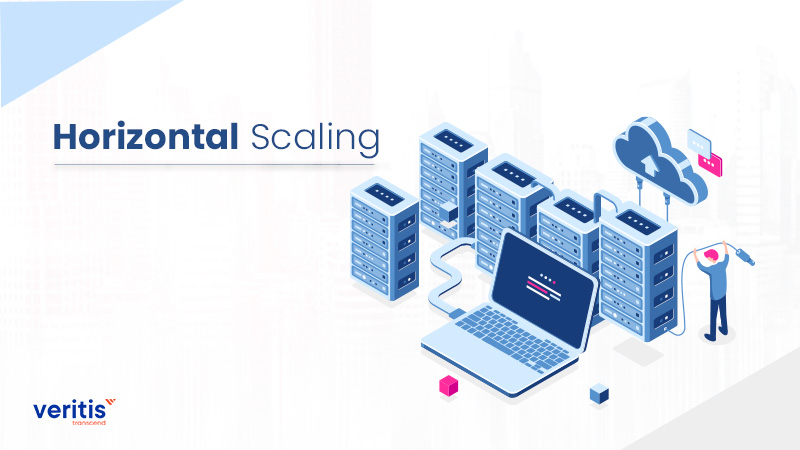
In horizontal scaling, computational power and devices become a factor. Here, you add more devices and distribute the existing computational capacity over the existing and additional devices. So, while there won’t be a spike in computational power, the devices across your infrastructure would increase. This distribution is what separates horizontal scaling from vertical scaling. It is also called scaling out.
Useful Link: ITOps vs DevOps vs NoOps Comparison
Differences Between Horizontal and Vertical Scaling
Although scalability is mainly associated with computational power, hardware is the key aspect that sets horizontal scaling apart from vertical scaling. Vertical scaling enhances the hardware configuration without disturbing or modifying the logical unit. In horizontal scaling, the hardware specifications remain the same while the number of instances spikes up. In other words, the hardware infrastructure is increased by adding more devices with the same specifications.
The other aspect they differ upon is that in horizontal scaling, a sequential piece of logic is broken into smaller units and implemented on multiple devices. The breakup of the code allows programmers to execute multiple tasks parallelly over different devices. Vertical scaling is not the case, as the logic code remains unchanged. The unchanged code is run across the boosted infrastructure. With the differences out of the way, let’s look at the advantages of both scaling methods.
Pros and Cons of Vertical Scaling and Horizontal Scaling
As with everything, both scaling methods have advantages and disadvantages. Both approaches differ, particularly in code and hardware. Vertical scaling does not involve a code change and is much easier to execute than horizontal scaling. The operations are easier to manage, and the data centers on one node.
This centralized node allows you to run operations across multiple devices. In addition, vertical scaling reduces expenses as your infrastructure footprint doesn’t increase. This boils down to the company not dedicating extra monetary resources to power consumption and cooling units. Additionally, managing the network from the nodal device is more straightforward and better from the control point.
The disadvantage of vertical scaling is that your hardware can only expand up to a specific limit. Though one can always boost the hardware on certain aspects, the scope to expand it holistically narrows down significantly. Also, one would have to shut down the required devices whenever they are scaling up, resulting in downtime. Additionally, the nodal device has to be taken care of, as unexpected downtimes from that device would stunt productivity.
Horizontal scaling scores well on these aspects. One adds additional devices to consume the existing power. No downtime is involved; you can choose how many devices you choose. The nodal control mechanism doesn’t exist in this scaling approach, which betters resilience. However, it runs aground on the data aspect. The data must be partitioned into multiple units due to multiple devices. This partition also complicates data sharing and processing.
Examples of Vertical and Horizontal Scaling
To better illustrate the benefits and challenges of vertical and horizontal scaling, consider the following examples:
Vertical Scaling Example
A growing e-commerce platform might initially use vertical scaling to handle increased site traffic during major sales events. By upgrading their existing servers with more powerful CPUs and additional memory, they can quickly accommodate more transactions without changing software configurations.
Horizontal Scaling Example
A social media company experiencing consistent growth might opt for horizontal scaling by adding more servers to handle additional users. This lets them distribute the load across multiple machines, improving redundancy and scalability without significant downtime.

Deciding Factors
With both approaches scoring higher than the other, it ultimately comes down to a few crucial aspects that help you decide which one to choose.
1) Costs Involved
Vertical scaling requires you to spend at the onset of the adoption itself. You will pay for the higher power, and effectively, it fares well in the initial stages. In horizontal scaling, you wouldn’t have to pay up much at the onset of the scaling process. You would be required to pay for the devices when you opt for them, but later on, your cost overheads would crop up in the form of cooling systems and space requirements.
2) Clientele
Horizontal scaling allows you to circumvent latencies and outages. You don’t have to shut down the servers to implement the scaling process. However, if the customer base is localized and if the burgeoning requirements demand higher processing power, it would be better to adopt a vertical scaling process. As latency and outages are involved, your clientele should be okay with these aspects.
3) Performance
Vertical scaling reduces your flexibility to a certain extent, as today’s technology limits you. In this approach, you wouldn’t be free to choose whatever you wish. In horizontal scaling, you can choose the required configuration and optimize operational costs.
Useful Link: AWS Vs Azure Vs GCP
Case Study: IT Infra and Virtualization Services for Financial Services Industry
A prominent financial services firm partnered with Veritis to enhance its IT infrastructure and virtualization capabilities amid rising performance demands. The client needed a flexible scaling approach to support its growing workloads while maintaining high availability and regulatory compliance. Veritis implemented a hybrid scaling strategy, leveraging vertical scaling to maximize the efficiency of existing hardware and horizontal scaling to ensure seamless service continuity even under heavy loads. This solution optimized resource utilization, improved system resilience, and highlighted the importance of selecting the right scaling model based on workload characteristics and business objectives.
The complete case study is available here: IT Infrastructure and Virtualization Services for the Financial Services Industry.
Trouble Deciding?
While the choice may seem easy, scaling is determined by your infrastructure’s architecture and other factors. Additionally, it would be beneficial to recognize that vertical and horizontal scaling are not always the best choices. One can implement both the scaling processes and reap their benefits.
While it may sound straightforward, improper scaling can hinder your production processes and result in unnecessary costs. To avoid this, Fortune 500 and emerging companies have turned to Veritis for expert IT infrastructure consulting services to streamline and optimize their operations.
So, reach out to us and scale your infrastructure as best as possible.