Table of contents
Azure Kubernetes Service (AKS) is a fully managed Kubernetes service offered by Microsoft Azure. It allows you to deploy and manage Kubernetes clusters on the Azure cloud platform. Azure Kubernetes Service makes it easier for developers to deploy, manage, and scale containerized applications using Kubernetes. In this article, we will delve deeper into Azure Kubernetes Service and look at its features, benefits, and drawbacks.
What is Azure Kubernetes Service?
Before we dive into Azure Kubernetes Service, let’s first understand what Kubernetes is. Kubernetes is an open source container orchestration platform that automates the deployment, scaling, and management of containerized applications. Google initially developed it, and it is now maintained by the Cloud Native Computing Foundation (CNCF).
Azure Kubernetes Service automates the deployment, scaling, and management of containerized applications. It does this by grouping the containers that make up an application into logical units called pods. These pods can be scaled up or down based on the application’s workload. Kubernetes also provides self healing capabilities, ensuring that the application is always running, even in a failure.
As a managed Kubernetes service, AKS removes the burden of managing the underlying infrastructure. It handles provisioning, scaling, and upgrading the Kubernetes cluster, allowing developers to focus on writing and deploying their code. DevOps consulting services can be instrumental in helping organizations leverage AKS effectively by streamlining cluster configuration, improving CI/CD pipelines, and ensuring the Kubernetes environment aligns with organizational DevOps strategies.
Azure Kubernetes Service provides all the benefits of Kubernetes while removing the complexity of managing the Kubernetes clusters. It enables developers to focus on building and deploying their applications quickly and efficiently.
Features of Azure Kubernetes Service
Azure Kubernetes Service offers several features that make it an attractive option for developers. These features include:
- Managed Kubernetes: Azure Kubernetes Service is a fully managed Kubernetes service, meaning that Microsoft manages Kubernetes clusters. This includes provisioning, scaling, and upgrading the Kubernetes clusters.
- Easy Deployment: AKS makes it easy to deploy Kubernetes clusters on Azure. Developers can deploy a cluster with just a few clicks, making it easy to start with Azure Kubernetes Service.
- High Availability: AKS provides high availability for Kubernetes clusters by distributing nodes across multiple availability zones. This ensures that the cluster is always available, even in a failure.
- Security: AKS provides security features such as role based access control (RBAC) and network security groups (NSGs) to secure Kubernetes clusters.
- Scalability: AKS allows you to scale your Kubernetes cluster up or down based on your application’s workload.
- Integration: AKS integrates with other Azure services such as Azure Container Registry, Azure Active Directory, and Azure DevOps.
Pros of Azure Kubernetes Service
- Simplified Kubernetes Management: AKS streamlines Kubernetes cluster management, enabling developers to focus on building and deploying their applications.
- High Availability: AKS provides high availability for Kubernetes clusters by using multiple nodes across different availability zones, ensuring the cluster remains available.
- Scalability: AKS allows you to scale your Kubernetes cluster up or down based on your application’s workload, making it easy to handle increased traffic.
- Security: AKS provides security features such as role based access control (RBAC) and network security groups (NSGs) to secure Kubernetes clusters.
- Integration: AKS integrates with other Azure services, making it easy to deploy and manage your containerized applications on the Azure cloud platform.
Cons of Azure Kubernetes Service
- Vendor Lock In: AKS is a Microsoft Azure service, meaning you may be locked into the Azure cloud platform if you choose to use AKS.
- Cost: AKS is a paid service that can quickly add up if you have large Kubernetes clusters.
- Limited Control: AKS is a managed Kubernetes service, meaning that Microsoft manages the Kubernetes cluster. This can limit your control over the underlying infrastructure.
- Learning Curve: Although AKS reduces the complexity of managing Kubernetes clusters, there is still a learning curve for deploying and managing containerized applications on Kubernetes.
Useful link: Azure DevOps Services – Plan Smart, Build Fast and Execute at a New Speed
Why Azure Kubernetes Services is Better Than Others
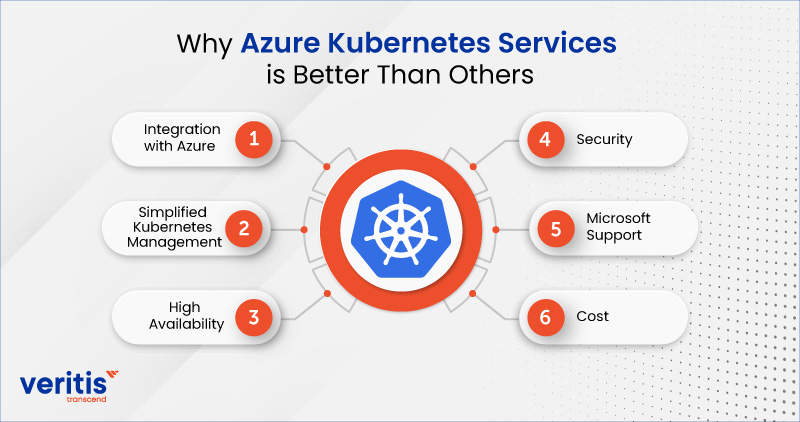
When it comes to Azure Kubernetes service, there are several options available in the market, including Google Kubernetes Engine (GKE), Amazon Elastic Kubernetes Service (EKS), and Azure Kubernetes Service (AKS). So, why should you choose AKS over other Kubernetes services?
- Integration with Azure: Using AKS makes sense if you already use Azure for your cloud infrastructure. AKS integrates seamlessly with other Azure services, making it easy to deploy and manage your containerized applications on the Azure cloud platform.
- Simplified Kubernetes Management: AKS streamlines Kubernetes cluster management, enabling developers to focus on building and deploying their applications.
- High Availability: AKS provides high availability for Kubernetes clusters by using multiple nodes across different availability zones, ensuring the cluster remains available.
- Security: AKS provides security features such as role based access control (RBAC) and network security groups (NSGs) to secure Kubernetes clusters.
- Microsoft Support: Microsoft provides support for AKS, ensuring you have access to experts who can help you resolve any issues.
- Cost: AKS is priced competitively, making it an attractive option for businesses deploying and managing containerized applications on Kubernetes.
Why Azure Kubernetes Services?
One of the main advantages of AKS is its seamless integration with other Azure services. This makes it easy to deploy and manage containerized applications on the Azure cloud platform. AKS can be used with Azure Container Registry (ACR) to store and manage container images, and with Azure DevOps to enable continuous integration and deployment (CI/CD) for containerized applications.
Azure Kubernetes Service also simplifies Kubernetes deployment. It automates the deployment, scaling, and management of Kubernetes clusters so developers can focus on building and deploying their applications. AKS provides features such as automatic scaling, self healing, and rolling updates, which help ensure that applications are always available and up to date.
Another advantage of AKS is its high availability. AKS uses multiple nodes across different availability zones, ensuring the Kubernetes cluster remains available. It also supports horizontal scaling, allowing the cluster to automatically adjust to changes in demand.
AKS also provides security features such as role based access control (RBAC) and network security groups (NSGs) to secure Kubernetes clusters. RBAC allows administrators to control access to Kubernetes resources, while NSGs allow administrators to define and enforce network security policies for Kubernetes clusters.
In addition to these advantages, AKS provides Microsoft support, ensuring businesses have access to experts who can help resolve any issues they may encounter. AKS is also priced competitively, making it an attractive option for businesses deploying and managing containerized applications on Kubernetes.
AKS stands out for its seamless integration with Azure services compared to other Kubernetes DevOps services, such as Google Kubernetes Engine (GKE) and Amazon Elastic Kubernetes Service (EKS). GKE integrates with Google Cloud Platform (GCP), while EKS integrates with Amazon Web Services (AWS). If a business already uses Azure for its cloud infrastructure, using AKS would be the logical choice.
AKS also simplifies Kubernetes management when compared to GKE and EKS. While all three services automate the deployment, scaling, and management of Kubernetes clusters, AKS is designed to work seamlessly with Azure services, making management easier.
All three services use multiple nodes in different availability zones for high availability. However, AKS supports horizontal scaling, which allows the cluster to adjust automatically to changes in demand.
All three services provide security to RBAC and NSGs. However, AKS also integrates with Azure Security Center, which provides additional security features such as threat detection and vulnerability assessment.
Azure Kubernetes Service provides all the benefits of Kubernetes while removing the complexity of managing the Kubernetes cluster. AKS offers several features, such as high availability, scalability, and security, making it an attractive option for businesses looking to deploy and manage containerized applications on the Azure cloud platform.
AKS provides several features that make it a powerful platform for deploying and managing containerized applications. One of these features is the ability to deploy Kubernetes clusters in minutes. AKS automates the creation of a Kubernetes cluster, so developers can focus on building their applications rather than worrying about infrastructure setup.
Another key feature of AKS is its ability to provide granular control over Kubernetes resources. AKS provides a rich set of RBAC controls, which enable administrators to control access to Kubernetes resources at a very granular level. This makes it easy to provide different levels of access to different teams within an organization.
AKS also provides seamless integration with Azure DevOps. Developers can use Azure DevOps to build, test, and deploy their applications, and AKS will automatically deploy the new containers to the Kubernetes cluster. This integration helps streamline the application development process and can save significant time.
AKS also provides built in support for monitoring and logging. The platform supports widely used monitoring and logging tools such as Prometheus, Grafana, and Fluentd, making it easy to monitor the health and performance of Kubernetes clusters and the applications running on them.
AKS also provides automatic scaling of Kubernetes clusters. If application demand increases, AKS will automatically spin up additional Kubernetes nodes to handle the additional load. Similarly, if demand decreases, AKS will automatically scale down the Kubernetes nodes to save resources and reduce costs.
Another important feature of AKS is its ability to perform rolling updates. This means that when a new version of an application is deployed to the Kubernetes cluster, AKS will automatically roll it out to minimize user disruption. This ensures that applications are always up to date while minimizing the risk of downtime or disruption.
In addition to these features, AKS provides several tools that make it easy to manage and troubleshoot Kubernetes clusters. The platform provides a web based dashboard that enables administrators to monitor the health and performance of Kubernetes clusters and applications running on the clusters. It also provides a command line interface (CLI) that enables administrators to perform advanced management tasks and troubleshoot issues.
Useful link: Azure DevOps Services for New Age DevOps Professionals
Conclusion
Finally, AKS provides Microsoft support, unavailable with GKE or EKS. This can be important for businesses that want to ensure they have access to experts who can help them resolve any issues they may encounter.
Overall, while all three services have advantages and disadvantages, AKS stands out for its seamless integration with Azure services, simplified Kubernetes management, high availability, security features, and Microsoft support. Businesses already using Azure for their cloud infrastructure should consider using AKS to deploy and manage their containerized applications.
Although AKS has some drawbacks, such as vendor lock in and limited control over the underlying infrastructure, its benefits outweigh the drawbacks. AKS integrates seamlessly with other Azure services, simplifies Kubernetes management, provides high availability and security, and is competitively priced.
Overall, Azure Kubernetes Service is an excellent option for businesses looking to deploy and manage containerized applications on Kubernetes. With AKS, you can focus on building and deploying your applications without worrying about managing the underlying infrastructure.
Veritis, a Stevie Award winning DevOps consulting company, is an expert in Kubernetes solutions. We can help you adopt and optimize a Kubernetes strategy that aligns with your business objectives. Reach out to us, and we’ll tailor an AKS solution to your needs and accelerate your digital transformation.
Got Questions? Schedule A Call
Also Read: