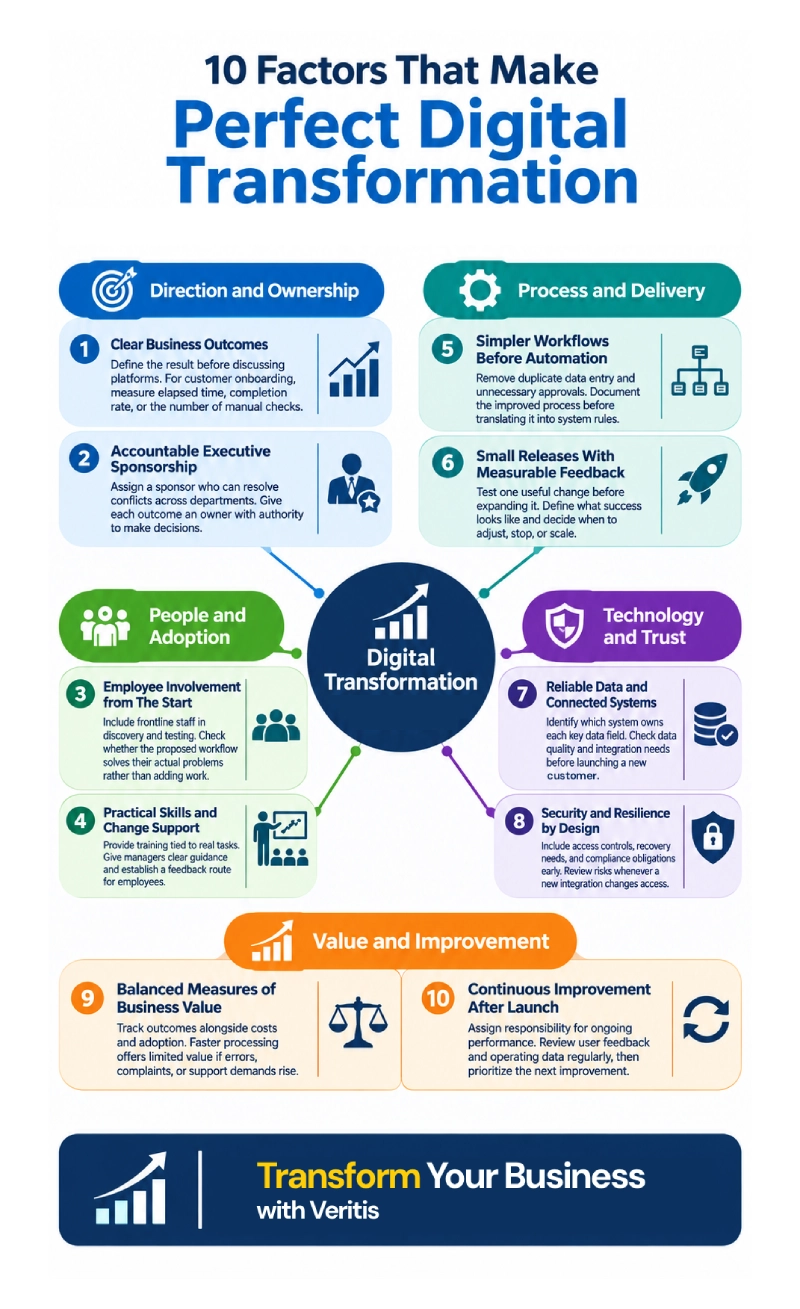
Sustained business improvement requires more than new software. This infographic on the 10 factors that make a perfect digital transformation explains how people, processes, and technology work together to improve speed, service, and control.
Digital Transformation (DX) has been the buzzword around and is now coming to the forefront. One such demand for DX efforts came with the COVID-19 crisis, which significantly changed how companies function.
Remote work culture, increased cloud usage, and business continuity have become crucial needs for businesses globally.
So, Digital Transformation can help you on this journey. Here is an infographic that details 10 crucial factors key to DX success.


Email us: connect@veritis.com; Call: 972-753-0022
What Do We Mean by Digital Transformation?
Digital transformation changes how a business operates and delivers value through digital capabilities. It connects business goals with changes in employee behavior, workflows, data, and systems.
Digitization converts information into a digital format. Digital transformation goes further by changing how work gets done.
For example, replacing a paper application with an online form is digitization. Connecting that form to automated checks, clear approval rules, and status updates changes the service itself.
The business outcome matters more than the tool. A useful digital transformation strategy defines the problem, desired result, accountable owner, and measures of progress before selecting technology.
Why is Digital Transformation a Top Priority?
Customers expect convenient services. Employees need reliable access to systems. Leaders need timely information and operations that can adapt to disruption.
Yet investment alone does not ensure success. In its 2018 report, exploring success in digital transformations, McKinsey reported that only 16% of respondents said their transformations improved performance and equipped their organizations to sustain those improvements.
That historical finding is not a forecast for every company. It highlights a lasting execution challenge: installing systems is easier than changing how an organization works.
Digital transformation should address a measurable business constraint. Useful priorities include:
- Reducing the time needed to serve customers.
- Removing repeated manual work and errors.
- Improving resilience and recovery readiness.
- Strengthening security and access controls.
- Giving leaders reliable data for decisions.
The benefits of digital transformation become credible when each goal has a baseline and a named owner.
What Are 3 Factors for Successful Digital Transformations?
People, process, and technology form the golden triangle of digital transformation. Each depends on the other two. Skilled employees cannot fix unclear approval rules through effort alone. Better software cannot rescue a workflow that no one owns.
1) People: Who Will Lead, Adopt, and Sustain the Change?
People turn a transformation plan into daily practice. Executive sponsors set priorities, managers remove barriers, and employees apply new ways of working.
Involve the people who perform the work before choosing a solution. Ask where they lose time, repeat tasks, or create workarounds. Their answers can expose problems that system requirements miss.
Give each affected role practical training. Explain what changes, why it matters, and where to get help. Track actual use and task completion, not attendance alone.
2) Process: What Needs to Change in the Workflow?
Processes connect business goals to repeatable action. Map the current workflow, including handoffs, exceptions, approvals, and delays.
Then ask which steps add value. Remove unnecessary work before automating it. Set clear rules for exceptions so that difficult cases do not disappear between teams.
For example, invoice automation may still stall if procurement and finance disagree about approval ownership. Fixing that responsibility is part of transformation, not a separate task.
3) Technology: Which Capabilities Support the Outcome?
Technology should support the redesigned process and the people using it. Evaluate integration, data quality, security, accessibility, and operating costs alongside features.
Cloud platforms, automation, analytics, and AI can all support transformation. None is a substitute for a clear business purpose.
Choose tools that fit the organization’s ability to operate and maintain them. Include support needs and legacy dependencies in the decision.
10 Factors That Make Perfect Digital Transformation
Use this practical checklist alongside the infographic to assess readiness and guide delivery. The five themes move from business direction to execution and continuous improvement.
Direction and Ownership
1) Clear Business Outcomes
Define the result before discussing platforms. For customer onboarding, measure elapsed time, completion rate, or the number of manual checks.
2) Accountable Executive Sponsorship
Assign a sponsor who can resolve conflicts across departments. Give each outcome an owner with authority to make decisions.
People and Adoption
3) Employee Involvement from The Start
Include frontline staff in discovery and testing. Check whether the proposed workflow solves their actual problems rather than adding administrative work.
4) Practical Skills and Change Support
Provide training tied to real tasks. Give managers clear guidance and establish a feedback route for employees who encounter problems.
Process and Delivery
5) Simpler Workflows Before Automation
Remove duplicate data entry and unnecessary approvals. Document the improved process before translating it into system rules.
6) Small Releases With Measurable Feedback
Test one useful change before expanding it. Define what success looks like and decide when to adjust, stop, or scale.
Technology and Trust
7) Reliable Data and Connected Systems
Identify which system owns each key data field. Check data quality and integration needs before launching a new customer or employee experience.
8) Security and Resilience by Design
Include access controls, recovery needs, and compliance obligations early. Review risks whenever a new integration or automated action changes system access.
Value and Improvement
9) Balanced Measures of Business Value
Track outcomes alongside costs and adoption. Faster processing offers limited value if errors, complaints, or support demands rise.
10) Continuous Improvement After Launch
Assign responsibility for ongoing performance. Review user feedback and operating data regularly, then prioritize the next improvement.
For additional planning context, explore these factors that drive digital transformation initiatives.
Which Comes First: People, Processes, or Technology?
Start with the business outcome, then examine people and processes before committing to technology. This sequence reduces the risk of buying a tool for a poorly understood problem.
It is not a rigid order. Security needs, legacy limits, and technical feasibility should inform planning from the beginning.
A practical sequence is:
a) Define the business problem and baseline measure.
b) Identify the people affected and the accountable owner.
c) Map the workflow and remove unnecessary steps.
d) Assess data, security, and integration requirements.
e) Select and test the supporting technology.
f) Measure results and refine the approach.
For example, a service team facing approval delays should first locate the bottleneck. A new portal will not resolve unclear decision rights.
How Do You Adopt an Iterative Approach?
An iterative approach delivers change in small, testable steps. Each release provides evidence for the next decision instead of relying on a large launch to prove the whole strategy.
Choose a pilot that matters to the business but has manageable dependencies. Establish a baseline before changing the workflow.
| Stage | Key Question | Evidence to Review |
| Define | What problem are we solving? | Current delays, errors, costs, or complaints |
| Design | What should change? | Workflow map and user feedback |
| Pilot | Does the change work in practice? | Task results, adoption, and support requests |
| Review | Did the outcome improve? | Comparison with the baseline |
| Scale | Can we repeat the result safely? | Integration readiness, controls, and support capacity |
Consider a manufacturer improving maintenance requests. The first release might cover one facility and one equipment group. The team can review request completion and data quality before extending the workflow.
Set decision rules before the pilot begins. Expand when results meet agreed criteria. Revise when adoption or quality falls short. Stop when the evidence no longer supports the investment.
How Should Leaders Measure Transformation Success?
Measure business results, adoption, and operational health together. A completed deployment is a delivery milestone, not proof of transformation.
| Dimension | Example Measure | What it Reveals |
| Business value | Cost per transaction | Whether operating efficiency improves |
| Customer experience | Time to complete a request | Whether service becomes easier or faster |
| People | Successful completion of key tasks | Whether employees can use the new approach |
| Process | Rework or exception rate | Whether the workflow is reliable |
| Technology | Availability and recovery test results | Whether the service can support operations |
Agree on definitions before comparing results. If teams calculate the same metric differently, leaders cannot judge progress with confidence.
Review costs as well as gains. Include licenses, integration, training, support, and ongoing operation in the assessment.
Conclusion
The strongest transformation connects every technology decision to a business result and a person accountable for it. That discipline matters more than the size of the technology portfolio.
Veritis digital transformation services can support enterprises as they connect strategy, process improvement, and technology delivery. Begin with a focused discussion of your business challenge and the evidence needed to demonstrate progress.