Information technology has advanced rapidly over the past several years, enabling more powerful and flexible cloud computing, richer software, better analytics, mobility, and sensors. If only most corporate IT vendors were keeping up. The incumbent worldview reflects their education in the previous era of proprietary systems, increased switching costs, and vendor lock in.
The cloud transformation tendency toward hybrid and multi cloud strategy solution is the best illustration of this. Both times, users can make greater use of existing resources and benefit from new methods for computing, storing, and analyzing data through cloud service management tools. This is a fact, not a theory. According to Gartner, 81% of firms collaborate with two or more public cloud service providers. Moreover, the multicloud strategy is gaining traction, as companies can use multiple clouds rather than being restricted to a single one.
Single cloud stacks, however, come at a hefty price. There is increasing complexity and a growing reliance on proprietary systems, where greater power is drawn from the distinctive capabilities of each cloud. There are segregated datasets that may provide a more precise understanding. There is concentrated danger in areas where completely different systems may be resilient. There are obstacles in areas where innovation and efficiency could be higher. Lack of control, haphazard security, and opaque expenses exist when there is a single view of assets.
So, without further ado, let’s look at multicloud strategy and what to consider when drafting the IT strategy.
Consult our Cloud Consulting Expert
What is Multicloud?

Over the past 15 years, two cloud computing trends have contributed to the transition to a multicloud strategy. First, IT departments wishing to migrate to the cloud no longer rely solely on the “Big Three” of AWS, GCP, and Azure. Since AWS’s debut in 2006, specialized infrastructure as a service (IaaS) providers have emerged to compete with the Big Three, offering businesses more options for multicloud deployments.
Second, several businesses invested heavily in cloud migration ten years after AWS’s debut. As a result, today’s startups rely on cloud native services, while established businesses are prepared to maximize their cloud deployments.
Employing two or more cloud computing services is known as a multicloud approach. Although a multicloud deployment can refer to any implementation of multiple software as a service (SaaS) or platform as a service (PaaS) cloud offerings, it now most frequently refers to a combination of public infrastructure as a service (IaaS) environments, such as Amazon Web Services and Microsoft Azure.
Many multicloud deployments nowadays are motivated by vendor lock in and redundancy concerns, but they are also driven by business and technical objectives. These objectives may involve using more affordable cloud consulting services or leveraging the speed, capacity, or capabilities of a specific cloud provider in a particular location.
Additionally, some businesses adopt multicloud architectures to maintain data sovereignty. Enterprise data must be physically stored in specific locations, as required by specific laws, rules, and business policies. Since customers can choose from various IaaS providers’ data center locations or availability zones, multicloud computing can help enterprises meet these needs. Organizations may place computing resources as close to end users as feasible to get the best performance and low latency, thanks to the flexibility of where cloud data sets. Once the on-premises infrastructure has been moved to the cloud, they can focus on designing their cloud environments to leverage a multicloud strategy fully. Let’s look at the vital aspects that would help you build a sound multicloud management platform strategy.
Useful link: Edge Computing Vs Cloud Computing: What are the Key Differences?
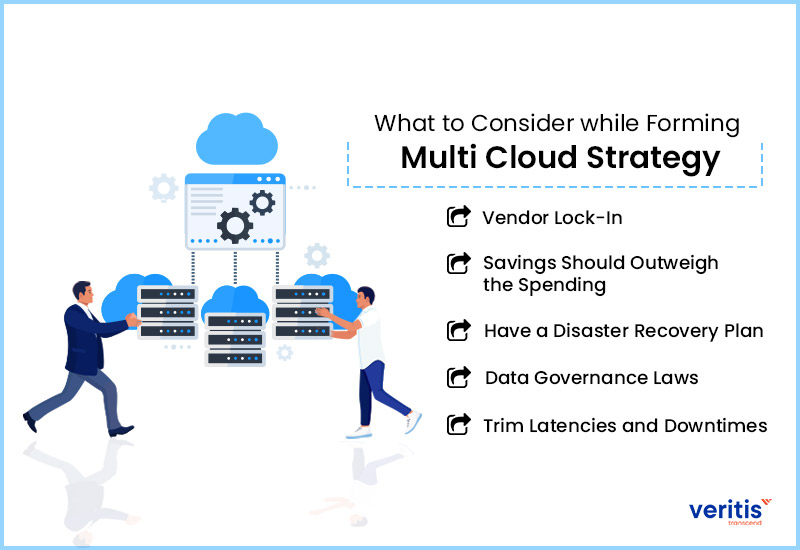
What to Consider while Forming Multicloud Strategy
Every company is unique due to its business goals and vision. Because of these factors, a standard policy is non-existent, which, among other things, motivates enterprises to seek the services of the Stevie Award winner Veritis. However, there are always vital considerations for the multicloud strategy.
1. Vendor Lock In
A key strategic driver for adopting a multicloud strategy is the desire to avoid the dangers of vendor lock in. Accordingly, workloads may be migrated based on which supplier has the best price structure for the precise resources or possesses the tools necessary to optimize performance. However, most significantly, from a tactical standpoint, it shifts the balance of power from the supplier to you.
If you are an enterprise level user, you will be better positioned to bargain for a unique pricing structure or other concessions. Additionally, you won’t be at risk of your cloud provider being a single point of failure.
Vendor lock in, however, is not always the case and should not be ” avoided if feasible” due to several other factors. You may optimize workloads, particularly for a single IaaS platform, and maximize its native tools and capabilities by building for and executing workloads on that platform. As a result, concerns about vendor lock in may be overstated, as we’ll discuss in more depth in the section after this.
2. Savings Should Outweigh the Spending
Building cloud independent apps as part of a multicloud strategy requires a more significant upfront resource commitment. It takes more time and requires professional knowledge and experience. Additionally, it is difficult for workloads and applications to be entirely cloud agnostic; usually, some customization or tuning is needed.
However, that front loaded distribution of extra resources can potentially spare a company from far higher costs and hassles. At a certain level of scale, moving workloads to the cloud provider that offers the best price to feature balance for a particular workload at any given moment might result in much more substantial savings than the additional original development cost.
3. Have a Disaster Recovery Plan
One of the main benefits of running a multicloud solution is establishing redundancy and preparing for disaster recovery. Keeping three copies of their data on two distinct media types, including one off site, helps IT departments establish a contemporary 3-2-1 backup plan. The evolution of 3-2-1 meant that the other two copies were stored on site to facilitate quick recoveries.
The requirement for an on-premises backup evolved as cloud IT services advanced. Today, many businesses no longer use physical infrastructure since data can be restored from the cloud as rapidly as on-premises equipment. Maintaining data across various public clouds lowers the risk when storing production and backup copies with a single provider for businesses that wish to become or are currently cloud native services. Additionally, the multicloud solution may recover data from their other, distinct cloud environment, ideally one that provides capabilities in the case of a disaster or ransomware attack.
4. Data Governance Laws
Several nations, including the European Union, have passed laws that control where and how data can be held. Businesses adhering to these data residency regulations might use a multicloud strategy to ensure their data complies with legal obligations. They employ several public cloud providers with various geographic reach in places where data storage is necessary.
5. Trim Latencies and Downtimes
A multicloud architecture eliminates any possibility of a severe app outage. Another cloud serves as the failover option, taking over the processing of the service if the primary cloud has trouble processing a particular service, such as an e-commerce transaction. The tasks may be automatically transferred back to the original cloud once it usually operates again.
Additionally, despite their rarity, catastrophic outages do occur. A significant or minor outage can interfere with the services offered by one provider. Multicloud deployment is essential if an app needs to have as near to 100% availability as possible at all times.
A multicloud strategy is an insurance policy against DDoS assaults, which can knock down a website or application and keep it down. The rise in brute force DDoS assaults has been a harmful side effect of expanding cloud installations. However, multicloud deployment gives an extra layer of resilience against danger. The load will instantly and smoothly migrate to another cloud environment, keeping the application up and running if the primary cloud platform is the target of a DDoS attack.
Useful link: How to Enhance Security in the Multi-Cloud Era
Case Study: Monitoring and Managing a Multi Cloud Environment for an HR Solutions Provider
Veritis partnered with a cloud-based HR solutions provider to deliver continuous monitoring and support services across a diverse cloud infrastructure. As the client expanded its services, a multi-cloud approach became essential for resilience, flexibility, and vendor independence. Veritis implemented a centralized monitoring framework that ensured visibility across all cloud platforms, enabling proactive performance tuning and rapid issue resolution. The proactive nature of our monitoring not only improved uptime and reliability but also aligned with key multi-cloud principles, including workload distribution and risk mitigation, providing security and confidence in our services.
This case illustrates the importance of robust monitoring in executing a successful multi cloud strategy.
Read the complete case study: Monitoring Support Services for Provider of HR Solutions in Cloud.
Conclusion
An organization’s DevOps teams and management overseeing the operation of specific apps often prefer a multicloud approach to align with management and C-suite priorities.
As we’ve seen, both a multicloud strategy and one that establishes a stronger bond with (or dependence on) a single public cloud provider have benefits and drawbacks. A multicloud approach saves costs while enhancing flexibility, performance, and dependability. However, unacceptable conditions might lead to the opposite outcome. To avoid such outcomes, please contact Veritis, and we will customize a solution to your specific requirements.
Got Questions? Schedule A Call With Cloud Expert
More Articles:
- Hybrid Cloud Vs Multi Cloud: What’s the Difference!
- What is Cloud Computing?
- Top 10 Security Issues in Cloud Computing
- Cloud Adoption Strategy: Which Approach Would be Most Effective for Your Company?
- What is Cloud Migration? Strategy, Process, and Tools
- Cloud Security Automation: Best Practices, Strategy, and Benefits