Banks that embed security into their software delivery pipelines reduce breach remediation costs by up to 60% compared with institutions that bolt security on after deployment. That single metric captures why DevSecOps for bankers with a futuristic vision is no longer a technology experiment. It is an executive mandate.
The banking sector has always operated at the intersection of trust and technology. Today, with mobile first customers, open banking APIs, real time payments, and an expanding regulatory perimeter, the stakes are higher than ever. A single misconfigured deployment can expose millions of accounts. A delayed patch can trigger a compliance violation that costs tens of millions in fines. The institutions pulling ahead are the ones that have stopped treating security as a checkpoint at the end of development and started treating it as a continuous, automated discipline woven into every sprint, every commit, and every release.
This is the promise of DevSecOps, and for forward thinking banking leaders, it is the architecture of competitive advantage.
Why Traditional Banking IT Models Cannot Keep Up?
Most banks were built on a three lane highway: an application development team, an information security team, and an operations team, each with its own priorities, timelines, and tooling. That separation made sense when software releases occurred quarterly, and the threat landscape evolved slowly. Neither condition is true anymore.
Release cycles have compressed from quarters to days. The average financial institution now runs hundreds of microservices in production. Open banking regulations such as PSD2 in Europe and emerging frameworks in the US require third party API integrations, which multiply the attack surface with every new connection. Meanwhile, the Ponemon Institute has consistently reported that the financial services sector faces average data breach costs above USD 5.9 million per incident, well above the cross industry mean.
The legacy model forces a brutal tradeoff: move fast and accumulate security debt, or move cautiously and fall behind competitors who are shipping features weekly. DevSecOps eliminates that tradeoff by making security a built in property of the delivery pipeline rather than a gate at its exit.
Banking leaders who understand the pros and cons of DevSecOps before committing to a transformation make faster, more confident decisions about where to begin.
What Does DevSecOps Actually Mean for a Banking Organization?
DevSecOps integrates security practices, tooling, and accountability into every phase of the software development lifecycle. For a bank, this means security controls are not reviewed once by a security team before go live. They are continuously verified, automated, and enforced from the moment a developer writes the first line of code.
In practical terms, a DevSecOps mature banking organization does the following.
1) Shifts Security Left
Static application security testing (SAST), software composition analysis (SCA), and secrets detection run automatically on every code commit. Developers receive feedback in their IDE or within the pull request, not six weeks later in a security audit report.
2) Automates Compliance Checks
Regulatory requirements such as PCI DSS, SOX, GLBA, and FFIEC guidelines are encoded as policy as code. Every deployment is automatically validated against those policies, creating an auditable, timestamped record that satisfies examiners without requiring manual evidence collection.
3) Monitors Continuously
Runtime application self protection (RASP), behavioral analytics, and SIEM integrations watch production environments in real time. Anomalies trigger automated responses, not help desk tickets.
4) Creates Shared Accountability
Developers, security engineers, and operations staff share dashboards, share on call responsibilities, and share the definition of done, which always includes security acceptance criteria.
Understanding the phases of DevSecOps gives banking IT leaders a structured roadmap for sequencing these capabilities without overwhelming delivery teams.
Useful link: All You Need to Know About DevSecOps and its Implementation
The Futuristic Banking Vision: What It Looks Like in Practice
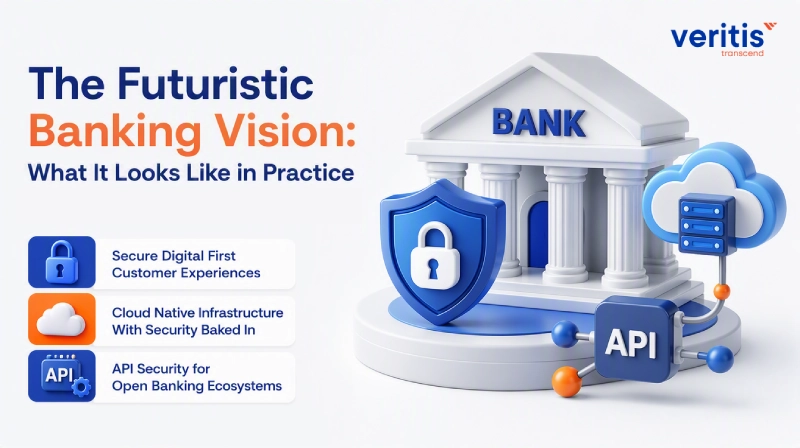
A futuristic bank is not defined by its branch count or its balance sheet alone. It is defined by its ability to release trusted software at speed, respond to new threat vectors within hours rather than months, and demonstrate compliance continuously to regulators, auditors, and customers.
Here is what that vision looks like across three operational dimensions.
1) Secure Digital First Customer Experiences
Mobile banking, instant payments, and personalized financial products all depend on application layers that must be both feature rich and hardened against attack. DevSecOps enables banks to ship new mobile features weekly, while automated security pipelines ensure that each release meets the same security standard as the previous one. Penetration testing is integrated into the CI/CD pipeline. Dependency scanning catches vulnerable open source libraries before they reach production. The customer never sees the security machinery, but they benefit from it every time they open the app.
2) Cloud Native Infrastructure With Security Baked In
The cloud migration is accelerating across banking. AWS, Azure, and Google Cloud offer the elasticity and global reach that modern banking products require. But the cloud also introduces infrastructure as code misconfigurations, overly permissive IAM roles, and shared-responsibility model gaps that can be exploited as vulnerabilities. DevSecOps addresses this through infrastructure security scanning, immutable deployment patterns, and network segmentation policies enforced at the pipeline level. Cloud security posture management (CSPM) tools continuously audit cloud environments against CIS Benchmarks and bank specific policies. Organizations exploring this intersection will find practical guidance in the DevSecOps solution to cloud security challenges that modern banks routinely encounter.
3) API Security for Open Banking Ecosystems
Open banking is not a future trend. It is the present reality for banks operating in regulated markets. Every API exposed to a fintech partner or third party aggregator is a potential entry point. DevSecOps addresses this by embedding API security testing (DAST, fuzzing, authentication validation) into the delivery pipeline. API gateways are configured as code. Rate limiting, token validation, and anomaly detection are deployed automatically with each new endpoint. The result is an open banking ecosystem that can scale without introducing proportional security risk.
DevSecOps and Regulatory Compliance: A Strategic Alignment
Regulatory compliance is not optional in banking. PCI DSS mandates vulnerability management and access controls for any system handling cardholder data. SOX requires demonstrable controls over financial reporting systems. FFIEC guidance sets expectations for cybersecurity maturity. GLBA governs the safeguarding of consumer financial information. The NYDFS Cybersecurity Regulation imposes specific technical requirements on covered entities.
Traditionally, meeting these requirements meant manually assembling evidence, often weeks before an audit, by pulling logs, screenshots, and attestations from teams already managing production systems. That approach is labor intensive, error prone, and always retrospective.
DevSecOps converts compliance from a periodic event into a continuous state. Policy as code frameworks, such as Open Policy Agent (OPA), encode regulatory requirements directly into the deployment pipeline. Every release either passes all compliance checks or it does not deploy. The audit trail is generated automatically. When an examiner requests evidence of access control validation or vulnerability remediation, the data is available in seconds, not weeks.
This is one of the most underappreciated financial benefits of DevSecOps for banking organizations. Audit preparation can cost mid sized and large financial institutions hundreds of thousands of dollars each year; it is reduced substantially when compliance evidence is a byproduct of normal delivery operations.
Leaders who want to ground their implementation in proven frameworks will find the DevSecOps best practices for security particularly relevant to the banking compliance context.
The DevSecOps Market: Growth That Reflects Urgency
According to Mordor Intelligence, the global DevSecOps market is anticipated to grow from USD 10.88 billion in 2026 to USD 29.52 billion by 2031, at a CAGR of 22.1%. That growth rate is not driven by enthusiasm for technology alone. It is driven by the measurable cost of insecure software delivery and the regulatory consequences of inadequate security controls in regulated industries.
For banking specifically, the urgency compounds. Sophisticated threat actors disproportionately target financial institutions. They carry regulatory obligations that impose hard deadlines for vulnerability remediation. And they operate in a competitive environment where customer trust is the core product. Any breach, any regulatory action, any service disruption caused by a security incident erodes that trust in ways that take years to rebuild.
Key DevSecOps Capabilities Banking Leaders Should Prioritize
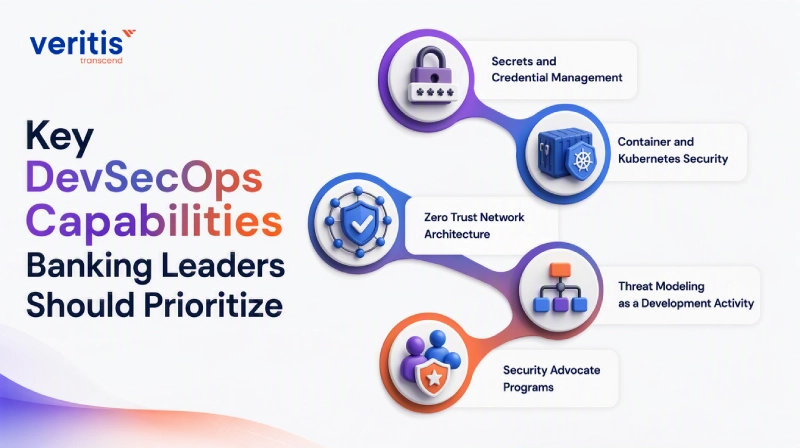
Not every DevSecOps capability carries equal weight in a banking context. Based on the threat profile and regulatory obligations of financial institutions, the following capabilities deliver the highest return on investment when implemented early.
1) Secrets and Credential Management
Hardcoded API keys, passwords, and tokens in source code are among the most exploited vulnerabilities in financial services. Automated secrets scanning at the commit stage, combined with secrets management platforms such as HashiCorp Vault or AWS Secrets Manager, eliminates this risk class.
2) Container and Kubernetes Security
Banks moving to containerized workloads need to scan container images for vulnerabilities before deployment and enforce pod security policies at runtime. Misconfigured Kubernetes clusters have been the source of significant data exposures across industries.
3) Zero Trust Network Architecture
DevSecOps principles align naturally with zero trust models. Every service to service call is authenticated and authorized. Network policies are defined as code and enforced automatically. Lateral movement by an attacker who gains an initial foothold is severely constrained.
4) Threat Modeling as a Development Activity
Future ready banks treat threat modeling not as a security team exercise but as a development team activity that occurs during the design phase of every significant feature. This prevents entire classes of architectural vulnerabilities from being built into systems in the first place.
5) Security Advocate Programs
DevSecOps does not work if security knowledge lives only in a centralized team. Banking organizations that scale successfully embed security trained engineers, often called security champions, within every product team. These team members connect centralized security expertise with day to day delivery.
For a comprehensive view of the tooling landscape that supports these capabilities, the top DevSecOps tools for modern secure software delivery provide a vendor neutral assessment that banking technology leaders will find useful.
Schedule a DevSecOps Consultation
How Does Veritis Approach DevSecOps for Banking Organizations?
Veritis brings a delivery first perspective to DevSecOps engagements with banking clients. The approach begins with an honest assessment of where security debt lives in the current delivery pipeline, not a generic maturity model exercise, but a hands on review of actual pipelines, toolchains, and deployment patterns.
From that baseline, Veritis builds a prioritized implementation roadmap that targets the highest risk gaps first, typically secrets management, container security scanning, and automated compliance checks, before expanding to more advanced capabilities such as runtime protection and behavioral analytics.
The devsecops services Veritis delivers span consulting, toolchain implementation, pipeline automation, and ongoing managed security integration, giving banking organizations the option to build internal capability over time or rely on Veritis as a long term delivery partner.
The measure of success is not tool deployment. It is the reduction of mean time to detect (MTTD) and mean time to remediate (MTTR) security issues, the elimination of manual compliance evidence gathering, and the acceleration of release cycles without an increase in security incidents.
Building the Interdependent Ecosystem: People, Process, and Technology
A futuristic bank will not achieve DevSecOps maturity through technology investment alone. The institutions that succeed do so because they align three interdependent dimensions.
1) People
Security literacy is distributed across the organization. Developers understand OWASP Top 10 risks. Product managers include security acceptance criteria in their definitions of done. Executives sponsor security investment not as a cost center but as a revenue protector.
2) Process
The software delivery lifecycle is redesigned so that security activities happen continuously rather than periodically. Threat modeling is part of design. Security testing is part of the build and deploy process. Incident response is practiced regularly through tabletop exercises and chaos engineering.
3) Technology
The toolchain automates security enforcement so that it does not depend on human discipline to function. Automation creates consistency. Consistency creates the audit trail that regulators require. And the audit trail creates the organizational confidence to move faster.
For banking leaders who want a thorough grounding before committing resources, this is a practical starting point on DevSecOps and its implementation.
Useful link: Achieving Continuous Application Security with DevSecOps
Case Study: DevOps and Security Integration for a Data Analytics Provider
Veritis partnered with a leading data analytics provider to overhaul its core platform, with a mandate to optimize performance, automate delivery pipelines, and eliminate manual processes that were causing delays and security gaps.
Challenge
- Persistent performance bottlenecks degrading application reliability
- Complex data feed integrations threatening system stability and data integrity
- Manual deployment processes introducing delays, errors, and inconsistent security controls
- Time consuming debugging across a heterogeneous technology stack
Veritis Approach
- Conducted exhaustive pre release performance testing and tuning to eliminate known bottlenecks
- Built scalable, security validated data enrichment pipelines for external feed integration
- Automated key workflows using Microsoft BI toolsets and DevSecOps best practices, including automated policy checks at each pipeline stage
- Provided hands on debugging support and reusable monitoring components that serve as early warning systems
Measurable Impact
- Sustained high throughput application performance with zero major slowdowns post deployment
- Fully automated data processing pipelines reduced manual effort by 70%
- On demand, policy compliant deployment environments accelerated release cycles and reduced error rates
- Proactive issue detection cut debugging time by 50%
This engagement illustrates a pattern Veritis applies consistently across financial services and data intensive industries: security and performance are not competing priorities. When DevSecOps is implemented correctly, they reinforce each other.
Read the complete case study: DevOps Solutions for Data Analytics Industry.
The Strategic Insight Every Banking Leader Should Take Away
The banks positioned to lead the next decade are not those with the most branches or the largest balance sheets. They are the ones who can deliver trusted digital experiences faster than their competitors, satisfy regulators without diverting engineering resources from product development, and respond to novel threats before they become incidents.
DevSecOps is the operational model that enables all three outcomes to be achieved simultaneously. It is not a tool purchase or a team reorganization. It is a fundamental redesign of how a bank builds and operates software, with security as a first class engineering concern from the first line of code to the last line of a production log.
The market data, the regulatory direction, and the competitive landscape all point in the same direction. The question for banking executives is not whether to invest in DevSecOps. It is how quickly they can move from intention to implementation.
Veritis has delivered that implementation for banking and financial services organizations across a range of complexity levels. The next step begins with a clear assessment of your current position.
Ready to build a future ready banking security posture?