
Why are Identity and Access Management Essential in Healthcare?
Globally, there has been an increasing focus on the healthcare sector, with stronger regulatory laws enforced. Due to data breaches and increased security threats, Identity and Access Management services have become a significant game changer for establishing security, data protection, and automating processes.
Hence, employee training is an essential aspect of healthcare administration; it is mandatory to train staff in relevant Identity Access Management Tools to manage patient data and sensitive information efficiently.
Healthcare Identity and Access Management (IAM) has emerged as an effective way to ensure data security is not compromised during daily operations. Hospital authorities have implemented IAM to ensure controlled, secure access to patient records, administrative information, medical reports, and files.
Five steps to establish Healthcare Identity and Access Management (IAM)
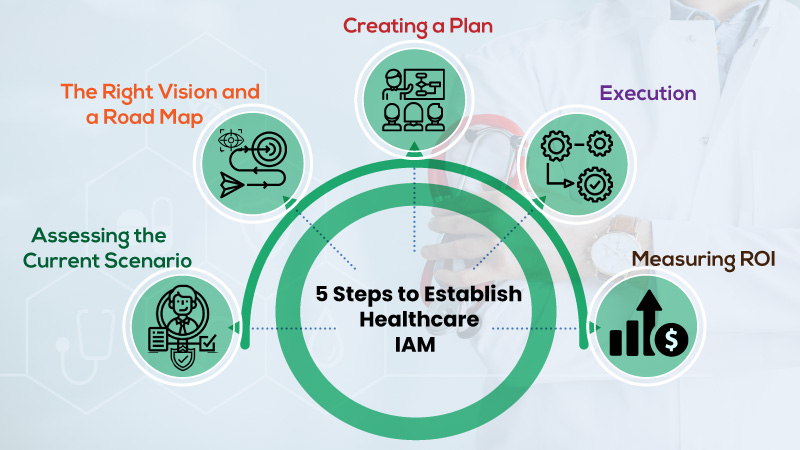
While IAM has numerous facets across healthcare processes, an organization must develop an initial strategy through planning, operational functions, and implementation methods.
By developing a roadmap to enhance the IAM methodology, organizations can reduce cybersecurity breaches, minimize maintenance, and ensure smooth program execution.
First, IAM should be implemented in small phases rather than launching a full fledged plan overnight. IAM is a continually evolving journey – to initiate this process, here are five steps we bring forward:
Step 1: Assessing the current scenario
The first step should be to assess and analyze the current data, system, procedures, people, process flows, applications, and roles. It will help create a clear picture and determine your organization’s standing concerning IAM.
The next step would be to focus on different aspects of IAM, i.e., federation, Multi Factor Authentication (MFA), Single Sign On (SSO), delegated Identity Governance and Administration, and understand where the organization stands and which aspect should be given priority.
Another critical step is to increase organizational Identity Lifecycle Management (ILM) maturity. This is primarily about automating identity processes across the organization, creating and managing user identities, removing identities, and ending user access. Most healthcare organizations struggle to provide third party vendors and contractors with access through firewalls.
Step 2: The right vision and a road map
After identifying and analyzing the systems and processes, the next step is to develop an implementation strategy and include milestones to measure the plan’s effectiveness.
Building touchpoints with the team, connecting with the key stakeholders, and measuring progress via KPIs and relevant data is essential.
Useful link: Identity and Access Management Best Practices for Enterprises
Step 3: Creating a plan
This stage involves inventorying all available resources, business impact, financial plans, and technologies. It also involves fleshing out the roadmap, incorporating timelines and milestones, and carving out the scope for adjustments if required.
It is also an excellent phase for understanding the investment required for implementation and the priorities to be considered.
Step 4: Execution
This stage involves executing various phases of the IAM program and understanding the integration of the new system or technology with other systems. Before IAM implementation, specific steps need to be taken, or could be challenging in the future.
Hence, execution, ROI measurement, and understanding the full impact are essential to ensuring the IAM program’s efficiency.
Step 5: Measuring ROI
This step is crucial to understanding whether the IAM maturity level planned for this phase of the program has been achieved. An assessment would involve addressing any issues, stepping back to review the implementation, and making adjustments as needed.
To achieve the vision, the next step is to identify the next level of IAM maturity and secure the required resources to execute it.
Case Study: Manufacturing Firm Secured by Robust IAM Solution
Veritis played a pivotal role in transforming the identity and access management of a global manufacturing leader. We implemented an Azure AD–based single sign on, multi factor authentication, and granular role based access controls. Our custom provisioning scripts automated user lifecycle workflows, while conditional access enforced security policies. Real time auditing was integrated for complete visibility. This comprehensive approach significantly reduced user onboarding times, eliminated orphaned and inactive accounts, and ensured continuous, audit ready IAM regulatory compliance. The result was a significant improvement in security and a streamlined operation for the manufacturing firm.
Read the full case study: Manufacturing Firm Secured by Robust IAM Solution.
Veritis IT Managed Service Provider: PowerPoint PPT
How, at Veritis, do we help you
Through Veritis’ IAM approach, you can achieve your organization’s digital transformation goals, enable secure access for end users, and enhance your identity management program.

Also Read: