Table of contents
- The Strategic Framework, Building Your GCP Cloud Migration Strategy
- Five Critical Implementation Steps for Enterprise Success
- Key Benefits of Migrating to Google Cloud Platform
- AWS vs Azure vs GCP: A Breakdown of Cloud Migration Services
- Financial Analysis, ROI, and Investment Planning
- The Business Impact of Structured Cloud Migration Support
- Case Study: Fortune 500 Manufacturer Transforms Operations
- An Executive Framework for Building a Strong Business Case
In the current market, GCP cloud migration for enterprise organizations has moved from optional to existential. McKinsey research reveals that companies with mature cloud strategies grow 2.5x faster than their peers, while 70% of cloud migrations fail when treated as purely technical exercises rather than strategic business transformations.
For US tech executives managing multimillion dollar infrastructure budgets, the decision to migrate to GCP represents a pivotal moment. According to IDC, enterprises investing in Google Cloud migration services see an average 300% ROI within three years, yet only 35% of organizations successfully capture these benefits without expert cloud migration support.
The gap between potential and performance lies in understanding that GCP Cloud Migration is fundamentally about business outcomes, not infrastructure modernization.
Get a Customized Cloud Migration Plan
Quantifiable Business Impact, Beyond Technical Metrics
Forward thinking enterprises leveraging strategic GCP cloud migration initiatives report transformative results:
1) Financial Performance
- Infrastructure Cost Reduction: 35 to 50% decrease in TCO through GCP cost optimization
- Operational Efficiency: 40 to 60% improvement in deployment speed
- Risk Mitigation: 75% reduction in security vulnerabilities through Google Cloud security best practices
- Revenue Enablement: 25% faster time to market for new products and services
2) Strategic Advantages
- Developer Productivity: 50% increase in feature delivery speed
- Scalability: Unlimited horizontal scaling without capital expenditure
- Compliance Readiness: Automated adherence to HIPAA, SOC2, and PCI DSS requirements
- Innovation Acceleration: Access to advanced AI/ML capabilities through native GCP services
For a typical enterprise spending $5M annually on IT infrastructure, these improvements translate to $1.75M to $2.5M in quantifiable annual benefits.
Useful link: Cloud Computing Market Share Analysis: Strategic Takeaways for Business Leaders
The Strategic Framework, Building Your GCP Cloud Migration Strategy
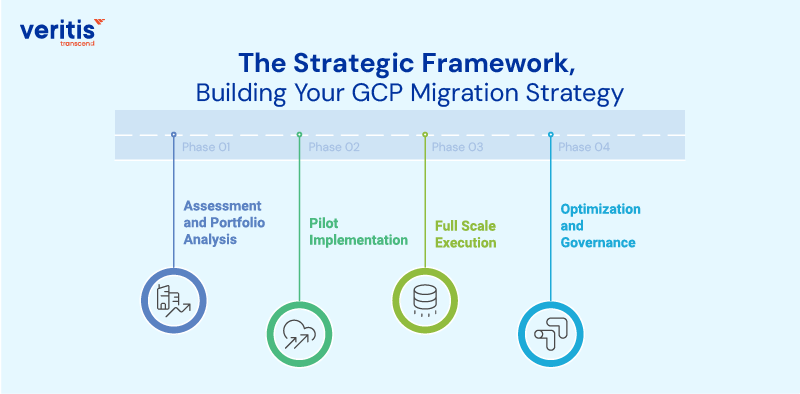
Maximizing the impact of GCP migration starts with executive sponsorship and disciplined execution, guided by the Veritis 4D GCP Acceleration Framework:
Phase 1: Assessment and Portfolio Analysis
Comprehensive inventory of applications, data dependencies, and compliance requirements. Industry data shows that organizations that spend adequate time in assessment reduce migration risks by 60%.
Phase 2: Pilot Implementation
Controlled migration of noncritical workloads to validate architecture decisions. Companies following this approach experience 40% fewer production issues post migration.
Phase 3: Full Scale Execution
Coordinated migration of production workloads with minimal downtime, leveraging Google Cloud migration tools for seamless transition.
Phase 4: Optimization and Governance
Implementation of GCP best practices for cost control, security hardening, and performance optimization.
Five Critical Implementation Steps for Enterprise Success
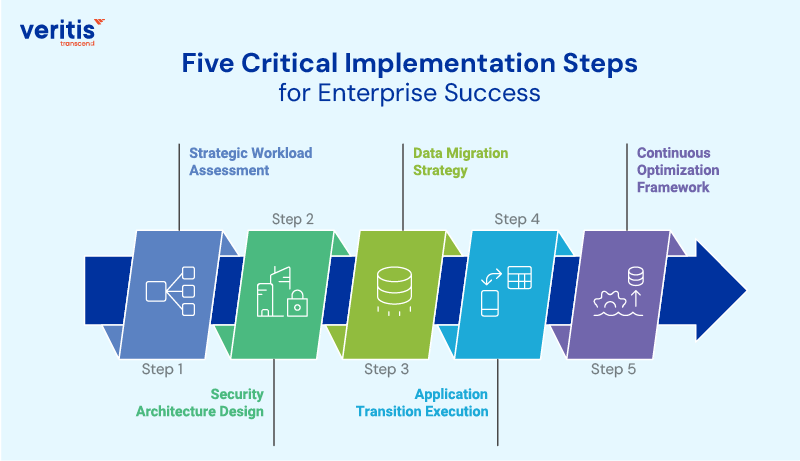
Step 1: Strategic Workload Assessment
Catalogue all applications and categorize based on migration complexity:
- Lift and Shift Ready: Legacy applications requiring minimal modification
- Refactor Opportunities: Modernization candidates for improved performance
- Re Platform Candidates: Applications benefiting from GCP native services
- Retire Considerations: Legacy systems eligible for decommissioning
Step 2: Security Architecture Design
Implement Google Cloud security best practices, including:
- Zero trust network architecture
- Identity and Access Management policies
- Data encryption at rest and in transit
- Continuous compliance monitoring
Step 3: Data Migration Strategy
Following GCP best practices, migrate data infrastructure before applications:
- Database migration using the database migration service
- Large scale data transfer via Transfer Appliance
- Real time data streaming through Pub/Sub
- Backup and disaster recovery planning
Step 4: Application Transition Execution
Systematic migration with performance monitoring:
- Containerized deployments using Google Kubernetes Engine
- Serverless architectures for event driven workloads
- API gateway integration for seamless connectivity
- Performance benchmarking against baseline metrics
Step 5: Continuous Optimization Framework
Establish ongoing improvement processes:
- Monthly GCP cost optimization reviews
- Quarterly security posture assessments
- Annual architecture modernization planning
- Continuous performance monitoring and tuning
Useful link: How Can C-Level Leaders Modernize Enterprise IT with a Cloud Transformation Strategy?
Key Benefits of Migrating to Google Cloud Platform
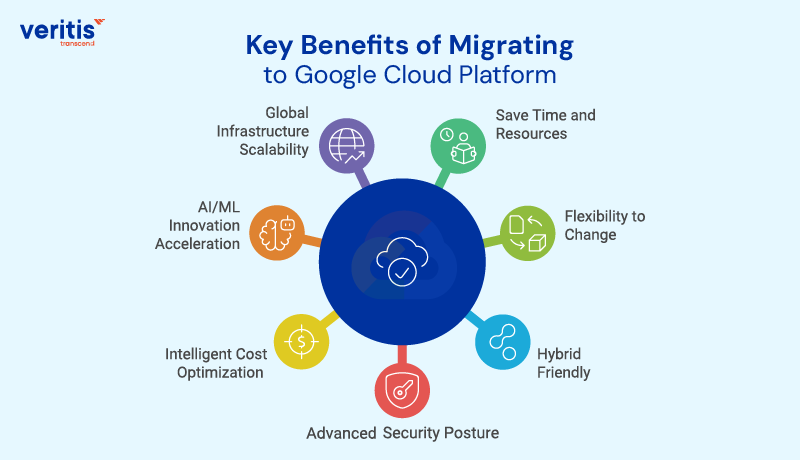
Understanding the key benefits of migrating to Google Cloud Platform helps executive teams move beyond infrastructure conversations and focus on measurable business outcomes.
1) Save Time and Resources
GCP allows a lift and shift approach, which works better with minimal architectural changes. By partnering with experienced cloud migration service providers, businesses can enjoy significant time and resource savings by migrating their infrastructure and applications from on premises Virtual Machines (VMs) to those running in the cloud.
2) Flexibility to Change
GCP offers extended support from Google and its network of partners, helping you modernize your traditional on premises applications. One can easily rearrange, re platform, or rearchitect applications, such as a group of microservices, operating on Google Cloud through comprehensive Google Cloud Migration Services.
3) Hybrid Friendly
GCP is designed to be hybrid friendly. It helps you leverage cloud security and scalability while managing on premises infrastructure. Flexible plans build and efficiently manage reliable applications across on premises data centres, multi cloud environments, and private hosted servers through GCP best practices.
4) Advanced Security Posture
GCP’s built in security features, including IAM, data encrypted at rest and in transit with ongoing threat monitoring, provide enterprise grade protection. Implementing Google Cloud security best practices during migration ensures compliance with HIPAA SOC 2, and PCI DSS from day one.
5) Intelligent Cost Optimization
Native integration with Google’s machine learning capabilities enables automatic GCP cost optimization through rightsizing recommendations, sustained use discounts, and committed use contracts. Businesses typically achieve 30 to 50% cost reductions compared to traditional on premises infrastructure when following GCP best practices.
6) AI/ML Innovation Acceleration
Seamless access to Google’s advanced artificial intelligence and machine learning services, including BigQuery, Vertex AI, and TensorFlow, enables rapid innovation. Organizations can leverage these capabilities during GCP Cloud Migration to transform data into a competitive advantage without additional infrastructure investment.
7) Global Infrastructure Scalability
With 35+ regions and 100+ zones worldwide, GCP provides unparalleled global reach for enterprises expanding internationally. The GCP migration strategy enables instant scalability across geographies while maintaining consistent performance and compliance through Google’s robust global infrastructure.
When evaluating the key benefits of migrating to Google Cloud Platform, the conversation shifts from infrastructure replacement to strategic enablement. It becomes less about where workloads run and more about how the organization accelerates growth, strengthens resilience, and improves operating efficiency through a modern cloud foundation.
Useful link: Which Cloud Migration Tools Deliver the Best ROI for Enterprises?
AWS vs Azure vs GCP: A Breakdown of Cloud Migration Services
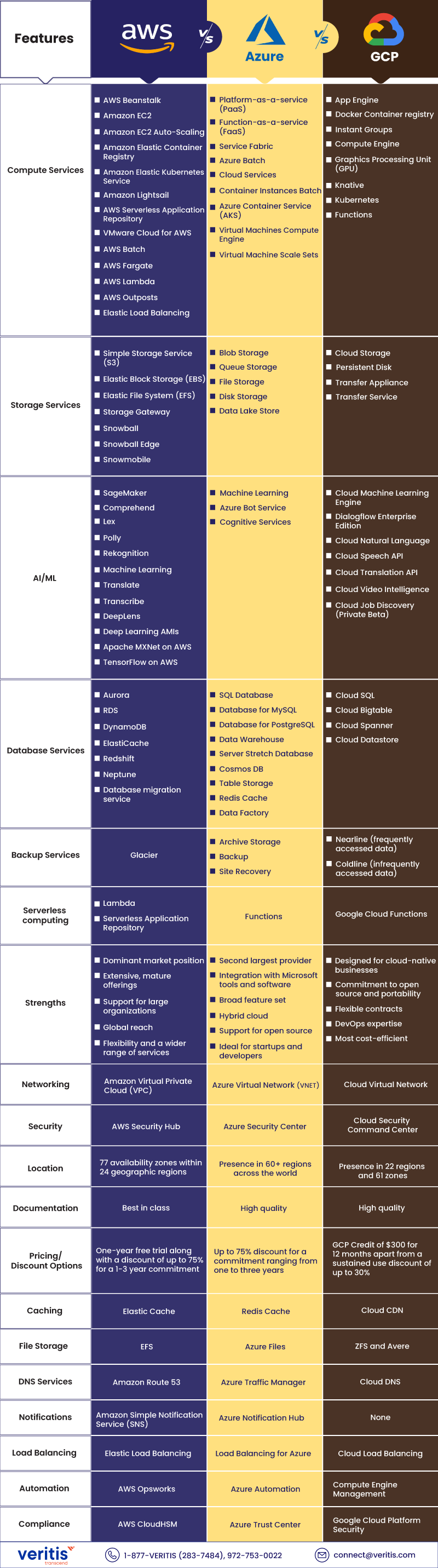
Given these advantages, it’s easy to see the benefits of migrating to Google Cloud Platform (GCP). Ready to get started? Many organizations turn to cloud migration companies to simplify the transition and ensure a smooth, efficient migration process. Are you trying to know how?
Financial Analysis, ROI, and Investment Planning
GCP Cloud Migration investments typically yield measurable returns within 12 to 18 months:
1) Direct Savings
- Infrastructure consolidation: 30 to 45% reduction in hardware/software costs
- Operational efficiency: $500K to $2M annual savings in IT labour costs
- Energy and facility costs: 60 to 80% reduction in data centre expenses
2) Revenue Generation
- Product development acceleration: 30 to 50% faster feature delivery
- Market expansion capabilities: Global deployment in minutes vs. months
- Customer experience improvements: Enhanced performance and reliability
3) Risk Mitigation Value
- Security breach prevention: Average cost avoidance of $4.45M per incident
- Compliance assurance: Reduced audit costs and regulatory penalties
- Business continuity: Disaster recovery capabilities eliminate downtime losses
The Business Impact of Structured Cloud Migration Support
Internal teams face significant challenges in cloud migration for enterprise environments:
1) Skills Gap Reality
- Only 28% of IT professionals hold current GCP certifications
- 73% of organizations lack dedicated cloud security expertise
- Average time to train internal teams: 12 to 18 months
2) Time to Value Acceleration
Organizations partnering with experienced cloud migration service providers:
- Experience 50% shorter migration timelines
- Achieve 35% higher success rates
- Reduce migration related downtime by 65%
- Capture ROI 6 months earlier than DIY approaches
3) Risk Mitigation Through Expertise
Professional Google Cloud Migration Services deliver:
- Proven methodologies refined across hundreds of migrations
- Automated tooling for consistent, repeatable processes
- Risk mitigation strategies developed through industry experience
- Compliance expertise spanning multiple regulatory frameworks
Useful link: CXO Roadmap to Overcoming Cloud Migration Challenges
Case Study: Fortune 500 Manufacturer Transforms Operations
Challenge:
A $12B manufacturing conglomerate faced escalating infrastructure costs ($8M annually) and an inability to support digital transformation initiatives. Legacy systems created bottlenecks, preventing innovation and customer experience improvements.
Solution:
Veritis implemented a comprehensive GCP Cloud Migration strategy, including:
- Migration of 150+ applications across manufacturing, supply chain, and customer facing systems
- Implementation of Google Cloud security best practices for compliance with industry regulations
- Integration of AI/ML capabilities for predictive maintenance and quality control
- Establishment of GCP cost optimization frameworks for ongoing expense management
Results:
- 45% reduction in total infrastructure costs ($3.6M annual savings)
- 60% improvement in application deployment speed
- Zero unplanned downtime during the 18 month migration process
- 75% faster incident resolution through enhanced monitoring
- $2.1M in avoided security breach costs through proactive security implementation
This engagement demonstrates how strategic GCP Cloud Migration transforms operational challenges into competitive advantages while delivering measurable ROI.
Explore the full case study: Provisioning Cloud Infrastructure Requirements for Global Technology Client.
An Executive Framework for Building a Strong Business Case
1) Investment Requirements
Typical GCP Cloud Migration engagements require:
- Initial assessment and strategy development: $100K to $500K
- Migration execution (small, medium enterprise): $500K to $2M
- Ongoing optimization and management: $100K to $500K annually
2) Expected Timeline
- Strategy and assessment: 2 to 3 months
- Pilot implementation: 1 to 2 months
- Full migration execution: 6 to 18 months, depending on scope
- Optimization and stabilization: Ongoing
3) Success Metrics
Track progress through:
- Cost per transaction/workload reduction
- Time to deployment improvements
- Security incident reduction
- User satisfaction scores
- Compliance audit results
The Path Forward, Transforming Your Enterprise
The question for US tech executives is not all about whether to invest in GCP Cloud Migration, but when and how to maximize returns while minimizing risk. Organizations that delay face increasing competitive pressure as cloud native competitors capture market share through superior agility and cost efficiency.
By partnering with experienced cloud migration consulting services, enterprises can:
- Accelerate time to value by 6 to 12 months
- Reduce migration risks by 50 to 70%
- Capture additional ROI through optimized implementation
- Focus internal resources on core business priorities
The key benefits of migrating to the Google Cloud Platform extend far beyond infrastructure modernization; they represent fundamental business transformation opportunities that can redefine competitive positioning and drive sustainable growth.
Conclusion
Ready to explore the maximum potential of Google Cloud Migration Services while minimizing risk and maximizing ROI? Veritis’ team of certified GCP specialists brings proven methodologies and deep industry expertise to ensure your GCP migration strategy delivers measurable business value.
Our track record includes successful cloud migration for enterprise clients across manufacturing, financial services, healthcare, and technology sectors, each achieving significant cost savings, performance improvements, and competitive advantages.
Schedule your complimentary GCP migration strategy session today and explore how Veritis can accelerate your cloud transformation journey while protecting your investment and ensuring long term success.
Learn more about our comprehensive cloud migration solutions and connect with our team of certified GCP specialists to discuss your specific requirements and timeline.
Get a Cloud Strategic Assessment
Additional Resources: