When systems fail, the cost is immediate: According to the survey Cost of a Data Breach Report, the average breach cost is $4.45 million, and Gartner estimates IT downtime alone runs $5,600 per minute for enterprise organizations. For CIOs and CTOs steering complex, hybrid environments, building a resilient IT infrastructure with business continuity and disaster recovery isn’t a contingency exercise; it’s a core operational mandate.
This article explores exactly how to build, measure, and mature that infrastructure: from foundational BCDR principles to the KPIs that prove your plan works when it counts.
Schedule a Disaster Recovery Consultation
What is Business Continuity and Disaster Recovery (BCDR)?
Business Continuity and Disaster Recovery (BCDR) is the combined framework of strategies, policies, and procedures that enable an organization to respond, adapt, and recover when disruption strikes, whether that’s a ransomware attack, power failure, natural disaster, or supply chain breakdown.
- Business Continuity (BC) focuses on keeping essential operations running during a disruption, maintaining customer communication, critical workflows, and revenue generating processes.
- Disaster Recovery (DR) focuses on restoring technology systems and data as rapidly as possible after an incident.
The two are interdependent. BC needs DR to ensure technical systems support ongoing operations. DR needs BC to understand which systems matter most and in what order they must be restored. Together, they form a unified resilience posture rather than two siloed plans.
Cloud DR solutions have become integral to modern BCDR strategies, delivering the flexibility, scalability, and geographic redundancy that on premises only approaches cannot match.
Why BCDR Is a Strategic Priority in 2026?
1) The Threat Landscape Has Changed Fundamentally
Ransomware attacks rose 49% in the first half of 2026, totaling 4,198 incidents globally, with a 63% year over year increase in Q2 alone. Simultaneously, IT environments have grown dramatically more complex, spanning on premises infrastructure, multiple clouds, SaaS applications, and remote endpoints. Legacy BCDR plans written for a single data center era are no longer sufficient.
Three critical shifts define BCDR in 2026:
- A)Cyber resilience is now the primary driver.Organizations are adopting air gapped backups (physically isolated from networks) and immutable storage (data that cannot be altered or deleted) to ensure clean restoration even after a successful ransomware attack.
- B)Coverage must be comprehensive across all layers.BCDR plans must account for cloud workloads, SaaS platforms, remote endpoints, and edge devices, not just the core data center.
- C)Compliance now demands provable, testable recovery.Cyber insurers and regulators increasingly require demonstrated recovery testing cadences. Organizations that cannot prove their plans work face rising premiums, audit risk, and potential coverage denial.
2) The Business Case is Quantifiable
Downtime is not an abstract risk. It carries a specific dollar figure that executives can model and defend against investment in resilience. When a CIO walks into a board conversation about BCDR spend, the ROI frame is straightforward: the cost of a robust plan versus the financial, reputational, and regulatory costs of an unplanned outage.
Understanding what a disaster recovery plan actually requires, and how it differs from a business continuity plan, is the necessary starting point before any architecture decisions are made.
Building a Resilient IT Infrastructure: 5 Foundational Approaches
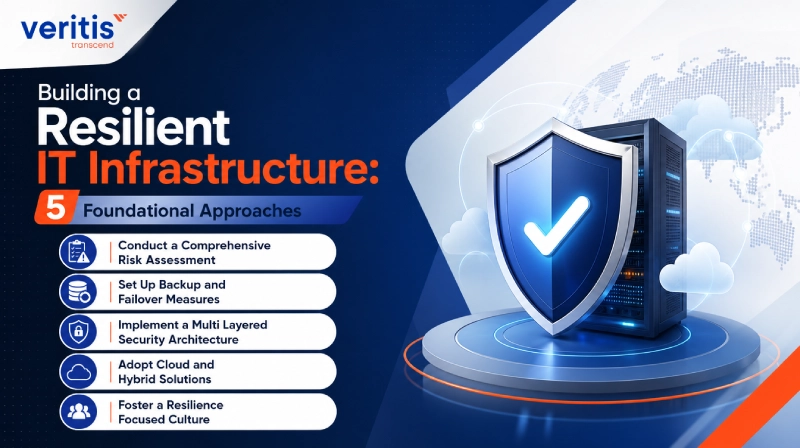
1) Conduct a Comprehensive Risk Assessment
Business Continuity vs. Disaster Recovery: Key Differences
| Dimension | Business Continuity | Disaster Recovery |
| Primary focus | Maintaining operations during disruption | Restoring IT systems after disruption |
| Scope | People, processes, facilities, communications | Technology, data, applications, networks |
| Timeframe | Ongoing throughout a disruption | Triggered at the point of incident |
| Owner | Cross functional (HR, Operations, IT, Legal) | Primarily IT and infrastructure teams |
| Key deliverable | Business Continuity Plan (BCP) | Disaster Recovery Plan (DRP) |
| Success metric | Operational continuity maintained | RTO and RPO targets met |
Identify threats and vulnerabilities across your IT infrastructure, not just technical failures, but physical risks, third party dependencies, geopolitical factors, and cyber threats. Prioritize by probability and business impact. Risk assessments are not one time exercises; they must be revisited whenever the threat landscape shifts or the infrastructure changes materially.
2) Set Up Backup and Failover Measures
Deploy redundant systems, data replication, and automated failover procedures for all mission critical operations. The industry standard 3-2-1 Backup Rule remains the baseline: maintain 3 copies of data across 2 different storage types, with one copy stored offsite or offline in an immutable format. Test these safeguards on a defined cadence; an untested backup is not a backup.
3) Implement a Multi Layered Security Architecture
Resilience and security are inseparable. A robust security posture, encompassing next generation firewalls, intrusion detection and prevention systems (IDPS), endpoint protection, encryption at rest and in transit, and regular penetration testing, reduces the probability that a disruption becomes a catastrophe. Segmented disaster recovery environments ensure that even a compromised production network cannot propagate into your recovery infrastructure.
4) Adopt Cloud and Hybrid Solutions
Cloud disaster recovery services and hybrid IT architectures provide the redundancy, geographic distribution, and elastic scalability that resilient infrastructure demands. Disaster recovery services built on cloud platforms enable organizations to spin up recovery environments on demand, pay for capacity only when needed, and achieve recovery time objectives that would be cost prohibitive with dedicated physical infrastructure alone.
For organizations evaluating their options, understanding how cloud disaster recovery strategy translates into a reliable, testable plan is essential before committing to a platform.
5) Foster a Resilience Focused Culture
Technology alone does not create resilience; people do. Invest in training that equips employees at every level to recognize threats, follow established procedures, and escalate appropriately. A C-suite approach to building human resilience ensures that leadership decision making under pressure is as practiced and deliberate as the technical recovery workflows beneath it.
Useful link: Developing a Robust IT Infrastructure Management to Support Business Expansion
What Every Disaster Recovery Plan Must Include?
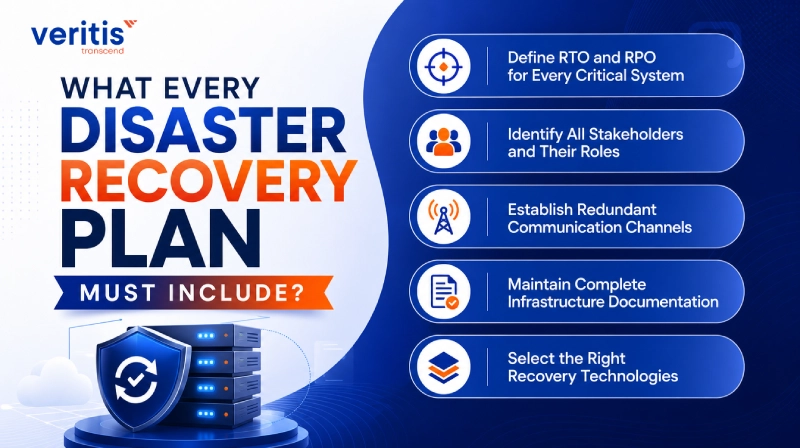
A disaster recovery plan is only as strong as its documentation and its tested assumptions. The following elements are non negotiable for enterprise grade plans.
1) Define RTO and RPO for Every Critical System
- Recovery Time Objective (RTO): The longest period a system or application can remain unavailable before it must be restored. For mission critical systems, this is often measured in minutes.
- Recovery Point Objective (RPO): The maximum tolerable data loss, measured in time. This determines how frequently backups or replications must occur.
RTO and RPO are not uniform across the enterprise. A customer facing payment system may require an RTO of five minutes and an RPO of near zero. An internal reporting tool may tolerate four hours. Mapping these targets to specific systems is the first architectural decision that shapes everything downstream.
2) Identify All Stakeholders and Their Roles
Effective disaster recovery requires clear ownership. Identify IT teams, business unit leads, senior management, legal and compliance, and external vendors, and document their specific responsibilities before an incident occurs. Ambiguity during a crisis compounds recovery time.
3) Establish Redundant Communication Channels
Define primary and backup communication modes, maintain current emergency contact lists, and establish protocols for incident reporting and escalation. Communication failures during a recovery event are among the most common and most avoidable causes of extended downtime.
4) Maintain Complete Infrastructure Documentation
Collect and keep current: network diagrams, system configurations, software licenses, hardware inventories, and vendor contact lists. During a crisis, teams should not be searching for this information; it should be immediately accessible from a secure, off network location.
5) Select the Right Recovery Technologies
Align technology choices to your RTO/RPO targets and infrastructure complexity. Options include backup and replication solutions, virtualization platforms, Disaster Recovery as a Service (DRaaS), and cloud native failover architectures. DRaaS platforms in particular offer automated recovery workflows, geo redundancy, and SLA backed uptime guarantees, well suited to hybrid and cloud native environments.
For organizations concerned about cost, the reality is that disaster recovery is no longer a budgetary constraint with cloud; the economics have shifted decisively in favor of cloud based DR models.
Schedule a Disaster Recovery Consultation
BCDR Maturity Model: Where Does Your Organization Stand?
A resilient IT infrastructure is not built in a single project; it evolves through defined stages of maturity. Understanding your current level is essential for prioritizing investment and setting a credible roadmap.
Most mid to large enterprises operate at Level 2 or Level 3. The gap between Level 3 and Level 4, particularly around automation and provable compliance, is where competitive resilience is won or lost.
For organizations formalizing their approach, the four core principles of a perfect business continuity plan provide a structured starting point before advancing up the maturity curve.
| Maturity Level | Characteristics |
| Level 1, Reactive | Ad hoc responses, minimal documentation, no formal RTO/RPO targets |
| Level 2, Defined | Documented plans, basic backup processes, limited testing |
| Level 3, Managed | Regular testing, defined KPIs, stakeholder alignment, DRaaS adoption |
| Level 4, Optimized | Automated failover, continuous validation, AI assisted threat detection, full compliance posture |
Measurable KPIs for BCDR Performance
A BCDR strategy that cannot be measured cannot be managed. Define and track these metrics consistently.
1) Core Metrics:
- RTO (Recovery Time Objective): Maximum acceptable restoration time per system
- RPO (Recovery Point Objective): Maximum tolerable data loss per system
- TRO (Testing Recovery Objective): Target cadence for recovery drills and plan validation
2) Advanced Metrics:
- Recovery Confidence Score: Derived from successful test recoveries and data integrity checks over a rolling period
- Automated Recovery Coverage: Percentage of critical systems with automatic failover/failback capability
- Mean Time to Recover (MTTR): Average time from incident declaration to full operational restoration
- Plan Currency Rate: Percentage of DR documentation reviewed and updated within the last 90 days
These metrics convert a theoretical BCDR strategy into a performance driven operational framework, and provide the evidence base that regulators, insurers, and boards increasingly require.
Best Practices to Accelerate BCDR Maturity
- Apply the 3 2 1 Backup Rule as the non negotiable baseline for all critical data
- Leverage DRaaS for automated workflows, geo redundancy, and SLA backed recovery guarantees
- Run regular, non disruptive recovery simulations, quarterly at minimum, monthly for mission critical systems, without impacting production
- Integrate BCDR testing into change management: every infrastructure change should trigger a continuity validation step
- Maintain segmented recovery environments to contain the blast radius of a cyber incident
- Align BCDR with compliance frameworks (NIST, ISO 22301, SOC 2) to meet insurer and regulator requirements proactively
For organizations looking to structure their path forward, five steps to preserve business continuity and enterprise resilience offers a practical sequencing of these priorities.
The Future of BCDR: AI, Edge, and Human Centered Planning
Enterprise BCDR is evolving rapidly. Three technology shifts are reshaping what best practice looks like:
1) AI and Machine Learning: Predictive analytics now enable organizations to detect failure patterns before they become incidents, recommend recovery actions in real time, and simulate impact scenarios across complex hybrid environments. Generative AI is compressing decision making time during crises, a meaningful advantage when every minute of downtime carries a measurable cost.
2) Edge Computing: As organizations deploy IoT devices, remote branch infrastructure, and microdata centers, BCDR strategies must account for site level failover, network rerouting, and offline continuity at the edge, not just in the core data center.
3) Human Centered Simulation: Advanced modeling tools now simulate disaster scenarios across supply chains, facilities, and infrastructure simultaneously. They allow organizations to test decision trees, team coordination, and escalation paths, so that when a real event occurs, the human response is as rehearsed as the technical one.
Useful link: Cybersecurity Best Practices: Protecting Your Business From Data Breaches in 2026
Case Study: Disaster Recovery and Business Continuity for a Major Airline
A major airline engaged Veritis to build a resilient IT infrastructure with a robust disaster recovery and business continuity framework before a disruption forced the issue.
Challenge: Legacy systems lacked adequate disaster recovery planning capabilities, creating unacceptable risk of prolonged downtime across flight operations, passenger systems, and back office functions.
Veritis’s Approach: Veritis designed and deployed a comprehensive DR and secondary data center solution with cloud integration, automated failover, and compliance focused configurations, ensuring resilience, regulatory readiness, and operational continuity across all critical systems.
Outcomes:
- Strengthened business continuity across all operational layers
- Measurably reduced risk of downtime and data loss
- Faster recovery enabled by automated DR workflows
- Cost effective, scalable infrastructure replacing legacy single point of failure architecture
Explore the full disaster recovery data center case study for the airline client.
Conclusion: Resilience is a Competitive Differentiator
Building a resilient IT infrastructure with business continuity and disaster recovery is not a project with a completion date. It is an ongoing operational discipline that matures over time, adapts to new threats, and ultimately determines how quickly your organization recovers and whether competitors who experience the same disruption recover faster.
CIOs who treat BCDR as infrastructure, not insurance, create organizations that are measurably more agile, more trustworthy to customers and regulators, and more capable of absorbing the disruptions that will inevitably come.
Veritis, a Stevie and Globee Business Awards recipient, partners with enterprise organizations to design, implement, and continuously improve BCDR frameworks that meet the demands of today’s threat environment. If your current plan hasn’t been tested recently, or at all, that conversation starts here.